


- Executive Summary
- Europe Cheese Alternative Market Snapshot, 2025 and 2032
- Market Opportunity Assessment, 2025 - 2032, US$ Mn
- Key Market Trends
- Future Market Projections
- Premium Market Insights
- Industry Developments and Key Market Events
- PMR Analysis and Recommendations
- Market Overview
- Market Scope and Definition
- Market Dynamics
- Drivers
- Restraints
- Opportunity
- Challenges
- Key Trends
- Macro-Economic Factors
- Europe Sectorial Outlook
- Europe GDP Growth Outlook
- COVID-19 Impact Analysis
- Forecast Factors - Relevance and Impact
- Value Added Insights
- Product Adoption Analysis
- Regulatory Landscape
- Consumer Behavior Analysis
- Value Chain Analysis
- Key Deals and Mergers
- PESTLE Analysis
- Porter’s Five Force Analysis
- Price Trend Analysis, 2019 - 2032
- Key Highlights
- Key Factors Impacting Product Prices
- Pricing Analysis, By Product Type
- Regional Prices and Product Preferences
- Europe Cheese Alternative Market Outlook:
- Key Highlights
- Market Volume (Tons) Projections
- Market Size (US$ Mn) and Y-o-Y Growth
- Absolute $ Opportunity
- Market Size (US$ Mn) Analysis and Forecast
- Historical Market Size (US$ Mn) Analysis, 2019-2024
- Market Size (US$ Mn) Analysis and Forecast, 2025-2032
- Europe Cheese Alternative Market Outlook: Product Type
- Introduction / Key Findings
- Historical Market Size (US$ Mn) Analysis, By Product Type, 2019-2024
- Market Size (US$ Mn) Analysis and Forecast, By Product Type, 2025-2032
- Mozzarella
- Cheddar
- Parmesan
- Cream cheese
- Others
- Market Attractiveness Analysis: Product Type
- Europe Cheese Alternative Market Outlook: Source
- Introduction / Key Findings
- Historical Market Size (US$ Mn) and Volume (Tons) Analysis, By Source, 2019-2024
- Market Size (US$ Mn) and Volume (Tons) Analysis and Forecast, By Source, 2025-2032
- Cashew
- Almond
- Soy
- Coconut
- Oat
- Others
- Market Attractiveness Analysis: Source
- Europe Cheese Alternative Market Outlook: Form
- Introduction / Key Findings
- Historical Market Size (US$ Mn) Analysis, By Form, 2019-2024
- Market Size (US$ Mn) Analysis and Forecast, By Form, 2025-2032
- Blocks
- Slices
- Shreds
- Spreads
- Others
- Market Attractiveness Analysis: Form
- Europe Cheese Alternative Market Outlook: Distribution Channel
- Introduction / Key Findings
- Historical Market Size (US$ Mn) Analysis, By Distribution Channel, 2019-2024
- Market Size (US$ Mn) Analysis and Forecast, By Distribution Channel, 2025-2032
- B2B
- B2C
- Supermarkets & Hypermarkets
- Specialty & Natural-food Stores
- Convenience Stores
- Online
- Others
- Market Attractiveness Analysis: Distribution Channel
- Key Highlights
- Europe Cheese Alternative Market Outlook: Country
- Key Highlights
- Historical Market Size (US$ Mn) Analysis, By Country, 2019-2024
- Market Size (US$ Mn) Analysis and Forecast, By Country, 2025-2032
- Germany
- U.K.
- France
- Italy
- Spain
- Russia
- Rest of Europe
- Market Attractiveness Analysis: Country
- Competition Landscape
- Market Share Analysis, 2024
- Market Structure
- Competition Intensity Mapping By Market
- Competition Dashboard
- Company Profiles (Details - Overview, Financials, Strategy, Recent Developments)
- Mondarella
- Overview
- Segments and Product Types
- Key Financials
- Market Developments
- Market Strategy
- Simply V
- Violife
- Bedda
- New Roots
- Happy Cashew
- Jay & Joy
- Väcka
- Veganz
- Those Vegan Cowboys
- Others
- Mondarella
- Appendix
- Research Methodology
- Research Assumptions
- Acronyms and Abbreviations


- Processed Food
- Europe Cheese Alternative Market
Europe Cheese Alternative Market Size, Share, Growth, and Regional Forecast, 2025 to 2032
Europe Cheese Alternative Market by Product Type (Mozzarella, Cheddar, Parmesan , Cream cheese , Others), Source (Cashew, Almond, Soy, Coconut , Oat, Others), Form (Blocks , Slices , Shreds , Spreads, Others), Distribution Channel (B2B, B2C), and Country Analysis from 2025 to 2032
Key Industry Highlights
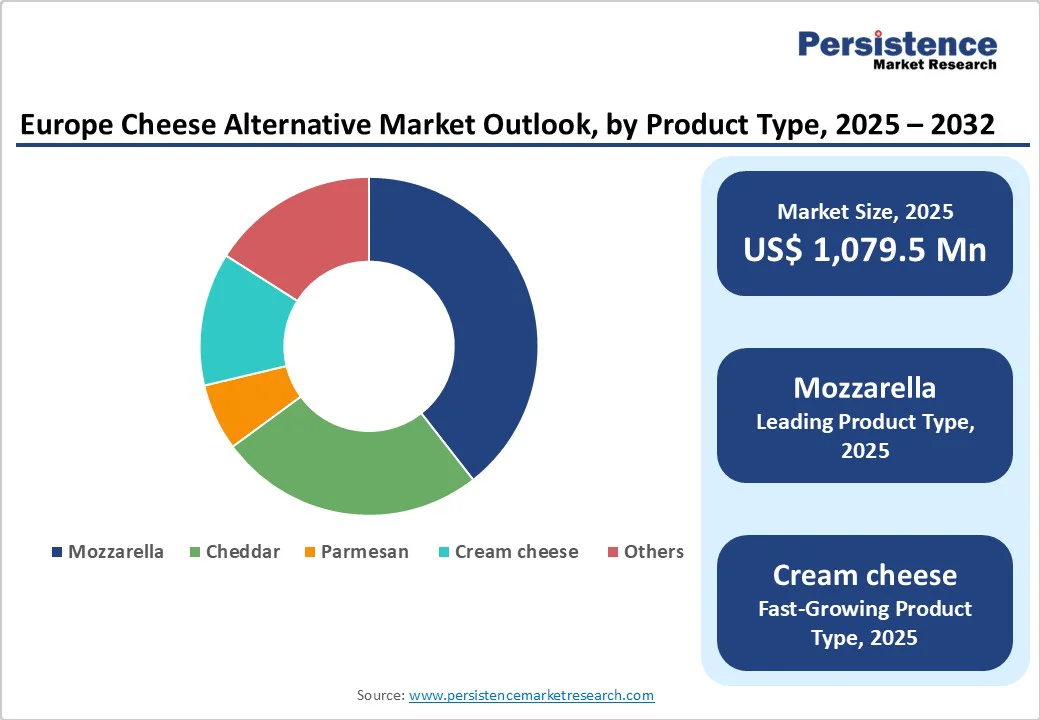
- Leading Product Type Segment: Mozzarella, holding the largest share in 2025, driven by high demand in pizzas, sandwiches, and foodservice, supported by strong meltability, consumer familiarity, and wide retail availability.
- Fastest-growing Source Segment: Oat-based cheese alternatives, driven by the rising popularity of oat beverages, health-conscious flexitarian consumers, and rapid innovation in allergen-friendly, fortified formulations.
- Investment Plans: Texture & Fermentation Innovation, with focus on improving melt/stretch properties, aged flavor profiles, and microbial fermentation, backed by multimillion-euro R&D programs and collaborations with food-tech startups.
- Leading Distribution Channel: In B2C, supermarkets and hypermarkets dominate with an over 60.0% share, supported by broad retail penetration, private-label expansion, and consumer preference for convenient one-stop shopping of plant-based cheese varieties.
| Key Insights | Details |
|---|---|
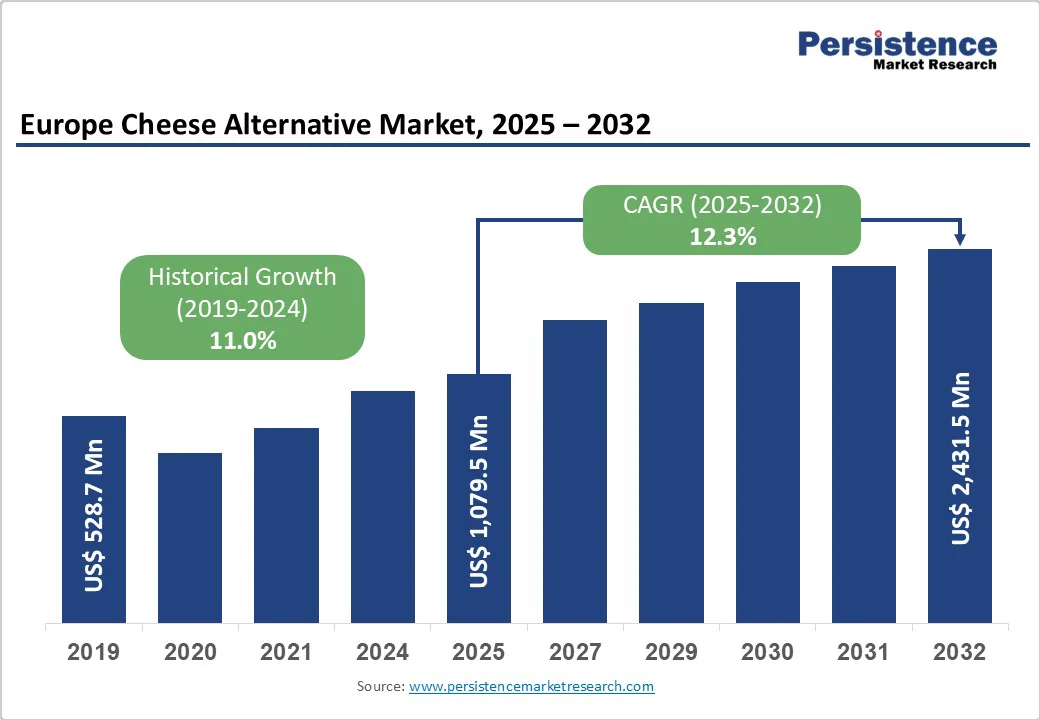
| Europe Cheese Alternative Market Size (2025E | US$ 1,079.5 Mn |
| Market Value Forecast (2032F) | US$ 2,431.5 Mn |
| Projected Growth (CAGR 2025 to 2032) | 12.3% |
| Historical Market Growth (CAGR 2019 to 2024) | 11.0% |
Market Dynamics
Driver - Growth of Vegan & Flexitarian Diets
The growth of vegan and flexitarian diets is a significant driver for the European cheese alternative market. According to the European Commission's 2023 Agricultural Outlook, approximately 30% of EU consumers identified as flexitarians in 2021, favoring plant-based foods while occasionally consuming meat and fish.
This dietary shift is further supported by findings from ProVeg's 2023 Smart Protein survey, which indicates that 90% of plant-based consumers are neither strictly vegetarian nor vegan, highlighting the prominence of flexitarianism across Europe.
Additionally, a 2020 survey by ProVeg revealed that cheese alternatives and meat alternatives are among the most popular plant-based food categories, with significant consumer interest in these products. This growing demand for plant-based options is driving the expansion of the cheese alternative market in Europe.
Restraints - Taste & Texture Gap
The taste and texture gap remains a significant restraint for the European cheese alternative market. A European consumer survey revealed that plant-based cheese was the category least favored in terms of taste and texture, with consumers expressing a desire for improvements to replicate the characteristics of dairy cheese better.
Additionally, a systematic review of 85 sensory studies highlighted that the absence of casein in plant-based cheese often results in undesirable textures such as brittleness or gumminess, and the use of plant-based fats and proteins can lead to phase separation and weak cohesion, affecting sensory quality. These sensory challenges contribute to lower consumer acceptance and hinder the widespread adoption of plant-based cheese alternatives in Europe.
Opportunity - Product Innovation and Diversification
Product innovation and diversification present significant opportunities for the European cheese alternative market, driven by evolving consumer preferences and technological advancements. The European Commission's 2023 Agricultural Outlook reports a shift in EU consumption patterns, with a projected growth in plant protein consumption, indicating a move towards plant-based diets and novel uses of dairy alternatives.
Additionally, the EU-funded DELICIOUS project aims to develop affordable, tasty, and nutritious plant-based dairy alternatives, such as cheese and kefir, by combining microbial products with plant-based materials. This initiative focuses on high-protein products enriched with vitamins, fibers, and probiotics, addressing consumer demand for healthier options.
Furthermore, the FlavourFerm project seeks to optimize fermentation techniques to enhance the flavor of plant-based foods, including cheese, by refining precision, biomass, and traditional fermentation methods. These efforts underscore the growing emphasis on innovation to meet the increasing demand for diverse and appealing plant-based cheese alternatives in Europe.
Category-wise Analysis
By Product Type, Mozzarella dominates the Cheese Alternative Market.
Mozzarella led the European market with a 33.0% share in 2025, due to its versatility and strong integration into everyday cuisine. It is the most commonly used cheese in pizzas, sandwiches, and baked dishes, making it highly recognizable and acceptable to consumers transitioning to plant-based options.
According to data from the European Union’s agricultural and food consumption reports, cheese is the top dairy product consumed in Europe, and mozzarella represents a significant share of household and foodservice usage. Its functional properties, such as meltability, stretch, and creamy texture, are easier to replicate with plant-based formulations compared to harder cheeses like cheddar or parmesan.
Moreover, the growing demand for lactose-free and vegan diets, especially in countries such as Italy, Germany, and the UK, has further reinforced mozzarella’s position as the preferred plant-based cheese alternative, bridging taste familiarity with dietary preferences.
By Source, Cashew is Gaining Traction due to Sustainability, Convenience, and Durability.
Cashew Source leads the European market with a 38.5% share in 2025, due to its superior texture, nutritional profile, and consumer acceptance. Cashews provide a creamy base that closely mimics the mouthfeel of traditional dairy cheese, making them ideal for crafting meltable, spreadable, and aged cheese alternatives. This versatility has led to widespread adoption among both artisanal producers and large-scale manufacturers.
For instance, Spain-based company Quevana has established one of Europe's largest cashew cheese production facilities, underscoring the ingredient's central role in the sector. Additionally, the European Union is the largest importer of cashew nuts globally, accounting for approximately 40% of the global cashew import value in 2022. This robust supply chain supports the growing demand for cashew-based products, including cheese alternatives, aligning with the region's increasing preference for plant-based diets and sustainable food options.
Country Insights
Germany Cheese Alternative Market Trends
Germany’s cheese alternative market is experiencing strong momentum as shifting dietary habits, sustainability concerns, and declining dairy consumption influence consumer choices. Traditional milk and cheese consumption has been steadily declining, while plant-based options are gaining visibility in supermarkets and foodservice establishments.
Consumers are increasingly attracted to innovative formulations that improve taste and texture, addressing one of the long-standing challenges of dairy-free cheese. Precision fermentation is also generating interest, with many Germans open to trying and even paying more for products developed with advanced technology.
Retail presence has expanded quickly, with plant-based cheese now a regular feature in major supermarket chains. This transformation reflects broader consumer awareness around health, lactose intolerance, animal welfare, and environmental impact, driving adoption across flexitarian and vegan segments.
Competitive Landscape
The European cheese alternative market is growing through innovations in flavors, textures, fortified nutrients, and meltable formulations. Leading brands focus on enhancing taste and nutrition, while emerging players prioritize organic and allergen-free options. Café partnerships, retail and e-commerce expansion, and sustainable packaging boost accessibility and appeal, driving broader consumer adoption and strengthening market competitiveness across Europe.
Key Industry Developments:
- In January 2025, Vegan cheese brand Julienne Bruno unveiled its latest innovation, Mozzafiore Pearls, a vegan alternative to classic mozzarella pearls. These revolutionary plant-based pearls, inspired by traditional mozzarella but crafted entirely without dairy, are now available exclusively at Whole Foods Market UK (Kensington & Piccadilly stores)
- In August 2024, Taghleef Industries unveiled an innovative lidding solution for mozzarella cheese, designed to enhance recyclability and performance. The new packaging structure replaces traditional multi-material designs with a single-material polyolefin-based alternative, aligning with polyolefin recycling streams. This change simplifies the recycling process, contributing to a circular economy.
- In August 2024, German plant-based cheese brand Simply V introduced its ParmVegan, a dairy-free parmesan alternative, to the UK market via Ocado. ParmVegan is crafted from almonds and is free from soy, gluten, and preservatives. The product aims to deliver an authentic parmesan experience with a freshly grated texture and tangy flavor, making it suitable for pasta, risotto, and lasagna.
Companies Covered in Europe Cheese Alternative Market
- Mondarella
- Simply V
- Violife
- Bedda
- New Roots
- Happy Cashew
- Jay & Joy
- Väcka
- Veganz
- Those Vegan Cowboys
- Others
Frequently Asked Questions
Europe cheese alternative market is projected to be valued at US$ 1,079.5 Mn in 2025.
Rising vegan, flexitarian, and lactose-free diets, health awareness, sustainability trends, product innovation, and increased retail and foodservice availability drive growth.
Europe cheese alternatives market is poised to witness a CAGR of 12.3% between 2025 and 2032.
Product innovation, fortified formulations, niche organic options, café collaborations, e-commerce expansion, sustainable packaging, and rising consumer demand present major market opportunities.
Major players in the global are Mondarella, Simply V, Violife, Bedda, New Roots, Happy Cashew, and Others.


