




- Healthcare Services
- Daily Cleansing Cream Market
Daily Cleansing Cream Market Size, Share, and Growth Forecast, 2026 – 2033
Daily Cleansing Cream Market by Product Type (Foam Type, No Foam Type, Others), Skin Type (Dry Skin, Oily Skin, Others), Distribution Channel (Retail Pharmacies, Supermarkets & Hypermarkets, Online Sales, Others), and Regional Analysis for 2026 - 2033

Daily Cleansing Cream Market Share and Trends Analysis
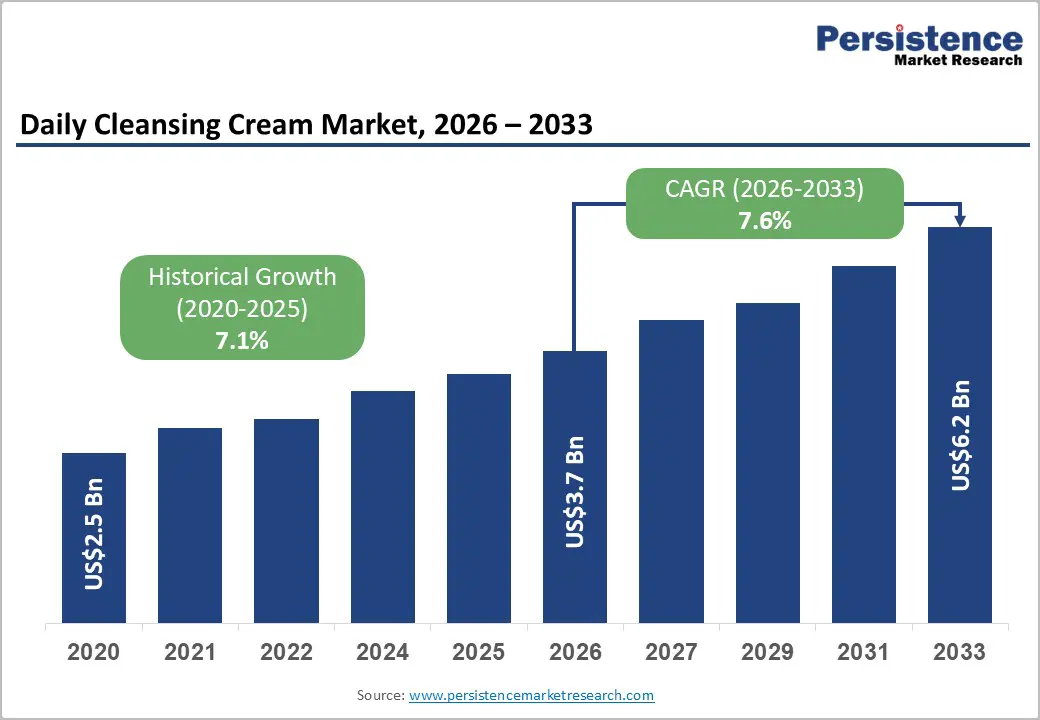
The global daily cleansing cream market size is likely to be valued at US$3.7 billion in 2026 and is estimated to reach US$6.2 billion by 2033, growing at a CAGR of 7.6% during the forecast period from 2026 to 2033, driven by rising skin health awareness, expansion of dermatology-focused skincare routines, and continuous innovation in mild cleansing formulations.
Consumer preference for multifunctional skincare products is accelerating premium cleansing cream adoption across both preventive and therapeutic skincare applications. Aging demographics and increasing exposure to pollution are creating sustained demand for hydration-oriented cleansing products with barrier protection properties. Regulatory focus on ingredient transparency and safety compliance is encouraging manufacturers to develop sulfate-free and hypoallergenic formulations.
Key Industry Highlights;
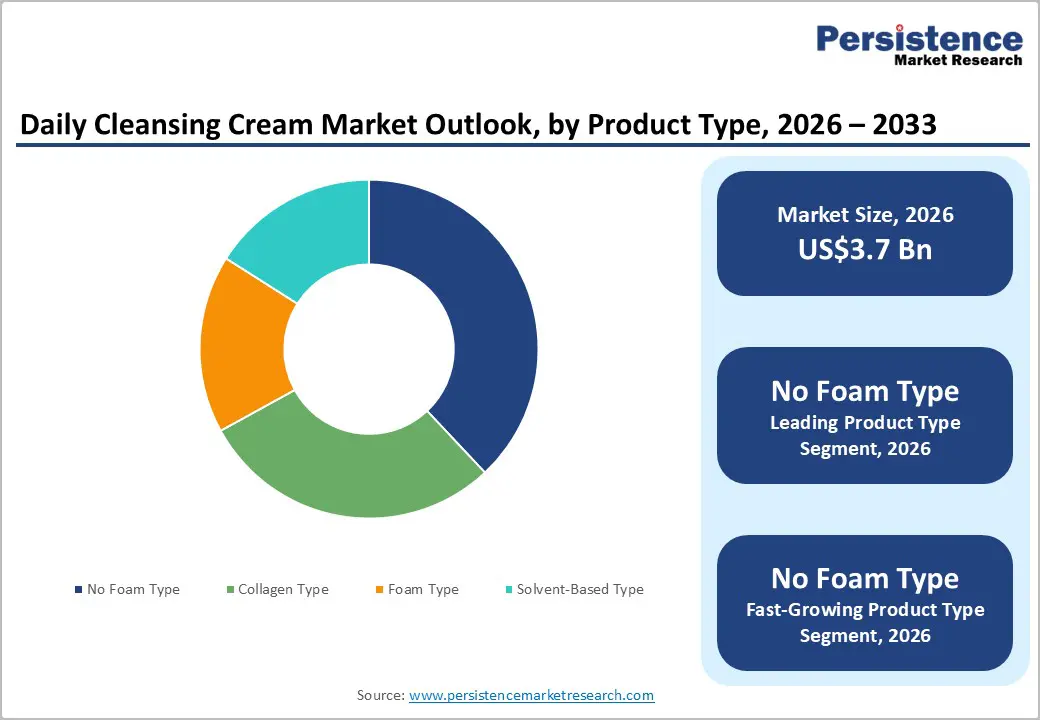
- Leading Product Type: No foam type is set to hold around 38% revenue share in 2026, driven by strong dermatologist endorsement for barrier-preserving cleansing formats among dry and sensitive skin demographics.
- Fastest-growing Product Type: Collagen type is projected as the fastest-growing segment, supported by rising anti-aging consumer demand and biotechnology-enabled ingredient innovation across prestige and mass retail tiers.
- Leading Distribution Channel: Supermarkets and hypermarkets are estimated to hold roughly 34% revenue share in 2026, due to high foot-traffic volumes that amplify product discovery and impulse purchase behavior in mass consumer markets.
- Fastest-Growing Distribution Channel: Online sales are forecast to record the fastest growth, driven by accelerating beauty e-commerce penetration and consumer adoption of subscription-based skincare replenishment models.
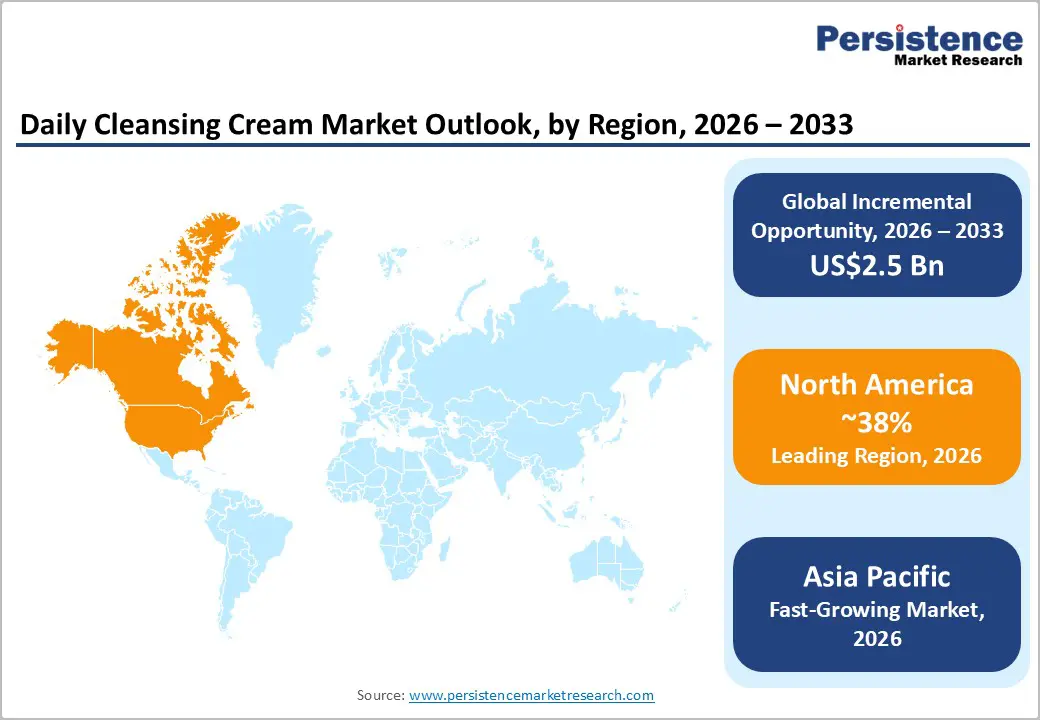
- Regional Leadership: North America is projected to capture roughly 38% of the market share in 2026, while Asia Pacific is forecast to record the fastest regional growth due to expanding middle-class skincare expenditure and K-beauty-led formulation innovation.
- Competitive Environment: The market reflects a moderately fragmented structure, with key players such as L'Oréal, Beiersdorf, and Shiseido leveraging clinical brand equity, ingredient innovation pipelines, and multi-channel distribution to maintain competitive positioning.
- Innovation Trends: Biotechnology-derived actives, sustainable waterless formulations, and clinical substantiation strategies are shaping long-term product development investment and defining the next competitive frontier in the cleansing cream category.
DRO Analysis
Driver - Rising Consumer Focus on Preventive Skincare and Skin Barrier Protection
Growing awareness regarding skin barrier preservation and hydration maintenance is increasing demand for daily cleansing creams formulated with non-irritating ingredients. Dermatology associations and skincare professionals are promoting gentle cleansing routines to reduce skin sensitivity linked with environmental exposure and excessive exfoliation. Demand growth among working populations and aging consumers is strengthening premium skincare consumption patterns. Expansion of personalized skincare recommendations through digital platforms is improving consumer understanding regarding ingredient compatibility and routine-based skincare selection.
The U.S. Food and Drug Administration reported in 2025 that adverse cosmetic reactions associated with harsh cleansing ingredients continued to increase across sensitive skin categories, supporting industry transition toward mild formulations. Ingredient-focused purchasing behavior is encouraging manufacturers to invest in ceramide, collagen, and botanical-based cleansing products. Product differentiation through dermatologist-tested claims is strengthening consumer confidence and increasing repeat purchases across premium skincare channels.
Restraint - Volatility in Raw Material Supply Chains and Ingredient Costs
Dependence on specialty ingredients, including collagen extracts, botanical oils, emulsifiers, and active hydration compounds, is exposing manufacturers to supply volatility and pricing fluctuations. Inflationary pressure across chemical processing and packaging materials is increasing operational costs. Margin pressure is becoming more visible among mid-scale manufacturers with limited procurement leverage and lower vertical integration capabilities.
Transportation disruptions and compliance-related sourcing restrictions are extending procurement timelines for imported cosmetic ingredients. Regulatory scrutiny regarding preservatives and synthetic additives is increasing reformulation expenses. Smaller manufacturers face scalability limitations due to certification costs associated with dermatology-tested and hypoallergenic cleansing formulations required for premium retail positioning.
Opportunity - Growth Potential in Dermatology-Recommended and Sensitive Skin Formulations
Increasing incidence of skin sensitivity, eczema-related irritation, and pollution-induced dryness is creating growth potential for dermatologist-recommended cleansing creams. Manufacturers are expanding investments in fragrance-free, sulfate-free, and microbiome-supportive formulations aligned with preventive skincare trends. Collaboration between skincare brands and dermatology clinics is strengthening clinical validation and improving consumer confidence regarding product safety and effectiveness.
Government attention toward cosmetic ingredient transparency is encouraging the development of cleaner skincare formulations with reduced allergen exposure. In 2025, several global cosmetic regulators strengthened disclosure requirements regarding preservative and fragrance compounds, accelerating innovation in minimalist skincare products. Expansion of pharmacy-based skincare distribution channels is improving accessibility of medically positioned cleansing creams among health-conscious consumers.
Category-wise Analysis
Product Type Insights
No foam type is anticipated to secure around 38% of the daily cleansing cream market share in 2026, reflecting strong consumer preference for gentle, non-stripping cleansing formats that preserve the skin barrier. Cetaphil Gentle Skin Cleanser, a widely recommended no-foam formulation, demonstrates the commercial viability of this approach in sensitive and dry skin demographics. Growing dermatologist endorsement of non-foaming cleansers is reinforcing this segment's dominance.
Collagen type is expected to be the fastest-growing segment, propelled by rising consumer awareness of collagen's role in skin firmness and hydration. Brands such as Shiseido have successfully commercialized collagen-infused cleansing cream formulations, establishing a proof-of-concept for premium-priced collagen variants. The convergence of anti-aging consumer interest and ingredient science innovation is accelerating adoption across both mass and prestige distribution tiers.
Skin Type Insights
Dry skin consumers are poised to dominate with a forecast market share of over 33% in 2026, powered by the clinical requirement for lipid-replenishing formulations in this consumer cohort. CeraVe Hydrating Cleanser exemplifies the demand for ceramide-enriched, cream-based formulations designed for dry skin, achieving significant market penetration globally. Persistent prevalence of dry skin conditions, particularly in colder climates, underpins the structural leadership of this segment.
Sensitive skin is estimated to be the fastest-growing segment, fueled by rising consumer self-identification with skin sensitivity and the concurrent increase in documented allergic contact dermatitis cases. La Roche-Posay Toleriane Hydrating Gentle Cleanser has achieved substantial sales growth by targeting this demographic with clinically validated hypoallergenic formulations. Regulatory pressure on ingredient safety labeling is further sensitizing consumers to formulation composition, accelerating demand for sensitivity-focused cleansing creams.
Distribution Channel Insights
Supermarkets and hypermarkets are likely to be the leading segment with a projected 34% of the daily cleansing cream market share in 2026 due to the convenience of consolidated purchasing and the high foot-traffic volumes that amplify product discovery. Retailers such as Walmart and Tesco dedicate significant shelf space to skincare cleansing categories, enabling both established and emerging brands to access mass consumer audiences. The ambient retail environment drives impulse purchase behavior, supporting volume-driven growth in this channel.
Online sales are anticipated to be the fastest-growing segment, fueled by the accelerating penetration of beauty e-commerce platforms, including Amazon Beauty, Nykaa, and Tmall. The direct-to-consumer format enables brands to communicate ingredient and efficacy narratives more effectively than in-store shelf space permits. Consumer adoption of subscription-based skincare replenishment, particularly in South Korea and the U.S., is generating recurrent revenue streams that underpin the rapid volume growth of this channel.
Regional Insights
North America Daily Cleansing Cream Market Trends
North America is expected to account for around a 38% share in 2026, supported by high premium skincare spending, widespread dermatology awareness, and strong penetration of clinically positioned cleansing products. Expansion of digital beauty retail infrastructure and ingredient transparency regulations is strengthening demand for sulfate-free and sensitive skin formulations.
U.S. Daily Cleansing Cream Market Insights
The U.S. is projected to hold nearly an 87% share of North America in 2026, driven by advanced skincare consumption patterns, strong e-commerce penetration, and high adoption of dermatologist-recommended cleansing products. Expansion of artificial intelligence-based skincare consultation platforms is accelerating premium product purchasing behavior.
Canada Daily Cleansing Cream Market Insights
Canada is forecast to capture approximately a 13% share of North America in 2026, supported by rising demand for clean-label skincare products and growing pharmacy-based beauty retail networks. Sustainability-focused skincare purchasing behavior is increasing the adoption of refillable and fragrance-free cleansing formulations.
Europe Daily Cleansing Cream Market Trends
Europe is anticipated to represent around a 27% share in 2026, stimulated by stringent cosmetic ingredient regulations, premium skincare adoption, and strong demand for microbiome-friendly formulations. Expansion of specialty beauty retail chains and sustainable cosmetic packaging initiatives is supporting long-term product penetration.
Germany Daily Cleansing Cream Market Insights
Germany is likely to account for nearly a 28% share of Europe in 2026, driven by a strong preference for dermatologically tested skincare products and expanding pharmacy-led skincare distribution infrastructure. Rising consumer awareness regarding barrier-protection skincare is strengthening premium cleansing cream demand.
France Daily Cleansing Cream Market Insights
France is expected to secure close to a 19% share of Europe in 2026, supported by luxury beauty product consumption and continuous innovation from premium skincare manufacturers. Increasing anti-aging skincare adoption is accelerating demand for collagen-based and hydration-supportive cleansing formulations.
Asia Pacific Daily Cleansing Cream Market Trends
Asia Pacific is forecast to be the fastest-growing market for daily cleansing cream, stimulated by rapid urbanization, rising disposable incomes, and the cultural prevalence of multi-step skincare routines across South Korea, Japan, and China. The regional market is projected to account for approximately 29% of market share by 2026, with accelerating growth expected through 2033.
China Daily Cleansing Cream Market Insights
China is projected to contribute nearly a 39% share of Asia Pacific in 2026, driven by strong online beauty retail penetration, expanding domestic skincare manufacturing, and increasing premium skincare spending among urban populations. Livestream commerce and social media-led skincare education are accelerating product visibility and purchasing activity.
Japan Daily Cleansing Cream Market Insights
Japan is expected to account for around 18% of the Asia Pacific in 2026, supported by aging demographics, high skincare awareness, and growing demand for minimalist beauty routines. Expansion of collagen-focused skincare innovation is strengthening premium cleansing cream adoption among mature consumers.
Competitive Landscape
The global daily cleansing cream market is moderately fragmented, characterized by competition among multinational cosmetic manufacturers, dermatology-focused skincare brands, and regional beauty companies. Key participants, including L'Oréal Groupe, Beiersdorf AG, Procter & Gamble, Unilever, and Shiseido Company, Limited, are strengthening product differentiation through ingredient innovation, dermatology partnerships, and premium skincare positioning across digital and specialty retail channels.
Competitive intensity is increasing due to the expansion of clean-label skincare demand and rapid digital commerce penetration. Manufacturers are prioritizing sulfate-free formulations, microbiome-supportive ingredients, and refillable packaging systems to strengthen consumer retention. Investment in artificial intelligence-enabled skincare diagnostics and direct-to-consumer retail strategies is improving operational efficiency and strengthening long-term brand visibility across premium skincare ecosystems.
Key Industry Development
- In April 2026, FutureMe launched its Advanced Cleansing Cream featuring an “Intelligent Cleansing” formula that combines cleansing, toning, and moisturizing functions, reinforcing innovation in multifunctional Daily Cleansing Cream products.
Companies Covered in Daily Cleansing Cream Market
- L'Oréal Groupe
- Beiersdorf AG
- Procter & Gamble
- Unilever
- Shiseido Company, Limited
- Johnson & Johnson
- Amorepacific Corporation
- Cetaphil
- La Roche-Posay
- Kao Corporation
- The Estée Lauder Companies Inc.
- Revlon, Inc.
- Edgewell Personal Care
- Proya Cosmetics
Frequently Asked Questions
The global daily cleansing cream market is projected to reach US$3.7 billion in 2026.
Rising consumer focus on skin hydration, barrier protection, and dermatologist-recommended daily skincare routines drives the daily cleansing cream market.
The daily cleansing cream market is poised to witness a CAGR of 7.6% from 2026 to 2033.
Expansion of sensitive skin formulations, clean-label skincare products, and digital beauty commerce platforms creates significant growth opportunities in the daily cleansing cream market.
Some of the key market players include L'Oréal Groupe, Beiersdorf AG, Procter & Gamble, Unilever, and Shiseido Company, Limited.


