




- Nutraceuticals & Functional Foods
- D-Mannose Market
D-Mannose Market Size, Share, and Growth Forecast 2026 - 2033
D-Mannose Market by Form (Powder, Capsules & Tablets), End-user (Functional Food, Dietary Supplements, Pharmaceuticals, Animal Feed, Others), Distribution Channel, and Regional Analysis, 2026 - 2033

D-Mannose Market Size and Trend Analysis
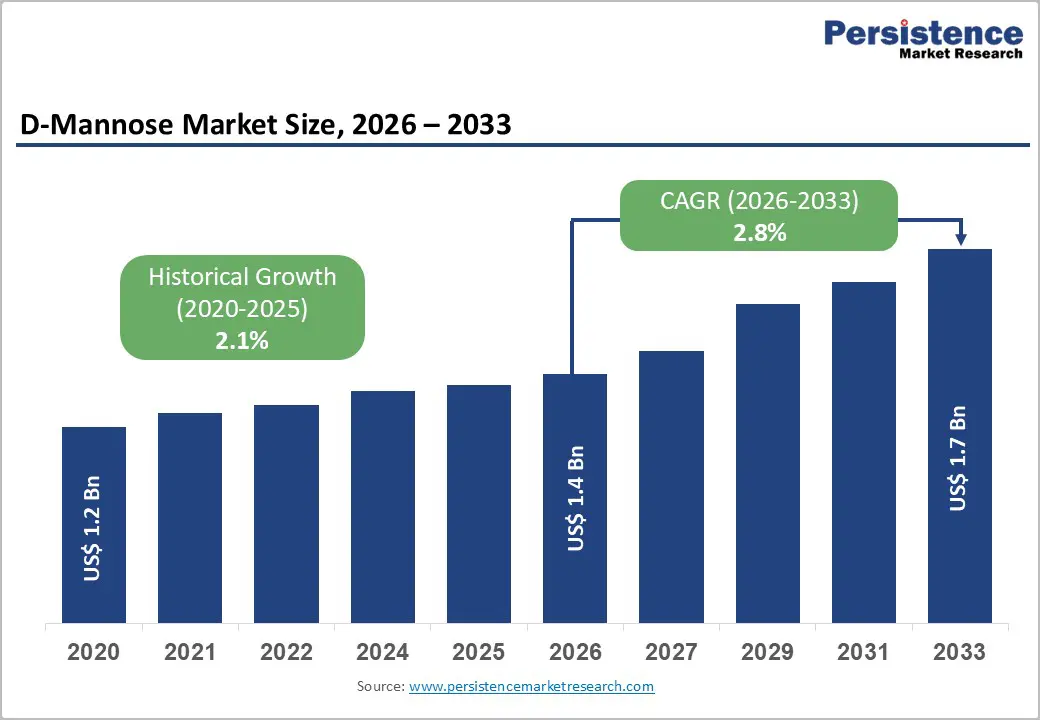
The global D-Mannose Market size is expected to be valued at US$ 1.4 billion in 2026 and projected to reach US$ 1.7 billion by 2033, growing at a CAGR of 2.8% between 2026 and 2033. D-mannose is a naturally occurring sugar, commonly available as a white crystalline powder, widely recognized for its functional and therapeutic properties. It is highly soluble in water and is widely used in dietary supplements, particularly for the management of urinary tract infections (UTIs). Its role as a precursor in the synthesis of D-mannitol further enhances its industrial relevance.
Growing consumer awareness regarding preventive healthcare and natural treatment alternatives is driving global demand for D-mannose. Additionally, increasing applications across pharmaceuticals, functional foods, and nutraceuticals are expanding its market scope. Manufacturers are actively investing in research and development to enhance product quality, purity, and application-specific formulations. This focus on innovation, combined with evolving consumer preferences and expanding end-use industries, is significantly contributing to the sustained growth of the D-mannose market.
Key Highlights:
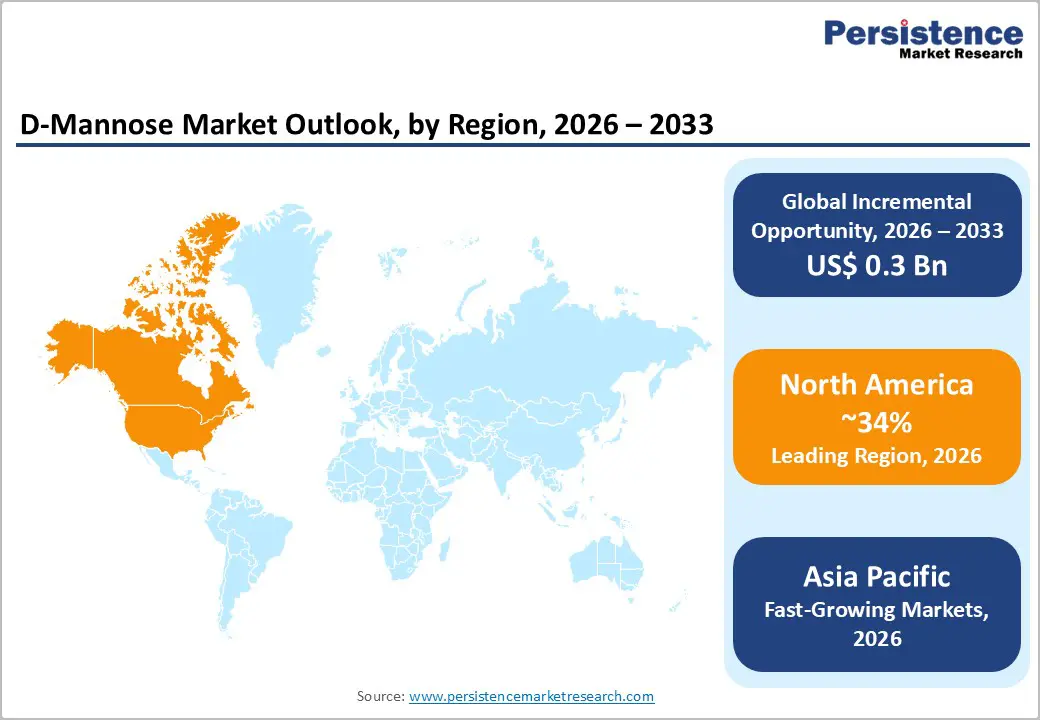
- Regional Leadership: North America leads the D-mannose market with 34% share, driven by strong preventive healthcare awareness, advanced infrastructure, and rising demand for natural urinary health supplements.
- Fast-growing Region: Asia Pacific is the fastest-growing region, supported by expanding manufacturing in China and India and increasing middle-class demand for nutraceutical and preventive healthcare products.
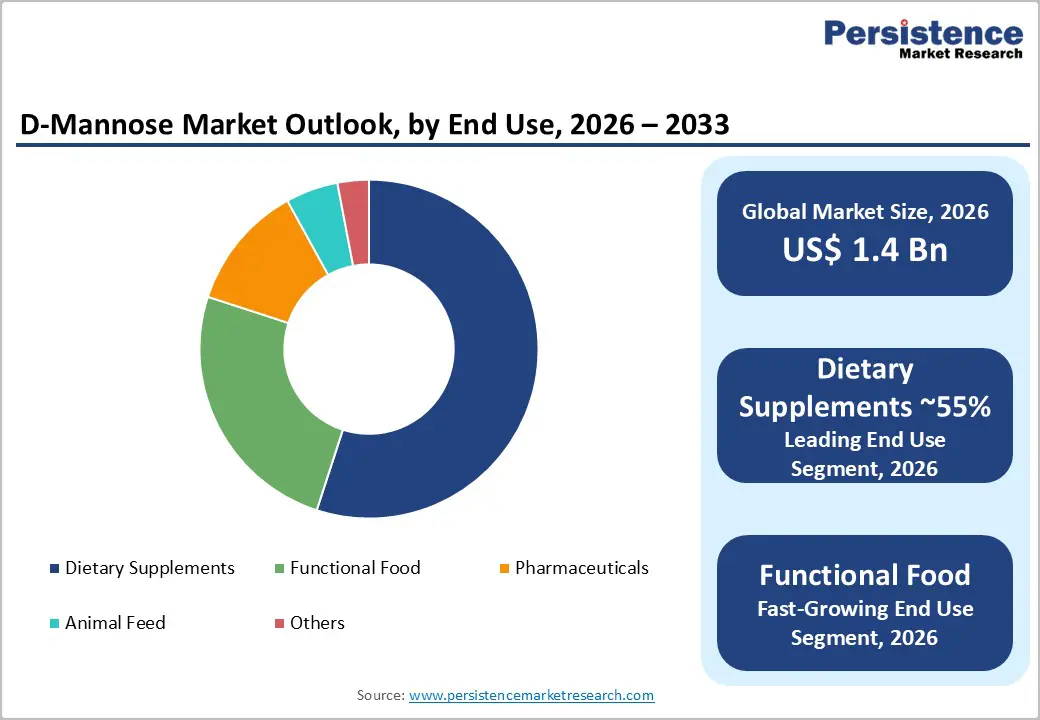
- Leading End-user: Dietary supplements dominate with around 55% share, as consumers increasingly prefer natural, non-antibiotic solutions for urinary tract health and immune support applications globally.
- Fast-growing End-user: Functional food is the fastest-growing segment, driven by rising demand for “food-as-medicine” products and integration of D-mannose into beverages and fortified health snacks.
- Opportunity: Animal feed application presents a key opportunity, offering natural gut health solutions and reducing antibiotic dependence amid tightening global livestock and agricultural regulations.
| Key Insights | Details |
|---|---|
|
D-Mannose Market Size (2026E) |
US$ 1.4 billion |
|
Market Value Forecast (2033F) |
US$ 1.7 billion |
|
Projected Growth CAGR (2026-2033) |
2.8% |
|
Historical Market Growth (2020-2025) |
2.1% |
Market Dynamics
Drivers - Growing Prevalence of Urinary Tract Infections and Antibiotic Resistance
The rising global incidence of Urinary Tract Infections (UTIs), affects approximately 150 million people annually, according to the World Health Organization (WHO). The emergence of multidrug-resistant bacterial strains increasingly challenges traditional treatment protocols relying on antibiotics. D-Mannose, a natural sugar, provides a prophylactic mechanism by inhibiting Escherichia coli from adhering to the urothelium. As health organizations like the Centers for Disease Control and Prevention (CDC) emphasize the importance of antibiotic stewardship, both practitioners and patients are turning to D-Mannose as a safe, long-term preventive measure. This shift is particularly evident in the Dietary Supplements sector, where consumer trust in natural prophylaxis is at an all-time high.
Increasing Consumer Demand for Non-GMO Products to Benefit the D-Mannose Market
The proportion of shoppers shunning genetically modified foods has been increasing. Distrust, discomfort, and uncertainty have increased concerns over genetically modified foods as consumers perceive such products as potentially harmful and unhealthy. Heightened concerns over bioengineered foods have translated to continued strong demand for verified non-GMO products, forcing manufacturers to adapt to the trend. Thus, manufacturers such as NOW Health Group, INC. are offering D-Mannose Powder, which is non-GMO verified for promoting normal urinary tract function by cleansing and maintaining the health of the bladder lining. According to the International Food Information Council Foundation’s Food and Health Survey, 40% of shoppers view items that contain non-GMO ingredients as advantageous as and healthier than identical products made with GMO ingredients.
Restraints - Stringent Regulatory Scrutiny and Health Claim Limitations
The D-Mannose Market faces challenges related to the strict regulatory frameworks governing health claims in major regions. While the U.S. Food and Drug Administration (FDA) and the European Food Safety Authority (EFSA) recognize D-Mannose as safe for consumption, they maintain rigorous standards for labeling products as "treatments" for medical conditions. In many jurisdictions, manufacturers are prohibited from making direct therapeutic claims regarding the cure without extensive, localized clinical trial data. This regulatory environment necessitates significant investment in compliance and limits the marketing efficacy of smaller players. Misalignment between consumer expectations and legally permissible label claims can lead to market confusion and potential legal repercussions for brands.
Opportunities - Growing Necessity for Diabetic-friendly Products to Propel Demand for D-Mannose
According to the World Health Organization, diabetes is one of the most common causes of death globally. Increasing concern regarding diabetes is influencing consumers to gradually move towards antidiabetic products. This has increased the number of products with antidiabetic claims. An average annual growth of 39% has been accounted in global antidiabetic product launches between 2014 and 2020.
D-mannose is a naturally occurring simple sugar that is found in fruits such as cranberries, blueberries, and pineapples as well as in other plants and fungi. When D-mannose is ingested, it is quickly absorbed in the upper portion of the gastrointestinal tract, but very little of the sugar is metabolized. It therefore does not affect blood sugar levels, which makes it safe for diabetic patients. Moreover, diabetes can be a potent cause of UTI infections. This factor has led to the emergence of D-mannose as a solution for both related diseases.
Category-wise Analysis
Form Insights
The capsules & tablets segment is the leading format in the D-Mannose Market, accounting for a dominant 58% share in 2025. This leadership is primarily attributed to the convenience and dosing precision that encapsulated forms provide to consumers. Unlike powders, which require mixing with water and may have a slightly bitter aftertaste in certain concentrations, capsules offer a tasteless, portable solution for on-the-go consumption. Furthermore, the stability of the active ingredient is often better preserved in tablet form, extending shelf life for retailers.
Distribution Channel Insights
The Business to Business (B2B) segment remains the leading distribution channel, commanding a 42% market share in 2025. This is due to the heavy reliance of final-product manufacturers on specialized ingredient suppliers for bulk, high-purity D-Mannose used in pharmaceutical and supplement formulations. Large-scale procurement by companies such as Nestle Health Science and GNC Holdings, Inc. ensures steady volume flow through this channel. The online retail is the fastest-growing segment, expected to witness a CAGR of 4.6% during the forecast period. The ease of price comparison, access to detailed customer reviews, and the rise of direct-to-consumer (DTC) brands are shifting the power balance toward digital storefronts, particularly in urbanized markets.
Regional Insights
North America D-Mannose Market Trends and Insights
North America remains the largest regional market, accounting for nearly 34% share in 2025, supported by advanced healthcare infrastructure and strong consumer awareness regarding preventive wellness. The United States leads the region, driven by the high prevalence of urinary tract infections (UTIs), which account for over 8 million annual medical visits, according to the National Institute of Diabetes and Digestive and Kidney Diseases (NIDDK). This has significantly increased demand for non-prescription and natural alternatives such as D-mannose. Growing preference for nutraceuticals and dietary supplements further strengthens market growth, particularly among aging populations and health-conscious consumers.
Innovation in the region is led by companies such as NOW Health Group, Inc. and DuPont de Nemours, Inc., focusing on high-purity and non-GMO formulations. The regulatory framework under the Dietary Supplement Health and Education Act (DSHEA) enables faster product commercialization while ensuring safety standards. Additionally, the presence of well-established retail networks, including specialty health stores and e-commerce platforms, ensures wide product accessibility. The increasing integration of digital health platforms and subscription-based supplement models is also contributing to sustained demand growth across diverse consumer segments.
Asia Pacific D-Mannose Market Trends and Insights
Asia Pacific is the fastest-growing region in the D-mannose market, projected to reach a CAGR exceeding 4.5% by, driven by strong manufacturing capabilities and rising domestic demand. Countries such as China and India serve as global production hubs for fermentation-based ingredients, enabling cost-efficient large-scale manufacturing. Increasing disposable incomes and growing awareness of preventive healthcare are encouraging consumers to adopt nutraceuticals, including D-mannose, as part of daily health regimens. This shift from export-driven production to domestic consumption is significantly strengthening regional market growth.
In addition to human health applications, the animal feed sector in ASEAN countries presents a notable opportunity, particularly in poultry farming where D-mannose is used for gut health and disease prevention. Government initiatives in China aimed at modernizing pharmaceutical and health food industries are further supporting market expansion. Moreover, rapid digitalization and the widespread adoption of mobile commerce platforms are enhancing product accessibility across urban and rural areas. This combination of manufacturing strength, policy support, and evolving consumer behavior positions Asia Pacific as a key growth engine for the global D-mannose market.
Competitive Landscape
The D-Mannose Market currently exhibits a moderate degree of consolidation, with approximately 55% of the total market value controlled by a group of key global players. These leaders, including Nestle Health Science, Pfanstiehl Inc, and NOW Health Group, Inc., maintain their dominance through extensive distribution networks, established brand trust, and significant investment in R&D. Competition is intensifying as emerging players focus on bio-based production methods and specialized formulations. Key differentiators in the market include the "Clean Label" status, degree of solubility, and the absence of residual solvents. We are seeing a trend toward vertical integration, where supplement brands are partnering directly with ingredient manufacturers to ensure supply chain transparency and cost efficiency.
Key Developments:
- In April 2026, Nestlé Health Science reinforced its commitment to improving health through advanced nutrition solutions, focusing on addressing dietary gaps, supporting patient care, and delivering innovative products for healthier living.
- In 2025, Source Naturals, Inc partnered with various suppliers to distribute the best quality products to consumers according to their needs. The company is committed towards sourcing botanical extracts and powders with other raw materials, including non-GMO verified and organic ingredients from the most reliable suppliers and also for distributing products.
Companies Covered in D-Mannose Market
- Nestle Health Science
- NOW Health Group, Inc.
- Pfanstiehl Inc
- Vibrant Health
- Hanseler AG
- Source Naturals
- DuPont de Numerous, Inc.
- Bio-Tech Pharmacal
- Jarrow Formulas
- Nutraceutical International Corporation
- GNC Holdings, Inc.
- Swanson Vitamins
- Sweet Cures
- VWR Lab Products Private Limited
- Others
Frequently Asked Questions
The global D-Mannose Market is expected to be valued at US$ 1.4 billion in 2026, following a steady growth trajectory from the 2020 base year.
The primary driver is the rising incidence of Urinary Tract Infections (UTIs) and the global trend toward using natural, non-antibiotic alternatives to combat Antibiotic Resistance.
North America is the leading region, accounting for 34% of the global market share in 2025, supported by high consumer awareness and a mature supplement industry.
A major opportunity lies in the Animal Feed sector, where D-Mannose is being adopted as a natural pathogen-binder for livestock, replacing sub-therapeutic antibiotics.
The market features prominent players such as Nestle Health Science, NOW Health Group, Inc., Pfanstiehl Inc, DuPont de Nemours, Inc., and GNC Holdings, Inc.


