




- Technology
- Citizen Service AI Market
Citizen Service AI Market Size, Share, and Growth Forecast 2026 - 2033
Citizen Service AI Market by Component (Software, Services), Deployment (Cloud-based, On-premise), by Technology (Machine Learning, Natural Language Processing (NLP), Generative AI, Computer Vision), by Application (Citizen Engagement, Smart Governance, Public Safety, Document Processing, Virtual Assistants/Chatbots), End-user (Government Agencies, Municipal Corporations, Smart Cities), and Regional Analysis, 2026 - 2033

Citizen Service AI Market Size and Trend Analysis
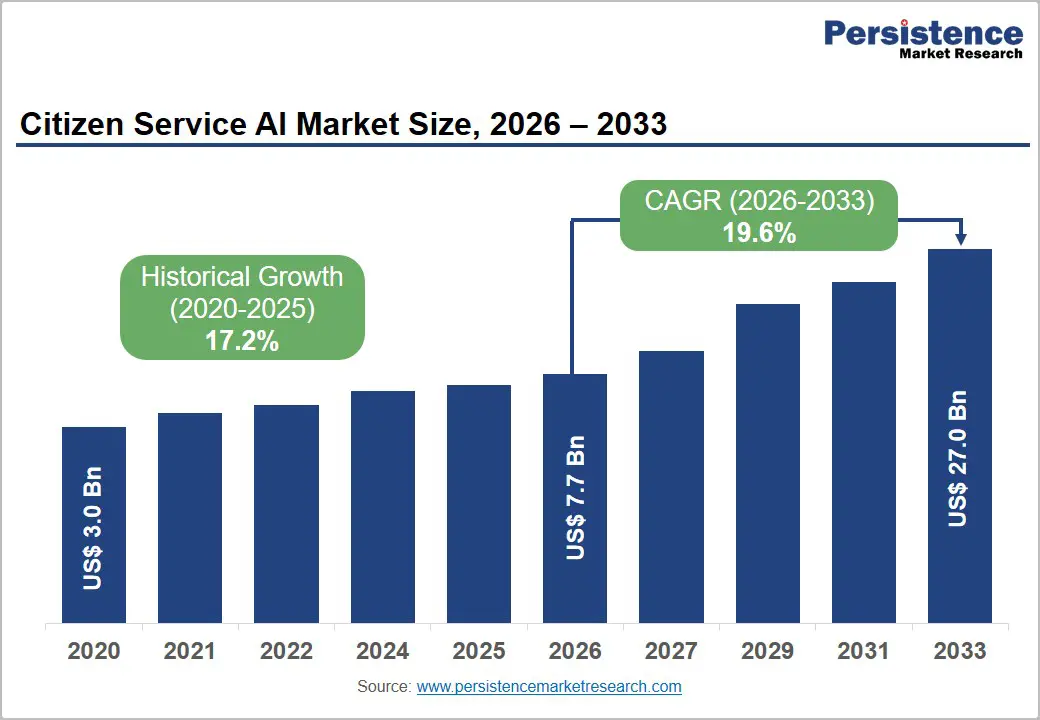
The global citizen service AI market is projected to grow from US$ 7.7 billion in 2026 to US$ 27.0 billion, expanding at a CAGR of 19.6%. Rapid digital transformation across public administration is fueling this momentum, with the United Nations E-Government Survey 2024 confirming that all 193 UN Member States now offer online citizen services.
Substantial public investment, including U.S. federal IT spending of US$ 75.13 billion in FY2025, is accelerating AI adoption across agencies. Rising 24/7 service expectations, smart city deployments, and expanding generative AI use cases in public service delivery further reinforce sustained market expansion.
Key Industry Highlights:
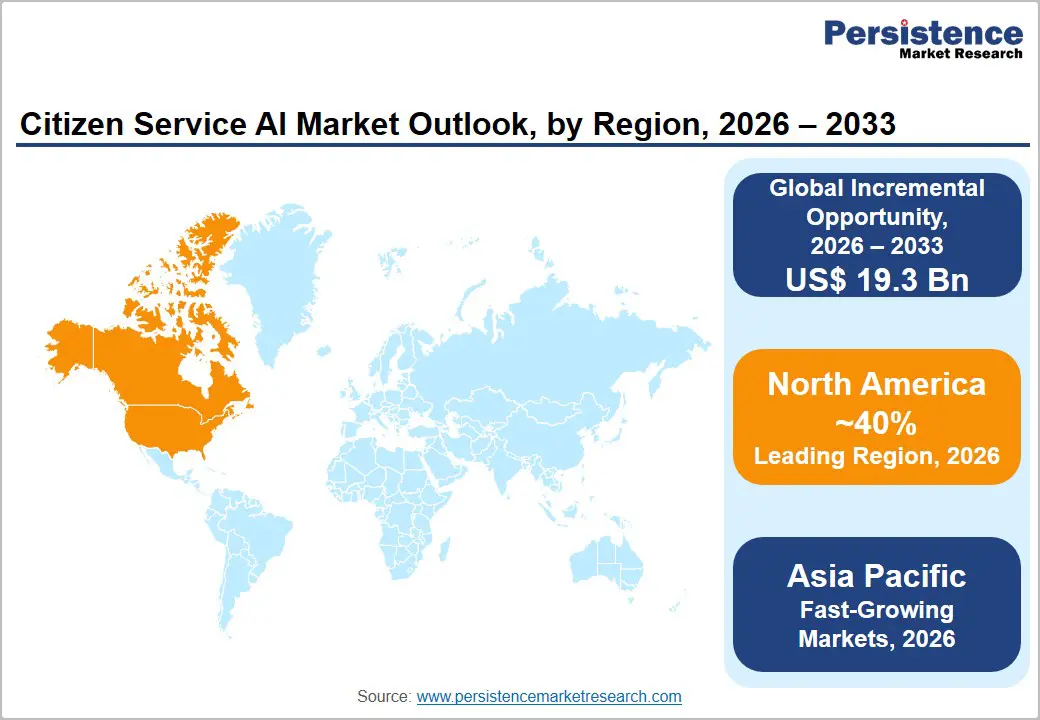
- Leading Region: North America is likely to register a 40% share in 2026, anchored by robust federal AI spending and mature cloud ecosystems.
- Fast-Growing Market: Asia Pacific is projected a positive CAGR led by smart city programs and India's IndiaAI Mission.
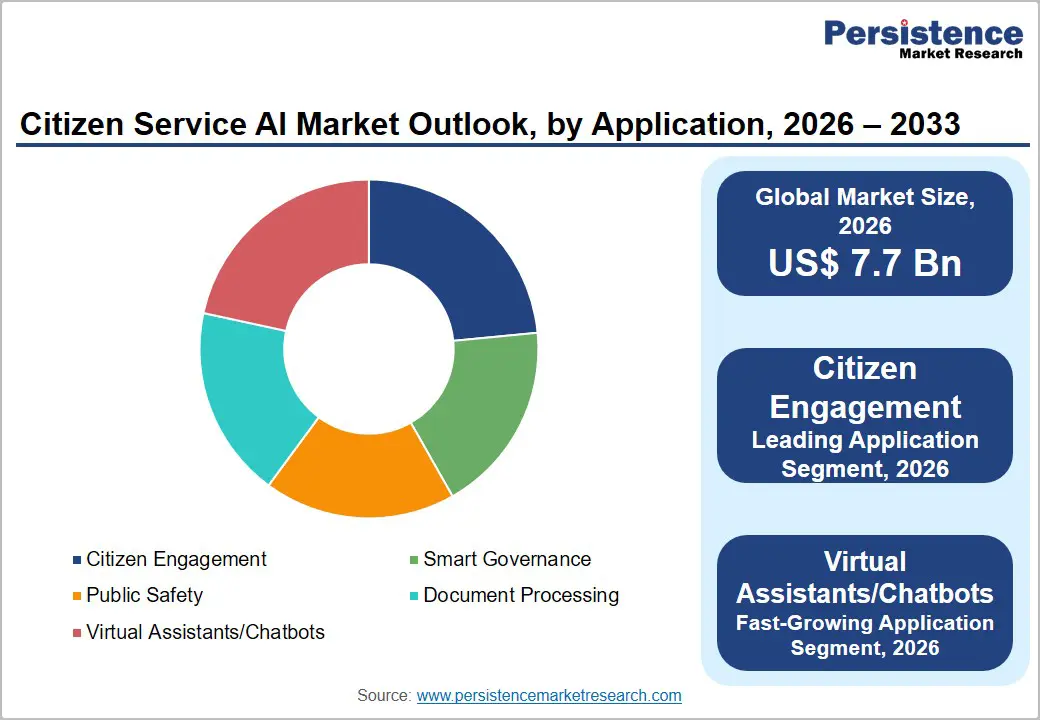
- Dominant Application Segment: Citizen engagement leads applications with a 32% share in 2026, driven by AI-powered grievance portals and contact centres.
- Fastest Growing Segment: Virtual Assistants/Chatbots are expanding fastest, fuelled by 24/7 self-service demand and generative AI adoption.
- Key Opportunity: Generative AI integration for hyper-personalised citizen services, backed by initiatives like USAi, GOV.UK Chat, and Bhashini.
Market Dynamics
Drivers - Accelerating Digital Government Transformation Initiatives Across Global Public Administration
Governments worldwide are aggressively investing in digital infrastructure to modernize citizen services and reduce operational costs through automation. The UN E-Government Development Index (EGDI) 2024 shows the global average climbed to 0.6382, up from 0.6102 in 2022, signalling rapid digital maturation. The European Commission's Digital Europe Programme has allocated €7.5 billion for the 2021-2027 period to accelerate AI deployment across European public administrations and citizen-facing services.
According to the U.S. Office of Management and Budget (OMB), federal agencies reported 1,757 AI use cases in their 2024 inventories, marking a sharp rise from prior years. Executive Order 14110 further mandates safe and responsible AI deployment across federal agencies, while sustained multi-year budget commitments and inter-agency coordination reinforce strong policy momentum behind AI-powered citizen engagement, identity verification, and benefits administration platforms globally.
Surging Conversational AI and Virtual Assistant Deployments by Governments
Rising preference for self-service digital channels is accelerating chatbot adoption across government portals worldwide. According to Eurostat, internet use for interaction with public authorities reached 75% across the EU in 2024, prompting member states to rapidly deploy AI-driven conversational interfaces. Singapore's Government Technology Agency (GovTech) reports that its Ask Jamie virtual assistant handles over 500,000 queries monthly across more than 70 government agencies nationwide.
India's MyGov platform has crossed 33 million registered users, with conversational AI integrated for grievance redressal across central and state ministries. Estonia's KrattAI initiative similarly networks over 100 public-sector chatbots into a unified digital assistant ecosystem available nationwide to all citizens and businesses. These deployments demonstrate scalable productivity gains, dramatically reduced wait times, multilingual accessibility, and measurably improved citizen satisfaction scores across diverse demographic groups.
Restraints - Data Privacy, Sovereignty, and Cybersecurity Compliance Pressures on Agencies
Heightened concerns around personal data handling, algorithmic transparency, and cross-border data flows are restraining the faster adoption of citizen-facing AI applications across government bodies. The European Union AI Act, which entered into force in August 2024, imposes strict obligations on high-risk AI systems deployed by public authorities, including mandatory conformity assessments, transparency requirements, registration in EU databases, and detailed risk management documentation throughout deployment lifecycles.
According to ENISA (European Union Agency for Cybersecurity), public administration accounted for nearly 19% of reported cyber incidents in 2024, the highest among all sectors. The U.S. Cybersecurity and Infrastructure Security Agency (CISA) similarly flagged escalating ransomware attacks on government systems. Compliance costs, mandatory impact assessments, and the need for sovereign cloud infrastructure are slowing procurement cycles and elevating total cost of ownership for new AI deployments.
Legacy IT Modernization Challenges and AI Talent Shortages
A significant share of government IT infrastructure still relies on aging mainframe systems and decades-old code bases that resist modernization. The U.S. Government Accountability Office (GAO) has identified 10 critical federal legacy systems requiring urgent modernization, with some still running on COBOL code more than 50 years old. Replacing these brittle systems while maintaining continuous citizen service operations creates substantial integration complexity for new AI projects.
The OECD reports that only 22% of public sector entities have adequate in-house AI talent, creating a significant deployment bottleneck across agencies. The U.S. Office of Personnel Management has launched dedicated AI hiring authorities to address this widening skills gap. Combined integration complexities, prolonged procurement timelines, and substantial budget reallocations to address mounting technical debt continue to slow new AI procurements across federal, state, and municipal agencies.
Opportunities - Generative AI Adoption for Hyper-Personalized Public Service Delivery
The rapid maturation of generative AI presents transformative opportunities for governments to deliver context-aware, conversational citizen experiences at scale and reduce service backlogs. The United Kingdom's Government Digital Service (GDS) piloted GOV.UK Chat, a generative AI tool answering business-related queries, with reports indicating that nearly 65% of users found the responses helpful during initial trials conducted with thousands of small businesses and entrepreneurs across the country.
Similarly, the U.S. General Services Administration (GSA) launched USAi in 2025, a secure generative AI evaluation suite enabling federal agencies to test enterprise-grade models. Australia's Digital Transformation Agency allocated AU$ 21.6 million in its 2024-25 budget for whole-of-government AI capabilities. These initiatives indicate sizable multi-year procurement pipelines for vendors offering compliant, fine-tuned generative AI solutions tailored specifically to public sector workflows and accessibility requirements.
Smart Governance Expansion Across Emerging Market Economies Worldwide
Smart city programs across emerging economies represent substantial untapped potential for AI vendors and integrators. India's Smart Cities Mission has approved more than 8,000 projects worth nearly INR1.6 trillion (US$ 19 billion), with many incorporating AI for traffic management, sanitation monitoring, and citizen grievance handling. The IndiaAI Mission complements this push with INR10,372 crore in dedicated funding, accelerating municipal AI deployments across over 100 cities nationwide.
Saudi Arabia's NEOM and Vision 2030 programs have committed over US$ 500 billion for AI-enabled urban infrastructure, including the Sakani housing portal supporting millions of citizens. The African Union's Digital Transformation Strategy for Africa 2020-2030 is fostering AI uptake across 55 member states. Brazil's Brasil Digital initiative further extends similar momentum. These programs present long-runway opportunities for chatbot, predictive analytics, and public safety AI vendors.
Category-wise Analysis
Component Insights
The software segment is anticipated to lead the Citizen Service AI market with an estimated 62% share in 2026, reflecting strong demand for AI platforms, NLP engines, analytics dashboards, and chatbot frameworks. Government agencies prioritise software acquisitions through programs such as the U.S. GSA Multiple Award Schedule (MAS), listing thousands of pre-vetted vendors, while the European Commission's GovTech4all initiative funds software innovation across member states.
The Services segment is emerging as the fast-growing category, driven by complex AI integration, change management, and managed services requirements across government agencies. Programs such as the U.K. Crown Commercial Service AI Dynamic Purchasing System and India's GeM portal facilitate large-scale consulting and implementation procurement. Rising demand for AI ethics audits, MLOps support, and post-deployment maintenance further accelerates services expansion across federal, state, and municipal buyers globally.
Deployment Insights
The Cloud-based deployment segment commands a leading 64% share in 2026, attributable to scalability benefits, lower upfront infrastructure costs, and government cloud-first mandates worldwide. The U.S. Federal Cloud Computing Strategy (Cloud Smart) drives sustained migration, with FedRAMP authorisations exceeding 400 cloud service offerings as of 2024. The U.K. Government's G-Cloud framework facilitates streamlined procurement across more than 30,000 buyer organisations annually, anchoring segment leadership.
Sovereign and hybrid cloud variants within this category represent the fastest growing deployment model, addressing data residency, AI Act compliance, and national security needs for sensitive citizen data. Hyperscalers have launched dedicated sovereign regions in Germany, France, and India to meet jurisdictional mandates. The EU's GAIA-X initiative and Singapore's Government Commercial Cloud further drive specialised deployments tailored to public sector workloads and classified information processing.
Technology Insights
The Natural Language Processing (NLP) segment leads the technology category with approximately 38% share in 2026, owing to its centrality in chatbots, voice assistants, multilingual citizen portals, and document understanding workflows. India's Bhashini program supports AI translation across 22 official languages, while the European Language Equality initiative, backed by over 52 partners, prioritises language technology for digital sovereignty across diverse member states and minority languages.
Generative AI is emerging as the fast-growing technology segment, propelled by transformative LLM-powered applications in citizen-facing workflows. The U.S. GSA's USAi evaluation suite, the U.K.'s GOV.UK Chat pilot, and France's Albert LLM, developed by Etalab demonstrate rapid government adoption. Singapore's Pair platform and the UAE's Falcon model further accelerate sovereign Gen AI deployment, enabling personalised responses, automated drafting, and multilingual citizen support at scale.
Application Insights
The Citizen Engagement segment is the leading application with an estimated 32% share in 2025, reflecting widespread deployment of grievance portals, e-participation platforms, and AI-enhanced contact centres. Estonia's e-Residency program, with more than 100,000 e-residents, exemplifies AI-supported engagement at scale, while India's CPGRAMS portal has processed over 20 million grievances, increasingly leveraging AI-driven routing and sentiment analysis to anchor segment leadership across democracies.
Virtual Assistants and Chatbots represent the fast-growing application segment, driven by surging demand for 24/7 self-service channels and generative AI integration across portals. Singapore's Ask Jamie handles over 500,000 monthly queries across 70+ agencies, while the U.S. IRS Direct File and U.K. HMRC virtual assistants demonstrate large-scale adoption. Falling deployment costs and improved multilingual capabilities are accelerating chatbot rollouts across federal, state, and municipal portals worldwide.
End-user Analysis
Government Agencies dominate the end-user landscape with roughly 58% market share in 2025, supported by sustained federal IT modernisation programs. The U.S. Technology Modernization Fund (TMF) has invested more than US$ 1 billion since inception across 60+ agency projects, many incorporating AI. The U.K. Central Digital and Data Office (CDDO) mandates AI roadmaps across departments, while defence, taxation, and immigration agencies drive procurement.
Smart Cities are emerging as the fast-growing end-user category, fuelled by ambitious urban modernisation programs and AI-enabled service delivery initiatives. India's Smart Cities Mission has approved over 8,000 projects spanning 100 cities, while Saudi Arabia's NEOM commits US$ 500 billion for AI-integrated urban infrastructure. The EU's 100 Climate-Neutral Cities Mission and Singapore's Smart Nation 2.0 further accelerate municipal AI procurement for citizen-facing applications.
Regional Insights
North America Citizen Service AI Market Trends and Insights
North America leads the global Citizen Service AI market with a 40% share in 2025, supported by sizable federal IT budgets, mature cloud infrastructure, and an active vendor ecosystem. Policy frameworks such as the U.S. AI Bill of Rights blueprint and the Canadian Directive on Automated Decision-Making provide structured deployment pathways across federal agencies.
U.S. Citizen Service AI Market Size
The U.S. accounts for approximately 85% of North America's Citizen Service AI market, valued at around US$ 2.6 billion in 2026. Federal IT spending of US$ 75.13 billion in FY2025, combined with Executive Order 14110 on Safe, Secure, and Trustworthy AI, has accelerated procurement across the Department of Veterans Affairs, IRS, and Social Security Administration.
Europe Citizen Service AI Market Trends and Insights
Europe represents a significant share of the global market, anchored by the EU AI Act, Digital Europe Programme, and Horizon Europe funding instruments. Citizen-facing AI is rapidly expanding across Scandinavian and Baltic nations, while Germany, France, and the U.K. lead procurement volumes, emphasising ethical AI, data sovereignty, and multilingual capabilities.
Germany Citizen Service AI Market Size
Germany holds approximately 22% of Europe's Citizen Service AI market in 2026, propelled by the Federal Government's AI Strategy, which committed €5 billion by 2025. The Online Access Act (OZG) mandates digitisation of over 575 administrative services, while the BundID identity platform, with more than 5 million users, increasingly integrates AI assistants.
U.K. Citizen Service AI Market Size
The U.K. accounts for around 20% of Europe's Citizen Service AI market, anchored by the GOV.UK Service Manual and the Central Digital and Data Office. The AI Opportunities Action Plan, announced in January 2025, attracted £14 billion in private investment commitments, with active deployments underway at HMRC, the NHS, and DWP.
France Citizen Service AI Market Size
France contributes nearly 15% of Europe's Citizen Service AI market, supported by the France 2030 plan committing €2.22 billion for AI through 2025. The Direction Interministérielle du Numérique (DINUM) drives AI deployment across service-public.fr, while the Albert large language model developed by Etalab supports over 2 million civil servants nationwide.
Asia Pacific Citizen Service AI Market Trends and Insights
Asia Pacific is the fast-growing market with a projected CAGR exceeding 22% during the forecast period, driven by smart city programs, large-scale citizen identity platforms, and aggressive digital-government strategies. China's Digital China initiative integrates AI across e-government portals, while ASEAN's Digital Masterplan 2025 promotes multilingual NLP and chatbot adoption.
India Citizen Service AI Market Size
India accounts for approximately 18% of Asia Pacific's Citizen Service AI market in 2026. The IndiaAI Mission, with a budget of INR10,372 crore (US$ 1.25 billion) approved in 2024, alongside Digital India and the Smart Cities Mission, is driving deployment. The UMANG app, with 80 million downloads, integrates AI for over 2,000 services.
Japan Citizen Service AI Market Size
Japan represents nearly 16% of the Asia Pacific's citizen service AI market, supported by the Digital Agency established in 2021 and the Society 5.0 vision. The Government Cloud initiative mandates migration of over 1,700 local government systems to cloud-AI platforms by 2025, while the My Number Portal expands AI-driven citizen services.
Southeast Asia Citizen Service AI Market Size
Southeast Asia contributes around 12% of Asia Pacific's Citizen Service AI market. Singapore's Smart Nation 2.0 allocates S$ 1 billion for AI through 2025, while Indonesia's INA Digital consolidates 27,000 government applications onto a single platform. Thailand's Digital Government Development Agency (DGA) drives chatbot adoption across central and provincial agencies nationwide.
Competitive Landscape
The Citizen Service AI market is moderately fragmented, with global hyperscalers competing alongside niche public-sector specialists and regional system integrators. Leading players differentiate through FedRAMP and IRAP-certified cloud platforms, multilingual NLP capabilities, sovereign deployment options, and pre-trained government-specific large language models tailored to public-sector compliance, accessibility, and citizen workflow requirements.
Strategic partnerships with system integrators, sustained R&D investment in generative AI, and acquisitions of citizen-engagement platforms are reshaping competitive positioning. Open-source LLMs, low-code AI builders, and outcome-based pricing are emerging business model trends that lower entry barriers for smaller municipal agencies while creating significant opportunities for specialised vendors and consortia.
Key Market Developments
- In March 2025, Google Public Sector expanded Gemini AI capabilities for U.S. federal agencies and secured FedRAMP High authorisation, enabling secure, large-scale citizen service deployments across departments handling sensitive data.
- In January 2025, Microsoft launched dedicated Azure AI sovereign cloud services for European public sector clients, focusing on EU AI Act compliance, data residency, and citizen-facing multilingual chatbot deployments across member states.
- In October 2024, Salesforce introduced Agentforce for Public Sector, an autonomous AI agent suite designed for citizen-engagement workflows including licensing, benefits adjudication, grievance handling, and high-volume contact-centre operations.
Companies Covered in Citizen Service AI Market
- Microsoft
- IBM
- Oracle
- Salesforce
- Google Cloud
- Amazon Web Services
- OpenText
- NICE Systems
- ServiceNow
- SAP
- Accenture
- Deloitte
- Cognizant
- Infosys
- NEC Corporation
Frequently Asked Questions
The global Citizen Service AI market is estimated to reach US$ 7.7 billion in 2026 and is projected to grow at a forecast CAGR of 19.6% between 2026 and 2033, reaching US$ 27.0 billion by 2033.
Accelerating digital government transformation, rising citizen expectations for 24/7 self-service, generative AI adoption, and substantial budgets such as U.S. federal IT spending of US$ 75.13 billion in FY2025 and the EU Digital Europe Programme's €7.5 billion allocation are key drivers.
North America dominates with 40% market share in 2025, anchored by federal AI mandates, FedRAMP-authorised cloud platforms, and large-scale modernisation programs across U.S. agencies.
Generative AI integration for hyper-personalised citizen services and AI-powered smart governance in emerging markets like India and Saudi Arabia represent the most significant opportunities.
Major players include Microsoft Corporation, IBM, Google Public Sector, Amazon Web Services, Oracle Corporation, Salesforce, ServiceNow, Accenture, SAP SE, and Palantir Technologies.


