




- Off-Road Equipment & Machinery
- Backhoe Loader Market
Backhoe Loader Market Size, Share, and Growth Forecast, 2026 - 2033
Backhoe Loader Market by Engine Type (Internal Combustion Engine, Electric Engine, and Hybrid Engine), End-user (Construction, Agriculture, Mining and Landscaping) Vehicle Type (Light Duty, Medium Duty, Heavy Duty), and Regional Analysis for 2026 - 2033

Backhoe Loader Market Size and Trends Analysis
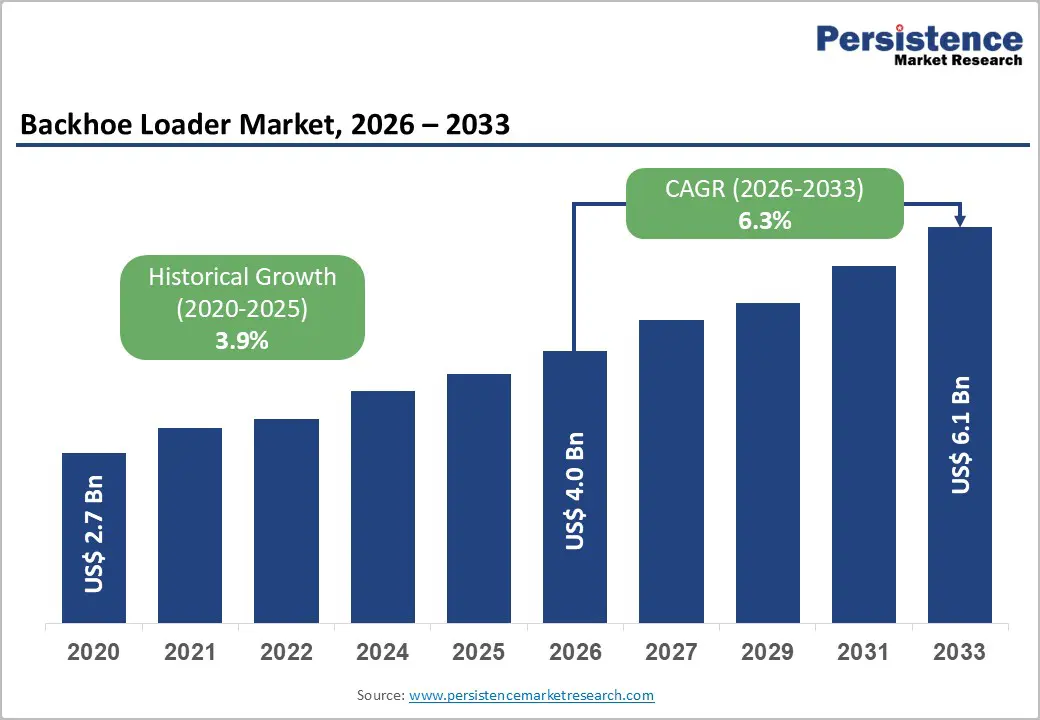
The global backhoe loader market size is likely to be valued at US$ 4.0 billion in 2026 and is projected to reach US$ 6.1 billion by 2033, growing at a CAGR of 6.3% between 2026 and 2033.
Market expansion is fundamentally driven by accelerating global infrastructure development, rapid urbanization, which creates demand for versatile construction equipment, and the rising adoption of mechanization across the agriculture and mining sectors. The transition toward electric and hybrid backhoe loader platforms, combined with advances in automation technologies, including telematics and AI-enabled systems, establishes sustained demand drivers for equipment rental companies and construction service providers.
Key Industry Highlights:
- Asia Pacific Regional Dominance: Asia Pacific commands a 40% global market share, with a 4.5% CAGR, driven by China's massive vehicle production and India's 8% aftermarket growth, establishing the region as the primary growth driver.
- Diagnostic Equipment Leadership with Software Growth: The diagnostic Equipment segment commands a 60.1% market share, while the hardware diagnostic software segment grows fastest at a 7% CAGR, reflecting the technology transition toward cloud-based solutions.
- Wireless Connectivity Expansion: Bluetooth commands a 41.5% market share, while the Wi-Fi segment is growing fastest at an 8% CAGR, supporting remote diagnostics and cloud-based platform adoption.
- Handheld Scanners Dominance with Code Reader Growth: Scanners commanding 43.4% handheld tool market share with Code Readers emerging as the fastest-growing segment at 6% CAGR driven by affordability and ease of use.
- Commercial Vehicle Acceleration: Commercial vehicle diagnostic segment growing at 5% CAGR, capturing USD 2 billion cumulative opportunity through 2033 as fleet operators prioritize maintenance optimization.
| Key Insights | Details |
|---|---|
| Backhoe Loader Market Size (2026E) | US$ 4.0 Bn |
| Market Value Forecast (2033F) | US$ 6.1 Bn |
| Projected Growth (CAGR 2026 to 2033) | 6.3% |
| Historical Market Growth (CAGR 2020 to 2024) | 3.9% |
Market Dynamics
Drivers - Global Infrastructure Development and Urbanization Expansion
Global urban population projected to reach 68% by 2050 from 55% in 2018, driving unprecedented demand for construction equipment supporting urban development projects across residential, commercial, and infrastructure segments. Government investments in infrastructure include road construction, railway development, and bridge construction, exceeding USD 2 trillion, establishing a structural demand foundation for backhoe loaders across developed and emerging markets. Smart city development initiatives across Asia-Pacific, Europe, and North America require specialized construction equipment for highway expansion, utility maintenance, and infrastructure repair.
Asia-Pacific infrastructure investments account for an estimated 40% of global construction equipment demand, with China investing USD 1 trillion in Belt and Road Initiative projects and India allocating USD 1.4 billion to infrastructure programs, thereby driving sustained backhoe loader adoption. Residential and commercial construction expansion driven by population growth and economic development, supporting an estimated 25% increase in backhoe loader demand through 2033.
Electric and Hybrid Technology Adoption with Environmental Compliance
Environmental regulations mandating emission reductions across construction equipment, with the CASE 580EV electric backhoe loader launched in 2024, delivering zero emissions and 8-hour operational runtime, establishing industry precedent for electrification adoption. The electric construction equipment market is projected to reach USD 126 billion by 2044 at 21% CAGR, supported by declining lithium-ion battery costs and a reduction in equipment premiums from 40-50% to an estimated 15-20% by 2030.
Hybrid backhoe loader adoption by manufacturers, including John Deere, is driven by E-Power technology, which delivers lower daily operating costs, reduced jobsite noise, and zero tailpipe emissions, thereby attracting environmentally conscious contractors and fleet operators.
Energy efficiency advantages with electric motors delivering 3x superior efficiency compared to internal combustion engines, combined with charging infrastructure expansion driven by 5G network deployment and renewable energy integration, are accelerating technology transition across the construction industry.
Agricultural Mechanization and Equipment Rental Market Growth
Global agricultural mechanization is expanding at 7% CAGR, with government incentive programs in India through NITI Aayog targeting farmer equipment adoption and small-scale mechanization initiatives. The rental equipment market growing at 9-10% CAGR driven by cost optimization among small contractors and emerging market operators preferring rental flexibility over equipment ownership. The compact and mini backhoe loader segment is expanding rapidly, supporting specialized applications in agriculture, landscaping, and confined-space construction projects.
The used backhoe loader market expansion, particularly in emerging economies, provides cost-effective alternatives for developing nation contractors and agricultural operations. Government farm mechanization programs across India, Southeast Asia, and Latin America are allocating billions in subsidies and financing to support the adoption of backhoe loaders among farming communities.
Restraint - High Capital Investment and Equipment Costs
Backhoe loader equipment costs range from USD 45,000 to USD 150,000, depending on capability and technology specifications, creating significant capital barriers for small contractors and independent operators in price-sensitive emerging markets. Electric backhoe loaders commanding 40-50% premium over diesel equivalents due to expensive lithium-ion battery packs and advanced drivetrain components limiting adoption among cost-constrained operators despite long-term operational savings.
Ongoing software updates, maintenance requirements, and subscription services for advanced telematics systems impose continuous operational costs that constrain equipment utilization efficiency. Rapid technology obsolescence cycles necessitate periodic equipment replacement, thereby limiting return-on-investment horizons, particularly for smaller equipment users.
Supply Chain Disruptions and Battery Availability Constraints
Global lithium-ion battery supply constraints are limiting the scaling of electric backhoe loader production, with an estimated 20% shortfall in production capacity relative to demand projections through 2025. Volatility in semiconductor component supply is affecting telematics system deployment and advanced control system integration. Geographic concentration of battery manufacturing in China and Southeast Asia is creating geopolitical supply chain vulnerabilities and tariff exposure for Western manufacturers. Charging infrastructure gaps, particularly in rural and emerging market regions, are constraining the feasibility of electric backhoe loader adoption.
Opportunities - Emerging Market Infrastructure Investments and Rental Ecosystem Expansion
Asia Pacific infrastructure investments exceeding USD 1.7 trillion through 2030, establishing a massive equipment demand foundation across construction, mining, and agricultural sectors. The equipment rental market in India and Southeast Asia is expanding at a 12% CAGR, creating a USD 5 billion cumulative equipment rental opportunity through 2033. Government smart city programs targeting 500+ cities across India, China, and ASEAN nations are generating an estimated USD 3-5 billion cumulative backhoe loader demand for urban infrastructure projects. Mining sector mechanization in Africa, Latin America, and Southeast Asia is creating specialized, high-capacity backhoe loader opportunities, estimated at USD 2-3 billion, through 2033.
Autonomous and Telematics-Enabled Equipment Innovation
Autonomous backhoe loader development incorporating GPS guidance systems, remote operation capabilities, and AI-enabled precision controls, establishing a USD 4-6 billion cumulative opportunity through 2033 for technology leaders. Telematics system integration enabling real-time fleet monitoring, predictive maintenance optimization, and operator productivity tracking, supporting an estimated 20-25% operational efficiency improvement for equipment operators. Compact and mini backhoe loader segment expansion for urban construction projects, capturing a USD 2-3 billion opportunity through 2033, supporting specialized applications in landscaping, utility maintenance, and confined-space construction.
Category-wise Analysis
Engine Type Insights
Internal Combustion Engine segment commanding 38.4% market share establishing dominant positioning through established technology maturity, lower equipment costs, and widespread infrastructure supporting fuel distribution and maintenance services. Internal combustion diesel and gasoline engine backhoe loaders providing proven reliability across diverse geographic and climate conditions with extensive operator training resources and established supply chain supporting spare parts availability.
Electric Engine segment emerging as fastest-growing engine type at 15-18% CAGR driven by CASE 580EV market launch, John Deere E-Power hybrid development, and environmental compliance requirements mandating emission reductions. Lithium-ion battery technology maturation enabling 6 hour operational runtimes and equivalent breakout force performance attracting environmentally conscious contractors and fleet operators seeking to reduce carbon footprint.
Application Insights
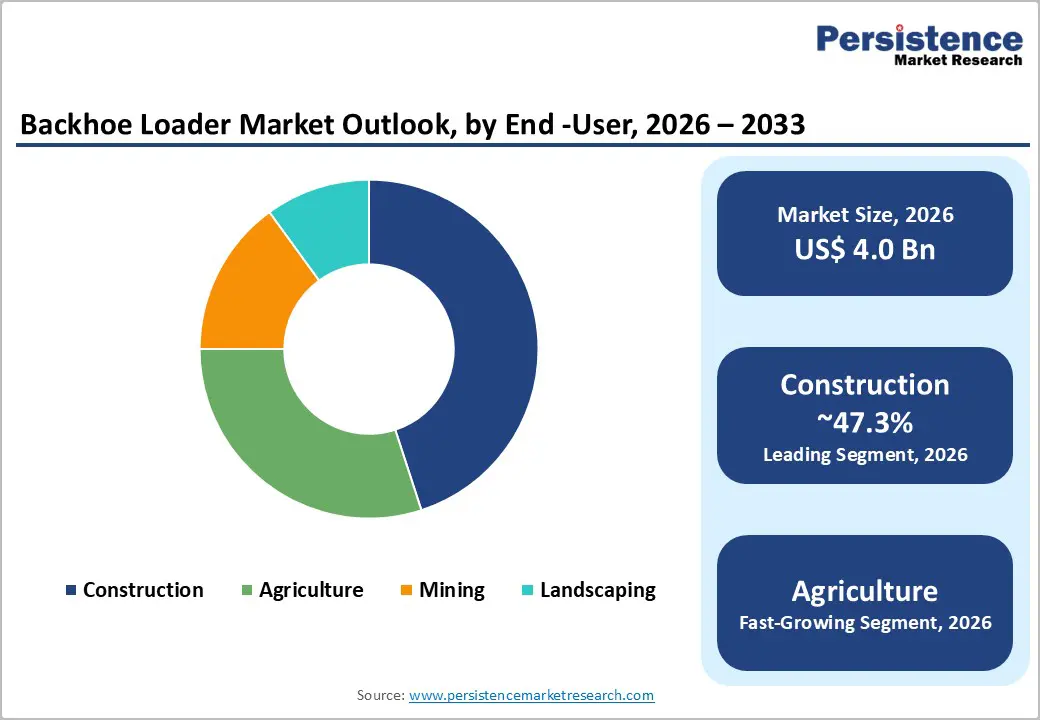
The construction segment is commanding 47.3% market share, establishing a dominant end-user category driven by infrastructure development, residential and commercial construction projects, and utility maintenance operations. Construction end-users leveraging backhoe loaders for excavation, trenching, material handling, site preparation, and small demolition tasks with equipment versatility supporting diverse application requirements across single platform.
The agriculture segment is emerging as the fastest-growing end-user category at 8% CAGR, reflecting the expansion of mechanization among farming operations and government farm mechanization programs allocating subsidies to support equipment adoption. Agricultural applications, including land clearing, soil preparation, drainage installation, and material handling, with compact and mini backhoe loader models gaining traction among small farmers and cooperative farming operations.
Vehicle Type Insights
The medium-duty backhoe loader segment commands a 43.4% market share, establishing a dominant vehicle category, reflecting an optimal balance between operational capabilities and equipment costs, thereby supporting broad contractor adoption. Medium-duty models delivering 65-90 horsepower with breakout forces of 12,000-17,000 pounds, supporting versatile applications across construction, agriculture, and utility maintenance projects. Heavy Duty segment emerging as fastest-growing vehicle type at 6-8% CAGR driven by infrastructure megaprojects requiring high-capacity excavation and material handling supporting mining operations and large-scale construction.
Heavy-duty models providing 90 horsepower with breakout forces exceeding 17,000 pounds, addressing specialized applications in quarrying, large-scale infrastructure projects, and heavy materials transport. Light Duty segment maintains specialized niche positioning with an estimated 15% market share, supporting compact applications in urban landscaping and small-scale agricultural operations.
Regional Insights
North America Backhoe Loader Market Trends
North America accounts for an estimated 25% of the global market, with a CAGR of 3.8%, supported by a mature equipment-rental market, established construction-industry infrastructure, and widespread adoption of premium equipment among professional contractors.
The United States market dominance reflecting 80% of North American backhoe loader consumption, driven by significant infrastructure investments through the Infrastructure Investment and Jobs Act, which allocated USD 110 billion for transportation infrastructure projects.
The equipment rental market is prevalent across North America, with established rental companies such as United Rentals and H&E Equipment Services maintaining substantial backhoe loader fleets, supporting contractors' access to equipment. Adoption of electric backhoe loaders is accelerating, with the CASE 580EV North American deployment and the John Deere E-Power hybrid development driving the technology transition.
The regulatory environment mandating emission reductions for construction equipment, particularly California air quality standards, is accelerating the adoption of electric platforms. Advances in technology and the integration of telematics systems among premium contractors, with GPS guidance, remote monitoring, and predictive maintenance capabilities, support the optimization of operational efficiency.
Europe Backhoe Loader Market Trends
Europe represents an estimated 22% global share with moderate growth at 2.8-3.5% CAGR driven by strict environmental regulations, established equipment safety standards, and mature construction industry infrastructure. German market leadership reflects 30-35% of European backhoe loader consumption through major equipment manufacturers, including Caterpillar, Komatsu, and JCB, maintaining significant regional production and distribution networks. European Union emission standards include Stage IIIB and Stage IV regulations mandating advanced emission control systems and driving the adoption of cleaner engine technologies.
United Kingdom market maintaining strong positioning post-Brexit with domestic construction and infrastructure maintenance projects supporting consistent backhoe loader demand. France and Spain emerging as secondary growth markets with government infrastructure investment programs and urban development initiatives supporting construction equipment demand. The equipment rental market prevalence across Europe, with established rental companies supporting small contractor access to advanced equipment.
Asia Pacific Backhoe Loader Market Trends
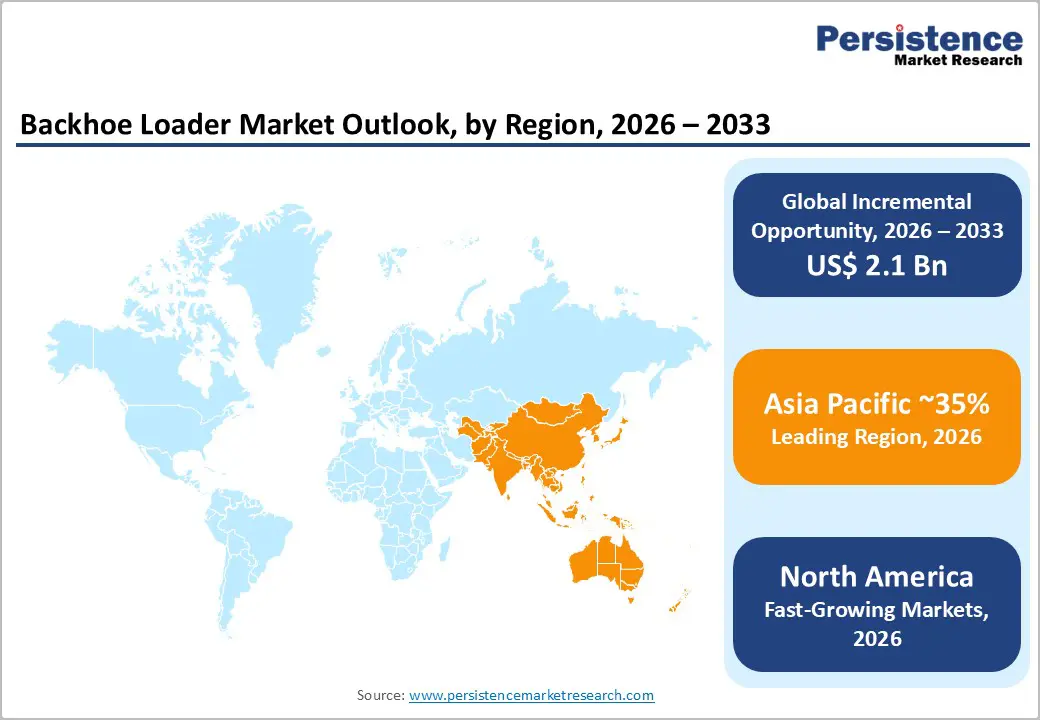
Asia-Pacific dominates the global market, commanding a 35% market share, with the highest regional growth projection at a 5.2% CAGR, driven by concentrated infrastructure investment, rapid urbanization, and the expansion of agricultural mechanization across emerging economies. China maintains a dominant regional position, with an estimated 35% share of the Asia-Pacific market, reflecting the world's largest construction equipment market and Belt and Road Initiative investments exceeding USD 1 trillion globally. China's domestic demand for backhoe loaders is driven by smart city development, high-speed rail infrastructure projects, and the expansion of urban mass transit systems.
India's backhoe loader market is growing at an 8% CAGR, making it the fastest-growing national market globally, driven by NITI Aayog's farm mechanization initiatives and government infrastructure investment programs allocating USD 1.4+ billion to smart city development. India's agricultural equipment rental market is expanding, with cost-effective rental platforms supporting farmers' equipment access and mechanization adoption.
Japan's specialized market positioning emphasizes quality and reliability, with manufacturers such as Komatsu and Hitachi maintaining significant regional production capacity. Southeast Asian market expansion, including Vietnam, Thailand, and Indonesia, is supported by the development of manufacturing hubs and infrastructure investments, thereby driving demand for construction equipment.
Competitive Landscape
The backhoe loader market demonstrates moderate consolidation with leading global manufacturers including Caterpillar, Komatsu, JCB, Volvo, and Case Corporation collectively commanding estimated 45% global market share. Caterpillar establishing market leadership through a comprehensive product portfolio covering diverse duty ratings and application segments, supporting 16% estimated global market share.
Chinese manufacturers, including Liugong and Sunward, are rapidly gaining market share through cost-competitive positioning and emerging market expansion strategies, capturing 12% combined market share, particularly in the Asia Pacific.
Market structure reflects significant manufacturing scale requirements, extensive OEM supply chain relationships, and continuous technology development capabilities, creating barriers protecting established manufacturers. Regional equipment manufacturersare penetrating the market through localized production, regional distribution networks, and price optimization, supporting competitive dynamics.
Key Industry Developments:
- In September 2024, Bobcat Company, part of the Doosan Group, expanded its North American portfolio with the launch of the B760 backhoe loader, offering versatile performance, over 2,000 pounds of capacity, an 18 ft 5 in digging depth, a 180-degree swing, and a 3.4-liter Bobcat engine for high torque and efficiency.
- In August 2024, CNH Industrial N.V. announced the launch of the industry’s first electric backhoe loader, the 580EV. The electric backhoe delivers performance comparable to traditional models, featuring four-wheel drive, 97 horsepower, a 400-volt, 71-kWh lithium-ion battery, and Level 2 charging compatibility.
Companies Covered in Backhoe Loader Market
- Bobcat Company
- CNH Industrial America LLC
- Hitachi Ltd., Caterpillar
- Action Construction Equipment Ltd.
- Escorts Limited
- Doosan Corporation
- Komatsu Europe International N.V.
- Terex Corporation
- JCB
- Volvo Construction Equipment and
- Mahindra Construction Equipment
- Others Key Players
Frequently Asked Questions
The Backhoe Loader market is estimated to be valued at US$ 4.0 Bn in 2026.
The key demand driver for the Backhoe Loader market is the rapid expansion of global infrastructure and construction activities. Governments and private sectors around the world are increasingly investing in large-scale infrastructure projects such as roads, bridges, highways, urban development, and public utilities.
In 2026, the Asia Pacific region will dominate the market with an exceeding 35% revenue share in the global Backhoe Loader market.
Among the End -User, Construction hold the highest preference, capturing beyond 47.3% of the market revenue share in 2026, surpassing other End -User.
The key players in Backhoe Loader are Bobcat Company, CNH Industrial America LLC, Hitachi Ltd., Caterpillar and Doosan Corporation.


