




- Medical Devices
- Dental Tourism Market
Dental Tourism Market Size, Share, and Growth Forecast 2026 - 2033
Dental Tourism Market by Service (Dental Implants, Orthodontics, Dental Cosmetics, Others), by Providers (Hospitals, Dental Clinics, Others), by Regional Analysis, 2026 - 2033

Dental Tourism Market Size and Trend Analysis
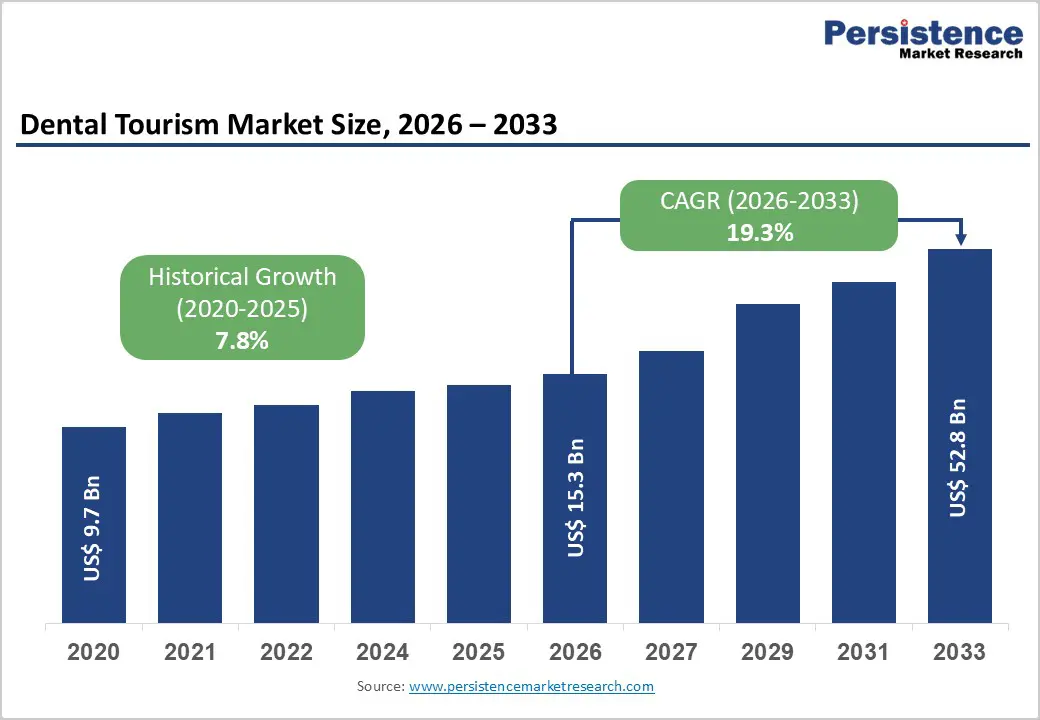
The global dental tourism market size is expected to be valued at US$ 15.3 billion in 2026 and projected to reach US$ 52.8 billion by 2033, growing at a CAGR of 19.3% between 2026 and 2033.
Dental tourism is expanding rapidly as patients from high-cost markets such as the U.S., Canada, and Western Europe travel to destinations including Mexico, Thailand, India, Turkey, and Hungary to access high-quality care at up to 60-80% lower prices, often bundled with leisure travel.
Historical growth of about 7.8% annually between 2020 and 2025 has been reinforced by rising out-of-pocket dental expenses, limited insurance coverage for cosmetic and implant procedures, and the normalization of cross-border healthcare under frameworks such as the EU Directive 2011/24/EU on patients’ rights in cross-border healthcare.
Key Industry Highlights:
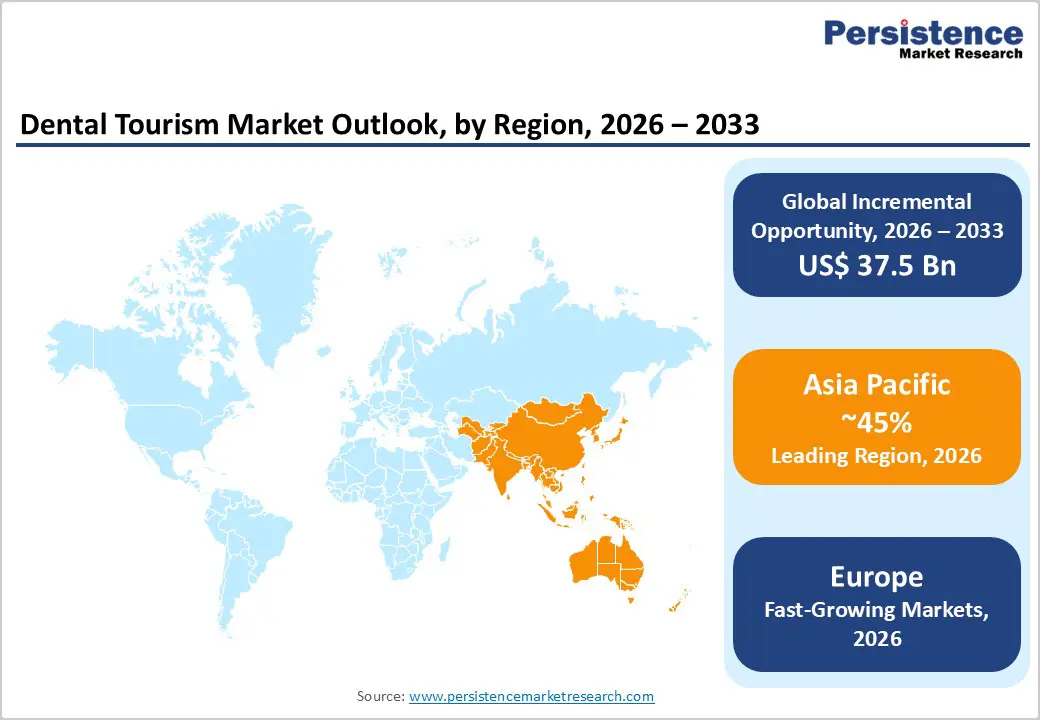
- Asia Pacific leads the dental tourism market, supported by affordable treatments, advanced dental infrastructure, and popular destinations like Thailand, India, Malaysia, and Vietnam.
- Europe is the fastest-growing region, driven by EU cross-border healthcare policies and increasing patient flows to Hungary, Poland, Croatia, and Turkey.
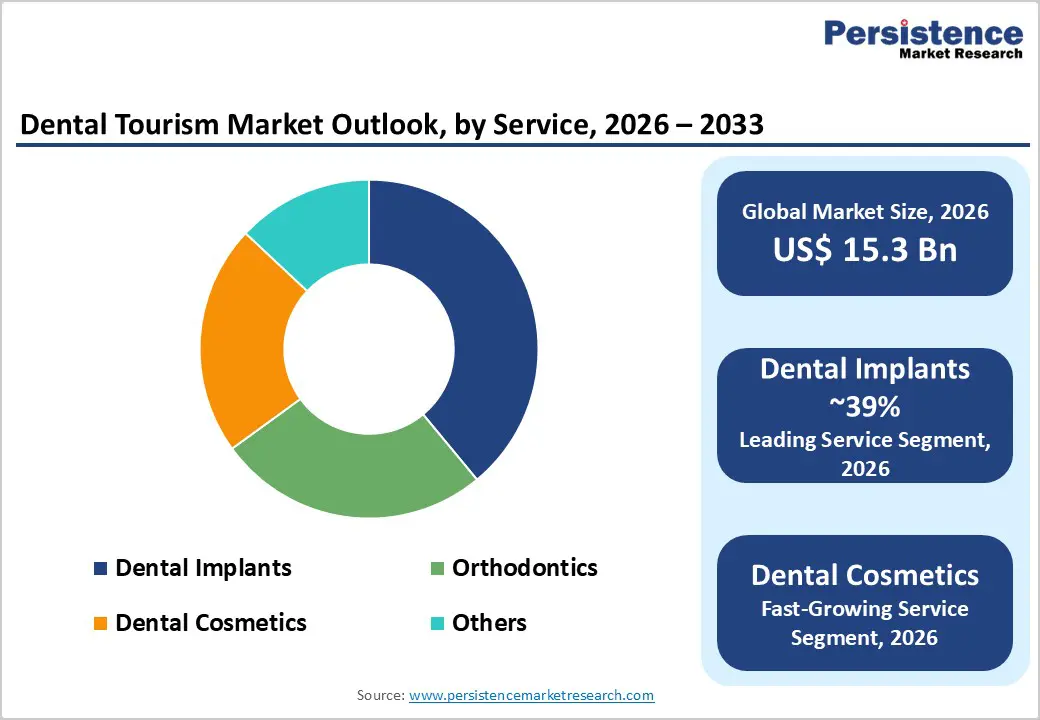
- Dental implants dominate the market with around 39% share, as international patients travel abroad to reduce high implant treatment costs.
- Dental cosmetics is among the fastest-growing segments, fueled by increasing aesthetic awareness, social media influence, and demand for smile makeover treatments.
- Key opportunities lie in premium implant and cosmetic packages combined with travel services and emerging dental tourism hubs across Asia, Latin America, and Eastern Europe.
| Key Insights | Details |
|---|---|
| Dental Tourism Market Size (2026E) | US$ 15.3 billion |
| Market Value Forecast (2033F) | US$ 52.8 billion |
| Projected Growth CAGR (2026 - 2033) | 19.3% |
| Historical Market Growth (2020 - 2025) | 7.8% |
Market Dynamics
Drivers - High-cost differrentials and limited dental coverage in source markets
One of the most powerful drivers of the dental tourism market is the substantial cost differential between dental procedures in developed markets and those in popular destination countries. Reports on cosmetic and implant dentistry show that patients can save between 60-80% on procedures such as implants, crowns, and veneers by traveling to countries like Mexico, Turkey, or Thailand, even after factoring in travel and accommodation costs. In the United States, for example, Americans traveling to Mexico for dental care can save 50-70% on major treatments, and surveys indicate typical savings of US$ 5,000-15,000 per trip. At the same time, many dental procedures especially implants and cosmetic dentistry are only partially covered or entirely excluded from public and private insurance schemes in high-income countries, intensifying patients’ search for affordable alternatives abroad. This structural cost and coverage gap underpins steady outbound patient flows and supports strong growth expectations for the dental tourism market.
Regulatory support for cross-border care and improved quality standards
Regulatory frameworks that clarify patients’ rights to seek care abroad and be reimbursed in their home systems are another important growth driver. In Europe, the EU Directive 2011/24/EU on the application of patients’ rights in cross-border healthcare formally recognizes citizens’ right to receive healthcare, including dental care, in another member state and be reimbursed under defined conditions, while requiring member states to ensure safety and quality standards and operate national contact points. This legal clarity has made it easier for European patients to consider cross-border dental treatment in countries such as Hungary, Poland, Croatia, and Spain. At the same time, many destination clinics pursue international accreditations, adopt advanced imaging and implant technologies, and employ dentists trained in U.S. or European institutions, helping to close perceived quality gaps between domestic and overseas care. These trends collectively build trust in dental tourism and support its mainstreaming.
Restraints - Travel risks, continuity-of-care challenges, and regulatory barriers
Despite its advantages, dental tourism faces restraints related to travel risks, post-treatment follow-up, and regulatory limitations. The COVID-19 pandemic illustrated this vulnerability when international tourist arrivals collapsed by about 73% in 2020, effectively shutting down cross-border medical and dental travel for extended periods. Even in normal times, long-distance travel for surgery or complex restorative work introduces challenges around managing complications, accessing emergency care, and coordinating with local dentists for follow-up. Regulatory barriers also exist: some countries restrict insurance reimbursement for treatment received overseas or impose prior-authorization requirements for care abroad under cross-border healthcare rules. These factors can deter risk-averse patients and slow growth during periods of geopolitical instability or public health crises.
Quality variability and information asymmetry
Another key restraint is quality variability across clinics and destinations, coupled with information asymmetry for international patients. Not all dental providers in popular tourism hubs maintain the same standards of infection control, technology adoption, or clinician training, and there is a risk that price-sensitive patients choose clinics based primarily on cost rather than accreditation or outcomes. Patient advocacy groups in Europe have emphasized the need for transparent information on safety and quality standards, and the EU Directive 2011/24/EU mandates that member states publish national guidance and ensure that professional registers are accessible for verification. Nevertheless, inconsistent regulation outside the EU, language barriers, and aggressive online marketing can make it difficult for patients to objectively compare providers, restraining full realization of the market’s growth potential.
Opportunities - Premium dental implant and cosmetic segments with bundled travel experiences
There is substantial opportunity in the higher-value segments of dental tourism, particularly dental implants and cosmetic procedures that combine clinical outcomes with experience-focused travel. Countries like Thailand and Hungary report strong revenue growth from full-mouth implant reconstructions and advanced cosmetic dentistry, with Thailand alone generating approximately US$ 932.1 million in dental tourism revenue in 2024 and projected to exceed US$ 5 billion by 2033, reflecting a CAGR above 20%. Destination marketing organizations and hospital groups are increasingly packaging dental care with flights, hotels, and tourism activities, positioning treatment as part of a “dental vacation” that offers both value and leisure. Providers that invest in digital smile design, guided implant surgery, and same-day restorative workflows can differentiate in this premium niche while commanding higher margins. This aligns with the fastest-growing service segment of dental cosmetics, where patients seek holistic smile transformations rather than isolated restorations.
Strategic development of emerging dental tourism hubs
A parallel opportunity exists in the strategic development of emerging dental tourism hubs across Asia Pacific, Latin America, Eastern Europe, and parts of the Middle East. Policy frameworks such as India’s “Medical Value Travel” strategy and targeted investment in international patient centers in countries like Vietnam, Malaysia, and United Arab Emirates are expanding the global map of competitive destinations. Thailand’s example hosting more than 972,000 dental tourists per year, or about 1.5% of its total foreign visitors, with Bangkok alone accounting for over 600,000 patients demonstrates the economic potential when tourism infrastructure, clinical capacity, and digital marketing are aligned. As more countries seek to replicate such models, there is room for hospital groups, clinic chains, and facilitator platforms to create integrated networks, standardize quality benchmarks, and leverage teleconsultation and financing tools to attract and manage international patients at scale.
Category-wise Insights
By Service
Within the dental tourism market, dental implants constitute the leading service segment, representing around 39% of global revenues in 2025. Implants are among the most expensive dental procedures in high-income countries, often costing several thousand US dollars per tooth and typically receiving limited insurance reimbursement, which makes them a primary driver of outbound dental travel. In destinations such as Mexico, Turkey, and Thailand, the cost of a single implant can be 60-70% lower than in the U.S. or U.K., even when using internationally recognized implant brands and modern imaging technologies. As full-arch implant restorations and all-on-four procedures gain popularity for edentulous and aging populations, more patients see substantial financial benefit in combining complex implant treatment with travel, reinforcing this segment’s leading share within the dental tourism ecosystem.
By Providers
Dental clinics are the leading provider segment in the dental tourism market, accounting for an estimated 70% of patient volumes in 2025. Independent clinics and specialized dental centers dominate because they can flexibly tailor pricing packages, invest in multilingual staff, and create hospitality-oriented environments that cater to international visitors. Many of the most prominent dental tourism brands in Bangkok, Budapest, Cancun, or Istanbul are clinics rather than large general hospitals, and they differentiate through digital marketing, transparent pricing, and concierge-style services such as airport transfers and hotel booking support. Hospitals participate primarily in high-complexity oral and maxillofacial surgeries or as part of larger medical tourism programs, but for mainstream implants, cosmetic dentistry, and orthodontic care, specialized dental clinics remain the primary locus of cross-border treatment.
Regional Insights
North America Dental Tourism Market Trends and Insights
In North America, dental tourism is shaped primarily by outbound flows from the United States and Canada to lower-cost destinations in Latin America and Asia. Rising dental expenses and limited insurance coverage for implants and cosmetic procedures have pushed many residents to seek care abroad, with estimates suggesting that more than 550,000 U.S. citizens traveled to Mexico alone for dental care in 2024. Border cities such as Los Algodones, Tijuana, and Mexicali have become dense clusters of dental clinics catering almost exclusively to American and Canadian patients, offering bilingual staff, U.S.-standard materials, and streamlined scheduling.
The regulatory framework in North America does not directly govern care provided overseas, but professional associations and consumer advocacy organizations advise patients to verify qualifications, hygiene standards, and aftercare arrangements when selecting foreign providers. As telehealth and cross-border partnerships evolve, some North American dentists are beginning to collaborate with overseas clinics for treatment planning and follow-up, creating hybrid care models. Outbound dental tourism from the U.S. is expected to remain robust as long as domestic cost pressures and coverage gaps persist.
Asia Pacific Dental Tourism Market Trends and Insights
Asia Pacific is the leading region in the dental tourism market, accounting for an estimated 45% of global revenues by 2025, driven by established hubs in Thailand, India, Malaysia, and Vietnam. Thailand alone is estimated to attract over 972,000 dental tourists annually about 1.5% of its total foreign visitors with Bangkok serving as the dominant hub hosting more than 600,000 dental patients each year. These markets offer a compelling combination of cost savings, advanced private healthcare infrastructure, and world-renowned leisure destinations, enabling patients to combine treatment with beach holidays or cultural tourism.
Government strategies such as India’s focus on “Medical Value Travel” and targeted promotion of dental services in tourism campaigns further accelerate regional growth. Many Asia Pacific clinics invest heavily in digital marketing, online reviews, and partnerships with international facilitators to attract patients from Australia, the Middle East, Europe, and North America. As connectivity expands and middle-class populations in neighboring countries seek affordable but high-quality dental care, Asia Pacific is expected to maintain its leadership while Europe emerges as the fastest-growing region by percentage growth over the forecast period.
Europe Dental Tourism Market Trends and Insights
Europe plays a dual role in the dental tourism landscape, functioning both as a source region and a destination hub. Patients from Western Europe frequently travel to Hungary, Poland, Croatia, and Spain to take advantage of lower treatment costs while remaining within the EU regulatory framework. The EU Directive 2011/24/EU on patients’ rights in cross-border healthcare clarifies entitlements to reimbursement and requires member states to provide transparent information on safety and quality standards, which has facilitated growth in intra-European dental tourism. Countries such as Hungary and Croatia now attract tens of thousands of dental tourists annually, with implant and cosmetic dentistry positioned as core offerings.
At the same time, Europe sends outbound dental tourists to destinations outside the region, notably Turkey and Thailand, where price differentials for implants and cosmetic work remain significant. European regulators and patient organizations continue to emphasize the importance of informed choice, professional registration checks, and continuity-of-care planning when receiving treatment abroad. As travel connectivity improves and more clinics pursue international accreditation, Europe is expected to remain both a key feeder market and, increasingly, a strongly regulated destination region for cross-border dental care.
Competitive Landscape
The dental tourism market is highly competitive and moderately fragmented, with numerous dental clinics, hospital networks, and medical tourism facilitators operating globally. Leading providers focus on offering high-quality treatments such as dental implants, veneers, and orthodontics at significantly lower costs compared to developed countries. Countries including Mexico, Thailand, India, Hungary, and Turkey host many specialized clinics that attract international patients. Key competitive strategies include adoption of advanced dental technologies such as 3D imaging and digital dentistry, obtaining international accreditations, and offering bundled packages that combine treatment, travel, and accommodation. Partnerships with travel agencies and healthcare facilitators also help providers expand global patient reach.
Key Developments:
- In November 2025: Tourism and industry reports highlighted Thailand’s dental tourism recovery, with more than 972,000 dental tourists annually and revenue growth of roughly 39% above 2019 peaks, driven by renewed travel from the U.K., Australia, and the U.S.
- In October 2024: Studies of outbound U.S. dental tourism indicated that over 550,000 U.S. patients traveled to Mexico in 2024 for dental procedures, including implants and cosmetic dentistry, reflecting rising cost pressures and awareness of reputable overseas clinics.
Companies Covered in Dental Tourism Market
- Franco-Vietnamese Hospital
- Apollo Hospitals Enterprise Ltd.
- Fortis Healthcare
- Clove Dental
- Medlife Group
- Raffles Medical Group
- Oris Dental Centre
- Dubai Dental Hospital
- Imperial Dental Specialist Center
- Liberty Dental Clinic
- Thantak It International Dental Center
- ARC Dental Clinic
- Others
Frequently Asked Questions
The global dental tourism market size is expected to reach about US$ 15.3 billion in 2026.
Key demand drivers include large cost differentials between home and destination countries, limited insurance coverage for implants and cosmetic treatments, improved quality and accreditation of overseas clinics, and clearer cross-border healthcare rights under frameworks such as EU Directive 2011/24/EU.
Asia Pacific leads the global dental tourism market, supported by mature hubs in Thailand, India, Malaysia, and Vietnam, which offer substantial price advantages, advanced private dental infrastructure, and attractive tourism ecosystems for international patients.
A major opportunity lies in premium implant and cosmetic dentistry packages that integrate digital smile design, guided surgery, and all-inclusive travel logistics.
Key players include hospital groups and clinic chains such as Franco-Vietnamese Hospital, Apollo Hospitals Enterprise Ltd., Fortis Healthcare, Clove Dental, and Bangkok International Dental Center (BIDC), among others.


