




- Medical Devices
- Aneurysm Clips Market
Aneurysm Clips Market Size, Share, Growth, and Regional Forecast, 2026 to 2033
Aneurysm Clips Market by Product (Titanium Alloy, Cobalt-Chromium-Nickel Alloy, and Others), by Indication (Cerebral Aneurysm, Stroke, Cerebral Artery Stenosis, and Others) by End-user (Hospitals, Specialty Clinics, and Ambulatory Surgery Centers), and Regional Analysis from 2026 to 2033

Aneurysm Clips Market Share and Trends Analysis
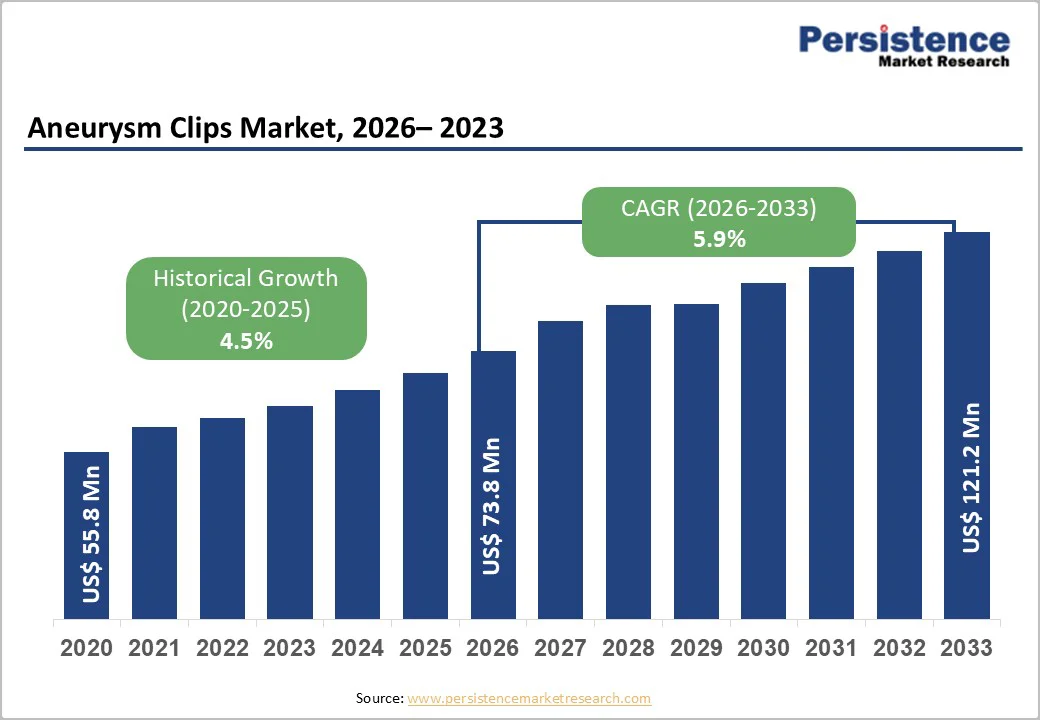
The global aneurysm clips market size is estimated to grow from US$ 73.8 million in 2026 to US$ 121.2 million by 2033, at a CAGR of 5.9% from 2026 to 2033. Global demand for aneurysm clips is rising steadily, driven by the increasing prevalence of cerebral aneurysms, expanding availability of diagnostic imaging, and the expanding use of microsurgical clipping as a definitive treatment option.
Advances in MRI-compatible materials, particularly titanium alloys, and innovations in low-carbon-artifact, high-precision clip designs are enhancing clinical outcomes and procedural safety. Growth in hybrid operating rooms, neurosurgical training programs, and adoption of minimally invasive skull-base approaches is further boosting demand. Manufacturers are increasingly focusing on enhanced consistency in closing force, ergonomic clip-applicator systems, and next-generation micro-engineered mechanisms. Additionally, expanding healthcare expenditure, rising stroke prevention initiatives, and improved reimbursement structures across developed and emerging markets continue to drive market growth.
Key Industry Highlights:
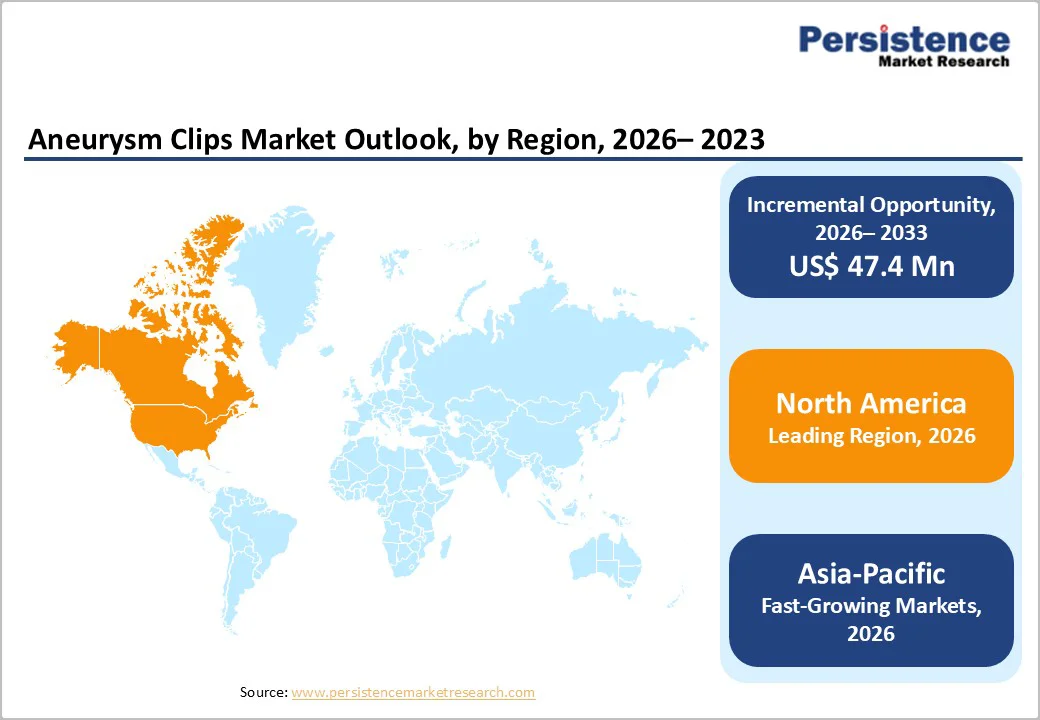
- Leading Region: North America holds the largest share at 44.6%, driven by high neurosurgical volumes, strong imaging penetration, advanced tertiary care centers, and rapid uptake of MRI-compatible titanium clips.
- Fastest-Growing Region: Asia Pacific is expanding at the quickest pace, propelled by rising cerebral aneurysm diagnosis rates, improving neurosurgical infrastructure, growing medical tourism, and the presence of cost-competitive regional suppliers and manufacturers.
- Leading Material Segment: Titanium alloy leads the category due to superior biocompatibility, full MRI compatibility, minimal imaging artifacts, and high mechanical stability, which are essential for long-term aneurysm occlusion.
- Fastest-Growing Material Segment: Cobalt-chromium-nickel alloy is growing fastest as demand increases for high-strength clips used in complex, wide-neck, and recurrence-prone aneurysm cases.
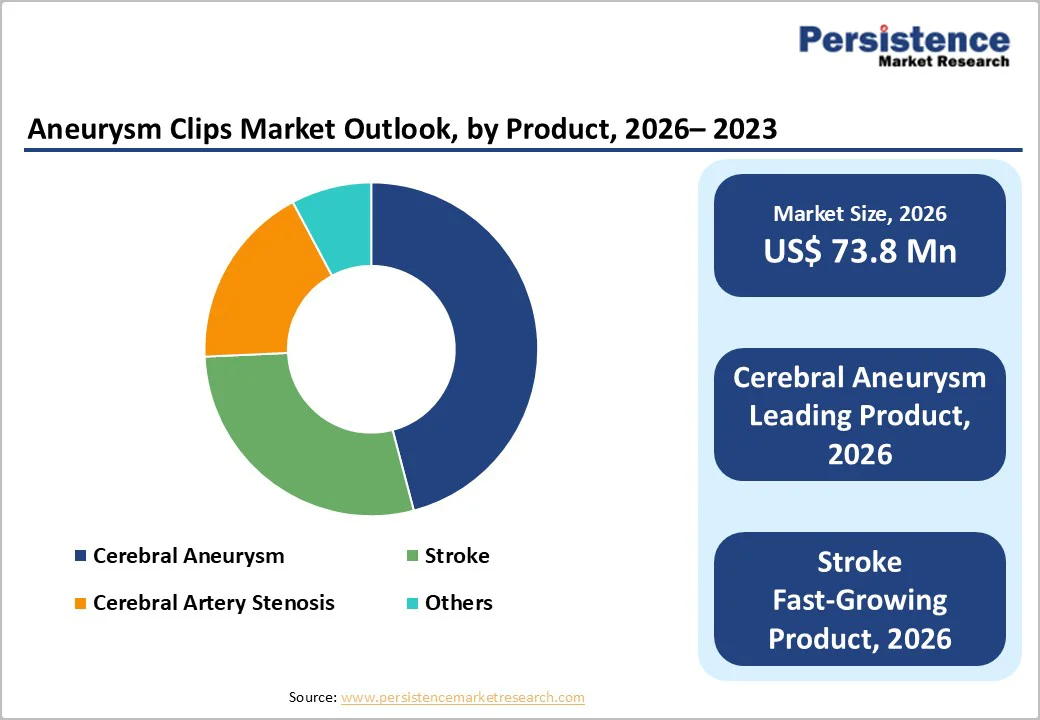
- Leading Indication Segment: Cerebral aneurysm dominates the market as surgical clipping remains a primary and definitive treatment option for wide-necked, irregular, or high-risk aneurysms requiring durable occlusion.
- Fastest-Growing Indication Segment: Stroke-related interventions are scaling rapidly as early aneurysm detection, subarachnoid hemorrhage management, and expansion of comprehensive stroke centers drive more surgical clipping procedures globally.
| Key Insights | Details |
|---|---|
| Aneurysm Clips Market Size (2026E) | US$ 73.8 Mn |
| Market Value Forecast (2033F) | US$ 121.2 Mn |
| Projected Growth (CAGR 2026 to 2033) | 5.9% |
| Historical Market Growth (CAGR 2020 to 2025) | 4.5% |
Market Dynamics
Driver - Rising Prevalence of Cerebral Aneurysms and Growing Adoption of MRI-Compatible Titanium Clips
The increasing incidence of both unruptured and ruptured cerebral aneurysms, driven by aging populations, hypertension, smoking, and lifestyle-related risk factors, is driving the market growth. For instance, according to the Brain Aneurysm Foundation, the annual rate of aneurysm rupture is approximately 8-10 per 100,000 people. Brain aneurysms occur most frequently in individuals between 35 and 60 years of age, though they can also appear in children. The majority of aneurysms tend to develop after the age of 40, highlighting the growing burden of aneurysm detection and intervention in aging populations. Earlier detection through MRI and CT angiography has also increased the number of patients identified with small, asymptomatic aneurysms that require timely intervention, thereby elevating the need for durable and definitive treatment options, such as surgical clipping. Rising clinical preference for MRI-compatible titanium aneurysm clips. Titanium alloys offer superior biocompatibility, consistent closing-force stability, and minimal imaging artifacts, making them ideal for both intraoperative visibility and long-term postoperative monitoring. Their full MRI safety profile has become a critical advantage as follow-up imaging becomes more frequent and essential in managing patients with treated or multiple aneurysms.
Restraints - Growing Shift Toward Endovascular Alternatives and MRI Safety Limitations of Non-Titanium Clips
The increasing preference for minimally invasive endovascular procedures, such as coiling, stent-assisted coiling, and flow diverters, is reducing reliance on traditional surgical clipping in several regions and restraining growth of the aneurysm clips market. These approaches offer shorter recovery times, lower perioperative risks, and broader applicability for anatomically complex aneurysms, prompting many neurosurgical centers to prioritize endovascular options over open microsurgery. Moreover, the continued presence of older stainless-steel and cobalt-based aneurysm clips in some healthcare systems presents significant MRI safety challenges. These clips may cause imaging artifacts, magnetic interference, or diagnostic limitations during postoperative scans, making them less desirable in modern neurosurgical practice, which is shifting toward fully MRI-compatible titanium clips. This transition also increases the demand for replacement of upgraded clip systems in high-volume neurosurgical centers.
Opportunity - Advancements in Clip Materials and Technologies Supporting Complex Aneurysm Treatment
Innovation in next-generation clip materials, including ultra-low-artifact titanium alloys, flexible hinge mechanisms, and precision micro-engineered designs, is creating significant product differentiation and boosting clinical adoption. Manufacturers are focusing on improving mechanical stability, reducing imaging interference, and enhancing ease of deployment during microsurgical procedures. Additionally, integrating advanced technologies, such as intraoperative imaging compatibility, surgical navigation, and 3D anatomical planning tools, is elevating surgical accuracy and enabling more personalized treatment strategies. Furthermore, the rising number of complex, wide-neck, and recurrent aneurysms is driving demand for specialized clip systems engineered for higher durability, consistent closing forces, and secure long-term occlusion. These technological enhancements allow neurosurgeons to manage anatomically challenging cases that may not be suitable for endovascular repair, are creating significant growth opportunities in the market.
Category-wise Analysis
By Material, Titanium Alloy Dominate Globally Due to its superior biocompatibility and Full MRI Compatibility
The titanium alloy segment is projected to dominate the global aneurysm clips market in 2026, accounting for a revenue share of 47.5%. The segment’s strong performance is primarily driven by the superior biocompatibility, corrosion resistance, and mechanical stability of titanium alloys, which make them ideal for long-term implantation in delicate neurovascular structures. Titanium clips are also non-ferromagnetic, offering full MRI compatibility with minimal artifact generation, a critical advantage in postoperative monitoring and lifelong neuroimaging follow-up. Growing surgeon preference for lightweight, high-precision clips with consistent closing force has further accelerated adoption. Continuous innovation in material purity, surface finishing, and micro-engineering technologies is enabling manufacturers to develop next-generation titanium clips with improved durability and ease of handling during microsurgical procedures.
By Indication, Cerebral Aneurysm Leads the Market Globally Due to High Prevalence and Strong Preference for Durable Surgical Clipping
The cerebral aneurysm segment is projected to dominate the global aneurysm clips market in 2026, accounting for 45.9% of revenue. This is due to the high prevalence of both ruptured and unruptured intracranial aneurysms, which remain the primary clinical indication for surgical clipping procedures. Advances in neuroimaging, such as MRI, CTA, and MRA, are enabling earlier detection of small, asymptomatic aneurysms, increasing the number of patients eligible for preventive surgical intervention. Surgical clipping remains preferred for definitive, long-term occlusion, particularly for wide-neck, complex, or recurrence-prone aneurysms, where endovascular options may be less effective. Additionally, growing adoption of MRI-compatible titanium clips, improved microsurgical techniques, and expanding availability of specialized neurosurgeons within tertiary centers are supporting higher procedural volumes.
By End-user, Hospitals Dominate Globally Due to High Surgical Volumes and Access to Advanced Neurosurgical Infrastructure
The hospitals segment is projected to dominate the global aneurysm clips market in 2026, accounting for a revenue share 53.6%. This is driven by the growing number of complex neurosurgical procedures performed in tertiary and multi-specialty hospitals, which are equipped with advanced neuroimaging systems, hybrid operating rooms, and high-precision microsurgical tools required for aneurysm clipping. Hospitals also house the largest pool of trained neurosurgeons, enabling higher procedural volumes and consistent adoption of premium titanium and MRI-compatible clip systems. Furthermore, hospitals benefit from stronger reimbursement coverage for aneurysm repair, better postoperative care infrastructure, and access to specialized neuro-intensive care units, making them the preferred setting for both elective and emergency aneurysm surgeries.
Region-wise Insights
North America Aneurysm Clips Market Trends
The North America market is expected to dominate globally with a value share of 44.6% in 2026, with the U.S. leading the region due to its strong concentration of advanced neurosurgical centers, high diagnostic imaging penetration, and rapid adoption of next-generation aneurysm repair technologies. The region benefits from widespread access to MRI, CT angiography, and hybrid OR facilities, enabling early identification and timely intervention for cerebral aneurysms. Additionally, the U.S. has a large pool of board-certified neurosurgeons and comprehensive stroke centers that consistently utilize premium, MRI-compatible titanium clips and precision micro-instrumentation. Favorable reimbursement policies for aneurysm surgical repair, strong adherence to clinical guidelines, and ongoing investments by major manufacturers further support market growth. North America also leads in R&D for biomaterial advancements, improved closing-force stability, and ultra-low-artifact clip designs, supported by collaborations between academic medical centers and medtech companies.
Europe Aneurysm Clips Market Trends
Europe is expected to achieve steady growth, driven by strong clinical adoption of advanced neurovascular technologies, well-established healthcare systems, and a consistently high volume of neurosurgical procedures across major countries such as Germany, France, the U.K., Italy, and Spain. The region benefits from widespread availability of MRI and CT angiography, enabling early detection of unruptured aneurysms and supporting timely surgical intervention. Europe also maintains a strong base of specialized neurosurgeons and comprehensive stroke centers, which fuels continuous demand for high-precision aneurysm clips with enhanced closing-force stability and minimal imaging artifacts. Regulatory support from the European Medicines Agency (EMA) and adoption of EU MDR standards are encouraging manufacturers to advance high-quality, biocompatible titanium clips and low-ferromagnetic alloy systems. Extensive collaboration between hospitals, research institutes, and medical device companies further drives innovation in clip design, material engineering, and microsurgical instrumentation.
Asia Pacific Aneurysm Clips Market Trends
The Asia Pacific market is expected to register a relatively higher CAGR of around 7.7% between 2026 and 2033, driven by rising neurological disease burden, expanding neuroimaging access, and rapid development of healthcare infrastructure across emerging economies. The region is witnessing a sharp increase in the diagnosis of unruptured cerebral aneurysms due to the wider availability of MRI, CT angiography, and digital subtraction angiography, enabling earlier intervention and greater surgical volumes. Moreover, countries such as China, India, Japan, and South Korea are investing heavily in tertiary care hospitals, neurosurgical training programs, and hybrid operating rooms equipped for complex brain and vascular surgeries. The growing adoption of MRI-compatible titanium clips, the presence of cost-competitive local manufacturers, and the increasing penetration of global players through distribution partnerships are further driving market growth in the region.
Competitive Landscape
The global aneurysm clips market is highly competitive, with key players such as B. Braun SE, Boston Scientific Corporation, Medtronic, Medline Industries, LP, and KLS Martin Group strengthening their presence through broad neurosurgical portfolios, precision engineering capabilities, and global distribution networks.
Companies are focusing on MRI-compatible titanium alloys, advanced cobalt-chromium systems, and low-artifact designs to enhance surgical safety and durability. Manufacturers are also investing in next-generation clip mechanisms, micro-instrument integration, and 3D-printed patient-specific planning tools, while accelerating R&D in hybrid materials and improved closing-force consistency to reduce intraoperative risks and improve long-term neurological outcomes.
Key Industry Developments:
- In February 2022, Viz.ai received FDA 510(k) clearance for Viz ANEURYSM, an AI tool that detects suspected cerebral aneurysms and standardizes aneurysm care workflows across health systems to improve follow-up and reduce costs.
Companies Covered in Aneurysm Clips Market
- B. Braun SE
- Boston Scientific Corporation
- Medtronic
- Medline Industries, LP
- KLS Martin Group
- inomed Medizintechnik GmbH
- Integra LifeSciences Corporation
- Mizuho
- Stryker
- RAUMEDIC AG
- Ortho-Medical GmbH
- Sangam Surgicals
- Others
Frequently Asked Questions
The global aneurysm clips market is projected to be valued at US$ 73.8 Mn in 2026.
Rising prevalence of cerebral aneurysms, expanding neurosurgical procedures, and increasing adoption of MRI-compatible titanium clips are driving the global aneurysm clips market.
The global aneurysm clips market is poised to witness a CAGR of 5.9% between 2026 and 2033.
Growing demand for MRI-compatible titanium clips and next-generation minimally invasive neurovascular solutions are creating opportunities in the market.
B. Braun SE, Boston Scientific Corporation, Medtronic, Medline Industries, LP, KLS Martin Group are some key players in the aneurysm clips market.


