




- Chemicals and Materials
- Acetoacetic Acid Market
Acetoacetic Acid Market Size, Share, and Growth Forecast 2026 - 2033
Acetoacetic Acid Market by Form (Powder, Solution), Purity (Below 98%, Above 98%), End-use Industry (Pharmaceutical, Chemical, Food & Beverage, Agriculture, Other), and Regional Analysis for 2026-2033

Acetoacetic Acid Market Size and Trend Analysis
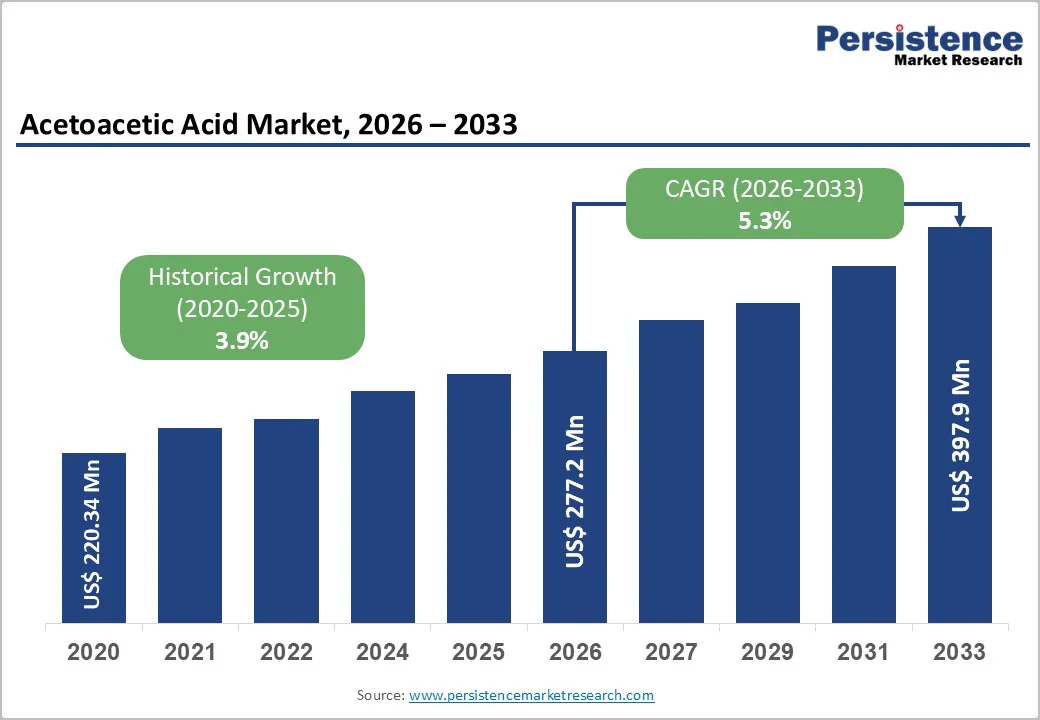
The global acetoacetic acid market size is supposed to be valued at US$ 277.2 Mn in 2026 and is projected to reach US$ 397.9 Mn by 2033, growing at a CAGR of 5.3% between 2026 and 2033.
The market's growth is driven by the increasing demand for pharmaceutical intermediates and specialty chemicals. The pharmaceutical industry's reliance on acetoacetic acid as a fundamental building block for synthesizing novel therapeutic compounds, particularly SGLT2 inhibitors for diabetes management and antimalarial agents, represents a significant growth factor. Additionally, the agrochemical sector's expanding use of acetoacetic acid derivatives to develop next-generation herbicides and pesticides with reduced environmental persistence is driving market growth. These dual demand drivers, supported by technological advancements in chemical synthesis and growing industrialization in the Asia-Pacific regions, create a compelling growth narrative for stakeholders across the supply chain.
Key Market Highlights
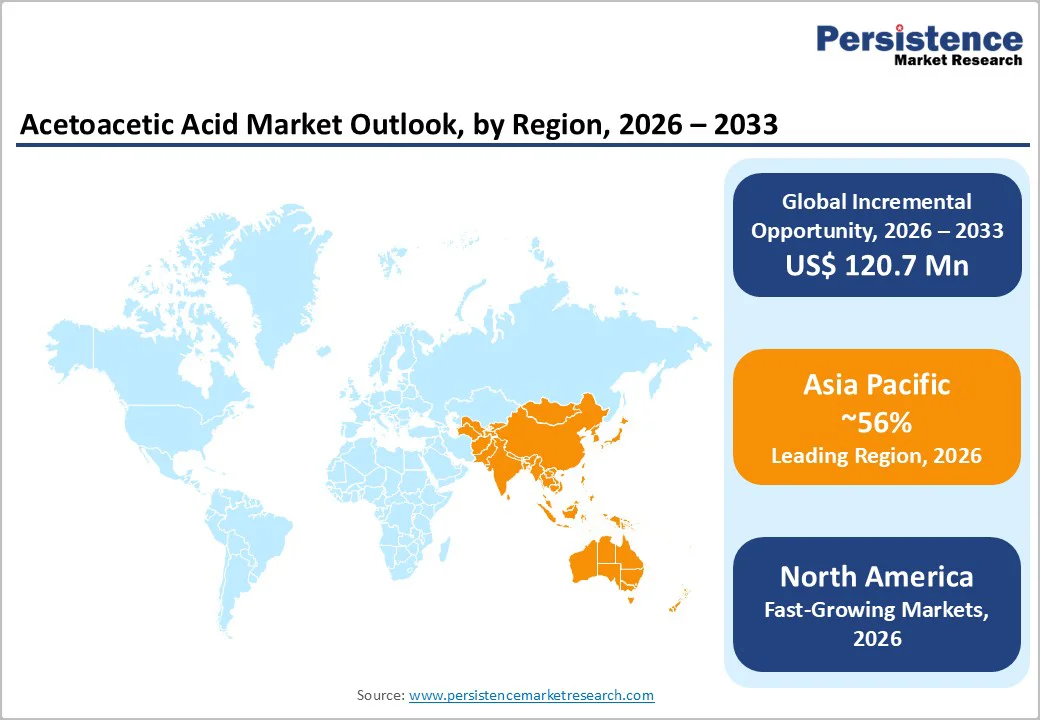
- Leading Region: Asia-Pacific dominates global acetoacetic acid production and consumption, commanding approximately 56% market share, driven by China's massive chemical manufacturing base, India's thriving pharmaceutical industry recognized as the pharmacy of the world, and regional government initiatives supporting domestic specialty chemical expansion through strategic capacity additions.
- Fastest Growing Region: North America represents the fastest-growing developed market, projected to register a CAGR of 6.6% between 2026 and 2033, supported by significant R&D investments in novel therapeutics, stringent quality standards driving demand for premium-grade acetoacetic acid, and FDA-compliant manufacturing requiring specialized pharmaceutical-grade intermediates.
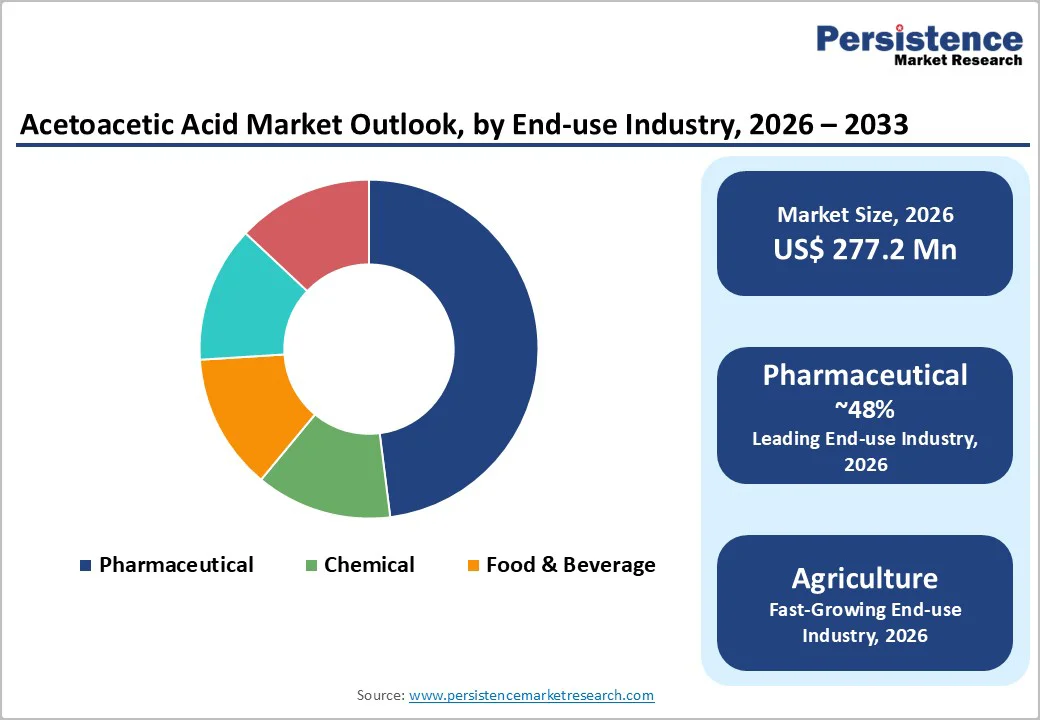
- Dominant Segment: The pharmaceutical industry commands approximately 48% of total market demand, driven by acetoacetic acid's critical role in synthesizing SGLT2 inhibitors, antimalarial agents, and vitamin B1 precursors, with the global SGLT2 inhibitor market exceeding US$ 25 billion by 2025.
- Fastest Growing Segment: The above 98% purity segment represents the fastest-growing category, reflecting escalating pharmaceutical industry emphasis on stringent quality specifications, regulatory compliance requirements, and ICH guideline mandates for active pharmaceutical ingredient synthesis.
- Key Market Opportunity: The agrochemical market's 5.2% annual growth creates substantial opportunities for acetoacetic acid applications in developing sustainable herbicides and pesticides, with recent capacity expansions increasing acetoacetic acid consumption by 12% since 2021 among major agrochemical manufacturers.
| Key Insights | Details |
|---|---|
| Acetoacetic Acid Market Size (2026E) | US$ 277.2 Mn |
| Market Value Forecast (2033F) | US$ 397.9 Mn |
| Projected Growth CAGR (2026-2033) | 5.3% |
| Historical Market Growth (2020-2025) | 3.9% |
Market Dynamics
Market Growth Drivers
Expanding Pharmaceutical Applications in Advanced Drug Synthesis
The pharmaceutical industry's increasing reliance on acetoacetic acid as a critical intermediate continues to drive substantial market demand. Over 60% of newly approved small-molecule drugs contain ketone functional groups, making acetoacetic acid indispensable in modern drug development pipelines. The compound serves as an essential building block for SGLT2 inhibitors, a therapeutic class with a global market exceeding US$ 25 billion by 2025, addressing the escalating prevalence of type-2 diabetes globally.
Furthermore, acetoacetic acid derivatives play a vital role in synthesizing precursors to beta-hydroxybutyrate for neurological treatments, aligning with the growing emphasis on metabolic therapies in neurology. Regulatory approvals for novel pharmacological agents that require acetoacetic acid in their synthesis pathways continue to expand globally, with major pharmaceutical companies investing substantially in R&D facilities that utilize this compound as a foundational intermediate.
Growing Demand from the Agrochemical Sector for Sustainable Crop Protection
The agricultural chemicals market's consistent 5.2% annual growth presents substantial opportunities for acetoacetic acid applications in developing next-generation crop protection formulations. As a versatile precursor for pyrazole and pyrimidine herbicides, the compound is essential for creating systemic herbicides with enhanced efficacy and reduced environmental persistence. Recent developments in sustainable herbicides have increased acetoacetic acid consumption by major agrochemical manufacturers by approximately 12% since 2021.
The Asia-Pacific agrochemical sector, accounting for 38% of global pesticide production, is witnessing heightened demand for acetoacetic acid derivatives as agricultural intensification and regulatory pressures favor safer, environmentally compliant formulations. Leading chemical manufacturers are strategically establishing dedicated supply chains to serve this expanding regional market, positioning acetoacetic acid as a cornerstone chemical in the evolution of eco-friendly agricultural solutions.
Market Restraints
Stringent Environmental Regulations and Production Sustainability Challenges
Stringent environmental regulations governing ketone-based chemicals and volatile organic compound emissions represent significant constraints on acetoacetic acid production and distribution. Regulatory bodies across North America, Europe, and, increasingly, Asia enforce compliance with air quality standards, waste management protocols, and occupational health requirements, elevating production costs.
Environmental concerns related to traditional synthesis methods utilizing petrochemical feedstocks create pressure for manufacturers to invest in sustainable production technologies, requiring substantial capital expenditure and process redesign. Compliance with ISO standards, GMP certifications, and regional chemical safety regulations extends the time-to-market for new production facilities and increases operational overhead, potentially limiting market expansion in cost-sensitive regions.
Price Volatility and Raw Material Cost Fluctuations
The acetoacetic acid market faces significant headwinds from raw material price volatility, particularly regarding precursor chemicals and energy costs required for synthesis. Fluctuating crude oil prices, methanol availability, and acetic acid feedstock costs directly impact production economics, compressing margins for manufacturers and creating uncertainty in pricing structures.
Supply chain disruptions, geopolitical tensions affecting chemical transport routes, and seasonal variations in feedstock availability contribute to unpredictable cost structures. Manufacturers face challenges in maintaining consistent pricing for end users while managing volatile input costs, which can deter long-term supply contracts and investments in capacity expansion, particularly in emerging markets with less-established supply chains.
Market Opportunities
Capacity Expansions and Manufacturing Investments in High-Growth Asian Markets
Significant growth opportunities exist through capacity expansion initiatives targeting the rapidly industrializing Asia-Pacific region, where chemical manufacturing bases continue strengthening. Henan Tianfu Chemical's announced capacity expansion in Q1 2024 reflects the industry's strategic response to mounting Asian demand, with production facilities being upgraded to meet pharmaceutical and agrochemical requirements. China alone is projected to contribute an additional 6.20 million metric tons per annum (mtpa) of acetic acid capacity through seven new construction projects, with several plants specifically designed for specialty chemical production, including acetoacetic acid derivatives.
India's expanding pharmaceutical manufacturing ecosystem and growing chemical industry present untapped opportunities for capacity additions and technology partnerships. Manufacturers investing in high-efficiency, environmentally compliant production methodologies in emerging markets can capture significant market share while establishing strong customer relationships with regional pharmaceutical and agrochemical companies seeking reliable, cost-effective acetoacetic acid supplies.
Development of Bio-Based and Green Chemistry Production Routes
The growing emphasis on sustainable production methods and bio-based chemical synthesis creates substantial opportunities for innovation and market differentiation. Pharmaceutical manufacturers and regulatory agencies increasingly prioritize compounds produced through environmentally benign processes, creating demand for acetoacetic acid derived from renewable feedstocks or synthesized via green chemistry methodologies. Research institutions and chemical companies are actively developing fermentation-based production routes and bioprocess technologies to reduce dependence on petrochemicals while maintaining cost competitiveness.
Companies pioneering these sustainable production methods can command premium pricing, access environmentally conscious customers, and secure advantageous regulatory positions in mature markets such as Europe and North America, where green chemistry initiatives are increasingly mandated. The intersection of rising environmental consciousness and pharmaceutical industry growth creates a compelling opportunity window for innovators introducing certified sustainable acetoacetic acid products.
Category-wise Insights
Form Analysis
The powder form segment represents the dominant category, commanding approximately 58% of the global market share, driven by its superior stability, extended shelf life, and ease of handling in pharmaceutical manufacturing facilities. Powder formulations enable precise dosage control, facilitate standardized batch production in GMP-certified environments, and reduce packaging and transportation costs compared to liquid alternatives. Major pharmaceutical manufacturers prefer powder-grade acetoacetic acid for solid-dose form development, active pharmaceutical ingredient synthesis, and standardized chemical intermediate applications.
The powder segment's dominance is supported by the pharmaceutical sector's expansion, where over 60% of newly approved drugs require high-purity solid intermediates. Regulatory acceptance of powder-form chemicals in quality-by-design manufacturing and enhanced product stability throughout extended storage periods reinforce the powder segment's market leadership. Solution-form products, while representing a smaller share, serve specialized applications where liquid intermediates facilitate faster reaction kinetics and simplified process workflows in specific pharmaceutical and chemical synthesis protocols.
Purity Analysis
The above 98% purity segment establishes market leadership with approximately 72% market share, reflecting the stringent quality requirements of pharmaceutical and specialty chemical applications. Pharmaceutical-grade acetoacetic acid with> 98% purity is required for active pharmaceutical ingredient (API) synthesis, as even trace impurities can compromise drug efficacy, patient safety, and regulatory compliance. High-purity formulations command premium pricing, typically ranging from 15%-25% above standard industrial-grade products, justified by enhanced quality control procedures, advanced purification technologies, and comprehensive analytical testing.
Manufacturers producing products with above-98% purity invest significantly in sophisticated equipment, validated testing protocols, and traceability systems to meet USP, Ph. Eur., and ICH compliance standards required by regulatory authorities. The below-98% purity segment serves cost-sensitive applications in agrochemical and non-pharmaceutical chemical synthesis where stringent purity specifications are not essential, allowing manufacturers to optimize production economics while serving diverse end-user requirements across varied industrial segments.
End-use Industry Analysis
The pharmaceutical sector is the dominant end-use industry, accounting for approximately 48% of total market demand, underscoring the compound's irreplaceable role in synthesizing advanced therapeutic agents. Acetoacetic acid serves as a critical intermediate in the manufacture of SGLT2 inhibitors for diabetes treatment, antimalarial drugs, vitamin B1 precursors, and numerous specialty pharmaceuticals that require ketone functionality. Major pharmaceutical companies including BASF SE, Eastman Chemical Company, and specialized chemical suppliers maintain dedicated production facilities to ensure uninterrupted supply of high-purity acetoacetic acid. The pharmaceutical segment's growth is underpinned by rising diabetes prevalence globally, with approximately 537 million adults living with diabetes as of 2021, driving substantial demand for SGLT2 inhibitor medications that depend on acetoacetic acid synthesis.
Chemical and agricultural industries collectively account for 42% of demand, using acetoacetic acid as a versatile building block to manufacture dyes, pigments, specialty polymers, and next-generation agrochemical formulations with enhanced environmental compliance profiles.
Regional Insights
North America Acetoacetic Acid Trends
North America represents a sophisticated, high-value market for acetoacetic acid, driven by the region's robust pharmaceutical manufacturing ecosystem and stringent quality standards. The United States pharmaceutical sector, characterized by significant R&D investments and continuous development of novel therapeutics, sustains substantial demand for high-purity acetoacetic acid as a fundamental intermediate.
Canada's market is growing in synchrony with broader North American trends toward sustainability and high-purity chemical solutions. In August 2024, Avantor Inc. expanded its high-purity chemical solutions portfolio, including specialized acetoacetic acid variants for HPLC applications and trace metal analysis, addressing growing demand for advanced chemical inputs in the biopharmaceutical and analytical chemistry sectors.
Europe Acetoacetic Acid Trends
Europe's acetoacetic acid market is significantly influenced by stringent environmental regulations, sustainability mandates, and the region's advanced pharmaceutical and specialty chemical manufacturing base. European regulatory frameworks emphasizing green chemistry principles, waste reduction, and circular economy initiatives create competitive advantages for manufacturers developing bio-based or environmentally benign acetoacetic acid production routes.
Major pharmaceutical markets in Germany, France, and the United Kingdom maintain sophisticated demand for pharmaceutical-grade acetoacetic acid, supported by established chemical supply chains and quality-conscious manufacturers investing in sustainable production methodologies. European manufacturers' emphasis on automation, digitalization, and advanced quality control systems supports the region's acceptance of premium-priced, specification-verified acetoacetic acid products, creating opportunities for suppliers demonstrating exceptional quality, traceability, and environmental responsibility.
Asia Pacific Acetoacetic Acid Trends
Asia-Pacific dominates global acetoacetic acid production and consumption, emerging as the market's powerhouse driven by rapid industrialization, massive pharmaceutical manufacturing expansion, and significant government initiatives supporting domestic chemical production. China, accounting for the largest production capacity globally, continues expanding acetoacetic acid manufacturing facilities, with seven announced construction projects expected to commence operations between 2026 and 2028. The Guangsheng Datech Yangjiang Acetic Acid Plant, projected to reach 1.50 mtpa capacity, exemplifies the region's strategic investment in expanding specialty chemical production infrastructure to meet escalating regional and global demand.
India's thriving pharmaceutical industry, recognized globally as the "pharmacy of the world," drives substantial acetoacetic acid demand for API synthesis, with particular emphasis on antimalarial drugs, SGLT2 inhibitors, and specialty intermediate production. The region benefits from cost advantages in raw material procurement, skilled chemical manufacturing workforce, and government policy frameworks encouraging pharmaceutical manufacturing expansion.
Competitive Landscape
The global acetoacetic acid market exhibits a moderately consolidated competitive structure, with clear segmentation between large multinational chemical conglomerates and specialized fine-chemical manufacturers. Leading companies employ parallel strategies of capacity expansion in the Asia-Pacific regions, investments in green chemistry production technologies, and vertical integration of pharmaceutical supply chains. Market leaders differentiate through comprehensive quality certifications, advanced analytical capabilities, regulatory compliance expertise, and customer support systems enabling seamless integration into sophisticated pharmaceutical manufacturing environments.
Key Market Developments
- December 2024: China announced nine planned and confirmed acetic acid facility projects expected to commence operations between 2026 and 2028, collectively adding over 6.20 mtpa of production capacity globally. This strategic expansion underscores Asia-Pacific's dominance in global acetoacetic acid supply and reflects rising pharmaceutical demand across the region.
- June 2022: INEOS initiated comprehensive assessment studies to evaluate the feasibility of constructing a new world-scale acetic acid production facility in the United States, signaling the company's commitment to strengthening North American specialty chemical production capacity and supporting regional pharmaceutical manufacturing growth.
- August 2024: Avantor Inc. significantly expanded its high-purity chemical solutions portfolio, introducing specialized acetoacetic acid variants engineered for HPLC applications and trace metal analysis, addressing the biopharmaceutical sector's escalating demand for advanced analytical chemistry inputs.
Top Companies in Acetoacetic Acid Market
BASF SE (Ludwigshafen, Germany) operates as a global chemical powerhouse with comprehensive acetoacetic acid production capabilities integrated across pharmaceutical, agrochemical, and specialty chemical markets. The company leverages extensive R&D infrastructure, advanced synthesis technologies, and established pharmaceutical industry relationships, positioning BASF as a preferred supplier for high-purity acetoacetic acid serving major pharmaceutical manufacturers worldwide.
Eastman Chemical Company (Kingsport, Tennessee, USA) maintains significant acetoacetic acid manufacturing expertise, with specialized production facilities serving the pharmaceutical and specialty chemical sectors. The company's focus on process innovation, sustainability initiatives, and customer partnership models enables Eastman to sustain competitive advantages in premium-grade acetoacetic acid production and supply chain responsiveness to evolving customer requirements.
SABIC (Riyadh, Saudi Arabia) leverages integrated petrochemical manufacturing infrastructure and regional cost advantages to produce competitive acetoacetic acid products serving Middle Eastern and Asian pharmaceutical and chemical markets. The company's strategic positioning in a major petrochemical hub enables efficient feedstock procurement and competitive pricing while maintaining quality standards required by demanding pharmaceutical customers.


