




- Food Ingredients & Additives
- Used Cooking Oil Market
Used Cooking Oil Market Size, Share, and Growth Forecast, 2026 - 2033
Used Cooking Oil Market by Source Type (Food manufacturers, Restaurant and caterers, Hotels, Household), Application (Biodiesel Production, Animal feed, Oleochemicals, Personal Care & Cosmetics), and Regional Analysis for 2026 - 2033

Used Cooking Oil Market Size and Trends Analysis
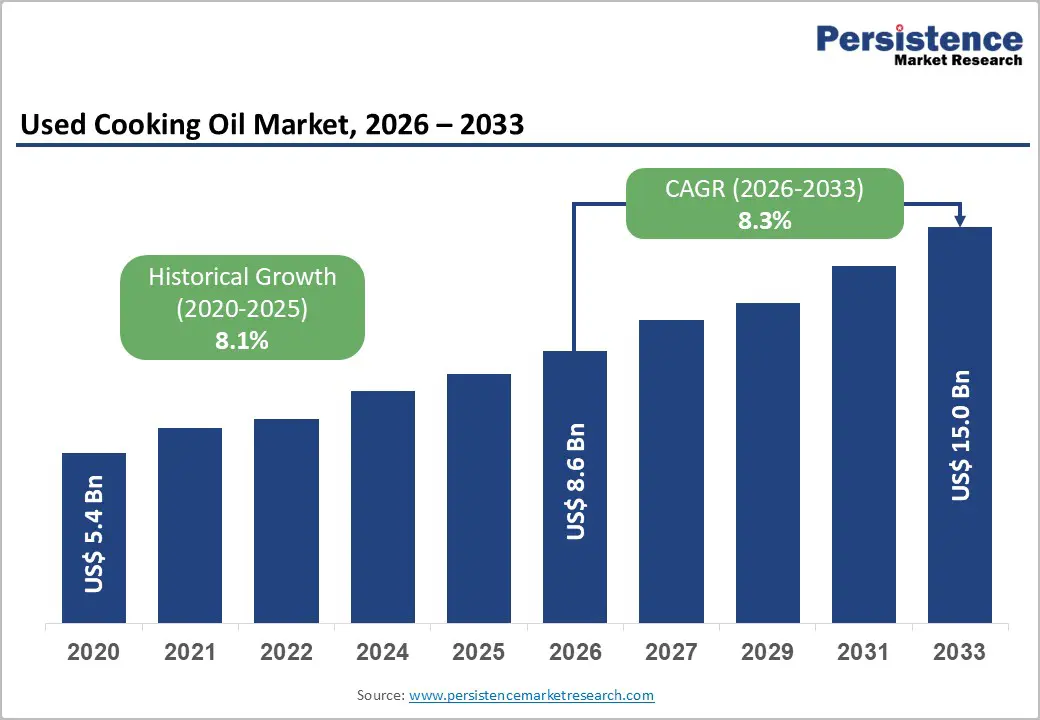
The global used cooking oil market size is likely to be valued at US$8.6 billion in 2026 and is expected to reach US$15.0 billion by 2033, growing at a CAGR of 8.3% during the forecast period from 2026 to 2033, driven by increasing adoption of renewable fuels, government policies supporting low-carbon alternatives, and heightened awareness of environmental benefits, including reduced greenhouse gas emissions compared to traditional fossil fuels. Used cooking oil (UCO) has emerged as a vital resource in the effort to transition toward sustainable and circular economies.
Serving as a key feedstock for biodiesel production, animal feed, oleochemicals, and personal care products, UCO transforms what was once considered waste into high-value commodities. Expanding commercial and household collection systems, coupled with technological advancements in processing and quality monitoring, have improved the availability and reliability of the used cooking oil supply. Biodiesel applications remain the dominant end-use, supported by blending mandates and incentives in several regions, while emerging applications in cosmetics and industrial chemicals diversify demand.
Key Industry Highlights:
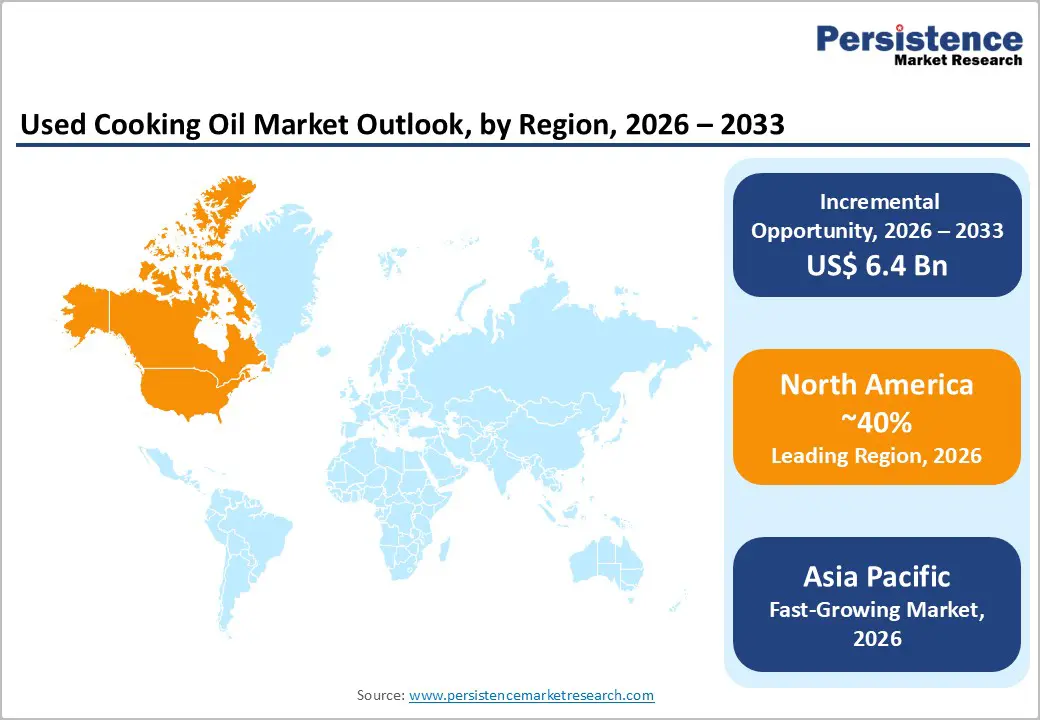
- Leading Region: North America is anticipated to be the leading region, accounting for a market share of 40% in 2026, driven by mature collection networks, strong biodiesel demand, regulatory incentives, technological innovations, and a robust innovation ecosystem.
- Fastest-growing Region: Asia Pacific is likely to be the fastest-growing region, supported by high consumption, expanding biodiesel programs, policy support, and manufacturing advantages in collection and processing.
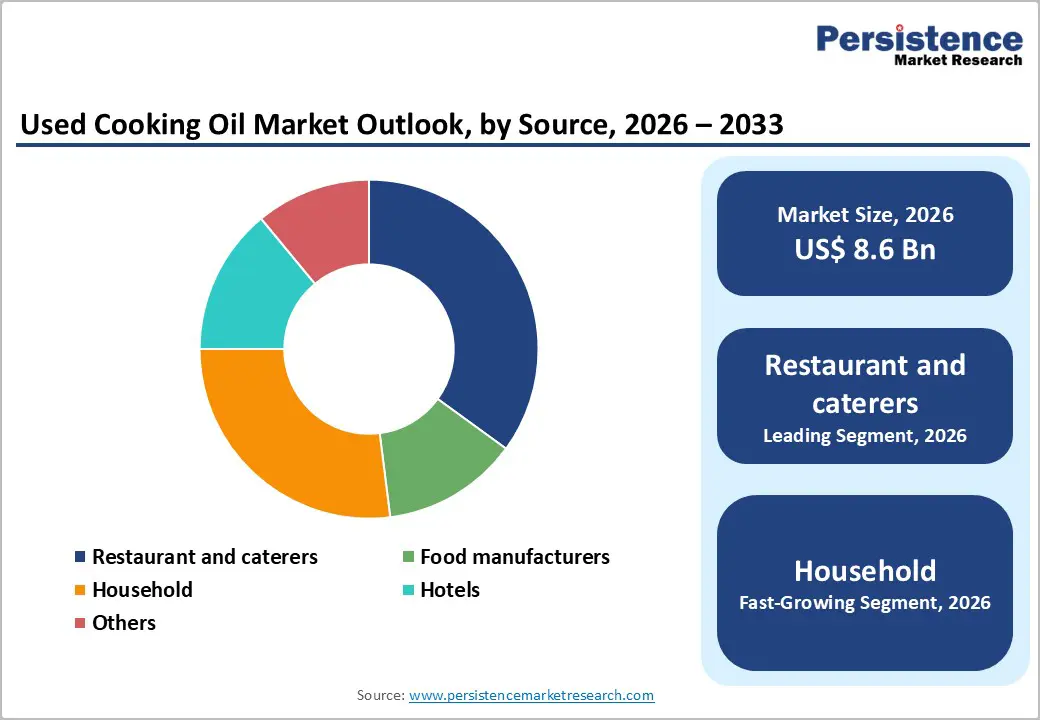
- Leading Source Type: Restaurants and caterers are projected to represent the leading Source type in 2026, accounting for 70% of the revenue share, driven by high-volume, frequent oil replacement, and centralized collection points.
- Leading Application: Biodiesel production is anticipated to be the leading application, accounting for over 50% of the revenue share in 2026, supported by renewable fuel mandates and low-carbon incentives.
| Key Insights | Details |
|---|---|
|
Used Cooking Oil Market Size (2026E) |
US$8.6 Bn |
|
Market Value Forecast (2033F) |
US$15.0 Bn |
|
Projected Growth (CAGR 2026 to 2033) |
8.3% |
|
Historical Market Growth (CAGR 2020 to 2025) |
8.1% |
DRO Analysis
Driver - Increasing Demand for Biodiesel and Renewable Fuels
The push toward sustainable energy solutions has significantly increased demand for biodiesel, positioning used cooking oil as a critical feedstock. Governments worldwide are implementing blending mandates and low-carbon fuel standards, incentivizing the conversion of UCO into renewable fuels. The consistent availability of used cooking oil from commercial foodservice outlets provides a cost-effective and environmentally friendly alternative to virgin oils.
The growing adoption of renewable energy policies encourages private sector participation in used cooking oil collection and processing. Large-scale biodiesel plants increasingly rely on formalized collection networks from restaurants, hotels, and food manufacturers. Technological improvements in refining and blending processes allow higher-quality biodiesel production from used cooking oil, driving industry confidence. Corporate sustainability programs and carbon reduction commitments amplify the focus on renewable fuels.
Circular Economy and Waste Reduction Initiatives
The used cooking oil market aligns strongly with circular economy principles, transforming waste into valuable feedstock for energy, chemicals, and consumer products. Programs promoting sustainable waste management encourage businesses and households to recycle used oil rather than dispose of it improperly. This creates reliable supply streams for biodiesel and oleochemical manufacturers while reducing environmental impact. Policies targeting landfill reduction and industrial waste recycling incentivize UCO collection and formalize supply chains.
Municipalities and private recyclers are implementing structured used cooking oil collection networks to support these initiatives. App-based and doorstep collection technologies streamline consumer participation, increasing volumes from households. Corporate programs in foodservice chains and hotels enforce standardized disposal protocols, improving traceability and reducing contamination risks. Partnerships between recyclers, biodiesel producers, and chemical manufacturers strengthen the market ecosystem. By valorizing waste into renewable energy and bio-based products, used cooking oil collection contributes to carbon reduction goals and resource efficiency.
Restraint - Quality Variability and Contamination
The quality of used cooking oil can vary significantly depending on its source, storage, and handling practices, affecting its suitability for biodiesel, oleochemicals, or animal feed. Contaminants such as food particles, water, and chemical residues reduce processing efficiency and final product quality, increasing operational costs. Variability in free fatty acid content and oxidation levels necessitates additional pretreatment and refining steps, impacting profitability. Inconsistent quality also limits the use of used cooking oil adoption in sensitive applications such as personal care or high-grade biodiesel.
Informal collection networks often exacerbate contamination issues, as households and small vendors may lack proper storage or transportation methods. Seasonal fluctuations in cooking habits or variations in oil types influence chemical composition, making standardization difficult. High contamination levels can cause equipment fouling and reduce biodiesel yield, discouraging new entrants. Regulatory authorities increasingly emphasize traceability and quality standards, compelling market participants to adopt robust sampling and certification processes.
Collection and Logistics Challenges
Efficient collection of used cooking oil remains a critical barrier due to its dispersed generation points and perishable nature. Restaurants, households, and small-scale food vendors produce varying volumes at different frequencies, making coordinated collection complex and costly. Transportation requires specialized containers and adherence to hygiene regulations, while geographical dispersion in suburban and rural areas increases operational expenses. These logistics challenges hinder large-scale aggregation and limit market penetration, particularly in emerging economies.
Informal markets often capture a portion of used cooking oil before it enters formal supply chains, reducing available volumes for biodiesel or oleochemical production. Inconsistent collection schedules, lack of awareness, and inadequate municipal support amplify operational inefficiencies. Seasonal demand peaks in foodservice sectors complicate logistics planning, while regulatory compliance adds reporting and handling requirements.
Opportunity - Sustainable Aviation Fuel (SAF) Convergence
Used cooking oil offers substantial potential as a feedstock for sustainable aviation fuel, aligning with carbon reduction goals in aviation. SAF derived from used cooking oil reduces lifecycle greenhouse gas emissions compared to fossil jet fuels and can be blended into existing infrastructure. Aviation companies and governments are increasingly incentivizing SAF adoption, creating demand for high-quality, reliable UCO sources. Converting used cooking oil into sustainable aviation fuel (SAF) provides recyclers with new market opportunities beyond biodiesel and increases the overall value of the collected oil.
The SAF opportunity drives investment in advanced processing technologies capable of upgrading used cooking oil to meet jet fuel specifications. Certification frameworks and carbon credit schemes enhance market attractiveness. By integrating UCO into the aviation sector, stakeholders leverage circular economy benefits, reduce environmental impact, and create new revenue streams. Emerging markets with growing airline operations and domestic used cooking oil generation present additional growth avenues.
Household Collection Tech Innovations
Technological innovations in household used cooking oil collection create new avenues for market expansion by increasing participation and volumes. Mobile applications, doorstep pick-up services, and smart collection bins streamline consumer engagement and tracking. These solutions address logistical fragmentation and incentivize proper disposal through rewards or monetization, ensuring a more consistent supply for biodiesel and oleochemical production.
Integration of IoT-enabled sensors and AI-driven route optimization reduces operational costs and enhances reliability. Pilot programs in urban and suburban areas demonstrate scalability, offering replicable models for other regions. By formalizing household contributions, the market benefits from diversified sources, reduced contamination risks, and predictable supply cycles. These technologies also align with sustainability agendas and municipal waste diversion targets, encouraging wider adoption.
Category-wise Analysis
Source Type Insights
Restaurants and caterers are expected to lead the used cooking oil market, accounting for approximately 70% of revenue in 2026, driven by the concentrated generation points and high-frequency oil replacement cycles in commercial foodservice operations. Large-scale restaurants, quick-service outlets, and catering chains produce consistent volumes of used cooking oil, enabling efficient collection through established contracts with recyclers. For example, major chains such as McDonald’s in the U.S. participate in formal used cooking oil recycling programs, ensuring centralized collection and quality control.
Household is likely to represent the fastest-growing segment, supported by municipal waste diversion programs and awareness campaigns that increase consumer participation, albeit from a smaller base. This segment leverages innovations such as doorstep pick-up services, mobile applications, and smart collection bins to aggregate small, dispersed quantities efficiently. For example, in India, programs under FSSAI’s RUCO initiative encourage households to segregate and submit used oil for biodiesel conversion, offering monetary incentives or coupons. Rising prices of fresh cooking oil motivate consumers to recycle, transforming household waste into a valuable feedstock.
Application Insights
Biodiesel production is projected to lead the market, capturing around 50% of the revenue share, supported by its low cost, availability from commercial and household sources, and compliance with renewable fuel standards. For example, Argent Energy in Europe processes used cooking oil into biodiesel that meets blending mandates, helping transport fuel suppliers reduce carbon intensity. The application dominates revenue contributions because biodiesel production offers predictable demand and policy-driven incentives, including tax credits, blending targets, and carbon reduction programs.
Oleochemicals are likely to be the fastest-growing application, driven by increasing demand for bio-based chemicals and sustainable ingredients in consumer products. For instance, L’Oréal has initiated programs sourcing renewable feedstock, including processed used cooking oil, to manufacture eco-friendly cosmetics. These applications benefit from technological advances that allow higher-purity refining, making used cooking oil suitable for creams, soaps, and industrial lubricants. Regulatory encouragement for renewable raw materials and circular economy adoption accelerates growth.
Regional Insights
North America Used Cooking Oil Market Trends
North America is anticipated to be the leading region, accounting for a market share of 40% in 2026, driven by mature collection networks, high commercial foodservice density, and strong renewable fuel policies. The U.S. market is a major driver, where restaurants, catering chains, and industrial kitchens generate consistent volumes of used cooking oil. The market benefits from structured logistics, traceability requirements, and technological innovations such as sensor-based storage and optimized collection routes. For example, Baker Commodities, Inc., a U.S.-based company, efficiently collects used cooking oil from restaurants and hotels, supplying it for biodiesel, oleochemicals, and animal feed applications.
The trend in North America emphasizes innovation and circular economy integration. Companies focus on converting used cooking oil into high-value bio-based products beyond biodiesel, including cosmetics and specialty chemicals. Corporate sustainability commitments encourage the adoption of formal collection contracts and quality monitoring systems. Urban and suburban foodservice hubs provide concentrated feedstock, reducing transportation costs and improving recovery rates. Technology adoption, including IoT-enabled monitoring and app-based reporting, enhances efficiency and supports regulatory compliance.
Europe Used Cooking Oil Market Trends
Europe is likely to be a significant market for used cooking oil, due to highly formalized collection systems, strict traceability standards, and regulatory support for renewable fuels and waste reduction initiatives. Governments across the EU incentivize biodiesel production from used cooking oil, while directives on circular economy adoption and landfill reduction strengthen the supply chain. For example, Olleco, a UK-based UCO collector and processor, partners with restaurants, food manufacturers, and retailers to supply consistent feedstock for renewable fuel and industrial chemical applications.
Europe also exhibits growth in high-value applications such as personal care and bio-based chemicals. Technological improvements in refining processes enable UCO to be converted into specialty products, aligning with consumer preferences for renewable and sustainable ingredients. Expansion of foodservice and hospitality networks increases feedstock availability, while municipal programs promote household collection.
Asia Pacific Used Cooking Oil Market Trends
The Asia Pacific region is likely to be the fastest-growing region, driven by high cooking oil consumption, expanding foodservice sectors, and increasing government support for renewable energy initiatives. The region benefits from labor-intensive collection cost advantages and large urban population centers that facilitate efficient aggregation. For example, Olleco, operating in partnership with local foodservice chains in Asia, ensures a consistent UCO supply for biodiesel and oleochemical industries, demonstrating the scalability of formalized collection models in emerging markets.
Urbanization, growth of restaurants and hotels, and increasing awareness campaigns expand both commercial and household collection volumes. App-based household collection and smart bin initiatives improve supply traceability and reduce contamination. Asia Pacific’s used cooking oil market is becoming a critical contributor to feedstock supply, complementing North America and Europe, and supporting low-carbon initiatives while promoting circular economy practices.
Competitive Landscape
The global used cooking oil market exhibits a moderately fragmented structure, driven by the coexistence of large multinational aggregators and numerous regional or specialized players competing across collection, processing, and value-added applications. Major companies maintain extensive logistics networks to ensure a steady supply from commercial foodservice outlets and industrial sources, supported by renewable fuel mandates and increasing demand for circular economy solutions.
With key leaders including Baker Commodities Inc., Darling Ingredients Inc., Olleco, Arrow Oils Ltd., and Valley Proteins, Inc., the industry reflects a mix of vertically integrated firms and dedicated UCO recycling specialists that shape market dynamics through service breadth and geographic reach. These players compete through strategic partnerships with foodservice chains, investment in advanced collection and processing technologies, and expansion of downstream applications such as biodiesel, oleochemicals, and sustainable aviation fuel.
Key Industry Developments:
- In January 2026, the Malaysian Palm Oil Board (MPOB) launched a used cooking oil (UCO) price reference portal to enhance market transparency, support fair trading, and strengthen price discovery across the domestic supply chain. The initiative aims to curb price manipulation while encouraging wider participation in UCO trading, aligning with circular economy goals and promoting UCO as a valuable feedstock for biodiesel and sustainable aviation fuel production.
- In April 2026, Darling Ingredients Inc. gained significant momentum following new renewable fuel mandates issued by the U.S. Environmental Protection Agency (EPA), which increased biofuel blending requirements and strengthened demand for feedstocks such as used cooking oil and animal fats.
- In October 2025, FSSAI’s RUCO initiative in India expanded significantly across multiple districts, increasing UCO collection from food businesses for conversion into biodiesel and boosting awareness of safe disposal practices.
Companies Covered in Used Cooking Oil Market
- Valley Proteins, Inc.
- Proper Oils Co. Ltd.
- ABP Food Group
- Arrow Oils Ltd.
- Baker Commodities, Inc.
- Grand Natural, Inc.
- Oz Oils Pty. Ltd.
- Brocklesby Limited
- GreaseCycle
- MBP Solutions Ltd.
Frequently Asked Questions
The global used cooking oil market is projected to reach US$8.6 billion in 2026.
The used cooking oil market is driven by increasing demand for biodiesel and renewable fuels, supported by sustainability regulations and circular economy initiatives.
The used cooking oil market is expected to grow at a CAGR of 8.3% from 2026 to 2033.
Key market opportunities lie in the expansion of sustainable aviation fuel (SAF) production and advancements in household collection technologies to increase UCO supply.
Valley Proteins, Inc., Proper Oils Co. Ltd., ABP Food Group, Arrow Oils Ltd., and Baker Commodities, Inc. are the leading players.


