




- Renewable Energy
- Pyranometer Market
Pyranometer Market Size, Share, and Growth Forecast 2026 - 2033
Pyranometer Market by Product Type (Thermopile, Photodiode Pyranometer), Sensitivity Range (<5 μV/(W/m²), 5-15 μV/(W/m²), >15 μV/(W/m²)), Application (Solar Energy Plants, Weather Monitoring), and Regional Analysis, 2026 - 2033

Pyranometer Market Size and Trends Analysis
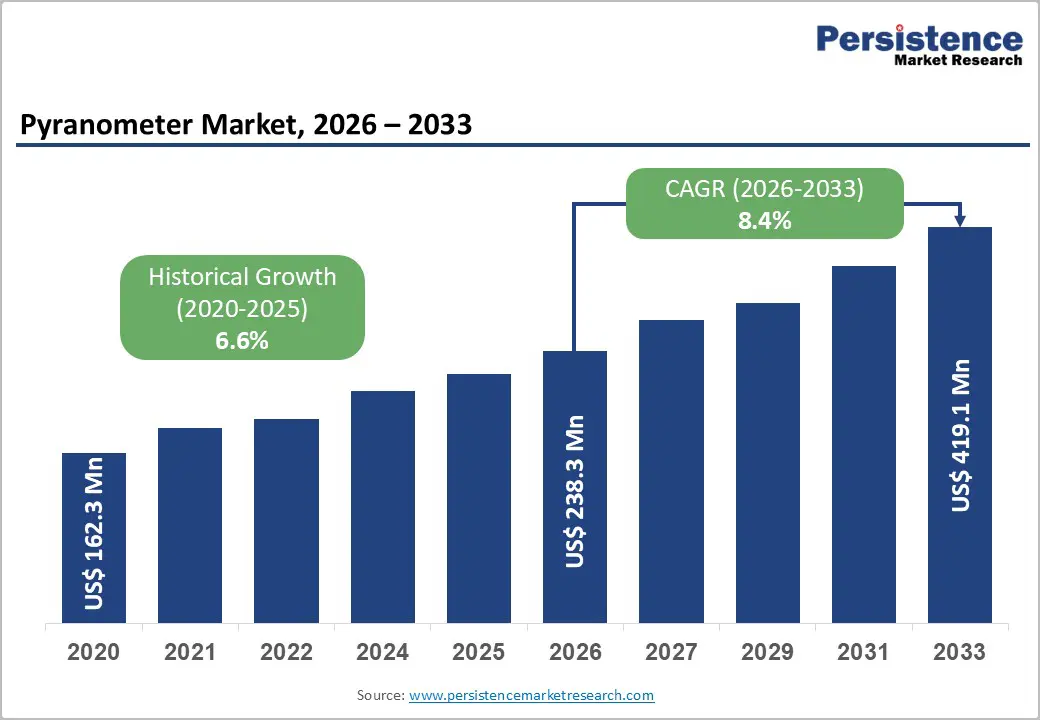
The global pyranometer market size is likely to be valued at US$238.3 million in 2026 and is expected to reach US$419.1 million by 2033, growing at a CAGR of 8.4% during the forecast period from 2026 to 2033, driven by the ongoing expansion of utility-scale solar projects that require precise irradiance monitoring for performance validation and grid integration.
Growth is further supported by increasing deployment of solar resource assessment stations by agencies such as the National Renewable Energy Laboratory to build long-term solar datasets.
Key Industry Highlights:
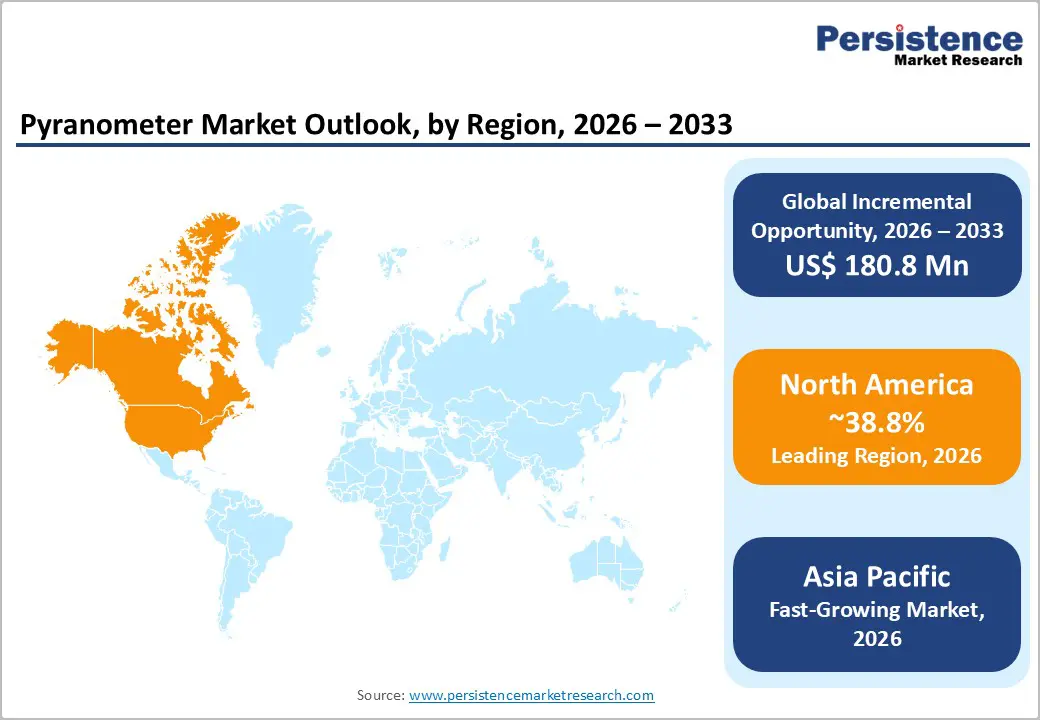
- Leading Region: North America, with about a 38.8% share in 2026, fueled by strict solar performance standards and widespread use of high-accuracy irradiance monitoring across utility-scale projects.
- Fast-growing Region: Asia Pacific, as countries are constantly expanding solar capacity and adopting both high-end and low-cost sensors.
- Leading Product Type: Thermopile pyranometers, approximately 67.3% share in 2026, as they measure the full solar spectrum with high accuracy.
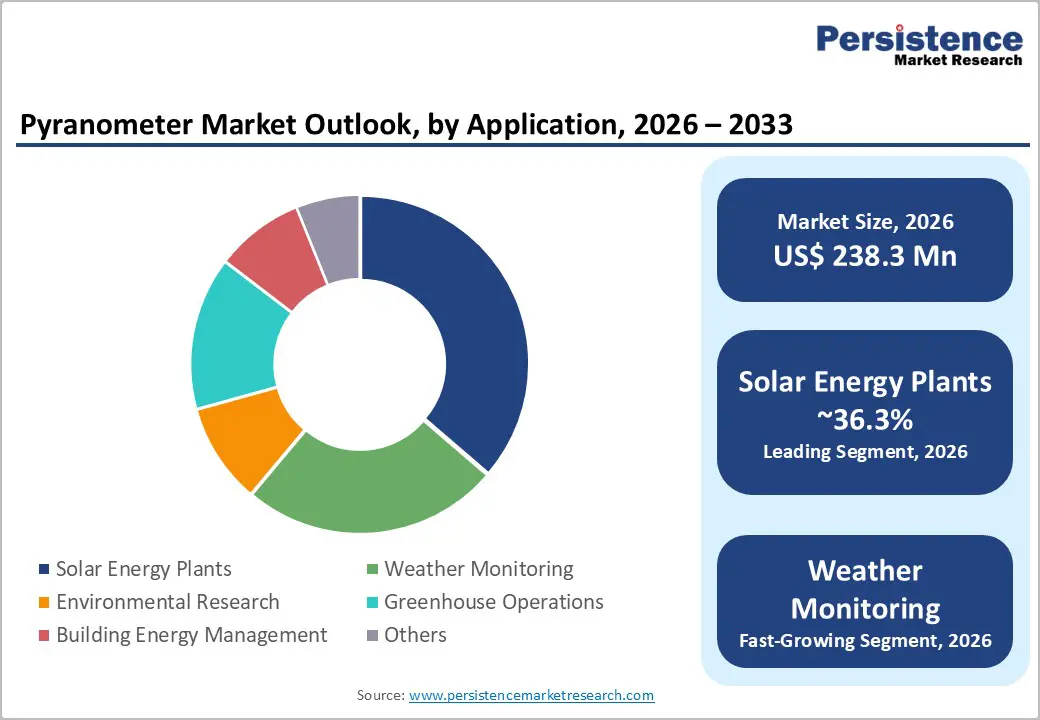
- Dominant Application: Solar energy plants, with nearly 36.3% share in 2026, as every large solar installation requires multiple pyranometers for real-time irradiance measurement and performance ratio validation.
- New Product: In April 2025, Senseca launched the LPR10 pyranometer, a fast-response Class A instrument compliant with ISO 9060:2018 and World Meteorological Organization (WMO) guidelines. The new model features an integrated heater, tilt sensor, advanced diagnostics, and RS485 Modbus connectivity. It would enable accurate solar radiation measurements for meteorology, environmental monitoring, and photovoltaic applications even under challenging weather conditions.
DRO Analysis
Driver - Surging Need to Compare Real and Theoretical Solar Output
Performance Ratio (PR) is the key metric used to measure how efficiently a solar plant converts incoming radiation into usable electricity. As defined under IEC 61724-1:2021, PR is calculated by dividing actual energy yield by the reference yield. That reference yield is derived directly from pyranometer readings. A pyranometer drifting by even 3% appears as a 3% PR error, which is why annual calibration is essential.
When PR drops without a corresponding drop in irradiance, operators can immediately flag soiling, shading, or hardware issues. A 2025 peer-reviewed study published in Results in Engineering confirmed that bird droppings alone increased PV module temperature by 10.2°C and that accurate PR measurement requires cleaning both PV modules and pyranometers simultaneously. This tight coupling between irradiance data and operational decisions makes pyranometers indispensable to modern Operations and Maintenance (O&M) workflows.
Grid Forecasting Compliance to Augment Pyranometer Adoption
As solar capacity expands globally, grid operators are demanding tight power output forecasts from plant owners. Inaccurate forecasts result in grid curtailment, which is a surging financial risk. According to the U.S. Energy Information Administration, California Independent System Operator (CAISO) curtailed 3.4 million MWh of utility-scale wind and solar in 2024, a 29% increase from the previous year, with solar accounting for 93% of all curtailed energy.
Pyranometers provide the localized, real-time irradiance data required to produce accurate day-ahead forecasts. Satellite-based estimates introduce significant error as they reflect regional averages and not site-specific conditions. Using satellite-derived Typical Meteorological Year (TMY) irradiance instead of actual measured data can overstate PR by about 5% if the actual year had 5% more sunshine. On-site pyranometers eliminate this margin of error, helping operators meet dispatch obligations and avoid financial penalties.
Restraint - High Maintenance Requirements May Hamper Demand
Pyranometers are precise instruments, but their accuracy degrades quickly when the glass dome gets dirty. Dust, pollen, and bird droppings scatter incoming light before it reaches the thermopile sensor, causing the device to underreport actual irradiance. This creates a misleading picture- inflated PR values that suggest the plant is performing well when it may not be. A 2025 study in Solar Energy found that soiling on the pyranometer dome reduces measured irradiance, which in turn inflates the theoretical output baseline and can mislead plant owners into delaying necessary cleaning.
Under IEC 61724-1:2021, Class A pyranometers should ideally be cleaned weekly to maintain high data accuracy, though actual frequency depends on site-specific conditions. At remote or arid sites, where manual access is limited, maintaining this schedule is operationally difficult and costly. This makes consistent data quality a persistent challenge for large-scale deployments.
Opportunity - Novel Optical Designs to Reduce Measurement Error and Maintenance Costs
Traditional thermopile pyranometers rely on black carbon-coated surfaces and double-dome glass to measure solar radiation. While effective, these designs come with drawbacks. Some of them are slow response times due to thermal mass, UV-induced paint degradation, and frequent recalibration cycles. Next-generation instruments such as the SEVEN 3S-TP-MB-A replace the black carbon surface with a white quartz diffuser and use a single-dome glass design, which improves measurement precision and significantly shortens response time.
The black disc sensor paint changes its properties when exposed to UV light, mainly in the first years of use, a problem the white diffuser design avoids entirely. Traditional double-dome models typically require recalibration every two years. However, the latest single-dome designs are pushing this interval to five years, thereby reducing lifecycle costs for large monitoring networks.
Emergence of Smart Pyranometers to Lower Field Failures
Dew, frost, and snow on the sensor dome are among the most common causes of data loss in pyranometers deployed at high-altitude or cold-climate sites. Conventional solutions rely on external ventilation units, which are bulky, power-hungry, and prone to failure. EKO Instruments addressed this with the MS-80SH. It features an energy-efficient integrated solid-state dome heating system designed for active dew and frost resistance, compliant with IEC 61724-1:2021 Class A monitoring.
The low-power heater draws just 1.4W and is switchable via Modbus/SDI-12 interface, helping minimize power consumption in battery-operated systems while delivering virtually zero offsets even during fast changes in ambient conditions. A 2025 study cited by EKO further supported these claims, with research from the 3IT Institute quantifying an 11.8% measurement error caused by light snow accumulation on standard pyranometers. These built-in environmental controls make high-accuracy monitoring viable in locations that were previously impractical to service.
Category-wise Analysis
Product Type Insights
Thermopile pyranometers are predicted to lead with a share of approximately 67.3% in 2026, as they deliver the highest measurement accuracy across all solar radiation conditions. These sensors measure the full solar spectrum (around 285 to 3000 nm), which makes them suitable for research-grade and utility-scale applications. Standards such as ISO 9060 classify thermopile pyranometers as Class A, B, or C, and most high-end solar and meteorological projects require Class A instruments. For example, the World Meteorological Organization recommends thermopile-based instruments for baseline solar radiation monitoring networks.
Photodiode pyranometers are estimated to be the fastest-growing segment over the forecast period, as they provide a low-cost and fast-response alternative for large-scale deployments. These sensors respond very quickly to changes in sunlight, often within microseconds, which makes them useful for real-time monitoring and control systems. This is especially important in modern solar plants using automated tracking systems and smart inverters. For example, several SCADA-integrated solar monitoring solutions now include photodiode sensors for quick irradiance feedback, even if a thermopile unit is used as a reference.
Application Insights
Solar energy plants are anticipated to dominate with a share of nearly 36.3% in 2026, as pyranometers are a core component in photovoltaic (PV) performance monitoring and solar resource assessment. Every utility-scale solar project uses multiple pyranometers for real-time irradiance measurement, plant efficiency validation, and compliance with performance ratio (PR) guarantees. The rate of deployment is much larger than any other segment. For example, a single 100 MW solar plant can deploy 10 to 25 pyranometers across arrays and weather stations. With global solar capacity crossing 1.6 to 1.8 TW in 2025, pushed by large installations in China, India, and the U.S., demand from this segment continues to outpace all others.
The weather monitoring segment is expected to remain in the second position in 2026, owing to its institutional and regulatory importance, but the volume remains lower compared to solar plants. National meteorological agencies, airports, and climate research bodies use pyranometers for long-term solar radiation datasets and forecasting models. For instance, organizations such as national weather departments and global climate networks maintain fixed monitoring stations with calibrated sensors. However, these deployments are limited in number and replaced less frequently, which restricts market share despite high precision requirements.
Regional Insights
North America Pyranometer Market Trends
North America is predicted to dominate in 2026 with a share of approximately 38.8%, owing to strong solar quality standards and advanced monitoring infrastructure. The region has a well-established solar market where performance validation is taken seriously. Utility-scale projects in the U.S. and Canada follow strict guidelines for irradiance measurement. For example, the National Renewable Energy Laboratory and the U.S. Department of Energy recommend high-accuracy pyranometers for solar resource assessment and plant performance testing. This pushes demand for premium instruments. Also, North America has a dense network of weather stations and research labs, which regularly upgrade sensors for climate tracking.
U.S. Pyranometer Market Trends
A share of nearly 57.7% is expected to be held by the U.S. in 2026, backed by large-scale solar expansion and strict performance benchmarking. The country is adding record levels of solar capacity every year, especially in states such as Texas and California. According to Department of Energy (DOE) updates, solar contributes a rising share of new electricity generation capacity. Each new solar farm requires multiple pyranometers for compliance with performance ratio contracts. Also, independent system operators and investors demand high-quality irradiance data to avoid revenue losses. This has increased the use of both thermopile and secondary sensors across projects.
Asia Pacific Pyranometer Market Trends
Asia Pacific is anticipated to be the fastest-growing region in 2026 with a share of nearly 32.4%, owing to high renewable energy targets and cost-driven deployments. Countries in this region are installing solar at a much faster pace than others. Governments are pushing solar to reduce coal dependence and meet climate goals. Along with large projects, there is steady growth in distributed solar, agriculture, and smart city projects. This creates demand for both high-end and low-cost pyranometers. The region is also more open to adopting photodiode sensors for expanding deployments quickly.
China Pyranometer Market Trends
China will likely dominate in Asia Pacific in 2026 with a share of around 42.1%, spurred by massive solar installations and domestic manufacturing strength. The country leads global solar deployment and continues to extend utility-scale and desert-based solar parks. Government-backed programs encourage continuous monitoring of solar resources and plant efficiency. Institutions associated with the China Meteorological Administration maintain extensive solar radiation monitoring networks. At the same time, local manufacturers produce pyranometers at competitive prices, which supports widespread adoption across industrial and research applications.
India Pyranometer Market Trends
In 2026, India is projected to account for a share of approximately 19.3%, backed by policy-driven solar expansion and resource assessment programs. The country’s solar push under missions led by the Ministry of New and Renewable Energy has increased the demand for accurate irradiance measurement. The National Institute of Wind Energy has deployed solar radiation resource assessment stations across multiple states. These stations use pyranometers to build long-term solar datasets. Growth is steady rather than quick as projects are cost-sensitive and sometimes rely on a mix of high-end and low-cost sensors.
Europe Pyranometer Market Trends
Europe will likely see decent growth over the forecast period, with a share of nearly 15.2% in 2026, fueled by favorable regulatory frameworks and a climate research focus. The region emphasizes precision and long-term climate monitoring. Solar installations are rising, but growth is controlled and policy-driven. Local agencies follow strict standards for irradiance measurement, especially for grid integration and forecasting. Programs under the European Commission support climate data collection, which sustains demand for high-quality pyranometers in research and meteorology.
Germany Pyranometer Market Trends
Germany will likely register a substantial share of approximately 34.2% in 2026, owing to its mature solar market and research network. The country has one of the oldest solar markets, with a key focus on efficiency and data accuracy. Institutions such as the Fraunhofer Institute for Solar Energy Systems actively use pyranometers for solar performance studies and innovation projects. While new installations are not as fast as Asia Pacific, replacement demand and research applications keep the market stable.
U.K. Pyranometer Market Trends
A share of around 25.4% is predicted to be held by the U.K. in 2026, boosted by climate monitoring and niche solar expansion. Solar growth in the country is moderate due to geographic and weather conditions. However, it invests heavily in climate science and environmental monitoring. Organizations such as the U.K. Met Office maintain radiation measurement networks that rely on accurate sensors. There is also gradual growth in rooftop solar and energy-efficient buildings, which supports steady demand for pyranometers.
Competitive Landscape
The global pyranometer market is moderately consolidated with a small group of established manufacturers controlling a significant share. Competition is primarily led by Kipp & Zonen, Hukseflux, EKO Instruments, Apogee Instruments, Campbell Scientific, LI-COR Biosciences, and Delta-T Devices. These companies have built dominant positions through extensive calibration networks, compliance with meteorological standards, and long-standing relationships with solar farm developers, research institutions, and weather agencies.
The market has shifted from pure hardware competition toward integrated monitoring solutions. Leading manufacturers are constantly differentiating themselves through digital outputs, remote diagnostics, cloud connectivity, predictive maintenance tools, and advanced calibration services. Customers now evaluate suppliers not only on sensor accuracy but also on data analytics capabilities, ease of integration with solar monitoring systems, and long-term service support.
Key Industry Developments:
- In February 2026, Hukseflux announced that its SR300-D1 digital pyranometer received certification from the Japan Meteorological Agency (JMA). The company stated that the certification confirms compliance with Japan's stringent accuracy requirements for meteorological monitoring, climate research, and solar energy applications, strengthening the product's position in the Asia Pacific market.
- In February 2026, EKO Instruments USA introduced a U.S.-based pyranometer calibration service. It will bring a new level of accuracy, cost-effectiveness, and turnaround speed to pyranometer calibration for utility-scale, commercial, and industrial solar applications.
- In November 2025, EKO Instruments USA announced the deployment of its MS-80SH Class A pyranometers and weather stations at the 110 MW Three W Solar project in Texas, owned by Mitsui & Co. The company noted that the sensors would support plant commissioning, capacity testing, and long-term performance monitoring by providing high-accuracy irradiance measurements.
Companies Covered in Pyranometer Market
- Kipp & Zonen
- Hukseflux
- EKO Instruments
- Apogee Instruments
- Delta OHM
- Middleton Solar
- Adolf Thies
- Geonica
- LI-COR
- LSI Lastem
- Environmental Measurements
- Yankee Environmental Systems
- Skye Instruments
- Solar Light Company
- Shenzhen X Photoelectric Technology
- Others
Frequently Asked Questions
The global pyranometer market is projected to be valued at US$238.3 million in 2026.
The pyranometer market is expected to reach US$419.1 million by 2033.
Key market trends include the shift toward digital and IoT-enabled sensors as well as surging adoption of low-cost photodiode devices for extending deployments.
Thermopile pyranometers are expected to be the leading product type with a share of nearly 67.3% in 2026, spurred by their long-term stability and low drift.
The pyranometer market is expected to grow at a CAGR of 8.4% from 2026 to 2033.
Kipp & Zonen, Hukseflux, and EKO Instruments are a few key market players.


