




- IT and Telecommunication
- Power SCADA Market
Power SCADA Market Size, Share, and Growth Forecast 2026–2033
Power SCADA Market by Architecture (Hardware, Software, Services), End-use Industry (Oil & Gas, Water & Wastewater Treatment, Metal & Mining), Component (Master Terminal Unit, Remote Terminal Unit, Human Machine Interface), and Regional Analysis, 2026–2033

Power SCADA Market Size and Trend Analysis
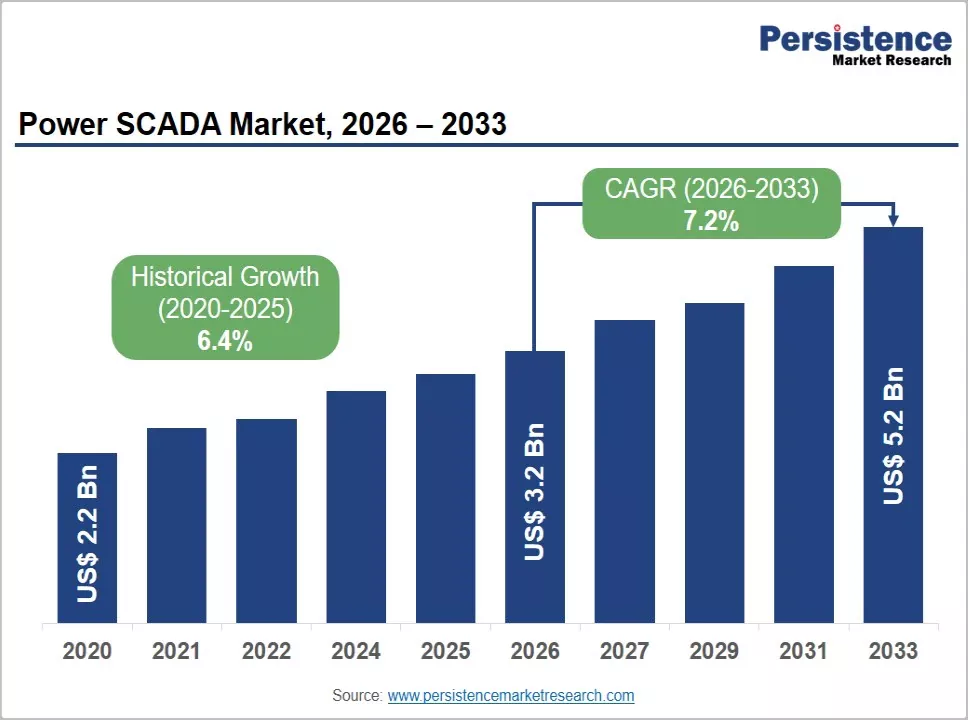
The global power SCADA market size is likely to be valued at US$ 3.2 billion in 2026, and is estimated to reach US$ 5.2 billion by 2033, growing at a CAGR of 7.2% during the forecast period 2026−2033. Growth is underpinned by the rising complexity of electrical networks, accelerating renewable and distributed energy integration, and increasing investment in cyber-secure monitoring and control across utilities and energy-intensive industries.
The market has been experiencing steady growth, supported by replacement of legacy systems and electrification programs. However, the forecast period anticipates stronger momentum as cloud-based architectures, artificial intelligence-enabled analytics, and grid edge intelligence reshape how power systems are supervised and optimized, while operators prioritize reliability, safety, and regulatory compliance.
Key Industry Highlights
- Dominant Architecture: Hardware is set to command around 44% of the revenue share in 2026, while software is likely to grow the fastest at about 8.6% CAGR through 2033, as cloud platforms, analytics, and advanced distribution management capabilities gain traction.
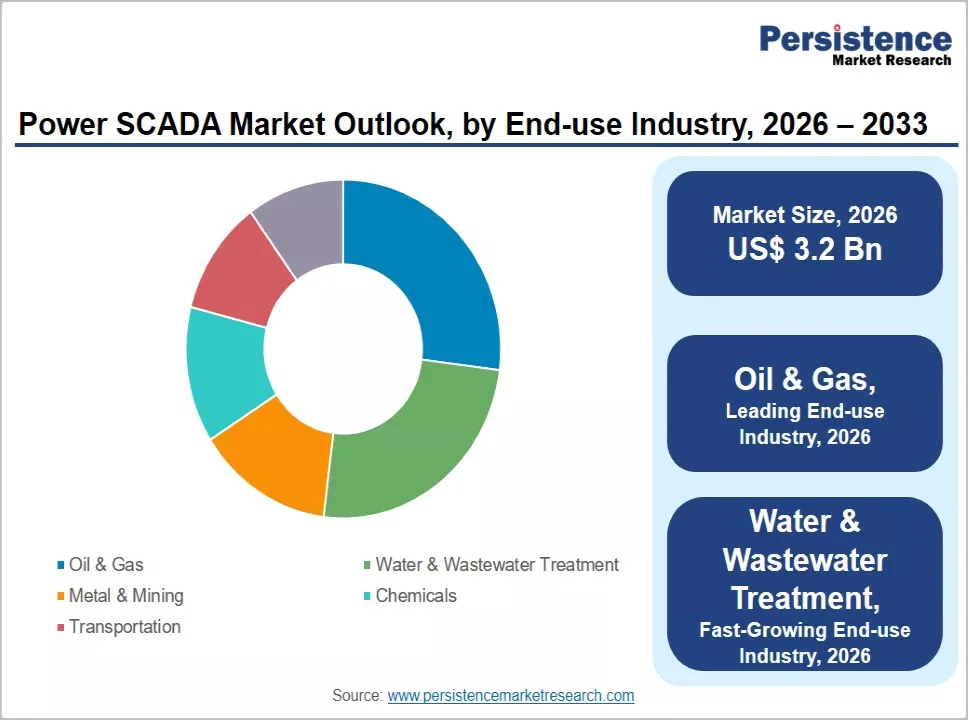
- Leading End-use Industry: Oil and gas is expected to lead with about 27% in 2026, while transportation is likely to be the fastest-growing end-use industry at about 8.2% CAGR during 2026–2033, reflecting electrified rail, metro, and airport power networks.
- Dominant Component: Remote terminal units (RTUs) are anticipated to lead with an estimated 24% share in 2026, while communication systems are slated to represent the fastest-growing component segment at 8.8% CAGR from 2026 to 2033.
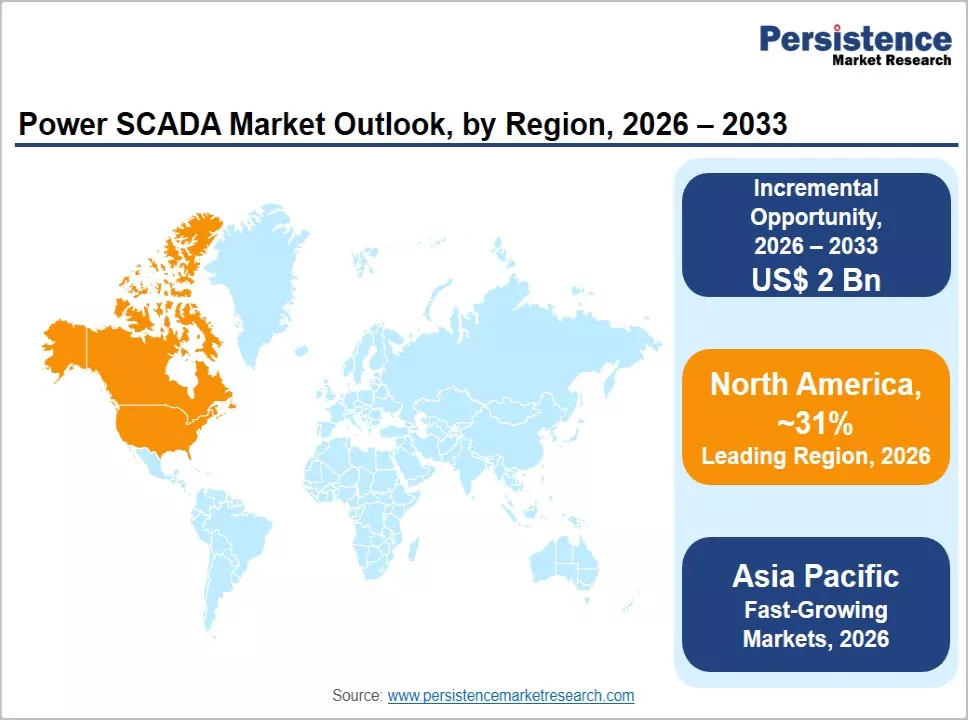
- Regional Leadership: North America is poised to lead with an estimated 31% share in 2026, while Asia Pacific is expected to register the fastest growth at a 9% CAGR through 2033, driven by grid expansion in China, India, and Southeast Asia.
- Competitive Environment: Competitive dynamics include cloud-based SCADA deployments for renewable fleets, cybersecurity-focused platform upgrades, and partnerships between automation majors and specialist software vendors
DRO Analysis
Drivers: Grid Modernization and Renewable Integration as Primary Growth Catalysts
Grid modernization and the integration of variable renewable energy are the leading forces driving the power SCADA market growth, as utilities and industrial operators require real-time visibility and control over increasingly decentralized power systems. Wind, solar, battery storage, and electric vehicle charging introduce bidirectional flows and rapid fluctuations that legacy control rooms were not designed to manage.
Modern power SCADA platforms provide supervisory monitoring, alarm management, remote switching, and data historians that support fault location, load balancing, and outage restoration. Government stimulus and regulatory mandates for reliability and resilience are accelerating replacement of ageing control systems, particularly in North America, Europe, and Asia Pacific.
Cloud-Based SCADA and Multi-Site Renewable Fleet Management
Renewable developers and independent power producers are adopting centralized, cloud-based SCADA to manage geographically dispersed assets with differing legacy systems and protocols. In February 2026, Siemens announced the delivery of a cloud-based SCADA system for Global Power Generation Australia that aggregates data from eight power plants and provides operators with a consistent interface across solar, wind, and battery storage sites. Such deployments reduce integration complexity, support faster commissioning, and enable portfolio-level optimization, making advanced power SCADA attractive to the rapidly expanding global renewable asset base.
Restraints: Cybersecurity Threats and Legacy System Integration Complexity
Cybersecurity is a major challenge for the power SCADA market, as control systems have become high-value targets for ransomware groups and state-linked actors seeking to disrupt critical infrastructure. Increasing connectivity between operational technology and information technology networks, remote access requirements, and the use of cloud services expand the attack surface.
Compliance with frameworks such as the North American Electric Reliability Corporation Critical Infrastructure Protection (NERC CIP) standards, the International Electrotechnical Commission (IEC) 62443 series, and the European Union's NIS2 Directive adds design and certification requirements. Many operators report shortages of skilled cybersecurity and control engineers, which can delay upgrades.
High Capital Costs and Interoperability Gaps
Installed power SCADA estates frequently combine equipment from multiple vendors and decades, running diverse protocols such as DNP3, IEC 60870-5-104, Modbus, and IEC 61850. Migrating these environments to unified platforms demands careful engineering, extensive testing, and downtime planning, increasing project cost and risk. Smaller utilities, municipal systems, and industrial operators often face constrained budgets and prolonged procurement cycles, as illustrated by public tenders for SCADA replacement that rely on staged contracts and incumbent integrators. These factors can slow adoption despite clear operational benefits, underscoring the need for open standards and phased modernization approaches.
Opportunities: Electrification of Transport and Industry and Distributed Energy Orchestration
Electrification of rail networks, metros, airports, ports, mining operations, and industrial processes is creating new demand for power monitoring and control. Data centers, driven by artificial intelligence workloads, are expanding electrical infrastructure and onsite generation, increasing requirements for supervisory control and energy management.
Utilities are extending SCADA into distributed energy resource management systems, as shown by vendors adding behind-the-meter coordination and time-series historians to their advanced distribution management platforms in 2026. These trends broaden the addressable market beyond traditional transmission and distribution into commercial, industrial, and campus-scale power systems.
Modernization Programs in Emerging and Public-Sector Markets
Public utilities and government agencies continue to modernize control systems, creating a steady project pipeline. In July 2026, the U.S. Department of Energy's Western Area Power Administration awarded annual term licenses for Open Systems International's monarch SCADA and energy management software, while Australian utility AGL contracted Synertec to upgrade its national SCADA infrastructure. Multilateral development banks are also financing SCADA and advanced distribution management projects in Europe, Africa, and Asia, supporting greenfield and retrofit deployments and offering opportunities in engineering services, cybersecurity, and long-term managed support.
Category-wise Insights
Architecture Analysis
Why Does Hardware Lead the Power SCADA Market?
Hardware is the leading architecture segment, expected to hold about 44% of the power SCADA market revenue share in 2026. It includes servers, workstations, field devices, controllers, communication gateways, and ruggedized equipment required for substations, power plants, and industrial facilities. Hardware demand is tied to capital projects, replacement cycles, and the expansion of electrical networks, which provides substantial and recurring volumes. Utilities and industrial operators also favor proven, certified equipment for mission-critical operations, supporting stable supplier relationships. Although software is capturing a growing share of value, hardware remains the foundation on which monitoring and control functions are deployed.
Software is likely to grow the fastest through 2033, at an estimated 8.6% CAGR. Platforms are evolving from standalone supervisory applications toward cloud-enabled, modular systems that integrate analytics, historians, digital twins, and artificial intelligence-driven decision support. Subscription licensing, remote updates, and containerized deployments are altering vendor revenue models and lowering entry barriers for smaller operators. Services, including engineering, system integration, cybersecurity assessments, and managed operations, are also expanding as operators outsource complex upgrades and lifecycle support. Together, software and services are expected to account for a rising proportion of total power SCADA spending.
End-use Industry Analysis
Which End-use Industry Dominates Power SCADA?
Oil and gas dominates the end-use industry segment, projected to capture about 27% of the revenue share in 2026. Upstream production sites, pipelines, refineries, and terminals depend on reliable electrical power and rely on SCADA to monitor motors, switchgear, compressors, and backup generation. High consequences of downtime, hazardous area safety requirements, and remote operating environments sustain investment in supervisory systems. Ongoing electrification of oil and gas operations, including power from renewable and grid sources to reduce emissions, is also increasing the scope of power monitoring and energy management within facilities.
Transportation represents the fastest-growing end-use industry segment, anticipated to achieve about 8.2% CAGR during the 2026–2033 period. Railway electrification, urban metro expansion, airport power systems, and electric vehicle charging corridors require integrated traction power and auxiliary power supervision. Water and wastewater treatment remains a consistent source of demand, as plants seek to reduce energy costs and ensure resilience, while metals and mining and chemicals use power SCADA to manage high-load processes, power quality, and safety interlocks. Other end-use industries, including data centers and commercial buildings, are emerging contributors as electrical systems grow in complexity.
Component Analysis
Why Do Remote Terminal Units Lead Component Demand?
Remote terminal units (RTUs) are poised to lead with an estimated 24% share in 2026, favored for their ability to collect field data and execute remote commands across geographically dispersed substations, feeders, and generation sites. RTUs support multiple communication protocols, operate reliably in harsh environments, and incorporate cybersecurity features and edge computing. Their widespread installation base and the need to retrofit legacy units sustain steady demand. Programmable logic controllers (PLCs) and protection relays, or intelligent electronic devices (IEDs), complement RTUs by delivering local automation and protection, and the convergence of these functions in multifunctional devices is a notable trend.
Communication systems are the fastest-growing component segment, expected to showcase an approximate 8.8% CAGR through 2033. Utilities are upgrading from serial and legacy links to Ethernet, fiber, private LTE, and 5G networks that deliver higher bandwidth, lower latency, and improved cybersecurity. Master terminal units (MTUs) and human machine interfaces (HMIs) form the control center layer, where operators visualize system status and issue commands; modern HMIs emphasize intuitive design, mobile access, and advanced alarm rationalization. Other components, including power meters, gateways, and time synchronization equipment, support accurate data and event sequencing.
Regional Insights
North America Power SCADA Market Trends and Insights
North America is anticipated to account for an estimated 31% of the global power SCADA market in 2026. The region's market is likely to benefit from ageing electrical infrastructure, rising electricity demand from data centers and electrification, and heightened focus on grid resilience and cybersecurity. Federal and state programmes supporting grid modernization, together with mandatory reliability standards, are encouraging utilities to replace legacy SCADA and energy management systems. Competition among established automation majors, specialist grid software vendors, and system integrators is expected to intensify through 2033 as utilities seek cloud-ready, cyber-secure platforms.
U.S. Power SCADA Market Size
The U.S. is estimated to account for approximately 84% of the North America power SCADA market in 2026. Market growth is likely to be supported by federal grid funding, including the Grid Resilience and Innovation Partnerships programme, utility capital plans, and demand growth from data centers and manufacturing. Municipal utilities and public power agencies are issuing tenders for SCADA, energy management, and outage management systems, while federal power marketing administrations are renewing software licenses and modernization contracts. NERC CIP compliance and resilience against extreme weather are expected to drive investment in secure, redundant control architectures through 2033.
Canada Power SCADA Market Size
Canada is projected to represent approximately 16% of the North America power SCADA market in 2026. Market expansion is expected to be driven by provincial utility investments in hydropower, transmission upgrades, and renewable integration, as well as electrification of mining and oil sands operations. Large utilities in Quebec, Ontario, British Columbia, and Alberta are likely to modernize control centers and distribution automation to improve reliability and accommodate distributed generation. Cybersecurity requirements for critical infrastructure and remote-site monitoring needs across vast geographies are anticipated to support adoption through 2033.
Europe Power SCADA Market Trends and Insights
Europe is estimated to account for approximately 15% of the global power SCADA market in 2026. The region's market is expected to benefit from the European Green Deal, rising renewable penetration, cross-border grid expansion, and stringent cybersecurity obligations under the NIS2 Directive. Transmission and distribution system operators are investing in advanced control centers, digital substations, and flexibility platforms to handle variable generation and electrification of heating and transport. Multilateral lenders are also financing SCADA and advanced distribution management projects in southeastern Europe, extending the market beyond Western European utilities.
Germany Power SCADA Market Size
Germany is anticipated to account for approximately 24% of the Europe power SCADA market in 2026. Demand is expected to be supported by the Energiewende energy transition, extensive grid expansion plans, and the need to manage high volumes of distributed wind and solar generation. Transmission operators and municipal utilities are upgrading network control systems, while industrial users in chemicals, metals, and manufacturing deploy power monitoring to reduce energy costs and improve resilience. Strong domestic automation suppliers and requirements for secure, interoperable systems are projected to sustain market expansion through 2033.
Why Is Asia Pacific Expected to Grow the Fastest in the Power SCADA Market?
Asia Pacific is projected to account for approximately 29% of the global power SCADA market in 2026, and is anticipated to register the fastest growth, expanding at an estimated CAGR of 9% through 2033. Market expansion is likely to be driven by rapid electricity demand growth, large-scale transmission and distribution investments, and the integration of renewable energy. China and India are expected to remain the primary demand centers, supported by government-led grid modernization, while Southeast Asian countries, Japan, South Korea, and Australia contribute through industrial automation, renewable fleet management, and utility upgrades.
China Power SCADA Market Size
China is estimated to represent approximately 38% of the Asia Pacific power SCADA market in 2026. The country's market is expected to benefit from sustained grid investment by State Grid Corporation of China and China Southern Power Grid, expansion of ultra-high-voltage transmission, and rapid additions of wind, solar, and energy storage. Domestic suppliers are strengthening their positions through localized software and hardware, supported by government emphasis on technological self-reliance and cybersecurity. Smart substations, distribution automation, and industrial power monitoring are projected to sustain China's regional market leadership through 2033.
India Power SCADA Market Size
India is projected to account for approximately 20% of the Asia Pacific power SCADA market in 2026. The market is expected to witness strong expansion, supported by the Revamped Distribution Sector Scheme, smart metering rollouts, and state utility investments in distribution automation and SCADA/ADMS systems. Rapid growth in renewable capacity, particularly solar and wind in Rajasthan and Gujarat, is increasing the need for real-time grid visibility and forecasting. Domestic engineering companies and global vendors are expanding delivery capacity, while industrial users in metals, mining, and water infrastructure are adopting power monitoring to improve reliability and efficiency.
Competitive Landscape
The global power SCADA market structure is moderately consolidated, with leading vendors including Siemens, ABB, Schneider Electric, GE Vernova, Hitachi Energy, and Honeywell holding a substantial share of revenue. These established players leverage deep utility relationships, integrated hardware and software portfolios, global service networks, and sustained R&D investment in cloud architectures, cybersecurity, and artificial intelligence-driven analytics. Long project cycles, high reliability requirements, and extensive certification needs favor incumbents with proven track records.
Specialist and regional competitors such as Emerson, Rockwell Automation, Mitsubishi Electric, Schweitzer Engineering Laboratories, and Larsen & Toubro focus on selected segments, protection and control technologies, and local markets. Digitalization is enabling software-centric companies to compete through cloud-hosted, subscription-based offerings, and system integrators play a key role in customizing deployments. Market consolidation is expected to continue gradually as global leaders acquire niche software and cybersecurity providers, while partnerships between automation vendors, telecom providers, and cloud platforms expand integrated solutions.
Key Market Developments
- In February 2026, Siemens announced the delivery of a cloud-based SCADA system for Global Power Generation Australia, aggregating data from eight renewable and storage plants with different legacy systems into a single operator interface.
- In July 2026, The U.S. Department of Energy's Western Area Power Administration awarded a sole-source contract for annual term licenses of Open Systems International's monarch SCADA and energy management system software.
- In July 2026, Synertec executed a binding contract with AGL Energy to deliver the SOLIS Project, a national SCADA upgrade replacing legacy infrastructure with a cyber-secure, scalable platform.
Companies Covered in Power SCADA Market
- Siemens AG
- ABB Ltd.
- Schneider Electric SE
- GE Vernova Inc.
- Hitachi Energy Ltd.
- Honeywell International Inc.
- Emerson Electric Co.
- Rockwell Automation, Inc.
- Mitsubishi Electric Corporation
- Schweitzer Engineering Laboratories, Inc. (SEL)
- Larsen & Toubro Limited
Frequently Asked Questions
The global power SCADA market is valued at US$ 3.2 billion in 2026 and is projected to reach US$ 5.2 billion by 2033, expanding at a CAGR of 7.2% during 2026–2033.
Grid modernization, renewable and distributed energy integration, replacement of legacy control systems, and investment in cyber-secure monitoring and control are driving the market.
Hardware leads architectures with about 44% share, oil and gas leads end-use industries with about 27%, and remote terminal units lead components with an estimated 24% in 2026.
North America leads the market with an estimated 31% share in 2026 on the back of grid resilience investment and ageing infrastructure, while Asia Pacific is projected to grow fastest at a 9% CAGR through 2033.
Cloud-based SCADA for renewable fleets, electrification of transport and industry, data center power management, and public-sector modernization programmes are key market opportunities


