




- Food Ingredients & Additives
- Powder Dairy Blends Market
Powder Dairy Blends Market Size, Share, and Growth Forecast, 2026 - 2033
Powder Dairy Blends Market by Ingredient Type (Fat-Filled Milk Powder Blends, Milk Protein & Whey-Protein Blends, Others), Application (Beverages & Creamers, Infant Formula & Baby Food, Others), End-User, and Regional Analysis for 2026 - 2033

Powder Dairy Blends Market Size and Trends Analysis
The global powder dairy blends market size is likely to be valued at US$ 2.3 billion in 2026 and is expected to reach US$ 3.8 billion by 2033, growing at a CAGR of 7.3% between 2026 and 2033.
Market growth is supported by increasing demand for shelf-stable dairy ingredients, expanding applications in processed foods and beverages, and the development of specialized nutritional formulations. Manufacturers are adopting powder dairy blends to improve formulation consistency, simplify ingredient handling, and manage production costs. Demand for high-protein ingredients, infant nutrition, and customized food formulations is expected to create additional opportunities through 2033.
Key Industry Highlights
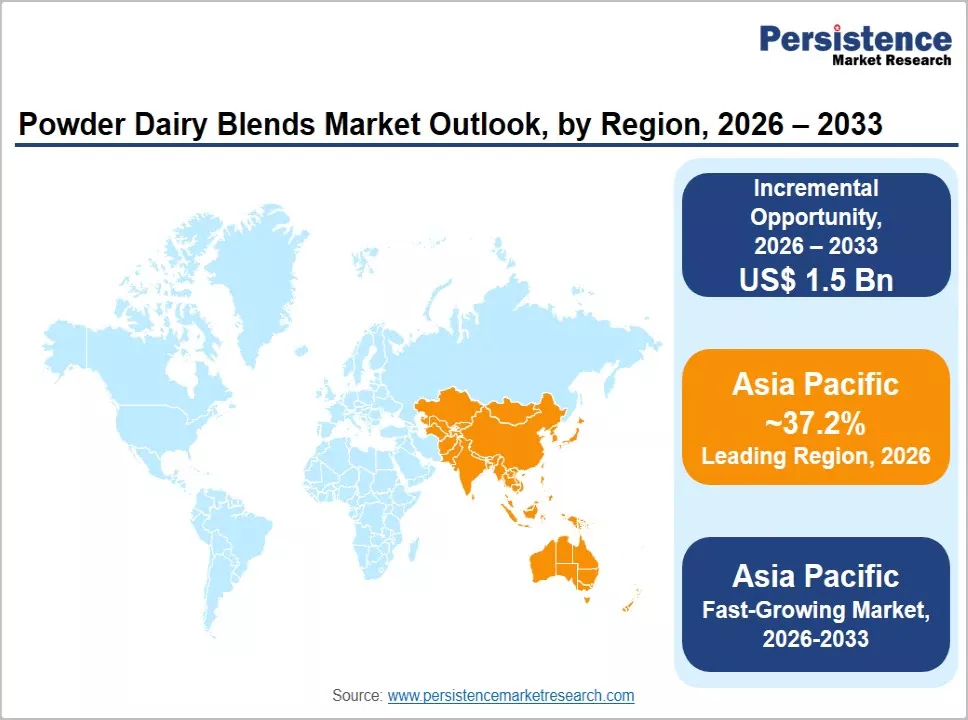
- Leading Region: Asia Pacific is likely to lead the global market by holding around 37.2% share in 2026, supported by large-scale dairy processing, expanding packaged-food manufacturing, and demand for dairy-based beverages and nutritional products.
- Dominant Ingredient Type: Fat-filled milk powder blends are the leading ingredient type, accounting for around 34.9% of market share in 2026, supported by their cost efficiency and applications in recombined dairy products, bakery fillings, confectionery, ice cream, and beverage mixes.
- Leading Application: Beverages & creamers represent the leading application, accounting for an estimated 41.6% of the market share in 2026, driven by demand for coffee creamers, instant beverage mixes, flavored milk powders, and dairy-based beverage formulations.
Market Dynamics
Drivers - Growing Demand for Cost-Efficient, Shelf-Stable Dairy Ingredients
Powder dairy blends help food manufacturers standardize fat, protein, lactose, flavor, and functional properties while simplifying transportation, storage, and production planning. Their use is particularly relevant in emerging economies, where manufacturers need to balance product quality with affordability. International dairy trade also supports demand for processed dairy ingredients by connecting milk-producing regions with food manufacturers across different markets. Milk powders and other processed dairy products offer practical advantages over liquid ingredients because they generally require less storage space per unit of product and have longer shelf lives when packaged and stored appropriately.
For manufacturers, blended powders can reduce ingredient-handling complexity and provide more predictable formulation performance. Fat-filled milk powder blends are particularly relevant to price-sensitive applications because they combine milk solids with vegetable fat. Their commercial advantage, however, depends on milk powder prices, edible-oil costs, import duties, transportation expenses, and the intended product formulation. Suppliers that maintain consistent quality while offering competitive pricing can strengthen relationships with industrial food manufacturers.
Increasing Demand for Protein-Rich Foods and Specialized Nutrition
Demand for dairy proteins is rising alongside the development of high-protein beverages, nutritional supplements, fortified foods, and specialized nutrition products. Manufacturers increasingly seek blends that deliver targeted protein content, solubility, flavor, and texture without requiring several independent ingredient additions. Milk protein and whey-protein combinations can help manufacturers achieve specific nutritional and processing requirements while simplifying formulation and production workflows.
Investment in specialty dairy ingredients reflects this trend. In March 2026, FrieslandCampina Ingredients completed an expansion at its Borculo facility in the Netherlands, doubling production capacity for whey protein isolate and milk fat globule membrane. The additional capacity supports early-life, active, and medical nutrition applications. Such investments demonstrate the industry's focus on higher-value dairy ingredients and specialized formulations.
Protein-oriented formulations can support product differentiation and premium pricing, although manufacturers must maintain tight controls over ingredient quality, formulation stability, nutritional specifications, and sensory performance. Suppliers with reliable technical support and consistent production capabilities are better positioned to serve customers developing differentiated nutritional products.
Restraint - Volatile Raw Material Prices and Supply-Chain Constraints
Powder dairy blends depend on milk powder, whey, milk proteins, lactose, vegetable oils, energy, packaging, and international freight. Price movements across these inputs can compress manufacturers' margins and make long-term pricing difficult. In 2024, U.S. nonfat dry milk and skim milk powder exports declined amid supply constraints and competition from other exporting countries, illustrating how changes in milk availability and international market conditions can affect ingredient flows.
Blenders face additional challenges when milk-based ingredients and vegetable fats move in different directions. Foreign exchange movements, import duties, shipping costs, and supplier concentration can alter the relative economics of competing formulations. Specialty blends also require qualification testing and customer approval, limiting the speed at which manufacturers can switch ingredients. Companies can reduce exposure through diversified procurement, supplier agreements, inventory planning, and carefully controlled formulations that maintain performance across approved ingredient specifications.
Opportunities – Rising Demand for Customized, High-Protein and Functional Dairy Blends
Ingredient suppliers can expand beyond commodity powders by developing blends for high-protein beverages, nutritional bars, clinical nutrition, and protein-enriched bakery products. Customer-specific formulations can combine milk protein, whey protein, lactose, and other dairy ingredients to meet defined nutritional and processing requirements. These formulations are particularly valuable when manufacturers need consistent dispersibility, controlled viscosity, reduced sedimentation, or acceptable flavor in protein-fortified products.
In May 2026, FrieslandCampina announced an investment program exceeding EUR 90 million to strengthen high-value whey-protein production across its Dutch manufacturing network. Planned upgrades support the production of WPC80, instantized whey proteins, and specialized ingredients for protein-enriched drinks, bars, and yogurts.
This investment trend creates opportunities for suppliers with application laboratories, formulation expertise, and reliable quality-management systems. Rather than competing exclusively on price, companies can differentiate themselves through product performance, technical collaboration, and the ability to develop blends tailored to specific processing conditions.
Increasing Demand in Asia Pacific
Asia Pacific offers opportunities across beverages, bakery, confectionery, recombined dairy products, and nutritional foods. The region combines large consumer markets with extensive food-processing capabilities and established dairy ingredient supply chains. India's milk production reached 247.87 million tons in fiscal year 2024–25, an increase of 3.58% from the previous year, according to the Department of Animal Husbandry and Dairying.
Despite India's substantial domestic milk supply, processors continue to evaluate dairy powders and blends based on seasonality, product specifications, processing requirements, and cost considerations. Other Asian markets also offer opportunities for ingredients used in packaged beverages, bakery products, desserts, and industrial food production.
Suppliers can capitalize on these opportunities through localized formulations, regional distribution partnerships, flexible packaging, and technical support tailored to national markets. Success depends on ingredient affordability, food safety compliance, local purchasing preferences, and the ability to maintain consistent product quality across different production environments.
Category-wise Analysis
Ingredient Type Insights
Fat-filled milk powder blends are the leading ingredient type segment, anticipated to account for around 34.9% of the market share in 2026. These blends combine skimmed milk solids with vegetable fat and are used in recombined dairy products, bakery fillings, confectionery, ice cream, and beverage mixes. Their appeal lies in formulation flexibility and cost management. For example, manufacturers can use them in economical tea whiteners, bakery creams, and frozen desserts. Product performance depends on fat selection, flavor, mouthfeel, moisture control, and storage stability.
Milk protein & whey-protein blends represent the fastest-growing ingredient type segment, driven by rising demand for protein-fortified beverages, sports nutrition, and clinical nutrition products. Whey-protein blends are heavily used in high-protein drink mixes and nutritional shakes, where solubility and consistent protein content are important. Suppliers offering customized compositions and reliable processing performance are well positioned to serve specialized food manufacturers.
Application Insights
Beverages & creamers constitute the leading application segment, holding around 41.6% share of the market in 2026. The segment's dominance is supported by rising demand for flavored milk powders, coffee creamers, instant beverage mixes, and ready-to-drink products. Dairy powders and blends are widely used in instant coffee whiteners, powdered milk-based beverages, and commercial beverage manufacturing. Key performance requirements include solubility, dispersion, flavor consistency, and stability across hot and cold applications.
Infant formula & baby food represents the fastest-growing application segment, growing at a projected CAGR of around 10.0% through 2033. Growth is driven by demand for specialized nutritional products and dairy-derived ingredients that meet precise compositional requirements. Selected dairy ingredients are used in infant formula and pediatric nutrition products when they comply with applicable nutritional, safety, and regulatory standards. Strict quality assurance, ingredient traceability, and supplier qualification remain essential, as conventional dairy blends are not automatically suitable for infant nutrition.
Regional Analysis
North America Powder Dairy Blends Market Trends
North America represents an established market for powder dairy blends, supported by advanced food-processing capabilities, a mature dairy ingredient industry, and demand from beverage, bakery, confectionery, and specialized nutrition manufacturers. The U.S. accounts for a substantial portion of regional demand, owing to rising adoption of bakery products. Canada contributes through its established dairy-processing sector.
U.S. Powder Dairy Blends Market Trends
The U.S. market is supported by an extensive dairy ingredient industry and demand for coffee creamers, instant beverage mixes, and protein-enriched nutrition products. U.S. dairy exports reached around US$ 9.63 billion in 2025, equivalent to 2.32 million metric tons of milk solids. Specialty whey proteins and milk protein concentrates serve higher-value applications, while commodity milk powders remain exposed to different pricing and trade conditions.
Companies such as Glanbia Nutritionals and Dairy Farmers of America supply dairy proteins and industrial ingredients that help food manufacturers adjust protein content, texture, and processing performance. Stringent food safety and labeling requirements, particularly for infant formula, further emphasize the importance of ingredient traceability and supplier qualification.
Canada Powder Dairy Blends Market Trends
Canada's dairy supply-management system influences domestic milk availability, pricing, and sourcing decisions. Established dairy processors supply ingredients to food manufacturers, while demand from bakery, beverage, and nutrition applications supports opportunities for customized blends. Suppliers need to account for import requirements and differences between Canadian and U.S. procurement conditions when planning regional distribution. Rising demand for protein-rich beverages, coffee whiteners, and application-specific blends offers growth opportunities, although raw-material price volatility and competition from alternative ingredients remain key constraints.
Europe Powder Dairy Blends Market Trends
The European market benefits from an established dairy-processing industry, cross-border trade, and manufacturers serving industrial food and nutrition markets. EU farms produced around 161.8 million tons of raw milk in 2024, supporting a broad range of dairy products and ingredients, although this output does not directly measure demand for powder dairy blends. Export trends also vary by product category: EU skim milk powder exports increased in 2025, while whole milk powder exports declined, reflecting differences in supply conditions and market demand.
Germany Powder Dairy Blends Market Trends
Germany's extensive food-processing base and established dairy industry support demand for milk powders and functional dairy ingredients. Companies such as DMK Group supply dairy products and ingredients to industrial customers. Demand from bakery, confectionery, and prepared-food manufacturers favors consistent ingredient quality, reliable bulk supply, and formulations suited to specific processing requirements. Energy costs, milk availability, and competition for raw materials influence production economics and purchasing decisions.
France Powder Dairy Blends Market Trends
France combines substantial dairy production with established food manufacturing and ingredient-processing capabilities. Lactalis Ingredients supplies milk powders and whey-based ingredients for industrial applications, supporting manufacturers across diverse product formulations. EU food safety, hygiene, and labeling requirements influence product development, particularly in specialized nutrition. Opportunities are supported by demand for customized blends, specialty proteins, and export-oriented production, while profitability remains sensitive to processing costs and international competition.
Asia Pacific Powder Dairy Blends Market Trends
Asia Pacific is expected to lead the global powder dairy blends market by holding around 37.2% share in 2026. The region’s leadership is supported by expanding food manufacturing capacity, rising consumption of packaged foods, and demand for dairy-based beverages. However, growth varies across countries according to domestic milk production, import dependence, consumer preferences, and dairy ingredient prices.
India Powder Dairy Blends Market Trends
India represents a significant market within Asia Pacific, supported by its large dairy industry and expanding food-processing sector. Milk production reached 247.87 million tonnes in fiscal year 2024–25, an increase of 3.58% from the previous year. The Amul portfolio illustrates the breadth of India's dairy market, while its cooperative network links milk procurement with large-scale processing and distribution. This domestic supply base supports demand for milk powders and industrial dairy ingredients used in beverages, bakery products, and prepared foods.
However, abundant liquid milk does not automatically translate into equivalent demand for powder dairy blends. Manufacturers assess seasonal availability, processing economics, product specifications, and end-use requirements when determining ingredient sourcing. Investment in value-added ingredients and customized blending offers opportunities to serve food manufacturers seeking consistent quality and cost-efficient production.
China Powder Dairy Blends Market Trends
China combines a large packaged-food industry with domestic dairy production and imports of selected specialized ingredients. In March 2026, Fonterra showcased its NZMP range of milk proteins and functional dairy ingredients at Food Ingredients China in Shanghai. This activity highlights the role of customer engagement and technical ingredient development in a market where demand differs between commodity powders and higher-value formulations. Suppliers face competition from domestic producers and need to address import requirements, customer-specific quality standards, and changing ingredient preferences.
Southeast Asia Powder Dairy Blends Market Trends
High demand from beverage, bakery, confectionery, and foodservice manufacturers across Indonesia, Vietnam, Thailand, and the Philippines creates opportunities for powder dairy blend suppliers. Market expansion depends on product affordability, localized formulations, reliable supply, and compliance with national food regulations. Suppliers that adapt ingredient specifications and distribution strategies to local manufacturing needs are positioned to serve the region's diverse food-processing markets.
Competitive Landscape
The global powder dairy blends market includes global dairy cooperatives, multinational ingredient manufacturers, specialty protein suppliers, and regional blending companies. Large integrated suppliers benefit from established milk procurement networks, processing infrastructure, export capabilities, and long-standing relationships with food manufacturers. Smaller specialists compete through customized formulations, flexible production volumes, local distribution, and application-specific technical support.
Leading suppliers emphasize specialty ingredient innovation, manufacturing efficiency, and geographic expansion. Integrated dairy processors leverage established milk procurement and production networks, while specialist manufacturers compete through protein functionality and customized formulations. Technical collaboration, consistent quality, reliable delivery, and application-specific product development remain important differentiators. Long-term supply agreements, joint formulation development, and regional distribution partnerships can strengthen customer relationships and support market expansion.
Key Industry Developments
- In October 2026, Hilmar Cheese Company launched PROtelyze Bio-Brain, a whey-derived peptide ingredient designed for cognitive wellness applications in food, beverages, powders, bars, and dietary supplements.
- In May 2026, FrieslandCampina Ingredients completed its acquisition of Wisconsin Whey Protein, a U.S.-based whey protein isolate producer.
Companies Covered in Powder Dairy Blends Market
- Fonterra Co-operative Group Limited
- FrieslandCampina Ingredients
- Lactalis Ingredients
- Arla Foods Ingredients
- Glanbia Nutritionals
- Dairy Farmers of America
- Saputo Inc.
- Kerry Group plc
- Agropur Cooperative
- DMK Group
- Milk Specialties Global
- Hilmar Cheese Company
- Valio Ltd.
- Ingredia SA
- Uelzena eG
- Gujarat Cooperative Milk Marketing Federation (Amul)
Frequently Asked Questions
The global powder dairy blends market is expected to be valued at US$ 2.3 billion in 2026.
The market is projected to reach US$ 3.8 billion by 2033.
Key trends include rising demand for protein-enriched beverages, customized dairy formulations, convenient powdered ingredients, and functional blends for bakery, confectionery, and specialized nutrition applications.
By ingredient type, fat-filled milk powder blends lead the market, accounting for an estimated 34.9% share.
The market is projected to grow at a CAGR of 7.3% from 2026 to 2033.
Major companies include Fonterra Co-operative Group, FrieslandCampina Ingredients, Lactalis Ingredients, Arla Foods Ingredients, and Glanbia Nutritionals.


