




- Technology
- Micro-location Technology Market
Micro-location Technology Market Size, Share, and Growth Forecast, 2026 - 2033
Micro-location Technology Market by Technology (Bluetooth Low Energy (BLE), Ultra-Wideband (UWB), Other), Component (Hardware, Software, Others), Application, End-use Industry, and Regional Analysis for 2026 - 2033

Micro-location Technology Market Size and Trends Analysis
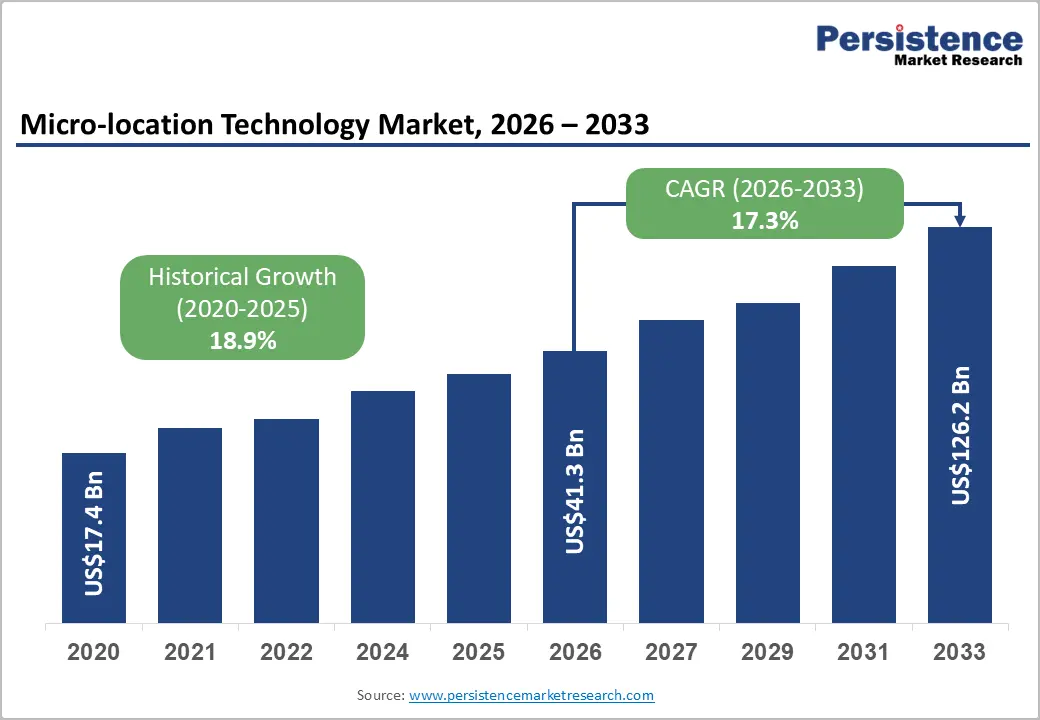
The global micro-location technology market size is likely to be valued at US$41.3 billion in 2026 and is expected to reach US$126.2 billion by 2033, growing at a CAGR of 17.3% during the forecast period from 2026 to 2033, driven by the increasing adoption of Bluetooth Low Energy (BLE), Ultra-Wideband (UWB), Wi-Fi, RFID, and NFC technologies for real-time indoor positioning and asset visibility.
Enterprises are prioritizing operational efficiency, workforce safety, and workflow optimization, while advancements in precision positioning and cloud-native analytics platforms are expanding the commercial applicability of micro-location systems. Regulatory harmonization for UWB spectrum use and growing investments in smart buildings, digital healthcare infrastructure, and connected retail environments are further supporting market expansion.
Key Industry Highlights:
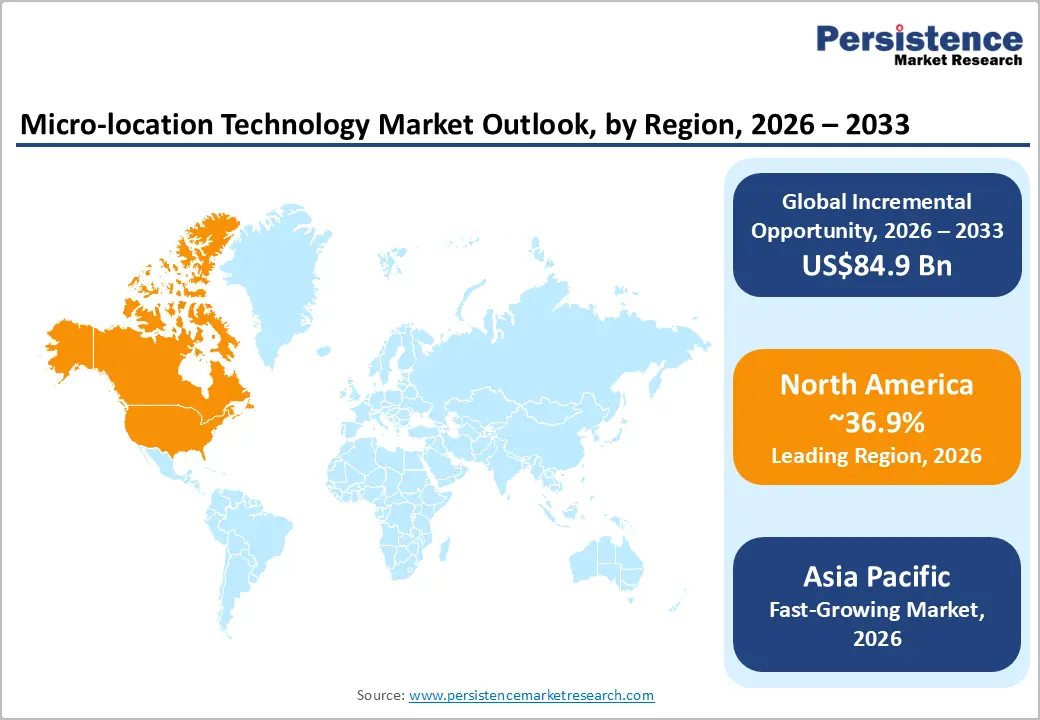
- Leading Region: North America is projected to lead with approximately 36.9% market share in 2026, supported by advanced healthcare infrastructure, strong enterprise IoT adoption, and large-scale RTLS deployment across the retail, logistics, and manufacturing sectors.
- Fastest-growing Region: Asia Pacific is anticipated to be the fastest-growing regional market, driven by rapid industrial automation, electronics manufacturing, smart city initiatives, and warehouse modernization across China, India, Japan, South Korea, and ASEAN countries.
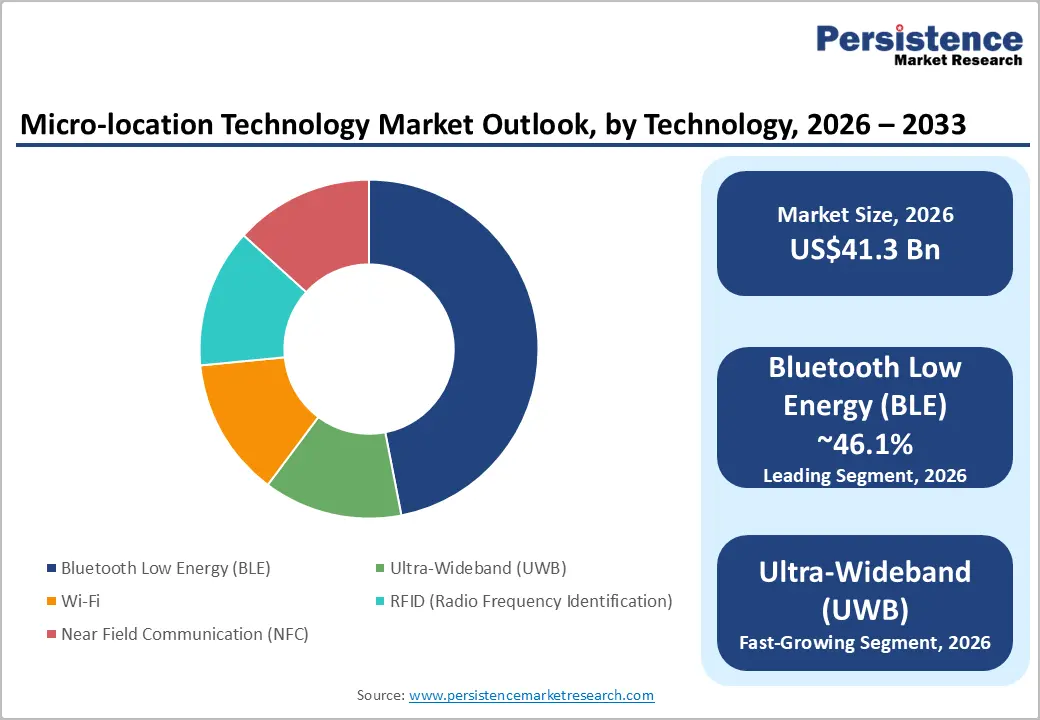
- Dominant Technology: Bluetooth Low Energy (BLE) is anticipated to lead with approximately 46.1% market share in 2026, supported by low power consumption, cost efficiency, and widespread adoption across retail, healthcare, logistics, and smart building applications.
- Leading Component: Hardware is estimated to account for approximately 58.3% revenue share in 2026, driven by strong demand for tags, sensors, anchors, readers, gateways, and wireless communication infrastructure required for RTLS and indoor positioning deployments.
DRO Analysis
Driver - Rising Demand for Real-Time Asset Visibility and Operational Efficiency
Micro-location technologies are increasingly becoming critical enterprise infrastructure rather than optional digital tools. Organizations across healthcare, retail, logistics, and manufacturing are deploying real-time location systems (RTLS) to improve operational transparency, optimize asset utilization, and enhance workforce safety. Hospitals are using RTLS platforms to monitor medical equipment, patient movement, and staff workflows, while warehouses and manufacturing facilities are integrating location intelligence into inventory and production management systems.
The retail sector is also adopting micro-location technologies to improve inventory accuracy, reduce stock losses, and support omnichannel operations. Industrial facilities are leveraging worker-tracking capabilities to strengthen safety compliance and reduce operational downtime. These deployments create recurring demand for tags, sensors, anchors, gateways, analytics software, and managed services. As enterprises prioritize data-driven operational control and automation, micro-location solutions are increasingly integrated into broader IoT and smart facility ecosystems, significantly strengthening long-term market demand.
Technological Advancements and Expansion of Device Ecosystems
The market is benefiting from rapid improvements in wireless positioning accuracy and interoperability. Bluetooth Direction Finding and UWB technologies now support centimeter-level positioning, enabling highly precise indoor navigation and object tracking applications. These advancements are expanding use cases across industrial automation, healthcare monitoring, connected retail, airport navigation, and smart campuses.
Consumer electronics companies are also accelerating adoption by integrating advanced positioning technologies into smartphones, wearables, and tracking devices. Improved compatibility between BLE, UWB, NFC, Wi-Fi, and cloud analytics platforms is reducing deployment complexity and broadening the addressable market. Standards development initiatives are further improving ecosystem interoperability and enabling scalable deployments across industries. The expansion of connected devices, combined with improvements in edge computing and low-power wireless communication, is expected to significantly increase enterprise investment in micro-location technologies throughout the forecast period.
Restraint - Privacy Concerns and Complex Deployment Requirements
Despite strong growth prospects, the market faces structural challenges related to privacy compliance, implementation complexity, and integration costs. Location intelligence systems often process sensitive employee, patient, or customer data, requiring organizations to comply with strict data protection regulations and cybersecurity standards. Compliance requirements surrounding consent management, data retention, and secure information handling increase deployment costs and lengthen procurement cycles.
Integration with the existing IT infrastructure, Wi-Fi networks, building management systems, and analytics platforms also creates operational challenges. Large-scale deployments require careful calibration, interoperability testing, and long-term maintenance, particularly in hospitals, industrial facilities, airports, and retail chains. Organizations without clearly defined operational goals may struggle to achieve measurable returns on investment, creating additional adoption barriers for smaller enterprises with limited digital transformation budgets.
Opportunity - AI-Driven Analytics and Cloud-Native RTLS Platforms
The market is shifting from hardware-centric deployments toward intelligent software ecosystems capable of transforming location data into actionable business insights. Enterprises increasingly demand cloud-native RTLS platforms that support occupancy analytics, workflow automation, predictive alerts, and centralized device management. Artificial intelligence and machine learning are enhancing the ability of micro-location systems to identify patterns, optimize workflows, and improve decision-making across complex operating environments.
Healthcare facilities are adopting AI-enabled RTLS solutions for patient flow management and equipment utilization analysis, while retail organizations are using location analytics to understand consumer movement patterns and optimize store layouts. Manufacturing companies are leveraging real-time location intelligence to improve logistics coordination and production efficiency. As organizations continue investing in digital transformation initiatives, software-driven micro-location platforms are expected to generate substantial long-term revenue opportunities.
Convergence with Smart Infrastructure and 5G Positioning
Micro-location technologies are increasingly converging with 5G infrastructure, smart buildings, digital identity systems, and proximity engagement platforms. The integration of BLE, UWB, NFC, Wi-Fi, and cellular positioning technologies is enabling highly scalable hybrid location environments capable of supporting both indoor and outdoor positioning applications.
Retailers are using proximity engagement systems to deliver personalized customer experiences, digital promotions, and loyalty program integration. Transportation hubs and smart cities are deploying location-aware navigation and crowd-management systems to improve operational efficiency and public safety. The emergence of 5G advanced positioning capabilities is expected to improve precision, latency, and scalability, opening new opportunities across autonomous systems, industrial automation, logistics management, and connected mobility ecosystems.
Category-wise Analysis
Technology Insights
Bluetooth Low Energy (BLE) is anticipated to account for approximately 46.1% market share in 2026, making it the leading technology segment in the micro-location technology market. BLE adoption is driven by low power consumption, cost-efficiency, scalability, and compatibility with smartphones, wearables, and enterprise IoT infrastructure. Retailers use BLE beacons for proximity marketing and in-store navigation, while hospitals deploy BLE-enabled RTLS systems to track medical equipment and staff movement.
Companies, such as Apple and Kontakt.io, have expanded BLE applications across consumer tracking and smart facility management. Manufacturing and logistics operators are also integrating BLE with warehouse management systems to improve inventory visibility and operational efficiency.
Ultra-Wideband (UWB) is anticipated to be the fastest-growing technology segment due to its centimeter-level positioning accuracy. UWB adoption is accelerating across automotive manufacturing, industrial automation, airport navigation, and healthcare environments where high-precision tracking is critical. Apple’s AirTag ecosystem and Samsung’s SmartThings Find platform demonstrate the growing consumer integration of UWB technology. Enterprises are increasingly deploying hybrid systems that combine UWB with BLE, RFID, and Wi-Fi to balance positioning accuracy with cost efficiency.
Wi-Fi, RFID, and NFC technologies continue to support specialized use cases such as access control, contactless payments, and inventory management.
Component Insights
Hardware is anticipated to hold approximately 58.3% revenue share in 2026, maintaining its position as the leading component segment. Market growth continues to depend on large-scale deployment of tags, sensors, readers, anchors, gateways, and wireless communication infrastructure. Retailers, such as Walmart and Decathlon, have expanded RFID-enabled inventory tracking systems, while healthcare providers increasingly deploy RTLS hardware to monitor critical equipment and patient movement. Hardware vendors are focusing on battery optimization, positioning accuracy, and industrial-grade durability to support deployment in warehouses, factories, airports, and healthcare facilities.
Software is anticipated to be the fastest-growing component segment during the forecast period as enterprises increasingly prioritize cloud-based analytics, workflow automation, and AI-driven operational intelligence. Cisco Spaces and Zebra Technologies are expanding software platforms that combine indoor positioning with occupancy analytics and workflow optimization. Healthcare providers are using RTLS software to improve patient flow management, while manufacturers are integrating micro-location analytics into industrial IoT and digital twin systems. Services remain important for infrastructure integration, deployment consulting, calibration, and long-term managed operations support.
Regional Insights
North America Micro-location Technology Market Trends
North America is anticipated to account for approximately 36.9% of market revenue, maintaining its position as the leading regional market throughout the forecast period. The region is projected to expand at a CAGR of approximately 17.8% through 2033, supported by strong enterprise technology adoption, advanced healthcare infrastructure, and a mature IoT ecosystem. Demand is being driven by increasing investments in RTLS systems, smart buildings, connected retail infrastructure, warehouse automation, and industrial digitalization.
U.S. Micro-location Technology Market Trends
The U.S. is anticipated to contribute approximately 72% of the regional share in 2026, making it the dominant country-level market within North America. The country benefits from high enterprise spending on smart infrastructure, healthcare digitization, industrial automation, and connected retail technologies. Hospitals across the U.S. are rapidly adopting RTLS systems for patient monitoring, medical equipment tracking, and workflow optimization, while retailers are using BLE and RFID solutions to strengthen omnichannel inventory management.
Smart campus deployments, airport modernization projects, and warehouse automation initiatives are further accelerating market growth. Industrial organizations are integrating micro-location technologies into Industry 4.0 environments to support predictive maintenance, robotics coordination, and digital twin applications.
Canada Micro-location Technology Market Trends
Canada is emerging as a steadily growing market due to increasing investments in smart healthcare infrastructure, industrial automation, and connected logistics systems. Retailers and transportation providers are adopting indoor navigation and asset tracking technologies to improve operational efficiency and customer experience. Government-led smart city initiatives and expanding IoT adoption across manufacturing and logistics sectors are expected to support long-term market growth.
Europe Micro-location Technology Market Trends
Europe represents a technologically advanced market supported by strong regulatory harmonization, industrial automation initiatives, and smart infrastructure investments. The region is witnessing increasing adoption of BLE, UWB, RFID, and NFC technologies across manufacturing, healthcare, transportation, retail, and logistics applications. Strict data protection regulations are encouraging enterprises to deploy secure, interoperable, and enterprise-grade location intelligence platforms.
Germany Micro-location Technology Market Trends
Germany remains the leading market in Europe due to its strong industrial automation ecosystem and advanced manufacturing infrastructure. Smart factory deployments and Industry 4.0 initiatives are driving significant demand for high-precision RTLS and workflow optimization platforms. Automotive manufacturers and industrial operators are increasingly deploying UWB and BLE technologies to improve production efficiency, inventory control, and worker safety.
U.K. Micro-location Technology Market Trends
The U.K. is witnessing strong adoption across healthcare, transportation, and retail sectors. Hospitals are investing in patient monitoring and medical asset tracking systems, while transportation hubs are deploying indoor navigation and passenger management technologies. Retailers are increasingly integrating BLE and NFC solutions into customer engagement and digital payment ecosystems.
France Micro-location Technology Market Trends
France is experiencing rising demand for smart infrastructure and connected mobility solutions. The country is investing in airport modernization, smart transportation systems, and healthcare digitization projects that rely on location intelligence platforms. Logistics providers and retailers are also strengthening adoption of RTLS systems to improve operational efficiency and supply chain visibility.
Spain Micro-location Technology Market Trends
Spain is emerging as a growing market for smart retail, tourism infrastructure, and transportation applications. Airports, shopping centers, and hospitality providers are adopting indoor navigation and proximity marketing technologies to enhance customer experience and improve operational management. Increasing investments in digital infrastructure modernization are expected to support future market expansion.
Asia Pacific Micro-location Technology Market Trends
Asia Pacific is anticipated to be the fastest-growing regional market, expanding at a CAGR of approximately 18.3% during the forecast period. The region benefits from large-scale electronics manufacturing, semiconductor production, rapid urbanization, and rising investments in industrial automation and smart infrastructure. Strong growth in organized retail, connected healthcare, warehouse automation, and smart transportation systems is accelerating demand for micro-location technologies across the region.
China Micro-location Technology Market Trends
China remains the dominant market in Asia Pacific due to its large-scale manufacturing ecosystem and leadership in IoT device production, semiconductor manufacturing, and wireless communication infrastructure. Industrial automation initiatives, smart city programs, and warehouse modernization projects are driving strong adoption of BLE, UWB, RFID, and Wi-Fi positioning technologies. Retailers and logistics providers are also investing heavily in real-time inventory visibility and automation systems.
Japan Micro-location Technology Market Trends
Japan continues to invest heavily in robotics, industrial automation, and smart mobility technologies. Manufacturing companies are deploying high-precision positioning systems to improve production workflows and robotic coordination. Airports, transportation hubs, and healthcare facilities are also adopting indoor navigation and asset tracking systems to improve operational efficiency and customer experience.
South Korea Micro-location Technology Market Trends
South Korea is witnessing strong growth due to advanced semiconductor manufacturing capabilities and rapid 5G infrastructure deployment. The country is integrating micro-location technologies into smart factories, connected mobility systems, and consumer electronics ecosystems. High smartphone penetration and strong technology adoption rates continue to support demand for UWB-enabled consumer and enterprise applications.
Competitive Landscape
The global micro-location technology market remains moderately fragmented, with competition distributed across hardware manufacturers, software providers, semiconductor companies, enterprise networking firms, and vertical-specific RTLS solution providers. The market includes global technology leaders as well as specialized indoor positioning and analytics vendors.
Leading companies are focusing on ecosystem expansion, cloud-native analytics platforms, interoperability improvements, and AI-driven automation capabilities. Vendors are increasingly bundling hardware, software, and managed services into unified subscription-based offerings. Strategic partnerships across semiconductor, enterprise networking, and healthcare technology ecosystems are also accelerating innovation and improving deployment scalability.
Key Industry Developments:
- In March 2025, Zebra Technologies announced the completion of its acquisition of Photoneo to expand its 3D machine vision portfolio for automotive manufacturing, logistics, and industrial automation applications, strengthening its real-time visibility and intelligent automation capabilities.
- In October 2025, Cisco launched its Smart Spaces Stack platform, integrating indoor navigation, occupancy analytics, sustainability monitoring, and asset tracking capabilities to strengthen enterprise smart building and location intelligence deployments.
Companies Covered in Micro-location Technology Market
- Cisco
- Zebra Technologies
- Impinj
- HPE Aruba Networking
- NXP Semiconductors
- Qualcomm
- Qorvo
- Quuppa
- Kontakt.io
- CenTrak
- infsoft
- Securitas Healthcare
- HID Global
- STMicroelectronics
- Siemens
- Sonitor Technologies
Frequently Asked Questions
The global micro-location technology market is anticipated to be valued at approximately US$41.3 billion in 2026.
The micro-location technology market is projected to reach approximately US$126.2 billion by 2033.
Key trends include increasing adoption of Bluetooth Low Energy (BLE) and Ultra-Wideband (UWB) technologies, rising deployment of AI-driven RTLS platforms, growth in smart healthcare infrastructure, expansion of warehouse automation, integration of micro-location systems with Industry 4.0 initiatives, and increasing demand for proximity marketing and indoor navigation solutions.
Bluetooth Low Energy (BLE) is the leading technology segment, accounting for approximately 46.1% market share, driven by low power consumption, scalability, and broad compatibility across enterprise and consumer devices.
The micro-location technology market is projected to grow at a CAGR of 17.3% between 2026 and 2033.
Major companies include Cisco, Zebra Technologies, Impinj, Apple, and NXP Semiconductors.


