




- Technology
- Chipboard Encapsulated Raised Access Floor Market
Chipboard Encapsulated Raised Access Floor Market Size, Share, and Growth Forecast, 2026 - 2033
Chipboard Encapsulated Raised Access Floor Market by Product Type (Standard Chipboard, High Load Chipboard, Others), Application (Data Centers, Commercial Offices, Others), and Regional Analysis for 2026 - 2033

Chipboard Encapsulated Raised Access Floor Market Size and Trends Analysis
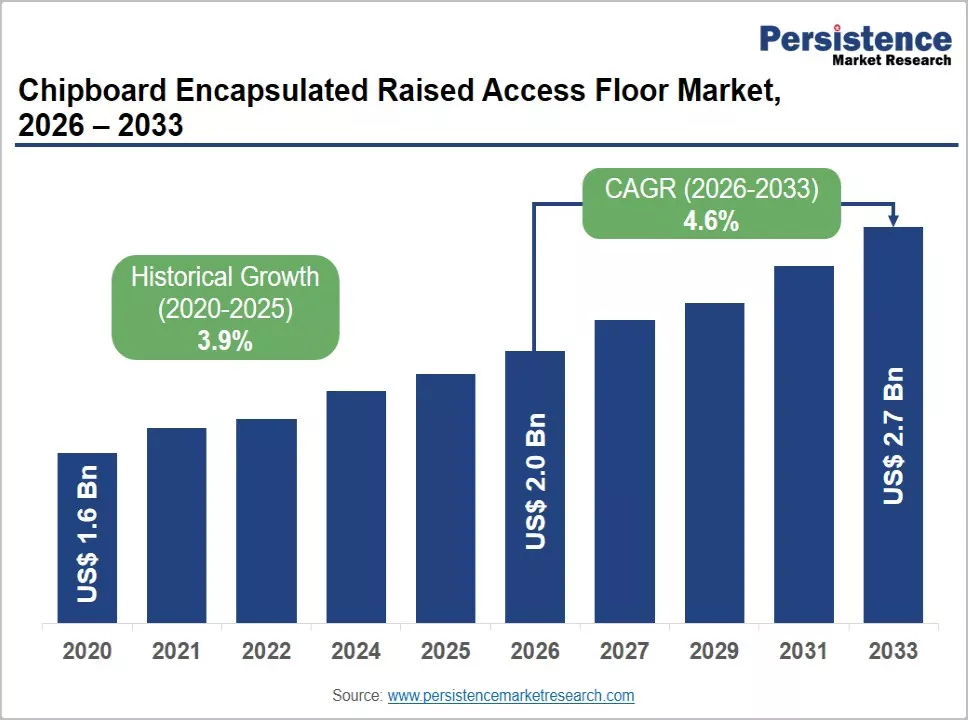
The global chipboard encapsulated raised access floor market size is likely to be valued at US$2.0 billion in 2026 and is expected to reach US$2.7 billion by 2033, growing at a CAGR of 4.6% during the forecast period from 2026 to 2033, driven by expanding data-center infrastructure, office modernization, and increasing demand for flexible underfloor cable and utility management.
The Uptime Institute (2025) reported that data-center operators are expanding and modernizing facilities to address rising power and density requirements. CBRE (2026) reported record office leasing and new development in India during 2025, supporting demand for adaptable commercial flooring systems.
Key Industry Highlights:
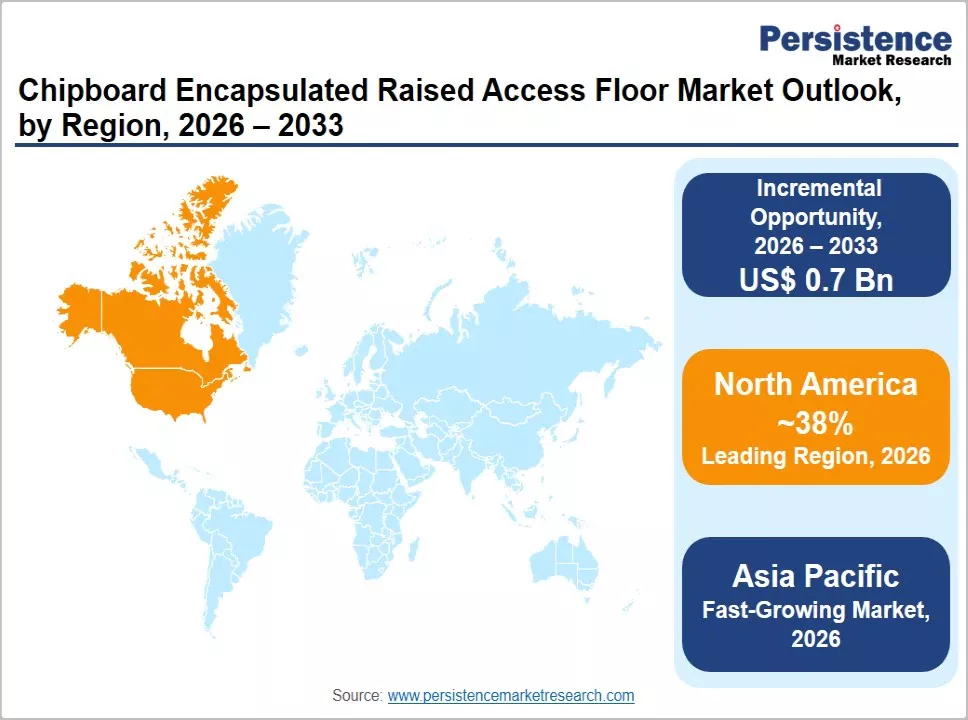
- Leading Region: North America is anticipated to be the leading region, accounting for a market share of 38% in 2026, driven by strong data-center investment, office modernization, and established raised-access flooring infrastructure.
- Fastest-growing Region: Asia Pacific is likely to be the fastest-growing region, supported by expanding data-center capacity, commercial construction, digitalization, and urban infrastructure development.
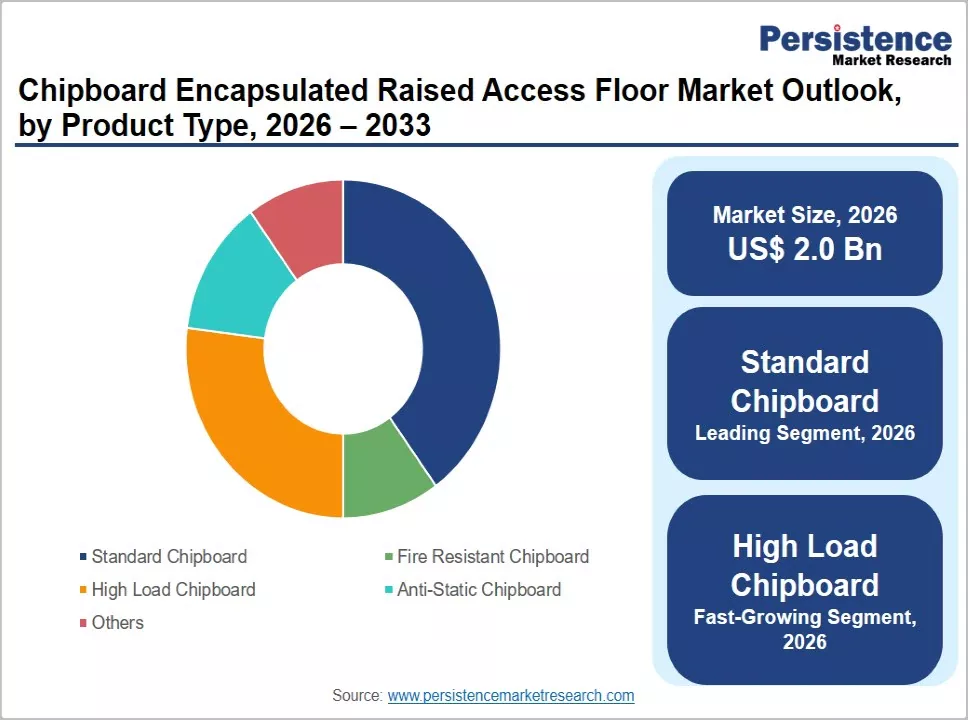
- Leading Product Type: Standard chipboard is projected to represent the leading product type in 2026, accounting for 42% of the revenue share, for cost-efficiency and broad adoption across commercial and institutional facilities.
- Leading Application: Data centers are anticipated to be the leading application, accounting for over 35% of the revenue share in 2026, supported by expanding digital infrastructure and the need for accessible underfloor cabling and services.
- Key Opportunity: Rising investments in AI-driven data centers, digital infrastructure, and smart commercial buildings creates significant opportunities for chipboard encapsulated raised access floors by increasing demand for flexible, high-load, sustainable systems that enable efficient underfloor cabling, power distribution, cooling, and maintenance access.
DRO Analysis
Driver - Expansion of Data-center and Digital Infrastructure
Expansion of data-center and digital infrastructure is a major driver for chipboard encapsulated raised access floors, as modern facilities require organized pathways for power, networking, cooling, and control systems. Hyperscale, colocation, and enterprise data centers increasingly prioritize flexible floor systems that permit cabling changes without extensive structural work. Encapsulated chipboard panels provide a practical combination of strength, dimensional stability, installation efficiency, and service accessibility.
Growth in cloud computing, artificial intelligence workloads, edge computing, and digital services is encouraging continued data-center construction and upgrades. Demand for raised flooring is expanding alongside higher equipment density and increasingly complex underfloor infrastructure requirements. Digital infrastructure expansion also supports demand beyond dedicated data centres, particularly in telecommunications facilities, network operation centres, and technology-intensive commercial buildings.
As organizations upgrade connectivity and computing environments, accessible floor voids help accommodate growing quantities of cables, power distribution, and ventilation components. Chipboard encapsulated systems support frequent reconfiguration, which is valuable where equipment layouts evolve rapidly. Increasing emphasis on efficient space utilization strengthens adoption because raised floors can consolidate building services beneath occupied areas.
Restraint - Installation Skill and Specification Complexity
Installation skill and specification complexity can restrain adoption because raised access flooring requires accurate planning, panel selection, pedestal positioning, and coordination with building services. Incorrect installation can create uneven surfaces, instability, poor panel alignment, or inadequate support for concentrated equipment loads. Projects involving high-load, fire-resistant, or anti-static panels require specifications that account for performance requirements, environmental conditions, and applicable building standards. Coordination among architects, contractors, mechanical teams, electrical installers, and flooring specialists can increase project complexity.
Specification complexity becomes more significant in data centers, telecommunications rooms, healthcare facilities, and other environments with demanding operational requirements. Designers must evaluate structural loading, access frequency, fire performance, electrostatic control, moisture exposure, and compatibility with cabling or airflow systems. Variations in floor height, panel dimensions, pedestal systems, and finish requirements can complicate procurement and installation across large projects. Training requirements for installers may also increase as customers seek precise tolerances and reliable performance.
Opportunity - Product Differentiation through Performance Grades
Product differentiation through performance grades presents a strong opportunity for manufacturers to capture higher-value applications within the chipboard encapsulated raised access floor market. Suppliers can develop panels according to load-bearing capacity, fire resistance, acoustic performance, moisture tolerance, and electrostatic control. High-load grades can target data centers and equipment rooms, while anti-static variants can address technology-intensive environments.
Fire-resistant products can support projects with stricter safety specifications, particularly in commercial and institutional buildings. By offering clearly differentiated performance levels, manufacturers can serve varied project requirements while reducing reliance on price-based competition. Certification, testing, and documented performance data can strengthen customer confidence. Performance-based product differentiation can also support premium positioning as building owners increasingly prioritize long-term durability, safety, flexibility, and lifecycle efficiency.
Manufacturers have opportunities to combine encapsulated chipboard cores with improved surface finishes, recyclable materials, enhanced edge protection, and robust pedestal systems. Products designed for easier handling and faster installation can appeal to contractors facing labor constraints. Digital specification tools, technical documentation, and application-specific recommendations can help suppliers simplify product selection for architects and engineers.
Category-wise Analysis
Product Type Insights
Standard chipboard is expected to lead, accounting for 42% of revenue in 2026, due to its cost efficiency, practical structural performance, and broad suitability across commercial buildings, offices, educational facilities, and conventional technical spaces. Its relatively lightweight construction also supports easier handling and installation, while removable panels provide convenient access to electrical, telecommunications, and building-service infrastructure beneath the floor. For example, Unitile offers chipboard raised access floor panels designed for applications including open offices, data centers, control rooms, and education facilities.
High load chipboard is likely to represent the fastest-growing segment, supported by increasing requirements for stronger and more durable raised flooring in data centers, server rooms, telecommunications facilities, and equipment-intensive environments. These panels provide enhanced load-bearing performance and improved stability where concentrated equipment loads and frequent maintenance access are important considerations. A notable example includes, Schneider Electric’s Uniflair Technical Floor uses high-density wooden chipboard cores for technical rooms such as data centers requiring high load capacity.
Application Insights
Data centers are projected to lead the market, capturing around 35% of the revenue share in 2026, supported by expanding digital infrastructure, cloud computing artificial intelligence workloads, and growing requirements for organized power and data distribution. Raised chipboard flooring enables service access beneath the finished floor, allowing operators to manage cabling, power infrastructure, and cooling requirements without major disruption to equipment areas. For instance, Polygroup supplied its Gamaflor high-density chipboard raised-floor system for a data-center project in Accra, Ghana, incorporating antistatic finishes and airflow panels.
Commercial offices are likely to be the fastest-growing application due to workplace modernization, flexible office layouts, technology upgrades, and renovation of existing commercial buildings. Raised chipboard flooring provides a practical method for organizing power, telecommunications, and IT infrastructure beneath accessible floor panels while maintaining a clean interior appearance. Its modular construction also supports workplace reconfiguration, enabling organizations to adapt service routes as office layouts and technology requirements change. For example, Mace and Arup identified raised access floors using particleboard/chipboard panels as a common feature in modern commercial office buildings.
Regional Insights
North America Chipboard Encapsulated Raised Access Floor Market Trends
North America is anticipated to be the leading region, accounting for a market share of 38% in 2026, supported by strong demand from data centers, technology facilities, corporate offices, and infrastructure modernization. Increasing AI workloads are encouraging operators to develop facilities requiring organized underfloor space for power, telecommunications, cooling, and data cabling. Tate supplies raised access flooring solutions designed for technology-intensive environments, including data centers and commercial facilities.
U.S. Chipboard Encapsulated Raised Access Floor Market Trends
The U.S. is expected to dominate the regional market, accounting for approximately 80% of the North America market in 2026. AI infrastructure is increasing requirements for organized cable-management and service-access systems beneath technical floors. Data-center construction spending surged strongly in 2026, reflecting continued investment associated with AI infrastructure. Large-scale facilities increasingly require flexible flooring systems capable of supporting dense technology environments. Modern offices also use raised floors to accommodate power, telecommunications, and changing workspace configurations.
Canada Chipboard Encapsulated Raised Access Floor Market Trends
Canada is likely to be a significant market for chipboard-encapsulated raised access floors, accounting for approximately 20% of the market share in 2026, supported by government-backed expansion of domestic AI-compute infrastructure. The federal government finalized support for Cohere’s domestic AI infrastructure project in 2025, while Canada launched a national initiative in 2026 to develop large-scale sovereign AI supercomputing capacity. These investments are supporting the development of new data centers and technology facilities. The country’s favorable climate and availability of sustainable energy resources further enhance its attractiveness for data-center development.
Europe Chipboard Encapsulated Raised Access Floor Market Trends
Europe is likely to be a significant market for chipboard encapsulated raised access floors in 2026, due to modernization of commercial buildings, expansion of data centers, digitalization, and increasing emphasis on energy-efficient infrastructure. Raised flooring provides accessible space for electrical, communication, and building-service infrastructure while supporting flexible building layouts. MERO-TSK supplies engineered-wood access-floor systems for offices and other technical environments in Germany.
U.K. Chipboard Encapsulated Raised Access Floor Market Trends
The U.K. is likely to be a significant market for chipboard encapsulated raised access floor estimates for 15% of Europe market share in 2026. Data centers are increasingly regarded as strategically important infrastructure supporting AI and digital economic activity. The government has introduced AI Growth Zones to accelerate investment by addressing planning and power-connection barriers. Ofgem reported in July 2026 that data-center projects represented a major portion of electricity-connection demand. This growing pipeline of technical facilities supports demand for accessible raised-floor systems. Commercial offices also require adaptable infrastructure as organizations modernize and reconfigure workplaces.
Germany Chipboard Encapsulated Raised Access Floor Market Trends
Germany is anticipated to dominate the regional market, accounting for around 37% of Europe’s market share in 2026, supported by its large commercial and technology infrastructure base. Growing adoption of AI is accelerating investments in German data centers, with Bitkom reporting significant data-center investment activity and strong expected expansion in AI-related capacity. In March 2026, the German government adopted a data-center strategy aimed at at least doubling national data-center capacity by 2030. This policy direction is expected to strengthen demand for infrastructure supporting high-density computing environments.
Asia Pacific Chipboard Encapsulated Raised Access Floor Market Trends
The Asia Pacific region is likely to be the fastest-growing region, driven by its rapid digitalization, data-center construction, cloud adoption, and commercial infrastructure development. China and India are particularly important growth markets as both countries expand computing capacity to support AI applications, cloud services, and digital economies. Huilian Floor in China manufactures woodcore raised access flooring and supplies flooring solutions for data-center environments.
China Chipboard Encapsulated Raised Access Floor Market Trends
China is projected to dominate, holding around 30% of the market in 2026, due to rapid expansion of computing infrastructure. The country's AI industry is generating strong demand for additional data-center capacity. China's national computing network is being developed through the East Data, West Computing initiative. Eight national computing hubs are supporting the coordinated development of computing resources across regions.
India Chipboard Encapsulated Raised Access Floor Market Trends
India is expected to emerge as a significant market, accounting for approximately 22% of the market in 2026, as rapid digitalization, cloud adoption, AI deployment, and data localization drive new data-center construction. Government data indicate that India’s data-center capacity reached around 1,500 MW by 2025, highlighting substantial infrastructure expansion. Growing investment in AI infrastructure is providing an additional catalyst for new facilities and capacity upgrades. In September 2026, TCS and its partners announced plans for a large AI data-center campus in Telangana.
Competitive Landscape
The global chipboard-encapsulated raised access floor market exhibits a moderately fragmented structure, supported by the presence of established international manufacturers and specialized regional flooring companies serving commercial offices, data centers, and technical facilities.
Key players, including Kingspan Group, Tate Access Floors, Lindner Group, MERO-TSK, and Polygroup, compete primarily on product performance, application suitability, and geographic reach. These companies focus on product innovation, customization, sustainability initiatives, technical performance enhancements, and strategic geographic expansion.
Key Industry Developments:
- In September 2025, Kingspan announced an expansion of its raised-access-floor manufacturing facility in Germany, with investment aimed at increasing production capacity and improving automated manufacturing.
Companies Covered in Chipboard Encapsulated Raised Access Floor Market
- Haworth
- Steelcase
- Interface
- Tarkett
- Gerflor
- Mats Inc.
- Forbo
- Armstrong World Industries
- LG Hausys
Frequently Asked Questions
The chipboard encapsulated raised access floor market is projected to reach US$2.0 billion in 2026.
Rapid data-center construction, digital infrastructure expansion, flexible office modernization, and growing demand for efficient underfloor cable management drive market growth.
The chipboard encapsulated raised access floor market is expected to grow at a CAGR of 4.6% from 2026 to 2033.
Rising AI and hyperscale data-center investments, smart-building development, and demand for sustainable, high-load flooring systems create key market opportunities.
Haworth, Steelcase, Interface, Tarkett, Gerflor, MATS Inc., Forbo, and Armstrong World Industries are the leading players.


