




- Nutraceuticals & Functional Foods
- Manuka Honey Market
Manuka Honey Market Size, Share, and Growth Forecast, 2026 - 2033
Manuka Honey Market by Product Type (Processed, Raw), Application (Food & Beverages, Pharmaceutical, Dairy Products, Cosmetics & Personal Care), Nature (Conventional, Organic), and Regional Analysis for 2026 - 2033

Manuka Honey Market Share and Trends Analysis
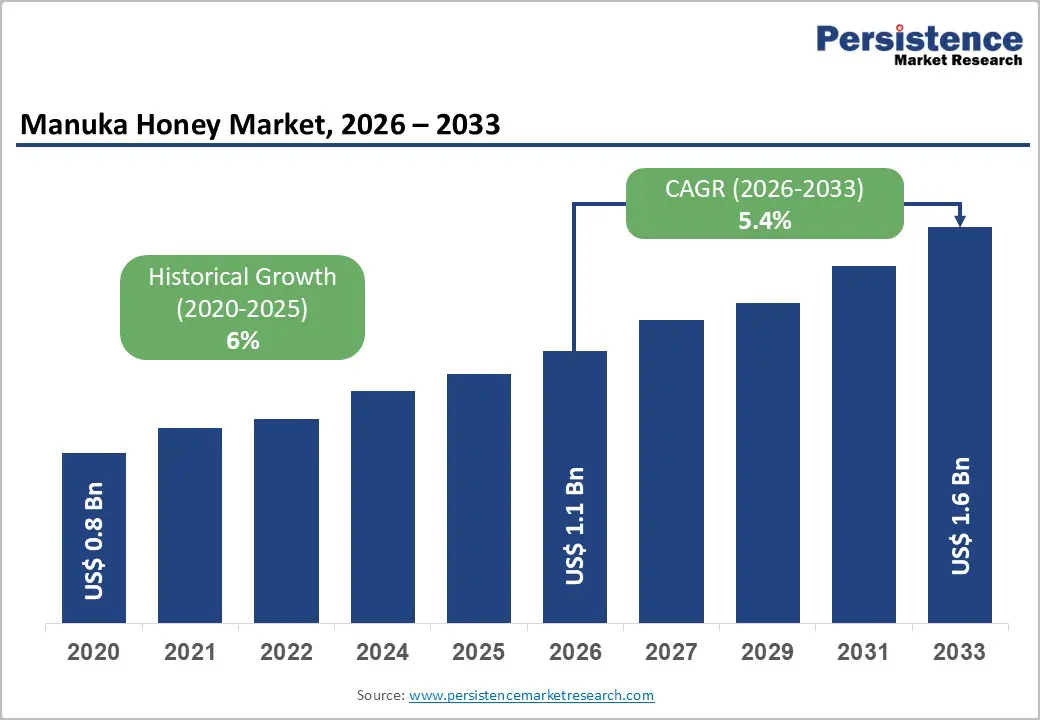
The global manuka honey market size is likely to be valued at US$ 1.1 billion in 2026, and is projected to reach US$ 1.6 billion by 2033, growing at a CAGR of 5.4% during the forecast period 2026 - 2033.
Consumers are demonstrating heightened curiosity regarding natural health alternatives beside every scientifically validated antimicrobial trait belonging to this unique nectar. Robust interest in premium wellness merchandise is accelerating regional momentum while expanding availability via e-commerce platforms keeps broadening an international customer base. Each sector has gained significant advantages utilizing versatile implementations in pharmaceutical blends, injury recovery, or functional dietary supplementation. Peer-reviewed clinical research has been authenticating medicinal benefits, such as those found in medical-grade honey (MGH) concerning chronic wounds alongside tissue regeneration. Trust among buyers can improve if market players are able to maintain strict purity standards near transparent supply chains.
Key Industry Highlights
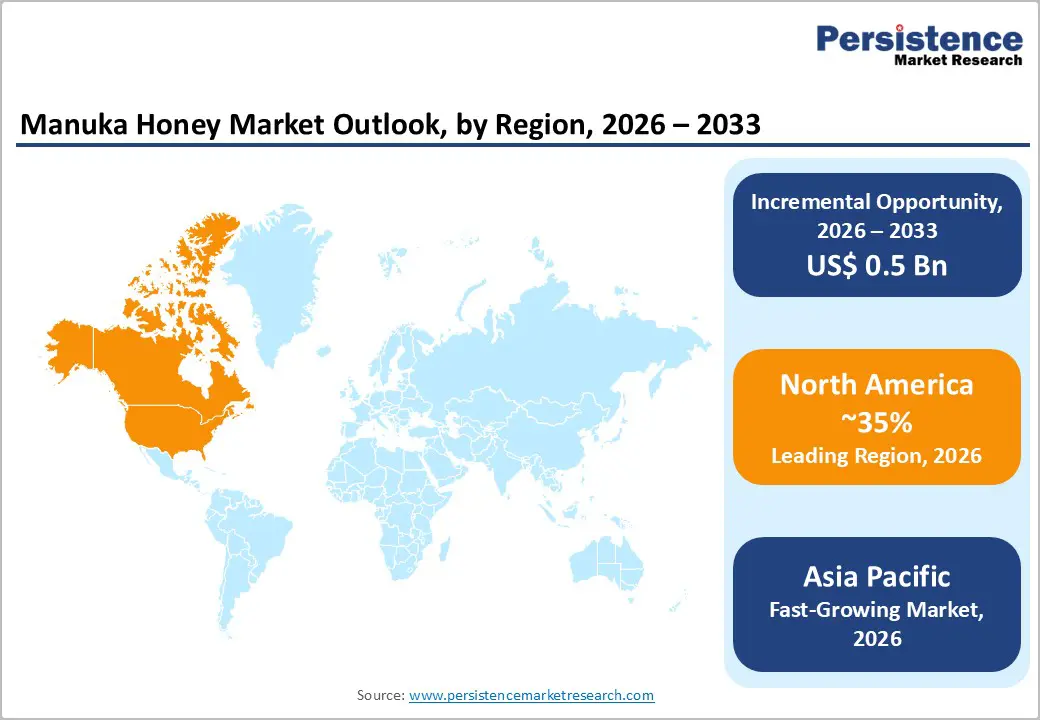
- Dominant Region: North America is expected to command a share of around 35% in 2026, boosted by high consumer awareness about natural health products.
- Fastest-growing Market: The Asia Pacific market is likely to display the highest 2026 - 2033 CAGR due to rising demand from middle-class populations for naturally derived food products.
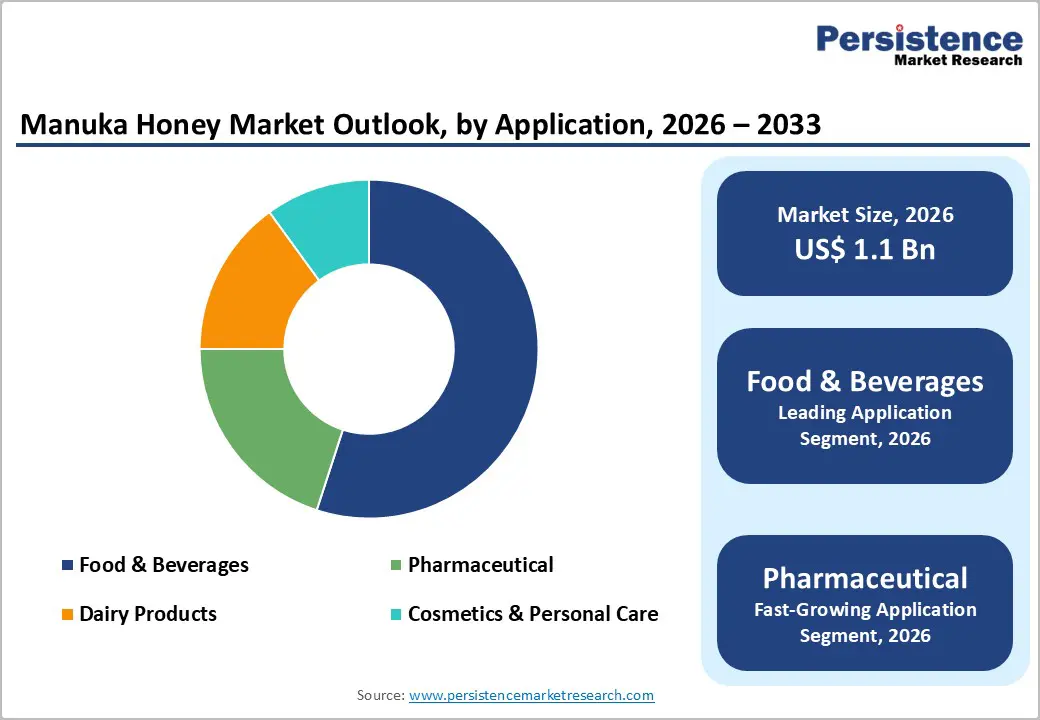
- Leading Application: Food & beverages is projected to hold about 55% revenue share in 2026, reflecting its broad acceptance as both a premium ingredient and a wellness product.
- Fastest-growing Application: Pharmaceutical is expected to be the fastest-growing segment through 2033, supported by growing clinical validation and broader healthcare adoption.
- Key Driver: Growing preference for natural and organic products devoid of synthetic additives among consumers is a prominent market driver.
- Market Opportunity: The expanding role of Manuka honey beyond traditional consumption formats opens new growth avenues across multiple industries.
- April 2025: Wedderspoon's Propolis and Manuka Honey Throat Spray won the 2025 remedies Health & Beauty Essentials Award for its immune-supporting blend of bee propolis, New Zealand Manuka honey, and natural herbs.
| Key Insights | Details |
|---|---|
| Manuka Honey Market Size (2026E) | US$ 1.1 Bn |
| Market Value Forecast (2033F) | US$ 1.6 Bn |
| Projected Growth (CAGR 2026 to 2033) | 5.4% |
| Historical Market Growth (CAGR 2020 to 2025) | 6% |
Market Factors - Growth, Barriers, and Opportunity Analysis
Growing Consumer Preference for Natural Health Products
Manuka honey has established itself as a leading natural health product within the global wellness movement. The growing preference for natural and organic products reflects consumer confidence in ingredients that support overall well-being without synthetic additives. Scientific validation of Manuka honey’s potent antibacterial activity, attributed to its methylglyoxal (MGO) content, has strengthened its reputation among healthcare practitioners and nutrition professionals. Research from recognized scientific bodies such as the National Center for Biotechnology Information (NCBI) continues to highlight its effectiveness against antibiotic-resistant bacteria. These findings reinforce its credibility as a functional ingredient and increase its acceptance in preventive health routines.
Health-conscious consumers are increasingly choosing authenticated Manuka honey products that align with their personal wellness and sustainability values. The product’s clinical evidence base, combined with its traceable sourcing and certification systems, positions it as a trusted choice in a market crowded with unverified supplements. Retailers and health brands have also leveraged its therapeutic potential by integrating it into functional foods, dietary supplements, and premium skincare lines. This evolution reflects a broader shift toward evidence-based, natural wellness solutions, were quality assurance and scientific integrity drive long-term consumer loyalty and brand success.
Product Authentication Challenges and Counterfeiting Issues
The high market value of Manuka honey has led to a surge in counterfeit and mislabeled products that threaten both consumer confidence and legitimate producers. A significant portion of products sold globally fail to meet required authenticity or quality parameters, creating a serious credibility issue within the category. Although New Zealand’s export regulations define chemical makers such as MGO, dihydroxyacetone (DHA), and leptosperin to verify product integrity, inconsistent international enforcement allows fraudulent items to circulate widely. Testing methodologies vary among laboratories, and the associated costs discourage smaller exporters from routine validation. This inconsistent oversight has weakened the credibility of many retail offerings and complicated price benchmarking for genuine, premium-grade honey.
Market stakeholders are responding to these challenges by strengthening certification frameworks and supply chain transparency. Brands are investing in technologies such as blockchain tracking, QR code authentication, and third-party validation to demonstrate traceability from hive to shelf. The implementation of uniform global standards for Manuka honey testing could reduce cross-border discrepancies and restore confidence among distributors and end consumers. Equally important is educating buyers about certification schemes such as the Unique Manuka Factor (UMF) grading system, which outlines clear benchmarks for purity and activity levels. Strategic communication around authenticity assurance will be central to protecting brand equity, maintaining fair competition, and ensuring that verified producers continue to benefit from Manuka honey’s premium market positioning.
Functional Food Product Innovation and Value-Added Applications
The application of Manuka honey beyond traditional consumption formats has opened new growth avenues across industries. Functional food manufacturers are increasingly adopting it as a key ingredient in wellness-oriented products such as fortified breakfast items, beverages, and nutraceutical blends. These innovations address consumer demand for convenient nutrition with proven health benefits. In the beauty and personal care segment, Manuka honey’s antimicrobial and wound-healing compounds make it highly desirable for skincare formulations that promote skin repair and barrier protection. Premium brands continue to develop serums, creams, and masks incorporating active Manuka components, positioning them within the fast-growing clean beauty market. The ability to combine clinical validation with a natural origin has made it one of the most sought-after ingredients for brands pursuing high-margin, science-backed product lines.
Sports and performance nutrition has also emerged as a promising application domain. Athletic consumers increasingly prefer natural solutions, viewing Manuka honey as both an energy booster and a post-exercise recovery aid. Its naturally occurring sugars, amino acids, and antioxidant profile support sustained energy release without artificial additives. Manufacturers are exploring innovative uses such as gels, protein blends, and fortified bars to target this niche. Research and development in extraction processes and compound isolation is enabling the creation of concentrated bioactive ingredients suitable for pharmaceutical and clinical applications. These technological advances could transform Manuka honey into a scalable, high-value input for functional foods and therapeutic formulations, ensuring continued industry relevance while unlocking new pricing and branding opportunities.
Category-wise Analysis
Product Type Insights
The processed format is poised to lead with an estimated 75% of the Manuka honey market revenue share in 2026, due to its consistency, scalability, and broad consumer appeal. This segment includes honey that has undergone careful heating, filtration, and blending to achieve stable texture, extended shelf life, and uniform MGO content across production batches. These controlled processes ensure product purity by removing wax residues and pollen traces while maintaining the honey’s natural bioactive properties. Retailers and foodservice chains favor processed Manuka honey because its stable texture and reduced crystallization risk enhance shelf presentation and minimize product returns. Manufacturers across food, beverage, cosmetic, and pharmaceutical sectors also prefer processed variants for their standardized composition, enabling consistent formulation and regulatory compliance.
Raw manuka honey is likely to be the fastest-growing during the 2026 - 2033 forecast period, driven by increasing consumer preference for minimally processed, nutrient-rich, and authentic natural foods. It undergoes only basic straining to remove visible impurities while retaining the full spectrum of naturally occurring enzymes, pollen, propolis, and bioactive compounds that contribute to its nutritional and therapeutic qualities. The product’s natural crystalline texture and enzymatic activity particularly diastase and invertase enhance its appeal among wellness-oriented consumers seeking unaltered food sources that align with clean-label and whole-food lifestyles.
Application Insights
Food & beverage applications are slated to hold a projected 55% revenue share in 2026. The food and beverage sector is the primary driver of Manuka honey demand, reflecting its broad acceptance as both a premium ingredient and a wellness product. Direct household consumption continues to lead usage, as consumers use it as a natural sweetener, table spread, and versatile culinary component. Food producers are capitalizing on this preference by formulating high-value items such as artisanal bakery goods, energy bars, breakfast cereals, and functional beverages that emphasize natural positioning. Specialty retailers, organic grocery chains, and gourmet sections of major supermarkets allocate dedicated shelf space to certified Manuka honey, reinforcing its perception as a premium product.
Pharmaceutical is expected to be the fastest-growing segment during the 2026 - 2033 forecast period, supported by growing clinical validation and broader healthcare adoption. A 2025 review examined medical-grade honey's antibacterial, anti-inflammatory, and tissue-regenerative properties. The study substantiated its efficacy in accelerating wound closure for chronic wounds, burns, and diabetic ulcers through mechanisms such as MGO activity, low pH, and phenolic compounds from botanical origins including Manuka and Gelam honeys. Hospitals and clinical facilities are increasingly integrating medical-grade Manuka honey into wound management protocols for chronic wounds, burns, and diabetic ulcers, recognizing its scientifically proven antimicrobial and healing properties. Pharmaceutical manufacturers are developing regulated formulations such as wound dressings, oral care therapies, and digestive health supplements that meet clinical testing and compliance standards. Over-the-counter applications, including throat lozenges and cough remedies, have also expanded, appealing to consumers seeking natural self-care alternatives.
Nature Insights
The conventional segment is likely to secure approximately 75% of the market revenue share in 2026, reflecting its robust production capacity, wide distribution reach, and balanced value proposition for consumers and producers. These products comply with established Manuka quality standards while enabling more flexible apiary management and higher yield efficiency than certified organic operations. Lower production costs support competitive pricing, making premium Manuka honey accessible to a wider consumer base through both mainstream retail channels and export markets. Consumers in this segment typically prioritize verified quality indicators such as the UMF rating and MGO concentration rather than organic certification, emphasizing measurable authenticity and proven health benefits.
The organic segment is anticipated to be the fastest-growing from 2026 to 2033, supported by consumers who prioritize sustainability, purity, and ethical sourcing in their purchasing decisions. Production within this segment adheres to defined organic beekeeping standards that require pesticide-free forage zones, environmentally responsible hive management, and third-party certification audits. Expansion of organically managed land in New Zealand, along with government programs promoting sustainable agriculture, has enabled producers to increase supply while maintaining quality integrity.
Regional Insights
North America Manuka Honey Market Trends
North America is predicted to command a considerable portion of the manuka honey market share at approximately 35% in 2026. The United States drives most of the regional consumption, representing the majority of demand through well-established distribution across organic supermarkets, health food retailers, digital marketplaces, and mainstream grocery chains. The U.S. Food and Drug Administration (FDA)’s recognition of medical-grade Manuka honey has created a favorable environment for pharmaceutical and clinical applications, while continued academic research validates its wound-healing, antimicrobial, and immune-supporting functions. This alignment between clinical validation and consumer health priorities positions the region for sustained premium growth and product diversification into therapeutic uses and self-care categories.
The competitive landscape is defined by a blend of New Zealand-origin exporters and North American firms that repackage or co-brand imported products. Brands in the region differentiate themselves by emphasizing UMF certification, MGO content verification, and transparent sourcing documentation to strengthen consumer trust. E-commerce remains a dominant growth engine, accounting for a large portion of retail sales through platforms such as Amazon, direct-to-consumer websites, and specialty online health stores. Companies are investing in marketing initiatives that highlight scientific validation, collaborate with wellness influencers, and explore functional food applications.
Europe Manuka Honey Market Trends
Europe remains a pivotal market for Manuka honey, driven by high consumer awareness, regulatory credibility, and mature health product infrastructure. The United Kingdom leads regional consumption, supported by long-standing trade relationships with major producer’s countries and an advanced retail environment for natural and functional foods. Germany, France, and Spain follow as strong secondary markets, each benefiting from established demand for premium, science-backed health products. The region’s stringent food safety and authenticity verification standards under European Union (EU) regulations favor certified producers with robust traceability systems and transparent labeling practices. Consumers across Germany, France, and Scandinavia increasingly associate Manuka honey with trusted wellness and preventive health applications, particularly within the context of natural medicine traditions.
The European market environment supports sustained premium positioning through regulatory convergence, expanding pharmacy distribution, and growing integration within the beauty and personal care sectors. The EU’s harmonized food standards promote consistency across member states, simplifying certification processes for exporters while encouraging competitive differentiation based on product quality. Meanwhile, the United Kingdom, operating under post-Brexit trade policies, continues to negotiate favorable import terms with New Zealand, ensuring stable supply chains. Consumer education campaigns that clarify certification systems, such as the UMF and MGO ratings, help safeguard brand credibility and mitigate concerns over counterfeit goods.
Asia Pacific Manuka Honey Market Trends
Asia Pacific is poised to emerge as the fastest-growing Manuka honey market through 2033, reinforced by rising consumer demand, expanding middle-class populations, and greater health awareness across major markets. China leads regional consumption, driven by increasing urban affluence, supportive government policies for imported premium health products, and trade agreements that strengthen access to certified New Zealand Manuka honey. Japan follows as a key market with consumers who place high value on authenticity and willingly pay premium prices for scientifically validated wellness products. Australia contributes a distinct advantage through its dual role as both an importer and a producer, benefitting from close geographic proximity to New Zealand and the presence of native Leptospermum species that enable local Manuka honey production.
India continues to be a promising growth market, supported by the rapid expansion of e-commerce, rising urban incomes, and strong cultural acceptance of honey as a natural therapeutic ingredient. The region’s manufacturing advantages complement its consumption growth, supported by localized beekeeping in Australia and increasing regional supply chain investments. However, the regulatory environment remains uneven, with China enforcing rigorous import quality controls while other markets maintain less structured authentication frameworks. This variation creates both compliance challenges and strategic opportunities for early entrants to establish trusted quality benchmarks.
Competitive Landscape
The global Manuka honey market structure has been exhibiting a moderate concentration, with leading producers such as Comvita Limited, Capilano Honey Limited, Watson & Son Limited, Melita Honey, and BeeNZ together accounting for about 45% to 50% of sales. These companies have been competing in an environment where both established international brands and newer innovators are actively expanding their presence through differentiated sourcing, robust traceability systems, and targeted regional strategies. Competitive positioning has been focusing increasingly on demonstrable authenticity, verifiable quality standards, and product innovation, as informed consumers have been scrutinizing origin, grading, and purity more closely. For stakeholders evaluating entry or expansion, success will have depended on building transparent supply chains, investing in credible certifications, and communicating clear value propositions that extend beyond basic table honey into higher-value health and wellness propositions.
The UMF certification has remained the cornerstone of trust, with higher UMF ratings supporting price premiums, repeat purchase behavior, and greater acceptance in clinical or therapeutic settings. Leading brands have been directing research and development resources toward new applications in areas such as immune support, topical wound care, and skincare formulations, aiming to translate Manuka honey’s bioactive profile into evidence-backed functional products. These initiatives have been enhancing brand visibility with practitioners and end consumers while creating defensible niches where scientific validation and documented efficacy influence buying decisions more than price alone.
Key Industry Developments
- In December 2025, India and New Zealand sealed a landmark Free Trade Agreement (FTA) that features an agri-technology action plan for apples, kiwifruit and Manuka honey to raise productivity without harming local farmers, alongside broader boosts to trade, investment, services and people-to-people ties.
- In July 2025, the UMF Honey Association partnered with the University of Waikato's Honey Research Unit to advance Manuka honey research, focusing on phenolic content's gut microbiome benefits and unique physical properties to support global market access and regulatory recognition.
- In July 2025, Gentell acquired New Zealand-based ManukaMed, a manufacturer of honey-based wound dressings, gaining control of the only honey wound-care product reimbursable by Medicare and other US insurers.
Companies Covered in Manuka Honey Market
- Comvita Limited
- Wedderspoon Organic Inc.
- Manuka Health New Zealand
- Oha Honey
- New Zealand Honey Co.
- Arataki Honey Ltd.
- Steens Honey
- Manuka Doctor
- Manukora Limited
- Three Peaks Manuka Honey
- Happy Valley Honey
- Midlands Apiaries Ltd.
- Egmont Honey
- Manuka Pharm
- Airborne Honey Ltd.
Frequently Asked Questions
The global Manuka honey market is projected to reach US$1.1 billion in 2026.
The market is driven by growing consumer demand for natural health products supported by clinical validation, premium certifications, and expanding applications in food, pharmaceuticals, and skincare.
The market is poised to witness a CAGR of 5.4% from 2026 to 2033.
Key market opportunities include innovation in functional and cosmetic applications, and differentiation through robust certification and traceability systems.
Comvita Limited, Capilano Honey Limited, Watson & Son Limited, Melita Honey and BeeNZ are some of the key players in the market.


