




- Electrical Equipment & Services
- Industrial Warning Light Market
Industrial Warning Light Market Size, Share, and Growth Forecast 2026–2033
Industrial Warning Light Market by Product Type (Flashing Lights, Steady Lights, Rotating Lights, Beacons), Mounting Type (Fixed Mount, Portable Mount, Others), End-use (Manufacturing, Construction, Transportation, Mining), and Regional Analysis, 2026–2033

Industrial Warning Light Market Size and Trends Analysis
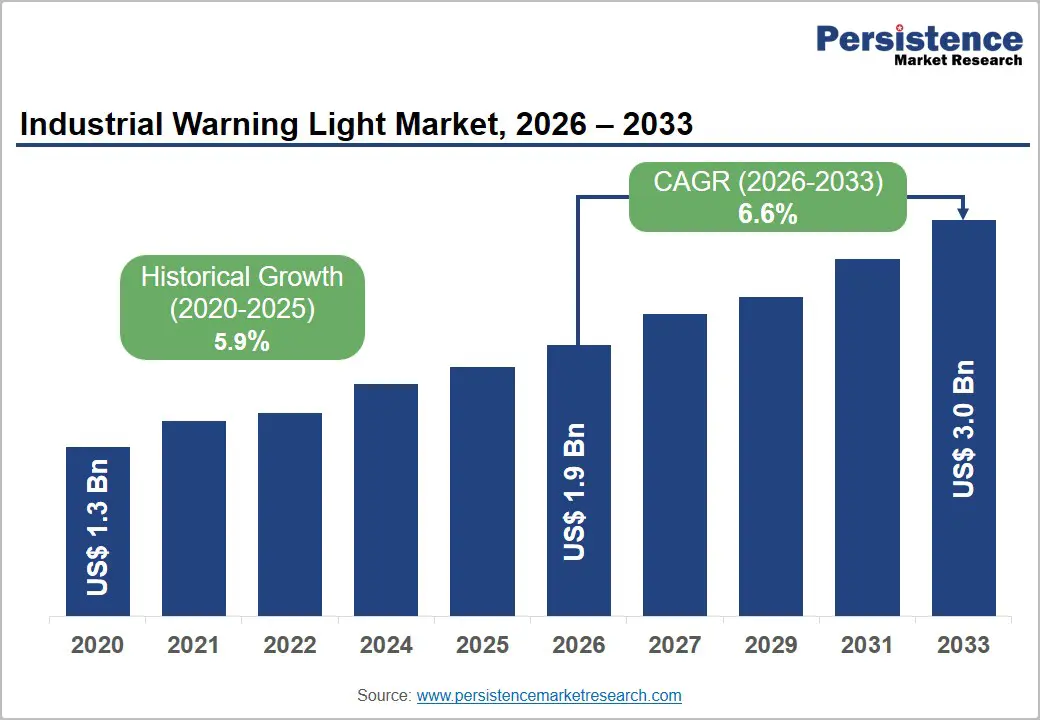
The global industrial warning light market size is likely to be valued at US$1.9 billion in 2026 and is expected to reach US$3.0 billion by 2033, growing at a CAGR of 6.6% during the forecast period from 2026 to 2033, driven by the increasing adoption of industrial warning lights as essential safety devices across hazardous work environments to alert personnel to potential hazards, equipment status, and emergencies.
These systems include flashing, rotating, steady, and beacon-type lights used in manufacturing facilities, construction sites, transportation hubs, mining operations, and other industrial settings. Rising workplace safety regulations, expanding industrial automation, and ongoing infrastructure modernization continue to support long-term market demand.
Key Market Highlights:
- Leading Region: North America is forecast to dominate with approximately 35% market share in 2026, supported by OSHA-mandated workplace safety requirements and high adoption of automated industrial safety systems.
- Fastest-growing Region: Asia Pacific is projected to grow at a CAGR of approximately 8.0% through 2033, led by rapid industrialization in China, India, and Southeast Asian manufacturing hubs.
- Dominant Product Type: Flashing lights are anticipated to lead, commanding approximately 38% of the product type revenue in 2026, due to widespread use in hazard alerts and emergency signaling across industries.
- Fastest-growing Product Type: Beacons are estimated to register the fastest product growth at a CAGR of approximately 7.5% through 2033, driven by adoption in automated warehouses and smart manufacturing environments.
- Dominant End-user: The manufacturing segment is expected to lead, accounting for approximately 40% market share in 2026, driven by factory automation, machinery status signaling, and regulatory compliance.
- Key Market Opportunity: The transition to LED-based smart warning lights integrated with Industry 4.0 platforms presents the largest innovation opportunity, reducing energy consumption and enabling remote condition monitoring.
- Sustainability Trend: Growing adoption of energy-efficient LED warning lights aligned with ESG objectives is reshaping product development strategies among leading manufacturers.
DRO Analysis
Driver – Industrial Automation and Smart Factory Expansion
The global adoption of industrial automation, robotics, and smart manufacturing is generating a significant new demand for integrated warning light systems. According to the International Federation of Robotics (IFR), global industrial robot installations exceeded 542,000 units in a recent year, with installations growing rapidly in China, the U.S., Germany, Japan, and South Korea. Every robot cell and automated guided vehicle (AGV) system requires status indicator lights and emergency strobes to protect co-workers in shared human-robot environments.
Industry 4.0 adoption is also driving demand for networked LED stack lights and smart beacons that communicate machine status in real time via industrial Ethernet, IO-Link, or wireless protocols. These connected warning systems generate operational data that supports predictive maintenance and overall equipment effectiveness (OEE) improvement. As manufacturers invest heavily in smart factory transformation, the per-facility installed base of warning light systems is expanding beyond traditional safety compliance into operational monitoring applications.
Barrier – Price Sensitivity and Competition from Low-Cost Manufacturers
Industrial warning lights are increasingly commoditized at the entry-level product tier, with a large number of low-cost manufacturers from Asia exerting significant price pressure on established brands. Small and medium-sized enterprises in price-sensitive markets often procure uncertified or minimally compliant warning light products to minimize capital expenditure, undermining the revenue potential of certified, premium-tier suppliers.
Established manufacturers face the challenge of differentiating on quality, reliability, and certification credentials in markets where procurement decisions are dominated by upfront cost rather than total cost of ownership. The proliferation of online industrial supply platforms has further intensified price competition by increasing price transparency and reducing switching costs between suppliers.
Opportunity – Integration with IoT and Industry 4.0 Smart Safety Platforms
The convergence of industrial warning lights with IoT connectivity and smart manufacturing platforms represents the highest-value growth opportunity for the market. Smart LED warning systems capable of communicating via IO-Link, Modbus, or wireless protocols enable centralized safety monitoring, remote diagnostics, and integration with manufacturing execution systems (MES). These capabilities transform warning lights from passive safety compliance devices into active data sources within the connected factory ecosystem.
Manufacturers that develop IoT-enabled product lines and offer integration with leading industrial automation platforms will access premium pricing tiers and differentiate effectively from low-cost commodity competitors. The global smart factory market is growing rapidly, creating a large and expanding addressable market for next-generation industrial signaling and safety visualization solutions.
Category-wise Analysis
Product Type Insights
Flashing lights are projected to dominate the product type segment, accounting for approximately 38% of the total product type revenue in 2026. Flashing lights deliver high-visibility intermittent signals that are instinctively recognized as hazard alerts across all industrial environments. Their widespread specification in OSHA-compliant machinery, construction zone delineation, and warehouse pedestrian safety systems ensures consistent demand.
Beacons are estimated to register the fastest-growing product type, advancing at a CAGR of approximately 7.5% through 2033. Beacons are experiencing accelerating adoption in automated material handling environments, including robotic warehouses, automated guided vehicle (AGV) systems, and smart manufacturing cells, where omnidirectional high-intensity signaling is critical for human safety in proximity to autonomous equipment.
Mounting Type Insights
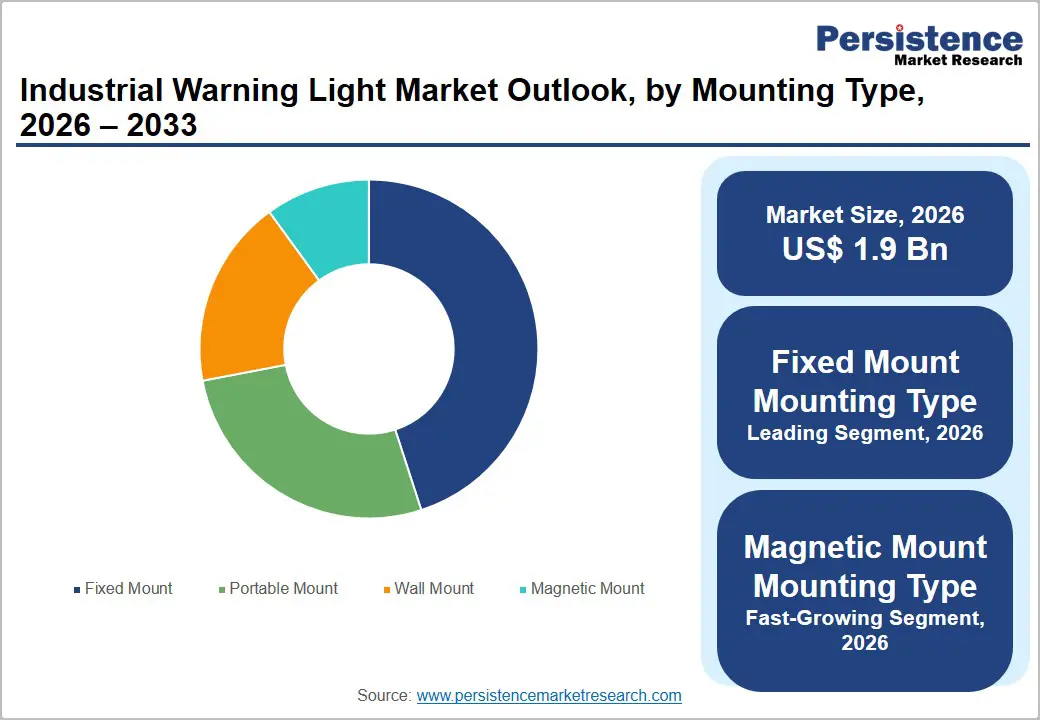
Fixed mount configurations are anticipated to lead the mounting type segment, estimated to represent approximately 45% of the total mounting type share in 2026. Fixed-mount warning lights are permanently installed on machinery, gantries, doorways, and structural elements within industrial facilities. Their permanence supports consistent safety compliance, ease of wiring integration, and compatibility with centralized control systems.
Magnetic mount warning lights are anticipated to be the fastest-growing mounting type at a CAGR of approximately 7.8% through 2033. Their tool-free installation, repositionability, and versatility make them ideal for temporary construction, maintenance, and mining applications where hazard zones shift frequently. Increasing use of magnetic mount lights on vehicles, mobile equipment, and temporary site infrastructure is fueling demand, particularly in construction and mining sectors across emerging economies.
End-user Insights
The manufacturing segment is projected to dominate the end-use segment, accounting for approximately 40% of the total end-use share in 2026. Manufacturing facilities represent the core addressable market for industrial warning lights, encompassing machinery status signaling, production line safety, automated equipment zones, and emergency evacuation systems. The global expansion of industrial automation and the increasing prevalence of human-robot collaboration environments are sustaining per-facility warning light density growth beyond baseline regulatory compliance requirements.
The mining segment is estimated to be the fastest-growing end-use segment at a CAGR of approximately 8.2% through 2033. Rising global commodity demand, expanding extraction operations in emerging economies, and increasingly stringent mine safety regulations in jurisdictions, including Australia, Canada, South Africa, and across Latin America, are driving demand for ATEX-rated and IECEx-certified warning lights. Hazardous atmosphere requirements in underground mining environments create a particularly high-specification and high-margin demand profile for warning light manufacturers with certified product portfolios.
Regional Insights
North America Industrial Warning Light Market Trends and Insights
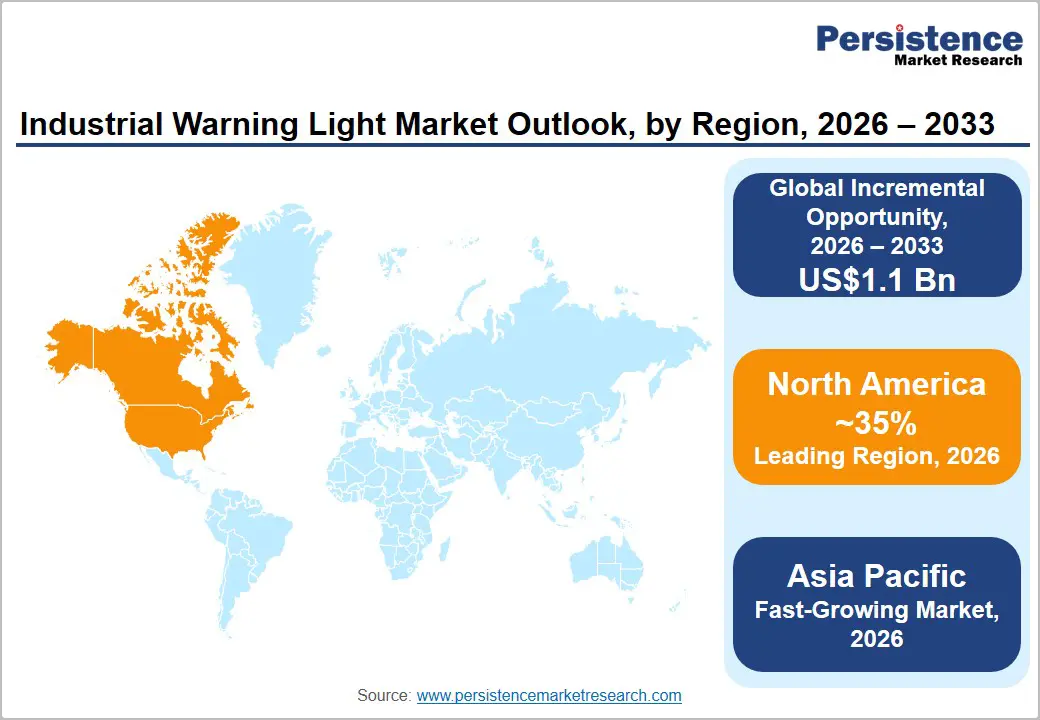
North America is projected to be the dominating regional market, capturing approximately 35% of the global share in 2026. The region's dominance is underpinned by comprehensive workplace safety regulations enforced by OSHA and provincial safety authorities, high industrial automation penetration, and the presence of major industrial warning light manufacturers and technology innovators. The region is growing at a CAGR of approximately 5.8% through 2033.
U.S. Industrial Warning Light Market Trends and Insights
The U.S. is expected to command approximately 80% of the North American market share in 2026. Strong demand from automotive manufacturing, aerospace, food processing, and warehousing sectors drives consistent replacement and expansion cycles for warning light systems. Federal OSHA enforcement and state-level safety programs ensure broad compliance-driven purchasing across small and large facilities alike. Increasing investments in domestic semiconductor and electric vehicle manufacturing, supported by the CHIPS and Science Act and the Inflation Reduction Act, are expected to drive substantial demand for factory safety signaling infrastructure through 2033.
Canada Industrial Warning Light Market Trends and Insights
Canada is anticipated to account for approximately 20% of the regional market share in 2026. Demand is driven by the country's large mining sector, oil sands operations, and ongoing infrastructure investment programs. Provincial occupational health and safety legislation mandates warning light use across most industrial categories. The expansion of lithium and critical mineral mining projects in response to global energy transition demand is expected to create incremental demand for hazardous-location-rated warning systems.
Europe Industrial Warning Light Market Trends and Insights
Europe is estimated to be the second-largest regional market, accounting for approximately 27% of the global share in 2026, growing at a CAGR of approximately 5.5% through 2033. The EU Machinery Directive and national transposition legislation create a uniform compliance framework that sustains demand across member states. Europe's leadership in advanced manufacturing, automotive production, and pharmaceutical processing generates consistent industrial warning light specification and procurement activity.
Germany Industrial Warning Light Market Trends and Insights
Germany is estimated to hold approximately 24% of the Europe market share in 2026, making it the regional leader. The country's high-density manufacturing base, Mittelstand industrial companies, and global leadership in industrial automation and robotics create deep structural demand for warning light systems. Germany is also a key center of engineering innovation for connected safety signaling solutions aligned with Industry 4.0 frameworks.
U.K. Industrial Warning Light Market Trends and Insights
The U.K. is expected to account for approximately 16% of Europe market share in 2026. The Health and Safety Executive (HSE) enforces comprehensive workplace safety requirements across construction, manufacturing, and logistics sectors. Ongoing investments in infrastructure, including HS2 rail and offshore wind farm development, are driving demand for construction-grade warning lights and portable safety signaling systems.
Asia Pacific Industrial Warning Light Market Trends and Insights
Asia Pacific is projected to be the fastest-growing regional market, advancing at a CAGR of approximately 8.0% through 2033. The region's growth is driven by rapid industrialization, large-scale infrastructure development, expanding manufacturing capacity, and increasingly stringent workplace safety legislation across major economies. Asia Pacific accounts for approximately 28% of the global market share in 2026.
China Industrial Warning Light Market Trends and Insights
China is projected to hold approximately 48% of the Asia Pacific market share in 2026. Massive investments in advanced manufacturing, electric vehicle production, semiconductor fabrication, and industrial automation are driving robust demand for warning light systems. China's Ministry of Emergency Management has progressively tightened industrial safety regulations, increasing compliance-driven purchasing. The country's BRI construction projects also generate export demand for Chinese-manufactured warning light systems across partner countries.
India Industrial Warning Light Market Trends and Insights
India is likely to be the fastest-growing major country market in the region, supported by the National Infrastructure Pipeline (NIP) targeting substantial infrastructure investment, the Make in India manufacturing promotion initiative, and rising enforcement of the Factories Act and Building and Other Construction Workers Act. Growing pharmaceutical, automotive, and electronics manufacturing clusters are increasing demand for factory safety equipment, including warning light systems.
Competitive Landscape
The global industrial warning light market is moderately consolidated, with established multinational safety equipment manufacturers competing alongside specialized regional suppliers. Leading players differentiate based on product certification breadth, LED technology performance, IoT connectivity features, and application engineering support. Companies with comprehensive ATEX, IECEx, UL, and CE-certified product portfolios hold structural advantages in high-specification end-use segments including mining, oil and gas, and chemical processing, where regulatory compliance is non-negotiable and product switching costs are high.
Innovation is increasingly focused on connected warning light platforms that integrate with industrial automation systems via IO-Link, Modbus, and wireless communication protocols. Manufacturers are investing in energy-efficient LED product lines, multi-signal combination devices, and customizable signaling sequences to address the evolving needs of smart factory and automated logistics environments. Strategic acquisitions, distribution network expansion in Asia Pacific and Latin America, and co-development partnerships with automation system integrators are shaping the competitive dynamics of the market through 2033.
Key Industry Developments;
- In January 2026, WERMA Signaltechnik introduced the eSIGN PROFINET LED signal tower, expanding its eSIGN series with native PROFINET communication and Power over Ethernet (PoE). The new product enables real-time machine status communication, simplified installation through a single Ethernet cable, and deeper integration with Industry 4.0 automation networks.
- In February 2025, PATLITE launched the LR6 Signal Tower with an M12 quick-disconnect connector, enabling faster installation, simplified wiring, and reduced maintenance time for industrial automation and factory signaling applications.
Companies Covered in Industrial Warning Light Market
- Siemens
- Honeywell
- Crompton Greaves
- Rockwell Automation
- Avery Dennison
- General Electric
- Eaton
- Panasonic
- R. Stahl
- Schneider Electric
- Sick AG
- LEDVANCE
- Federal Signal
- Emerson Electric
Frequently Asked Questions
The global industrial warning light market is estimated at US$1.9 billion in 2026, reflecting consistent growth driven by workplace safety mandates, industrial automation, and expanding mining and construction activities worldwide.
The market is primarily driven by stringent OSHA, EU Machinery Directive, and international workplace safety regulations that mandate visual warning systems in industrial environments, combined with accelerating industrial automation and smart factory investments that increase per-facility demand for connected warning light systems.
The industrial warning light market is forecast to grow at a CAGR of 6.6% between 2026 and 2033.
Key opportunities include the integration of warning lights with IoT and Industry 4.0 platforms for smart safety monitoring, and expanding demand from mining and construction sectors in high-growth emerging markets across Asia Pacific, Africa, and Latin America, where infrastructure investment and safety regulation enforcement are both increasing.
The leading key players include Siemens, Honeywell, Crompton Greaves, Rockwell Automation, Avery Denison, General Electric, Eaton, Panasonic, R. Stahl, and Schneider Electric.


