




- Hardware & Software IT Services
- India IoT Devices Market
India IoT Devices Market Size, Share, and Growth Forecast, 2026 - 2033
India IoT Devices Market by Device Category (Smart Wearables, Smart Home Devices, Industrial IoT Devices, Connected Vehicles & Telematics Devices, Healthcare IoT Devices, Smart Metering Devices, Retail & Supply Chain IoT Devices, Agricultural IoT Devices, Miscellaneous.), Connectivity Technology (Cellular IoT, Short-Range Wireless IoT, LPWAN (Non-Cellular), Wired IoT, Other Connectivity Technologies.), Industry, and Regional Analysis for 2026 - 2033

India IoT Devices Market Size and Trends Analysis
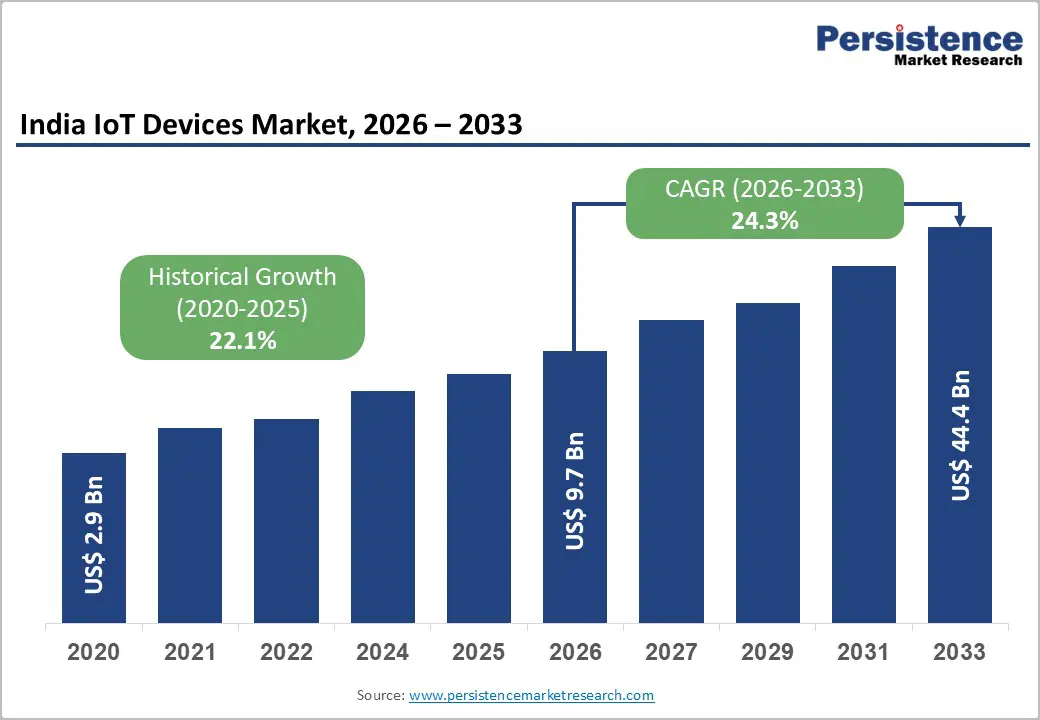
India IoT devices market size is likely to be valued at US$ 9.7 Billion in 2026 and is projected to reach US$ 44.4 Billion by 2033, growing at a CAGR of 24.3% between 2026 and 2033. The market demonstrated exceptional historical momentum, recording a CAGR of 22.1% from 2020 to 2026, with the market valued at US$ 2.9 Billion in 2020, reflecting a half-decade of policy-accelerated digital infrastructure investment, expanding 5G connectivity, and structural enterprise adoption of connected device systems.
This trajectory is anchored by three converging fundamentals: the Government of India's National Digital Communication Policy 2018, the Telecommunications Act 2023 establishing a comprehensive M2M and IoT regulatory architecture, and the documented capital commitment of global semiconductor and technology leaders to India as a strategic IoT hub. Qualcomm Incorporated announced an investment of up to US$ 150 million in India in February 2026 through Qualcomm Ventures, specifically targeting edge AI adoption in IoT devices and industrial applications, validating durable long-term confidence in the India IoT Devices Market as a globally significant technology ecosystem.
Key Industry Highlights:
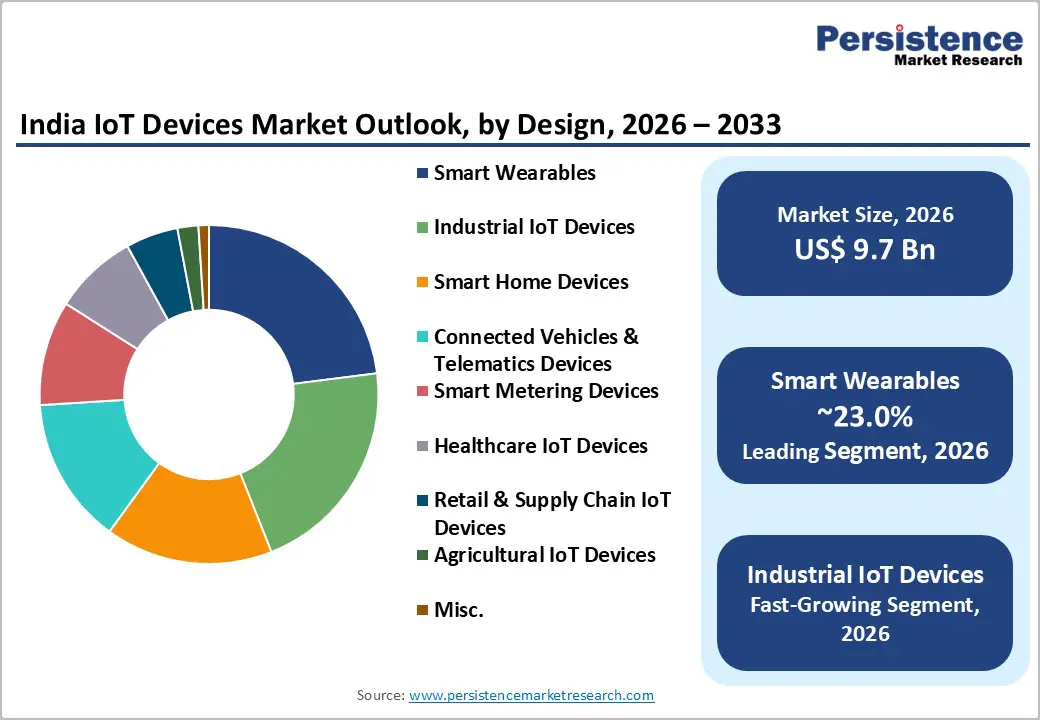
- Leading Device Segment: Smart wearables lead the device segment with approximately 23% market share, driven by health monitoring, fitness tracking, and growing adoption among India’s young and urban population.
- High-Value Industrial Segment: Industrial IoT devices are the fastest-growing segment, driven by Industry 4.0 adoption, predictive maintenance, and AI-at-the-edge integration across manufacturing and supply chain operations.
- Leading End-use: Residential and individual users dominate with around 24% share, fueled by mass adoption of smart home devices, wearables, and connected personal electronics.
- Fastest-Growing End-use: Manufacturing is the fastest-growing vertical, driven by government-aligned smart factory initiatives, PLI scheme-linked investments, and enterprise adoption of connected industrial hardware.
- Growth Opportunity: Agriculture and rural IoT deployments present high-volume opportunities, with farm equipment telematics, irrigation automation, and soil monitoring enabling scalable adoption across millions of farm holdings.
| Key Insights | Details |
|---|---|
| India IoT Devices Market Size (2026E) | US$ 9.7 Bn |
| Market Value Forecast (2033F) | US$ 44.4 Bn |
| Projected Growth (CAGR 2026 to 2033) | 24.3% |
| Historical Market Growth (CAGR 2020 to 2025) | 22.1% |
Market Dynamics
Drivers - Government-Led Smart Infrastructure Mandates and Regulatory Frameworks Enabling IoT Adoption at National Scale
India's national and state governments have established a coordinated policy architecture that directly mandates and funds large-scale IoT device deployment across utilities, public infrastructure, and rural connectivity programs, creating structurally assured institutional demand for the India IoT Devices Market. The Telecommunication Engineering Centre (TEC) under the Department of Telecommunications released the "Code of Practice for Securing Consumer Internet of Things," establishing baseline security requirements aligned with global standards for device-level protection, vulnerability management, and compliance across manufacturers, service providers, and application developers. The Telecom Regulatory Authority of India (TRAI) introduced recommendations on establishing a regulatory framework for the "International M2M SIM Service Authorisation," implementing a fully online, light-touch approval mechanism to streamline export-oriented IoT device manufacturing, specifically targeting globally competitive products such as smart meters and connected vehicles.
At the state level, the Bihar Panchayati Raj Department deployed IoT-based sensor devices across districts under the Har Ghar Nal Ka Jal scheme, installing devices in tens of thousands of wards to monitor motorised pumps, detect water wastage, and ensure consistent delivery of per capita water to millions of households. This program illustrates how the Indian IoT Devices Market intersects with adjacent infrastructure sectors, including water pump management, where real-time pump monitoring through connected sensors directly enables utility efficiency at the district scale. These coordinated government mandates provide reliable procurement pipelines, regulatory certainty, and public sector reference deployments that underpin private-sector investment confidence across the forecast period.
Third-Party Logistics Sector Expansion and Supply Chain Decentralisation
The commercial rollout of 5G across India's major urban centres delivers the high-bandwidth, ultra-low-latency, and massive device density capabilities required for industrial automation, connected vehicle telematics, and smart city IoT deployments at a national scale, forming the essential connectivity foundation for the India IoT Devices Market. Tech Mahindra and Anritsu launched a 5G IoT Experience Lab, enabling IoT device manufacturers to validate product performance across functional, performance, and stress testing in a pre-commercialisation environment, materially accelerating time-to-market for next-generation IoT hardware.
Cisco and Tata Communications integrated Tata Communications MOVE's global eSIM orchestration platform with Cisco IoT Control Center, allowing enterprises to activate, manage, and scale IoT devices across multiple networks, simplifying SIM lifecycle management for millions of connected IoT devices globally. Silicon Labs supplied RF mesh-enabled SoCs for India's Advanced Metering Initiative, powering smart electricity meters with ultra-reliable, scalable, and energy-efficient connectivity for both urban and rural deployments.
Vi Business expanded its partnership with C-DOT in December 2023 to operate the Vi C-DOT IoT Lab, enabling interoperability, standardisation, and certification of IoT devices across 4G, 5G, and NB-IoT modules through 175 testing scenarios against oneM2M standards, accelerating market readiness for India's connected device ecosystem.
Industry 4.0 Adoption and AI-at-the-Edge Integration Accelerating Industrial IoT Device Deployment
India's organized manufacturing sector is structurally redirecting capital investment toward Industry 4.0-aligned industrial IoT devices and AI-enabled monitoring hardware as enterprises seek quantifiable gains in operational efficiency, predictive maintenance, and real-time production visibility across factory and supply chain environments. ABB India expanded its Smart Power factory in Bengaluru in August 2022 with Industry 5.0-enabled production integrating cobots, AI, and IoT-connected systems, achieving documented improvements of 40% in productivity and 15% in energy efficiency through IoT platform integration of robots, motors, and drives.
Robert Bosch Engineering and Business Solutions (RBEI) launched the Phantom Edge AIoT platform in India, providing real-time monitoring of electrical energy consumption across industries through edge-based AI and IoT sensors for machine efficiency optimisation, safety enhancement, and sustainability support. Honeywell and Tata Consultancy Services (TCS) formed a strategic partnership to integrate Honeywell Forge IoT platform capabilities with TCS cloud and IT modernisation expertise for real-time data integration, predictive analytics, and OT/IT convergence, initially targeting Indian enterprises. The BEET and Tech Mahindra Global Strategic Partnership established Tech Mahindra as a Master Certified Systems Integrator for the BEET AI-enabled industrial IoT platform, advancing intelligent manufacturing capabilities across India's production sector.
Restraint - Cybersecurity Vulnerabilities and Regulatory Compliance Gaps in Deployed IoT Device Ecosystems
The India IoT Devices Market faces substantive cybersecurity challenges that materially constrain institutional and enterprise adoption, particularly in sensitive verticals including healthcare, defence, and critical utility infrastructure. The U.S. and China Economic and Security Review Commission has documented how state-sponsored IoT vulnerabilities can enable unauthorised data access at scale through embedded firmware and network-layer exploits. While the TEC's January 2022 Code of Practice establishes baseline consumer IoT security standards, enforcement mechanisms for the large and fast-compounding installed base of non-compliant legacy IoT devices remain underdeveloped, increasing systemic network exposure risk. The financial cost of implementing certified, compliant security architectures across multi-device enterprise deployments adds measurable procurement friction, particularly for cost-sensitive small and mid-scale enterprise buyers.
Hardware Import Dependency and Semiconductor Component Supply Chain Fragility
India's IoT device manufacturing ecosystem, despite substantial policy support under the Atmanirbhar Bharat initiative and Production Linked Incentive (PLI) schemes, retains structural dependency on imported semiconductor SoCs, RF connectivity modules, and sensor components primarily sourced from East Asia. This import dependency exposed the India IoT Devices Market to significant production delays during the 2021 to 2023 global semiconductor shortage, which deferred IoT device shipments across consumer, industrial, and smart infrastructure verticals.
While domestic ventures, including Amara Raja Blaze Technologies Pvt. Ltd., established in July 2020 by Amara Raja Group and Blaze to design and manufacture IoT devices for global markets, signal progress in local manufacturing capability, scaling globally competitive domestic chipset and module production requires sustained multi-year capital commitments well beyond current program scale.
Opportunity - Smart Agriculture and Rural IoT Deployment Across India's 140 million Farm Holdings
India's agricultural economy, encompassing over 140 million farm holdings per the Agriculture Census of India and contributing approximately 18% of GDP per the Ministry of Statistics and Programme Implementation, represents one of the highest-volume and most strategically consequential IoT deployment environments for the India IoT Devices Market, with acute unmet needs in farm equipment telematics, irrigation automation, soil monitoring, and supply chain traceability.
In March 2023, Mahindra's Krish-e agtech business launched the IoT-based Smart Kit, a GPS-enabled plug-and-play device for tractors and farm equipment developed by Carnot Technologies, enabling real-time monitoring, fuel tracking, geofencing, and fleet analytics through a mobile application for over 25,000 active users at launch. The documented rural infrastructure deployment by the Bihar Panchayati Raj Department, monitoring motorised water pumps across 50,000 wards through IoT sensor networks, demonstrates the scalability of connected device programs across non-urban government infrastructure. For IoT device manufacturers and solution providers, this combination of private agtech commercialisation and government-funded rural deployment creates a dual-channel demand mechanism that can sustain high-volume device procurement well into the India IoT Devices Market's forecast period through the convergence of agricultural digitisation with India's smart infrastructure agenda.
Export-Oriented IoT Hardware Manufacturing Under TRAI M2M Framework and Make in India
India's regulatory and industrial policy ecosystem is progressively establishing the country as a globally competitive hub for IoT device manufacturing and export, creating a tangible strategic opportunity for domestic and multinational IoT hardware manufacturers to anchor India-based production within their global supply chains and serve international M2M device demand at competitive cost and quality.
The TRAI "International M2M SIM Service Authorisation" recommendation introduces a fully online, minimal-compliance mechanism specifically designed to facilitate export-oriented IoT device production targeting smart meters, connected vehicles, and M2M modules. Initiatives such as the Sensorise SenseIT Energy MAID under the Make in India and Atmanirbhar Bharat programs demonstrate how government-policy-aligned IoT product development positions Indian manufacturers for both domestic deployment and global export. Honeywell’s India-designed and manufactured CCTV camera portfolio, in partnership with VVDN Technologies, confirms that global tier-1 technology companies are investing in India as an IoT hardware design and manufacturing hub, strengthening the India IoT Devices Market’s export competitiveness.
Category-wise Analysis
Device Category Insights
The smart wearables segment holds the leading position in the India IoT Devices Market by device category, commanding approximately 23% of total device market share in 2026. India's young demographic profile, with a median age of approximately 28 years per the Census of India estimates and a rapidly expanding urban middle class with disposable income allocated toward health and fitness technology, sustains the structural dominance of smartwatches, fitness bands, and health monitoring wearables as the highest-volume consumer IoT device category. Samsung India's innovation strategy, emphasising India-led product development with over 14,000 patents filed from India across smartphones, AI-enabled appliances, and connected wearables, reflects the strategic priority that global consumer electronics OEMs assign to India's smart device ecosystem.
Eurostat's 2024 IoT adoption data across the European Union confirms that wearables represent the second most widely adopted consumer IoT device category at 30% usage among citizens, validating the structural appeal of wearable devices as the primary consumer-facing segment in comparable technology adoption trajectories.
Industrial IoT Devices represent the fastest-growing device category within the India IoT Devices Market, propelled by documented enterprise ROI from connected manufacturing systems, government-mandated smart metering deployments, and the progressive integration of AI at the edge into industrial hardware platforms. ABB India's Bengaluru Smart Power factory expansion demonstrated a 40% productivity improvement and 15% energy efficiency gain from IoT-integrated industrial systems, a quantified ROI benchmark that is accelerating enterprise capital allocation toward connected industrial hardware across India's organised manufacturing sector.
End-user Insights
The residential and individual users segment leads the India IoT Devices Market by end-use industry, accounting for approximately 24% of total market share in 2026, reflecting the mass-market penetration of smart home, wearable, and connected personal electronics across India's urban consumer base. ABB India launched ABB free@home, a wireless smart home automation solution for the Indian residential market in September 2024, featuring Matter Bridge integration and interoperability across Apple HomeKit, Google Home, Amazon Alexa, and Samsung SmartThings, enabling centralised control of appliances, EV chargers, lighting, and energy systems.
The Manufacturing end-use industry is the fastest-growing vertical within the India IoT Devices Market, driven by government-aligned Industry 4.0 adoption mandates, PLI scheme-linked smart factory capital investment, and the breadth of high-value enterprise IoT partnerships across the sector.
Cognizant and OMRON Corporation partnered in April 2025 to integrate IT and OT in manufacturing, combining OMRON's automation technology with Cognizant's IoT, AI, and cloud expertise across automotive, semiconductor, and life sciences production environments. was also recognised as a Horizon 3 Leader in the 2024 HFS Horizons IoT Service Providers report for its comprehensive IoT strategies and platforms, including APEx for asset performance and Neuro Edge for AI at the edge.
Competitive Landscape
The India IoT devices market is moderately consolidated, driven by a combination of global technology leaders and strong domestic players catering to industrial, enterprise, and consumer segments. Key players such as Samsung, Honeywell, Tata Communications, Robert Bosch Engineering and Business Solutions (RBEI), and Silicon Labs dominate enterprise and industrial IoT solutions, while startups and niche providers add competition in consumer and sensor segments.
The market reflects oligopolistic tendencies in industrial and utility IoT applications, where strategic partnerships, localised manufacturing, and innovation-driven differentiation define competitive advantage. Collaboration between global vendors and Indian IT and manufacturing firms is accelerating adoption of AIoT platforms, smart meters, and connected infrastructure, while regulatory compliance and Make-in-India initiatives further shape the competitive landscape. Emerging mid-tier players introduce some fragmentation in consumer IoT devices, but the dominance of top players ensures technology leadership, scalability, and reliability across critical applications.
Key Developments:
- In Feb 2026, Qualcomm Ventures announced a $150 million Strategic AI Venture Fund to invest in Indian startups specialising in AI, robotics, automotive, mobile, and Internet of Things (IoT) devices. The initiative aims to strengthen India’s edge AI capabilities and IoT device ecosystem, supporting the development of intelligent, connected devices across multiple industries. This move reflects Qualcomm’s long-term commitment to nurturing India’s deep-tech innovation landscape and accelerating the adoption of next-generation IoT solutions.
- In Feb 2026, Honeywell partnered with Tata Consultancy Services (TCS) to advance AI-powered autonomous operations for buildings and industrial operations in India. By integrating Honeywell Forge IoT platform capabilities with TCS’ cloud and IT modernisation expertise, the collaboration enables real-time monitoring, predictive analytics, and seamless OT/IT convergence. This initiative strengthens India’s industrial IoT infrastructure, helping enterprises optimise operational efficiency, improve safety, and adopt intelligent building and manufacturing solutions.
- In Dec 2024, Silicon Labs shipped four million FG23 System-on-Chip (SoC) devices integrated with Wirepas RF mesh for India’s Advanced Metering Initiative (AMI), supporting smart electricity meters across urban and rural areas. These IoT-enabled chips provide ultra-reliable, energy-efficient, and scalable connectivity, ensuring 99.9% data delivery reliability for utilities. The deployment accelerates India’s IoT-driven energy management ecosystem, enabling utilities to improve operational efficiency, monitor consumption in real time, and support national smart grid initiatives.
Companies Covered in India IoT Devices Market
- ABB Group
- Cisco Systems, Inc.
- Honeywell International Inc.
- Huawei Technologies Co., Ltd.
- Intel Corporation
- NXP Semiconductors NV
- PTC Inc.
- Qualcomm Technologies, Inc.
- Robert Bosch GmbH
- Samsung Electronics Co., Ltd.
- Siemens AG
- Sierra Wireless
- Watsoo
- Pratiti Technologies
- Aeron Systems
- iTriangle Infotech
- Eelink Tracker
- Teltonika Networks
- Jimi IoT
- Vighnaharta
- TronicsZone
- LivWize
- Silicon Laboratories, Inc.
- STMicroelectronics NV
- Texas Instruments Incorporated
Frequently Asked Questions
The India IoT Devices Market is projected to be valued at US$ 9.7 Bn in 2026.
The Smart Wearables segment is expected to account for approximately 23% of the India IoT Devices Market by Device Category in 2026.
The market is expected to witness a CAGR of 24.3% from 2026 to 2033.
The India IoT Devices Market growth is driven by government-led smart infrastructure mandates, 5G and advanced connectivity enabling industrial automation and smart city deployments, and Industry 4.0 adoption with AI-at-the-edge integration enhancing operational efficiency, predictive maintenance, and real-time production visibility across manufacturing and supply chains.
Key market opportunities in the India IoT Devices Market include large-scale smart agriculture and rural IoT deployments across millions of farm holdings, alongside export-oriented IoT hardware manufacturing supported by TRAI’s M2M framework and Make in India initiatives.
Key players in the IoT Devices Market include ABB Group, Honeywell, Bosch, Siemens, and Samsung Electronics, which are especially prominent in the India IoT devices market.


