Food Certification Market Size, Share, Growth, and Regional Forecast, 2026 - 2033

Food Certification Market is segmented by Certification Type (Food Safety Certifications, Organic Certifications, Religious Certifications, Dietary and Allergen Certifications, Sustainability Certifications), Food Category (Fresh fruits & vegetables, Dairy products, Meat & poultry processing, Infant & Special Nutrition, Nutraceuticals & Supplements, Food Service, Others), End-user, and Regional Analysis, 2026 - 2033

ID: PMRREP36356
Calendar

March 2026

210 Pages

Author : Abhijeet Surwase

Key Industry Highlights:

  • Leading Region: Europe, holding 34% market share, supported by stringent EU food safety regulations, strong adoption of organic and geographical indication certifications, and a highly aware consumer base prioritizing verified food quality and sustainability.
  • Fastest-Growing Region: Asia Pacific, driven by rising middle-class food safety concerns, modernization of retail supply chains, expansion of food exports, and increasing adoption of halal, organic, and functional food certifications across emerging economies.
  • Fastest-Growing Certification Type Segment: Religious Certifications, fueled by the expanding global halal food market, growing Muslim population, and increasing cross-border demand for ethically produced and culturally compliant food products.
  • Fastest-Growing End-User Segment: Exporters, supported by expanding international trade agreements and the growing need for internationally recognized certifications to access global food supply chains.
  • Market Drivers: Rising consumer demand for transparency, traceability, and verified food claims is accelerating the adoption of globally recognized certification systems across food manufacturing and retail sectors.
  • Opportunities: Integration of blockchain, IoT sensors, and digital traceability platforms is enabling real-time certification monitoring and farm-to-fork verification, opening new service opportunities for certification bodies.
  • Key Developments: In March 2026, the UK Government announced progress toward a new SPS agreement with the EU to align food safety regulations and support smoother agri-food trade. In February 2026, AFYREN obtained FSSC 22000 certification for its AFYREN NEOXY plant, strengthening its commitment to global food safety standards.
Key Insights Details

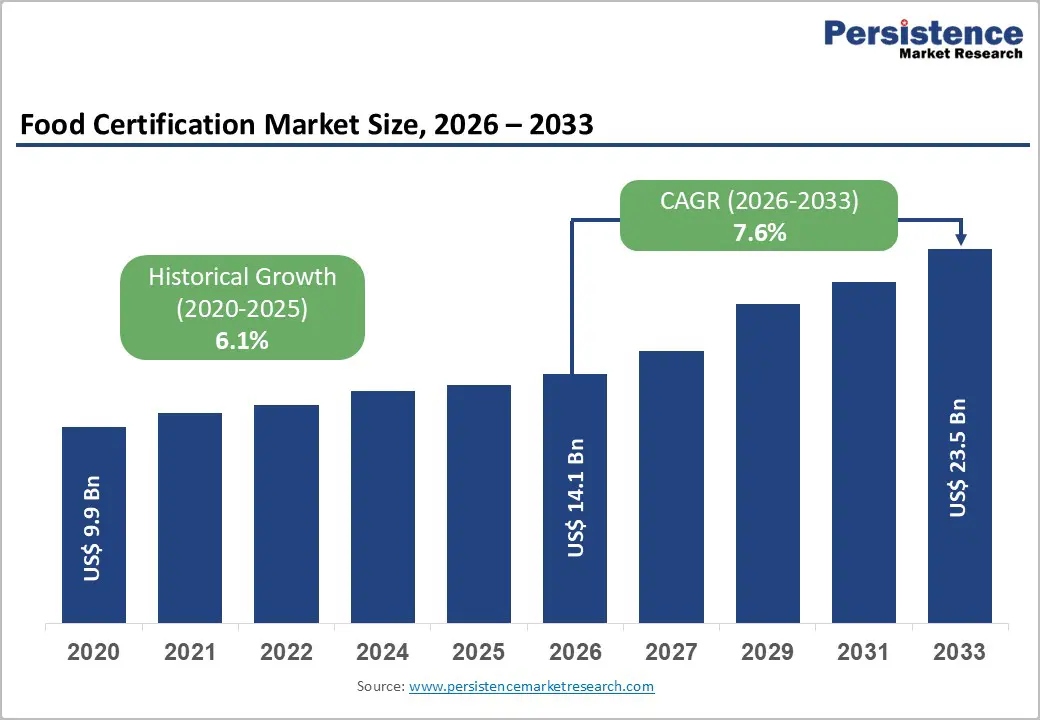
Global Food Certification Market Size (2026E)

US$ 14.1 Bn

Market Value Forecast (2033F)

US$ 23.5 Bn

Projected Growth (CAGR 2026 to 2033)

7.6%

Historical Market Growth (CAGR 2020 to 2025)

6.1%

Market Dynamics

Driver - Growing Consumer Demand for Transparency and Verified Food Claims

A primary driver for the industry is the fundamental shift in consumer behavior toward transparency and ethical consumption. According to the World Health Organization (WHO), roughly 600 million people fall ill after eating contaminated food annually, which has made Food Safety Certifications a non-negotiable requirement for the modern consumer. Shoppers are increasingly looking for third-party validation to confirm that products are free from harmful chemicals, allergens, or unethical labor practices. Organizations like the Global Food Safety Initiative (GFSI) have standardized these benchmarks, encouraging manufacturers to adopt high-tier certifications like FSSC 22000 or BRCGS. This demand is particularly strong in developed economies where health-conscious demographics are willing to pay a premium for certified organic and sustainably sourced products.

Restraints - High Costs of Certification and Multi-tier Auditing Processes

A significant barrier to broader market adoption is the substantial financial investment required to obtain and maintain global certifications. Small and medium-sized enterprises (SMEs) often struggle with the direct costs of audit fees, as well as the indirect costs associated with facility upgrades, staff training, and the implementation of advanced laboratory testing. The Food and Agriculture Organization (FAO) has noted that for small-scale Growers, the price of multiple certifications ranging from organic to fair trade can outweigh the initial profit margins gained from entering premium markets. This financial burden often creates a consolidated landscape where only large-scale operators can afford the pay-to-play model of international retail, potentially limiting the diversity of certified products available to the general public.

Opportunity - Rapid Integration of Blockchain and IoT for Real-time Traceability

The digital transformation of the food industry presents a massive opportunity for certification bodies to offer high-tech, real-time verification services. By utilizing Blockchain technology, organizations like FoodChain ID and Intertek Group Plc can provide an immutable ledger of a product's journey from farm to fork. This technology addresses the growing consumer demand for instant proof of origin and safety. Opportunities exist for service providers to integrate Internet of Things (IoT) sensors that monitor temperature and humidity during transit, automatically triggering compliance reports. As the World Economic Forum highlights the role of digital twins in food security, the move toward smart certification is expected to be a major differentiator for market leaders, allowing them to capture a larger share of the high-growth Fresh fruits & vegetables and Dairy products segments.

Category-wise Analysis

Certification Type Insights

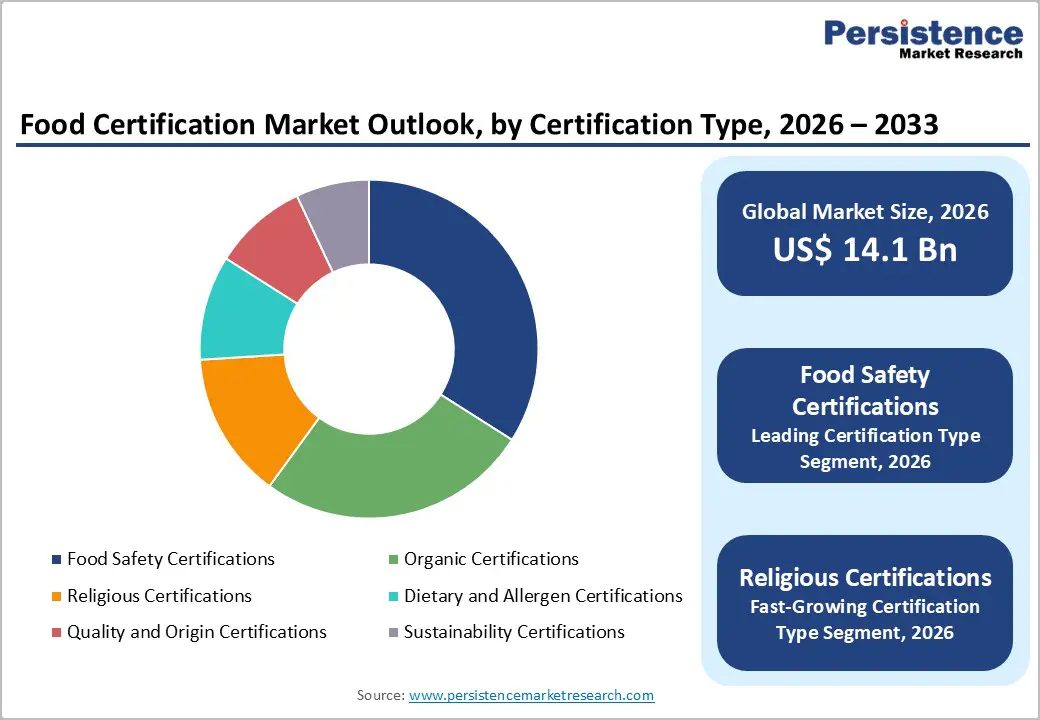
The Food Safety Certifications segment is the leading segment in certification type, accounting for a dominant 35% market share in 2025. This leadership is justified by the mandatory nature of safety standards in almost every jurisdiction globally. Large-scale retail chains like Walmart and Tesco require their suppliers to hold GFSI-recognized certifications to minimize liability and ensure product quality. Meanwhile, Religious Certifications is identified as the fastest growing segment through 2033. This rapid growth is fueled by the rising global Muslim population and the increasing mainstreaming of Halal products in non-Muslim majority countries. As Halal becomes synonymous with clean and ethical among a broader demographic, the demand for these specialized audits is set to outpace traditional safety standards in terms of annual percentage growth.

End-user Insights

The Food & Beverage Manufacturers segment stands as the leading end-user for food certification services. These companies are the primary bridge between raw materials and final consumers, and they bear the greatest regulatory and reputational risk. Manufacturers utilize certifications to differentiate their brands in a crowded marketplace and to streamline their internal quality control processes. On the other hand, the Exporters segment is identified as the fastest-growing end-user. As trade agreements like the AfCFTA and CPTPP expand, companies in developing regions are racing to acquire international certifications to compete on a global stage. The need for Growers to meet the GlobalGAP standards to supply international supermarkets is also a significant driver of volume in this category.
Regional Insights

Europe Food Certification Market Trends and Insights

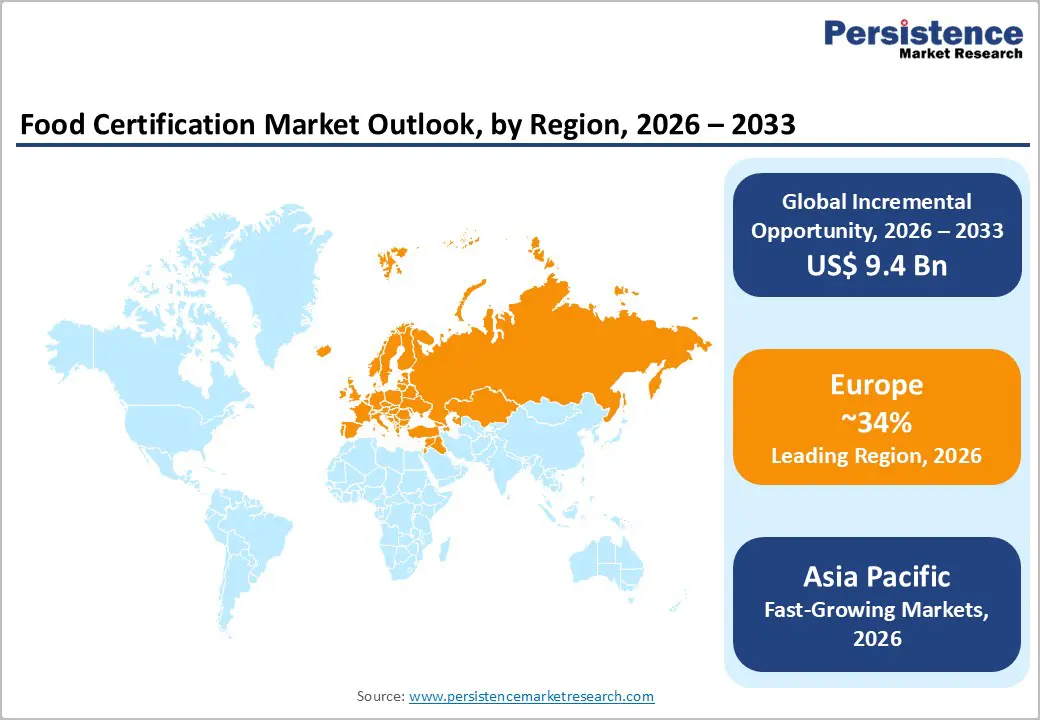
Europe currently holds the leading market share of 34% in 2025, underpinned by the world's most rigorous food safety regulations and a highly mature consumer base. The European Union (EU) has a long-standing tradition of protecting food quality through PDO (Protected Designation of Origin) and PGI (Protected Geographical Indication) labels. This regional leadership is supported by the high penetration of Organic Certifications, with countries like Germany and France being global leaders in organic land area and consumption.

The innovation ecosystem in Europe is currently focused on the Farm to Fork strategy, which aims to make food systems fair, healthy, and environmentally friendly. Regulatory harmonization across the continent allows major firms like ECOCERT GROUP and DEKRA to offer standardized services across multiple borders. Performance analysis indicates that the demand for Sustainability Certifications is higher in Europe than in any other region, driven by proactive governmental policies on carbon labeling and plastic reduction. The presence of world-class accreditation bodies ensures that European food certifications remain the global benchmark for quality and safety.

Asia Pacific Food Certification Market Trends and Insights

Asia Pacific is identified as the fastest growing segment for the food certification market through 2033. This rapid expansion is primarily driven by the burgeoning middle class in China, India, and the ASEAN countries, who are increasingly concerned about food adulteration and safety. The region's growth dynamics are further supported by a massive shift from traditional wet markets to modern, organized retail formats that require certified suppliers.

The region also benefits from significant manufacturing advantages, with China and Vietnam being global hubs for processed food exports. Governments in the region are actively updating their food laws such as the FSSAI in India to align with international standards, creating a massive requirement for domestic certification services. In Japan and South Korea, there is a notable trend toward functional food certifications. Furthermore, the rapid growth of the Halal food market in Indonesia and Malaysia is a major engine for the Religious Certifications segment. As local companies look to access global supply chains, the Asia Pacific region is poised to become a central pillar of the global certification industry.
Competitive Landscape

The Food Certification Market exhibits a moderately consolidated structure at the top, where a few global giants with extensive laboratory networks and diverse service portfolios hold a significant share. Leaders like SGS, Bureau Veritas, and Intertek Group Plc dominate the industry through their ability to offer one-stop-shop solutions that cover safety, quality, and sustainability across multiple regions. These companies employ strategies focused on strategic acquisitions of specialized local firms to expand their geographic footprint and technical expertise. Key differentiators in the market include the speed of audit turnaround, the global recognition of the certificate, and the integration of digital platforms for certificate management. Emerging business models are prioritizing continuous compliance through AI and remote monitoring, helping companies move away from once-a-year snapshot audits toward a more proactive, always-on safety culture.

Key Developments:

  • In March 2026, the UK Government announced progress toward a new Sanitary and Phytosanitary (SPS) agreement with the European Union, aimed at aligning food safety regulations and facilitating smoother agri-food trade.
  • In February 2026, AFYREN obtained FSSC 22000 Food Safety Certification for its AFYREN NEOXY Plant, reinforcing its commitment to high food safety and quality standards.
  • In September 2025, NSF International introduced NSF Protocol 525, a science-based assessment for food contact materials designed to limit exposure to harmful substances such as PFAS, BPA, and heavy metals.

Companies Covered in Food Certification Market

  • DEKRA
  • ECOCERT GROUP
  • FoodChain ID
  • SGS
  • ICEA Certifica
  • Intertek Group Plc
  • Bioagricert Srl
  • Bureau Veritas
  • RINA S.p.A.
  • Cotecna
  • Others
Frequently Asked Questions

The global Food Certification market is projected to be valued at US$ 14.1 Bn in 2026.

Growing Consumer Demand for Transparency and Verified Food Claims is a major factor driving global Food Certification market.

The Global Food Certification market is poised to witness a CAGR of 7.6% between 2026 and 2033.

Rapid Integration of Blockchain and IoT for Real-time Traceability is a significant opportunity in the Food Certification market.

Major players in the Global Food Certification market include SGS, Bureau Veritas, Intertek Group Plc, ECOCERT GROUP, DEKRA and others.

Global Food Certification Market Report Scope
Report Attribute Details

Historical Data/Actuals 

2020 - 2025

Forecast Period 

2026 - 2033 

Market Analysis

Value: US$ Bn

Geographical Coverage

  • North America
  • Europe
  • East Asia
  • South Asia and Oceania
  • Middle East and Africa
  • Latin America

Segmental Coverage

  • Certification Type
  • Food Category
  • End User
  • Region

Competitive Analysis 

  • DEKRA
  • ECOCERT GROUP
  • FoodChain ID
  • SGS
  • ICEA Certifica
  • Intertek Group Plc
  • Bioagricert Srl
  • Bureau Veritas
  • RINA S.p.A.
  • Cotecna
  • Others

Report Highlights 

  • Market Forecast and Trends 
  • Competitive Intelligence & Share Analysis  
  • Growth Factors and Challenges 
  • Strategic Growth Initiatives 
  • Future Opportunities and Revenue Pockets 
  • Market Analysis Tools
Market Segmentation

By Certification Type

  • Food Safety Certifications
  • Organic Certifications
  • Religious Certifications
  • Dietary and Allergen Certifications
  • Quality and Origin Certifications
  • Sustainability Certifications

By Food Category

  • Fresh fruits & vegetables
  • Dairy products
  • Meat & poultry processing
  • Bakery & Confectionery
  • Beverages
  • Infant & Special Nutrition
  • Nutraceuticals & Supplements
  • Food Service
  • Others

By End-user

  • Food & Beverage Manufacturers
  • Growers
  • Food Service Operators
  • Retailers
  • Exporters

By Region

  • North America
  • Europe
  • East Asia
  • South Asia and Oceania
  • Latin America
  • Middle East and Africa

Related Reports

  1. Executive Summary
    1. Global Food Certification Market Snapshot 2026 and 2033
    2. Market Opportunity Assessment, 2026-2033, US$ Bn
    3. Key Market Trends
    4. Industry Developments and Key Market Events
    5. Demand Side and Supply Side Analysis
    6. PMR Analysis and Recommendations
  2. Market Overview
    1. Market Scope and Definitions
    2. Market Dynamics
      1. Driver
      2. Restraint
      3. Opportunities
      4. Trends
    3. Macro-Economic Factors
    4. Forecast Factors – Relevance and Impact
    5. COVID-19 Impact Assessment
  3. Value Added Insights
    1. Value Chain analysis
    2. Key Market Players
    3. Key Promotional Strategies by key players
    4. PESTLE Analysis
    5. Porter's Five Forces Analysis
    6. Regulatory Landscape
  4. Price Trend Analysis, 2025
    1. Region-wise Price Analysis
    2. Price by Segments
    3. Price Impact Factors
  5. Global Food Certification Market Outlook: Historical (2020 – 2025) and Forecast (2026 – 2033)
    1. Key Highlights
    2. Global Food Certification Market Outlook: Certification Type
      1. Introduction/Key Findings
      2. Historical Market Size (US$ Bn) Analysis by Certification Type, 2020-2025
      3. Current Market Size (US$ Bn) Forecast, by Certification Type, 2026-2033
        1. Food Safety Certifications
        2. Organic Certifications
        3. Religious Certifications
        4. Dietary and Allergen Certifications
        5. Quality and Origin Certifications
        6. Sustainability Certifications
      4. Market Attractiveness Analysis: Certification Type
    3. Global Food Certification Market Outlook: Food Category
      1. Introduction/Key Findings
      2. Historical Market Size (US$ Bn) Analysis by Food Category, 2020-2025
      3. Current Market Size (US$ Bn) Forecast, by Food Category, 2026-2033
        1. Fresh fruits & vegetables
        2. Dairy products
        3. Meat & poultry processing
        4. Bakery & Confectionery
        5. Beverages
        6. Infant & Special Nutrition
        7. Nutraceuticals & Supplements
        8. Food Service
        9. Others
      4. Market Attractiveness Analysis: Food Category
    4. Global Food Certification Market Outlook: End User
      1. Introduction/Key Findings
      2. Historical Market Size (US$ Bn) Analysis by End User, 2020-2025
      3. Current Market Size (US$ Bn) Forecast, by End User, 2026-2033
        1. Food & Beverage Manufacturers
        2. Growers
        3. Food Service Operators
        4. Retailers
        5. Exporters
      4. Market Attractiveness Analysis: End User
  6. Global Food Certification Market Outlook: Region
    1. Key Highlights
    2. Historical Market Size (US$ Bn) Analysis by Region, 2020-2025
    3. Current Market Size (US$ Bn) Forecast, by Region, 2026-2033
      1. North America
      2. Europe
      3. East Asia
      4. South Asia & Oceania
      5. Latin America
      6. Middle East & Africa
    4. Market Attractiveness Analysis: Region
  7. North America Food Certification Market Outlook: Historical (2020 – 2025) and Forecast (2026 – 2033)
    1. Key Highlights
    2. Pricing Analysis
    3. North America Market Size (US$ Bn) Forecast, by Country, 2026-2033
      1. U.S.
      2. Canada
    4. North America Market Size (US$ Bn) Forecast, by Certification Type, 2026-2033
      1. Food Safety Certifications
      2. Organic Certifications
      3. Religious Certifications
      4. Dietary and Allergen Certifications
      5. Quality and Origin Certifications
      6. Sustainability Certifications
    5. North America Market Size (US$ Bn) Forecast, by Food Category, 2026-2033
      1. Fresh fruits & vegetables
      2. Dairy products
      3. Meat & poultry processing
      4. Bakery & Confectionery
      5. Beverages
      6. Infant & Special Nutrition
      7. Nutraceuticals & Supplements
      8. Food Service
      9. Others
    6. North America Market Size (US$ Bn) Forecast, by End User, 2026-2033
      1. Food & Beverage Manufacturers
      2. Growers
      3. Food Service Operators
      4. Retailers
      5. Exporters
  8. Europe Food Certification Market Outlook: Historical (2020 – 2025) and Forecast (2026 – 2033)
    1. Key Highlights
    2. Pricing Analysis
    3. Europe Market Size (US$ Bn) Forecast, by Country, 2026-2033
      1. Germany
      2. Italy
      3. France
      4. U.K.
      5. Spain
      6. Russia
      7. Rest of Europe
    4. Europe Market Size (US$ Bn) Forecast, by Certification Type, 2026-2033
      1. Food Safety Certifications
      2. Organic Certifications
      3. Religious Certifications
      4. Dietary and Allergen Certifications
      5. Quality and Origin Certifications
      6. Sustainability Certifications
    5. Europe Market Size (US$ Bn) Forecast, by Food Category, 2026-2033
      1. Fresh fruits & vegetables
      2. Dairy products
      3. Meat & poultry processing
      4. Bakery & Confectionery
      5. Beverages
      6. Infant & Special Nutrition
      7. Nutraceuticals & Supplements
      8. Food Service
      9. Others
    6. Europe Market Size (US$ Bn) Forecast, by End User, 2026-2033
      1. Food & Beverage Manufacturers
      2. Growers
      3. Food Service Operators
      4. Retailers
      5. Exporters
  9. East Asia Food Certification Market Outlook: Historical (2020 – 2025) and Forecast (2026 – 2033)
    1. Key Highlights
    2. Pricing Analysis
    3. East Asia Market Size (US$ Bn) Forecast, by Country, 2026-2033
      1. China
      2. Japan
      3. South Korea
    4. East Asia Market Size (US$ Bn) Forecast, by Certification Type, 2026-2033
      1. Food Safety Certifications
      2. Organic Certifications
      3. Religious Certifications
      4. Dietary and Allergen Certifications
      5. Quality and Origin Certifications
      6. Sustainability Certifications
    5. East Asia Market Size (US$ Bn) Forecast, by Food Category, 2026-2033
      1. Fresh fruits & vegetables
      2. Dairy products
      3. Meat & poultry processing
      4. Bakery & Confectionery
      5. Beverages
      6. Infant & Special Nutrition
      7. Nutraceuticals & Supplements
      8. Food Service
      9. Others
    6. East Asia Market Size (US$ Bn) Forecast, by End User, 2026-2033
      1. Food & Beverage Manufacturers
      2. Growers
      3. Food Service Operators
      4. Retailers
      5. Exporters
  10. South Asia & Oceania Food Certification Market Outlook: Historical (2020 – 2025) and Forecast (2026 – 2033)
    1. Key Highlights
    2. Pricing Analysis
    3. South Asia & Oceania Market Size (US$ Bn) Forecast, by Country, 2026-2033
      1. India
      2. Southeast Asia
      3. ANZ
      4. Rest of SAO
    4. South Asia & Oceania Market Size (US$ Bn) Forecast, by Certification Type, 2026-2033
      1. Food Safety Certifications
      2. Organic Certifications
      3. Religious Certifications
      4. Dietary and Allergen Certifications
      5. Quality and Origin Certifications
      6. Sustainability Certifications
    5. South Asia & Oceania Market Size (US$ Bn) Forecast, by Food Category, 2026-2033
      1. Fresh fruits & vegetables
      2. Dairy products
      3. Meat & poultry processing
      4. Bakery & Confectionery
      5. Beverages
      6. Infant & Special Nutrition
      7. Nutraceuticals & Supplements
      8. Food Service
      9. Others
    6. South Asia & Oceania Market Size (US$ Bn) Forecast, by End User, 2026-2033
      1. Food & Beverage Manufacturers
      2. Growers
      3. Food Service Operators
      4. Retailers
      5. Exporters
  11. Latin America Food Certification Market Outlook: Historical (2020 – 2025) and Forecast (2026 – 2033)
    1. Key Highlights
    2. Pricing Analysis
    3. Latin America Market Size (US$ Bn) Forecast, by Country, 2026-2033
      1. Brazil
      2. Mexico
      3. Rest of LATAM
    4. Latin America Market Size (US$ Bn) Forecast, by Certification Type, 2026-2033
      1. Food Safety Certifications
      2. Organic Certifications
      3. Religious Certifications
      4. Dietary and Allergen Certifications
      5. Quality and Origin Certifications
      6. Sustainability Certifications
    5. Latin America Market Size (US$ Bn) Forecast, by Food Category, 2026-2033
      1. Fresh fruits & vegetables
      2. Dairy products
      3. Meat & poultry processing
      4. Bakery & Confectionery
      5. Beverages
      6. Infant & Special Nutrition
      7. Nutraceuticals & Supplements
      8. Food Service
      9. Others
    6. Latin America Market Size (US$ Bn) Forecast, by End User, 2026-2033
      1. Food & Beverage Manufacturers
      2. Growers
      3. Food Service Operators
      4. Retailers
      5. Exporters
  12. Middle East & Africa Food Certification Market Outlook: Historical (2020 – 2025) and Forecast (2026 – 2033)
    1. Key Highlights
    2. Pricing Analysis
    3. Middle East & Africa Market Size (US$ Bn) Forecast, by Country, 2026-2033
      1. GCC Countries
      2. South Africa
      3. Northern Africa
      4. Rest of MEA
    4. Middle East & Africa Market Size (US$ Bn) Forecast, by Certification Type, 2026-2033
      1. Food Safety Certifications
      2. Organic Certifications
      3. Religious Certifications
      4. Dietary and Allergen Certifications
      5. Quality and Origin Certifications
      6. Sustainability Certifications
    5. Middle East & Africa Market Size (US$ Bn) Forecast, by Food Category, 2026-2033
      1. Fresh fruits & vegetables
      2. Dairy products
      3. Meat & poultry processing
      4. Bakery & Confectionery
      5. Beverages
      6. Infant & Special Nutrition
      7. Nutraceuticals & Supplements
      8. Food Service
      9. Others
    6. Middle East & Africa Market Size (US$ Bn) Forecast, by End User, 2026-2033
      1. Food & Beverage Manufacturers
      2. Growers
      3. Food Service Operators
      4. Retailers
      5. Exporters
  13. Competition Landscape
    1. Market Share Analysis, 2025
    2. Market Structure
      1. Competition Intensity Mapping
      2. Competition Dashboard
    3. Company Profiles
      1. DEKRA
        1. Company Overview
        2. Product Portfolio/Offerings
        3. Key Financials
        4. SWOT Analysis
        5. Company Strategy and Key Developments
      2. ECOCERT GROUP
      3. FoodChain ID
      4. SGS
      5. ICEA Certifica
      6. Intertek Group Plc
      7. Bioagricert Srl
      8. Bureau Veritas
      9. RINA S.p.A.
      10. Cotecna
      11. Others
  14. Appendix
    1. Research Methodology
    2. Research Assumptions
    3. Acronyms and Abbreviations

Research Methodology Framework for Market Research Excellence

At Persistence Market Research, we implement a comprehensive, validated, and multi-dimensional approachto market analysis that delivers actionable insights across complex market landscapes. Our methodology combines the analytical rigor of leading consulting firms with innovative research techniques, ensuring robust market assessments that guide strategic decision-making with confidence.

Core Research Philosophy

Our methodology is built on four foundational pillars:

Research Philosophy Image

At Persistence Market Research, our methodology is designed to transcend conventional market studies by combining analytical rigor, multi-source validation, and future-focused insights.

We integrate advanced research frameworks, robust data collection strategies, cutting-edge analytics, and innovative technologies to deliver a 360-degree view of complex markets.

We integrate advanced research frameworks, robust data collection strategies, cutting-edge analytics, and innovative technologies to deliver a 360-degree view of complex markets.

Each stage spanning from strategic scoping and hypothesis-building to competitive intelligence, quality validation, and actionable recommendations is engineered to provide clients with unmatched clarity, precision, and confidence in decision-making.

By embedding innovation and technology at the core, our approach ensures that insights are not only comprehensive but also predictive, empowering businesses to seize opportunities, mitigate risks, and achieve sustainable growth

Research Philosophy Image

Capturing Key Information and Events

During this phase, key research objectives focus on essential information and data points for assessing the market, including:

Research Philosophy Image

TAM-SAM-SOM Framework Implementation

We employ both top-down and bottom-up approaches to ensure accurate market sizing.

Top-Down Market SizingBottom-Up Market Sizing
Universe Definition: Total global/regional market identificationUnit Economics: Average transaction values, purchase frequencies, customer lifecycle
Segmentation Filters: Geographic, demographic, and behavioral constraintsCustomer Segmentation: Detailed buyer persona development and sizing
Market Share Analysis: Competitive landscape assessment and share allocationPenetration Analysis: Market penetration rates by segment and geography
Growth Rate Application: Historical trends and forward-looking growth assumptionsScaling Methodology: Extrapolation techniques with confidence intervals

Validation & Cross-Verification

  • Triangulation: Comparing top-down and bottom-up results for consistency
  • Sensitivity Analysis: Testing key assumptions and parameter variations
  • Peer Benchmarking: Comparison with analogous markets and industry benchmarks
  • Expert Review: External validation through industry specialist consultation

Research Philosophy Image

Forecasting & Projection Modeling

Our proprietary forecasting models incorporate multiple variables and scenarios.

Forecasting Components

  • Historical Trend Analysis: 10-year historical growth patterns and cyclical variations
  • Driver-Based Modeling: Economic indicators, demographic shifts, technology adoption
  • Scenario Planning: Base case, optimistic, and conservative projections
  • Monte Carlo Simulations: Probability-weighted outcomes and risk assessments

Model Validation

  • Back-Testing: Historical accuracy assessment over 3–5-year periods
  • Cross-Validation: Multiple modeling approaches for result comparison
  • External Benchmarking: Comparison with established market forecasts
  • Continuous Calibration: Quarterly model updates based on new data

Comprehensive Data Collection Strategy

Our secondary research phase establishes a robust knowledge base utilizing diverse, credible sources.

Secondary Data Sourcess

  • Industry Publications & Reports
  • Government & Regulatory Data
  • Financial Intelligence (filings & reports)
  • Academic Research & Digital Intelligence

Quality Assurance Protocol

  • Source credibility assessment and publication date validation
  • Data consistency checks across multiple sources
  • Bias identification and neutralization techniques
  • Information gap tracking for primary research prioritization

Research Philosophy Image

Primary Research Excellence

Our primary research methodology employs best-in-class techniques to capture unique market insights.

Quantitative Research Methods

  • Large-Scale Surveys: Statistically representative samples with 95% confidence intervals
  • Survey Methodology: Multi-channel deployment (online, telephone, in-person)
  • Question Architecture and Response Optimization

Qualitative Research Methods

  • Executive Interviews
  • Focus Groups
  • Expert Consultations

Quality Assurance & Validation Framework

Multi-Stage Validation Process

  • Source Verification and Consistency Testing
  • Outlier Detection and Bias Assessment
  • Peer Review Process and External Validation
  • Sensitivity Analysis and Confidence Intervals

Research Philosophy Image

Methodology Validation & Credibility

Our research methodology has been extensively validated through:

  • Academic Partnerships: Collaborations with top-tier business schools and research institutions
  • Client Success Stories: Documented case studies demonstrating research impact and ROI
  • Continuous Benchmarking: Performance comparison with leading global research firms

This comprehensive methodology framework positions Persistence Market Research at the forefront of market intelligence, combining the analytical sophistication of top-tier consulting firms with innovative research techniques. Our approach ensures that every market assessment delivers precise, actionable, and strategically valuable insights that drive business success in competitive market environments.

Ready to unlock your market potential? Contact our research experts to discuss how our validated methodology can transform your strategic decision-making with data-driven market intelligence.

Copyright © 2026 Persistence Market Research. All Rights Reserved

Connect With Us -