




- Non-food Packaging
- Foldable and Collapsible Container Market
Foldable and Collapsible Container Market Size, Share, and Growth Forecast, 2026 - 2033
Foldable and Collapsible Container Market by Material (Plastic, Metal, Others), Product Type (Bulk Bins, Crates, Others), End-user, and Regional Analysis for 2026 - 2033

Foldable and Collapsible Container Market Size and Trends Analysis
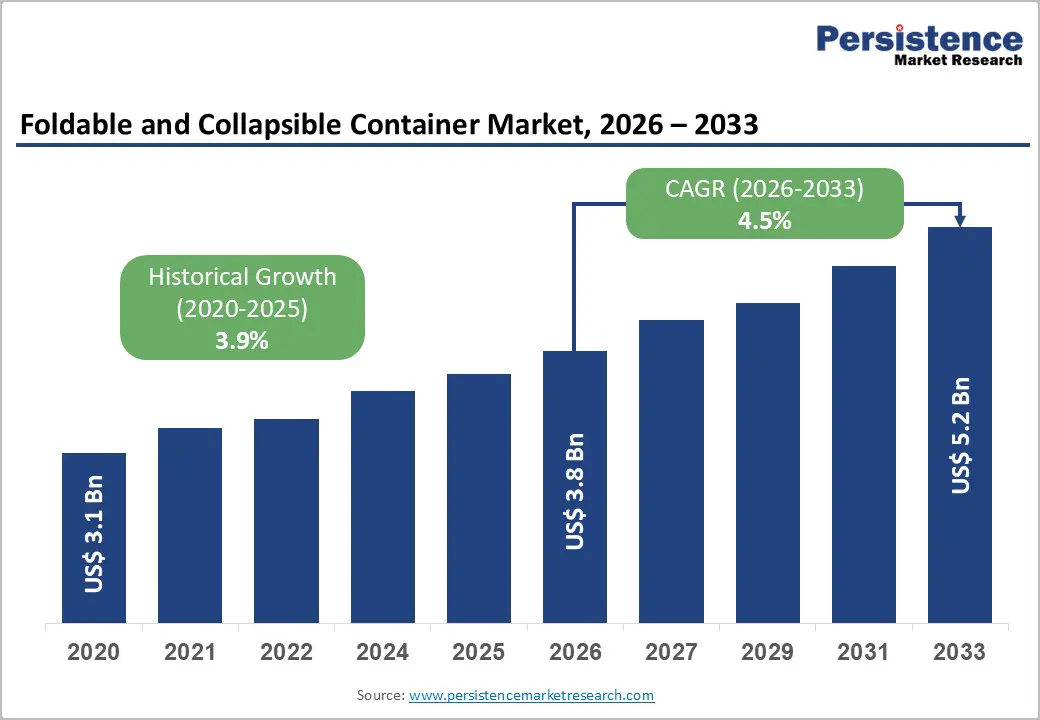
The global foldable and collapsible container market size is likely to be valued at US$3.8 billion in 2026 and is expected to reach US$5.2 billion by 2033, growing at a CAGR of 4.5% during the forecast period from 2026 to 2033, driven by increasing adoption of reusable packaging systems, rising demand for cost-efficient logistics solutions, and growing sustainability initiatives across industrial supply chains.
Foldable and collapsible containers enable significant reductions in transportation and storage costs by minimizing empty-return space requirements. Industries such as automotive, food and beverage, pharmaceuticals, and manufacturing are increasingly integrating reusable container systems to improve operational efficiency and support circular economy objectives.
Key Industry Highlights:
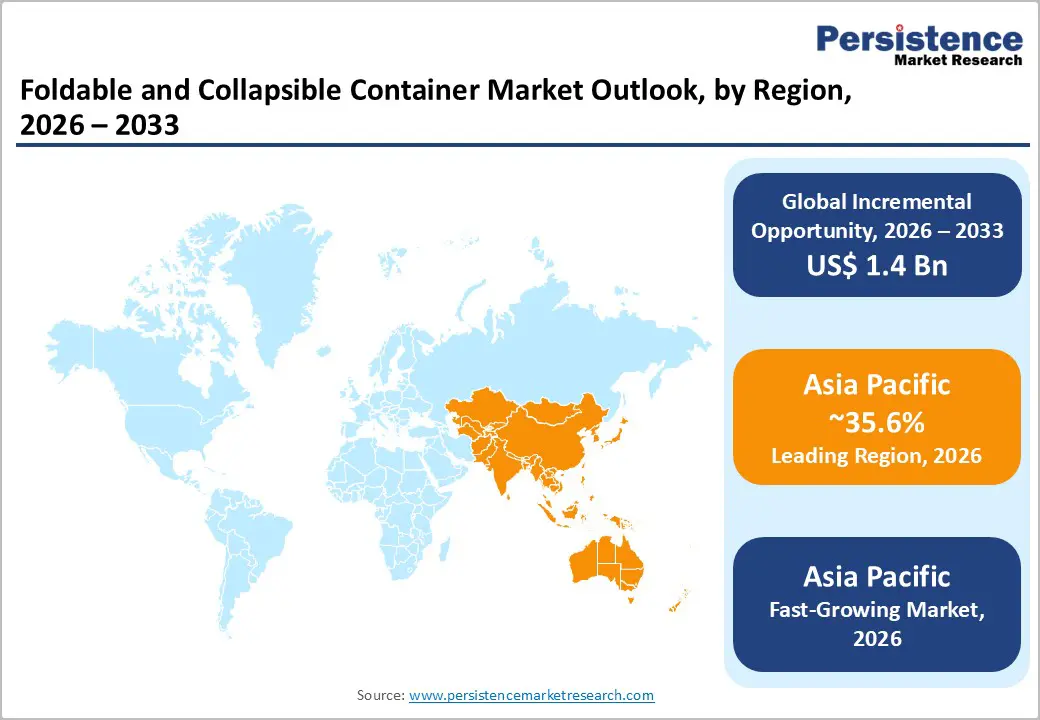
- Leading Region: Asia Pacific is projected to account for 35.6% of the market share in 2026, driven by strong manufacturing output, expanding logistics networks, and growing adoption of reusable packaging solutions across China, Japan, India, and ASEAN countries.
- Fastest-growing Region: Asia Pacific is expected to register the highest growth rate through 2033, supported by rapid industrialization, increasing e-commerce penetration, infrastructure development, and investments in warehouse automation and supply chain modernization.
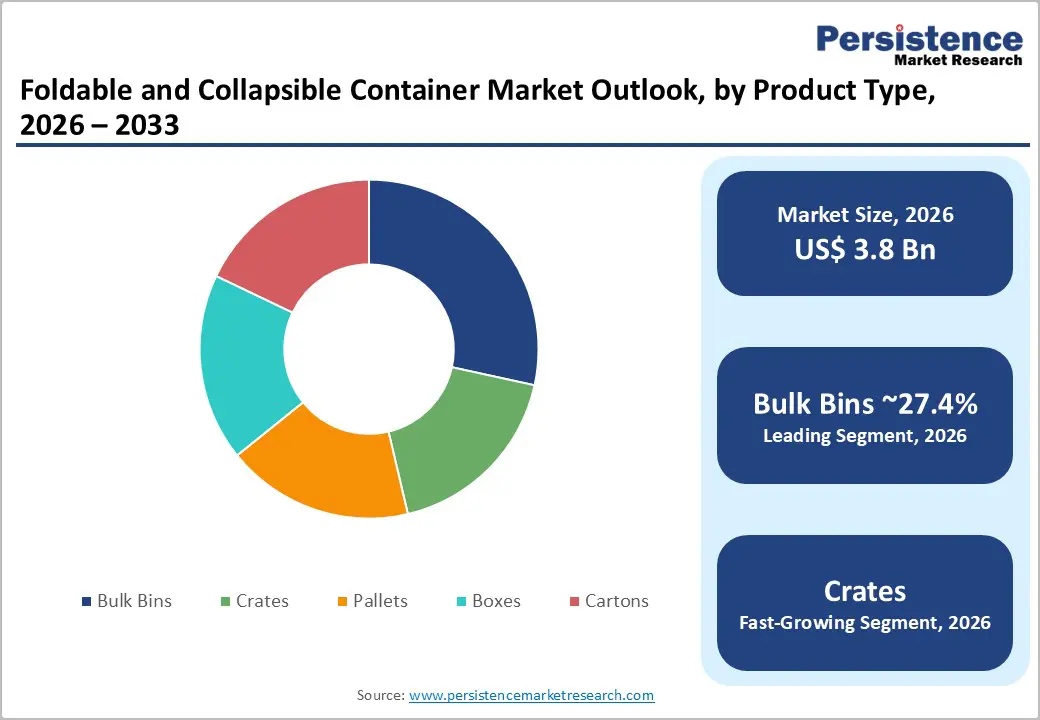
- Dominant Product Type: Bulk bins is estimated to account for 27.4% market share in 2026, driven by widespread use in automotive, manufacturing, agriculture, food processing, and distribution industries requiring high-capacity and durable transport packaging solutions.
- Leading End-user: The industrial & automotive segment is estimated to represent 32.1% of the market revenue in 2026, supported by increasing utilization of reusable packaging systems for component transportation, inventory management, and closed-loop supply chain operations.
DRO Analysis
Driver - Growing Emphasis on Sustainable and Reusable Packaging Solutions
Governments, regulatory agencies, and large corporations are intensifying efforts to reduce packaging waste and improve resource efficiency. Sustainability targets established across North America, Europe, and Asia Pacific are encouraging businesses to transition from single-use packaging toward reusable transport packaging systems. Foldable and collapsible containers offer a practical solution by supporting multiple usage cycles while reducing waste generation and carbon emissions associated with disposable packaging.
The adoption of reusable containers is particularly strong among manufacturers and retailers seeking to improve environmental performance and reduce long-term packaging expenses. The ability of these containers to be reused hundreds of times during their lifecycle significantly lowers packaging consumption. As environmental regulations become stricter and corporate sustainability reporting gains importance, demand for reusable foldable container systems is expected to continue rising across global supply chains.
Supply Chain Optimization and Warehouse Efficiency Improvements
The increasing focus on logistics efficiency is creating substantial demand for foldable and collapsible containers. Companies are seeking solutions that maximize storage utilization, reduce transportation costs, and streamline reverse logistics operations. Foldable containers can reduce storage space requirements during return transportation by more than 70%, providing measurable savings for manufacturers and distributors.
The expansion of automated warehouses, distribution centers, and e-commerce fulfillment operations is further supporting market growth. Modern supply chains require packaging solutions that integrate seamlessly with material handling systems, automated storage equipment, and digital tracking technologies. Foldable containers equipped with RFID tags and tracking capabilities enable enhanced visibility throughout the supply chain. As organizations prioritize operational efficiency and cost optimization, investment in reusable and collapsible packaging systems continues to accelerate.
Restraint - High Initial Investment and Reverse Logistics Complexity
Despite their long-term economic benefits, foldable and collapsible containers often require higher upfront investment compared to traditional single-use packaging alternatives. Organizations must allocate capital toward container acquisition, tracking systems, maintenance infrastructure, and reverse logistics networks. These requirements can present adoption challenges, particularly for small and medium-sized enterprises operating under budget constraints.
Effective utilization of reusable containers depends on efficient collection, cleaning, inspection, and redistribution systems. In regions with underdeveloped reverse logistics infrastructure, achieving optimal container utilization rates can be difficult. Container loss, damage, and administrative costs may extend return-on-investment timelines. Consequently, while the total lifecycle cost of reusable containers is generally favorable, the initial implementation complexity remains a key barrier to wider market penetration.
Opportunity - Rapid Industrialization and Manufacturing Expansion across Asia Pacific
Asia Pacific presents significant growth opportunities due to expanding manufacturing output, increasing international trade, and growing adoption of modern logistics infrastructure. The region accounted for 35.6% of the global market and remains the fastest-growing regional market.
Manufacturers across China, India, Japan, South Korea, and Southeast Asia are increasingly adopting reusable packaging systems to improve supply chain efficiency and reduce transportation costs. The development of industrial parks, export-oriented manufacturing hubs, and large-scale distribution centers creates substantial demand for foldable and collapsible containers. Companies establishing localized production facilities and service networks are well-positioned to capitalize on this growing regional demand.
Increasing Adoption in Pharmaceutical and Chemical Logistics
The pharmaceutical and chemical sectors are creating new opportunities for advanced foldable container solutions. These industries require secure, durable, and traceable packaging systems capable of protecting high-value products during transportation and storage. Regulatory requirements related to product integrity, contamination prevention, and supply chain visibility are driving demand for reusable packaging systems with enhanced monitoring capabilities.
Manufacturers are developing specialized containers featuring RFID integration, tamper-evident designs, and improved material performance to meet industry requirements. As pharmaceutical production and global chemical trade continue expanding, demand for high-performance collapsible packaging solutions is expected to increase significantly.
Category-wise Analysis
Product Type Insights
Bulk bins are anticipated to hold approximately 26.5% of the market share in 2026. Their popularity stems from their ability to transport and store large volumes of goods efficiently across manufacturing, agriculture, food processing, and automotive industries. Bulk bins are commonly used for handling automotive components, agricultural produce, and industrial materials, where high load capacity, stackability, and durability help reduce logistics costs and improve warehouse productivity.
Crates are anticipated to be the fastest-growing segment. Demand is increasing due to their versatility, lightweight design, and suitability for food distribution, retail logistics, pharmaceutical transportation, and e-commerce fulfillment. For instance, fresh produce suppliers and grocery retailers increasingly use foldable crates to improve transportation efficiency and reduce storage space requirements. Enhanced hygiene standards, traceability features, and growing demand for last-mile delivery solutions are expected to support continued segment growth.
End-user Insights
The industrial & automotive segment is anticipated to account for approximately 32.1% of the market share in 2026. Automotive manufacturers widely use foldable and collapsible containers for transporting engines, transmission systems, electronic components, and spare parts across production facilities and supplier networks. For example, major automotive OEMs utilize reusable foldable containers in closed-loop logistics systems to reduce packaging waste and transportation costs. Rising vehicle production, increasing localization of component sourcing, and greater emphasis on supply chain efficiency continue to support segment growth.
The pharmaceutical & chemical segment is anticipated to be the fastest-growing. Growth is driven by increasing pharmaceutical production, expanding chemical trade, and stricter product safety requirements. Foldable containers are increasingly used for transporting active pharmaceutical ingredients (APIs), specialty chemicals, and laboratory materials, where traceability and contamination control are critical. The adoption of RFID-enabled and hygienic reusable containers is further supporting demand across regulated supply chains.
Regional Insights
North America Foldable and Collapsible Container Market Trends
North America remains one of the most significant markets for foldable and collapsible containers, supported by advanced logistics infrastructure, a strong manufacturing base, and widespread adoption of reusable packaging systems. Growing investments in supply chain optimization, warehouse automation, and sustainability initiatives continue to drive market expansion across the region.
U.S. Foldable and Collapsible Container Market Trends
The U.S. represents the largest market in North America, driven by extensive manufacturing activities, sophisticated distribution networks, and increasing emphasis on sustainable packaging solutions. The automotive sector remains a major consumer of foldable containers for transporting components, assemblies, and spare parts through just-in-time production systems. Food and beverage companies are also expanding the use of collapsible containers to improve transportation efficiency and reduce packaging waste. Investments in RFID-enabled containers, digital asset tracking, and automated warehouse systems are further strengthening market demand.
Canada Foldable and Collapsible Container Market Trends
Canada is witnessing steady adoption of reusable packaging solutions across food processing, retail distribution, and industrial manufacturing sectors. The country's focus on waste reduction initiatives and circular economy practices is encouraging businesses to replace single-use packaging with returnable container systems. Growth in cross-border trade with the United States is also increasing demand for durable and space-efficient transport packaging solutions.
Europe Foldable and Collapsible Container Market Trends
Europe represents a mature yet highly innovative market characterized by strong environmental regulations and widespread commitment to circular economy principles. The region's well-established reverse logistics networks and sustainability-focused policies continue to accelerate the adoption of reusable transport packaging solutions.
Germany Foldable and Collapsible Container Market Trends
Germany remains the largest market within Europe owing to its strong manufacturing sector and export-oriented economy. The country's automotive, industrial machinery, and chemical industries are major consumers of foldable and collapsible containers. Companies increasingly utilize reusable packaging systems to improve operational efficiency while complying with sustainability regulations. Continued investments in logistics automation and smart packaging technologies support market growth.
U.K. Foldable and Collapsible Container Market Trends
The U.K. is experiencing rising demand for reusable packaging solutions across retail, food distribution, and e-commerce sectors. Businesses are adopting foldable containers to improve supply chain efficiency and meet sustainability targets. Growing investments in warehouse automation and last-mile delivery infrastructure are creating additional opportunities for market participants.
France Foldable and Collapsible Container Market Trends
France benefits from a strong demand across the food and beverage, pharmaceutical, and industrial manufacturing sectors. Sustainability regulations and corporate environmental commitments are encouraging companies to implement reusable transport packaging systems. Increasing adoption of circular economy practices is expected to support long-term market growth.
Spain Foldable and Collapsible Container Market Trends
Spain is emerging as a key market for foldable containers, particularly within agriculture, food processing, and export-oriented industries. The country's growing logistics sector and expanding trade activities are increasing demand for durable and reusable packaging solutions. Investments in modern warehousing and transportation infrastructure further contribute to market expansion.
Asia Pacific Foldable and Collapsible Container Market Trends
Asia Pacific accounted for 35.6% of the market share in 2026, making it the largest regional market and the fastest-growing region worldwide. Rapid industrialization, expanding manufacturing activities, growing e-commerce penetration, and increasing trade volumes are driving strong demand for foldable and collapsible containers throughout the region.
China Foldable and Collapsible Container Market Trends
China dominates the Asia Pacific market due to its extensive manufacturing base and large-scale export activities. The country continues investing heavily in logistics infrastructure, warehouse automation, and supply chain modernization. Growing demand from automotive, electronics, food processing, and industrial manufacturing sectors is accelerating adoption of reusable packaging solutions. China's emphasis on sustainable industrial practices is expected to further support market growth.
Japan Foldable and Collapsible Container Market Trends
Japan remains a significant market driven by its advanced automotive, electronics, and industrial manufacturing sectors. Companies increasingly utilize foldable containers to optimize storage space, improve transportation efficiency, and support lean manufacturing practices. The country's focus on automation and high-quality logistics systems continues to strengthen demand for reusable packaging solutions.
India Foldable and Collapsible Container Market Trends
India is emerging as one of the fastest-growing markets in the region due to rapid industrial expansion, increasing e-commerce activity, and ongoing infrastructure development. Growth in automotive manufacturing, pharmaceutical production, and organized retail sectors is driving demand for foldable and collapsible containers. Government initiatives supporting manufacturing and logistics modernization are expected to create substantial growth opportunities over the forecast period.
Competitive Landscape
The global foldable and collapsible container market exhibits a moderately fragmented competitive structure, with several global manufacturers competing alongside regional specialists. Market competition is primarily based on product durability, foldability efficiency, sustainability performance, logistics support capabilities, and pricing strategies.
Leading companies maintain competitive advantages through extensive distribution networks, strong customer relationships, advanced manufacturing capabilities, and continuous product innovation. Increasing customer demand for customized reusable packaging solutions is encouraging suppliers to expand their product portfolios and service offerings. Key strategic priorities include increasing recycled content, improving foldability ratios, developing RFID-enabled solutions, expanding pooling services, and strengthening reverse logistics capabilities. Companies are increasingly transitioning from product-centric models toward comprehensive reusable packaging service ecosystems.
Key Industry Developments
- In May 2026, Nefab Group opened a new manufacturing and engineering campus in Wixom, Michigan, dedicated to returnable plastic packaging and protective solutions for the automotive and advanced manufacturing sectors.
- In July 2025, IPL and Schoeller Allibert completed their merger to form IPL Schoeller, creating a global reusable packaging company with more than US$ 1.4 billion in annual revenue and a manufacturing footprint spanning 26 locations across North America, Europe, and the United Kingdom.
Companies Covered in Foldable and Collapsible Container Market
- Brambles Limited (CHEP)
- IFCO Systems
- IPL Group
- Schoeller Allibert
- ORBIS Corporation
- Nefab Group
- Tosca Services, LLC
- Cabka Group
- Craemer Group
- Mauser Packaging Solutions
- Greif, Inc.
- Georg Utz Holding AG
- SSI Schaefer Group
- TranPak Inc.
- RPP Containers
- DS Smith plc
Frequently Asked Questions
The global foldable and collapsible container market is estimated to be valued at US$3.8 billion in 2026.
The foldable and collapsible container market is projected to reach US$5.2 billion by 2033.
Key trends include increasing adoption of reusable packaging systems, growing investments in warehouse automation, expansion of RFID-enabled tracking solutions, rising demand for sustainable logistics, and the development of circular economy-based supply chains.
Bulk Bins represent the leading product type, holding 27.4% of the market share due to their widespread use in industrial, automotive, agricultural, and food processing applications.
The foldable and collapsible container market is expected to grow at a CAGR of 4.5% between 2026 and 2033.
Major market participants include Brambles Limited (CHEP), IFCO Systems, IPL Group, Nefab Group, and ORBIS Corporation.


