




- Food Ingredients & Additives
- Fish Peptones Market
Fish Peptones Market Size, Share, Growth, and Regional Forecast, 2026 to 2033
Fish Peptones Market by Product Type (Enzymatic Hydrolysis Peptones, Acid Hydrolysis Peptones, Autolysates), Form (Powder, Liquid), Application (Microbial Culture Media, Pharmaceuticals and Vaccines, Nutraceuticals and Functional Foods, Veterinary and Animal Health Bioproduction, Cosmetics and Personal Care), Sales Channel (Direct Sales (B2B), Distributors, Online Platforms), and Regional Analysis from 2026 to 2033

Fish Peptones Market Share and Trends Analysis
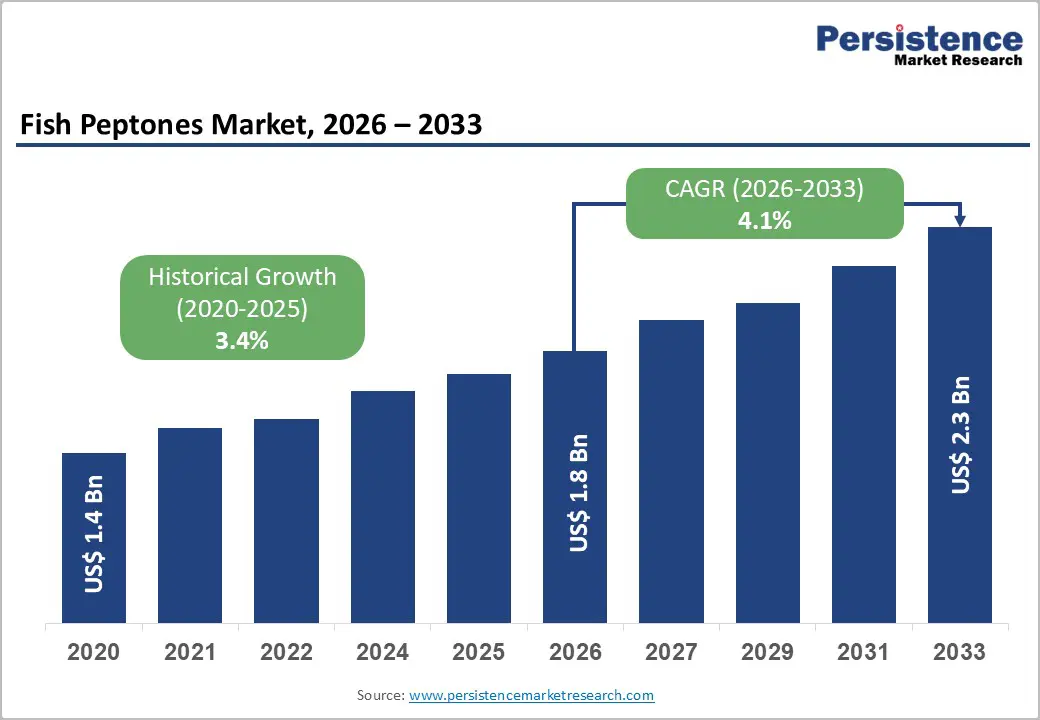
The global fish peptones market is estimated to grow from US$ 1.8 billion in 2026 to US$ 2.3 billion by 2033, growing at a projected CAGR of 4.1% during the forecast period from 2026 to 2033.
The global fish peptones market is witnessing steady growth, driven by rising demand from microbiology, biotechnology, and pharmaceutical industries for high-quality culture media ingredients. Increasing R&D activities, expanding biopharmaceutical production, and growth in diagnostic laboratories support market expansion. North America leads due to a strong biotech infrastructure, while Asia-Pacific is growing rapidly, driven by expanding manufacturing and research capabilities.
Key Industry Highlights:
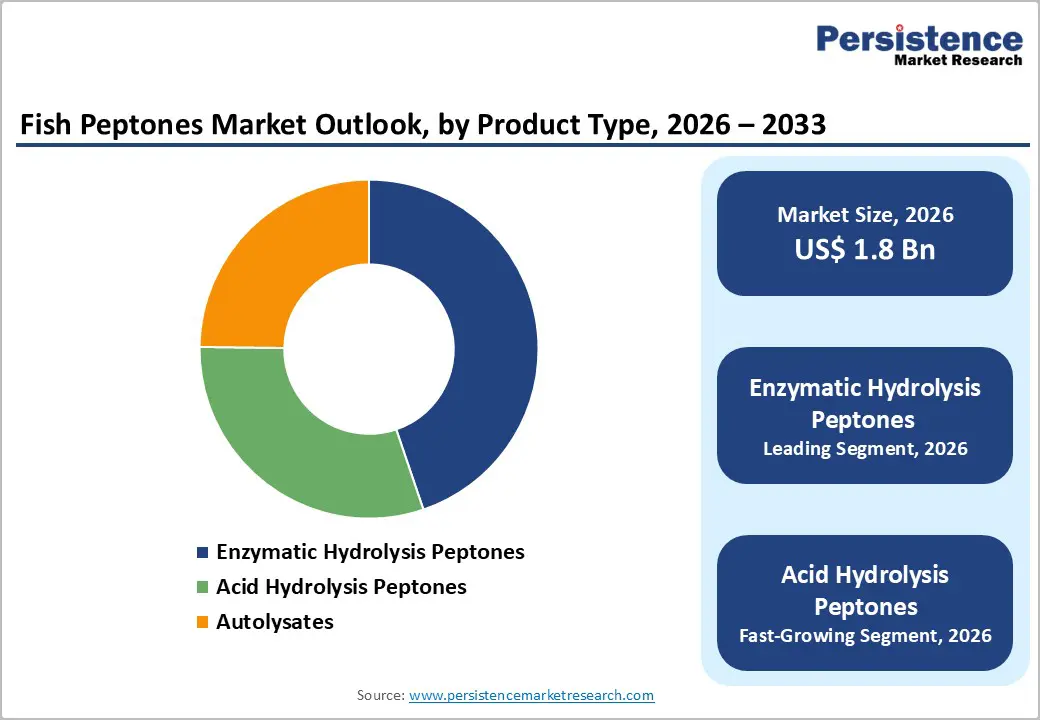
- Dominant Product: Enzymatic Hydrolysis Peptones account for 44.8% share of the fish peptones market in 2025, driven by superior nutrient composition, high protein digestibility, consistent batch quality, and suitability for microbial fermentation and cell culture applications. Their ability to enhance microbial growth and productivity supports widespread adoption in biotechnology and pharmaceutical manufacturing.
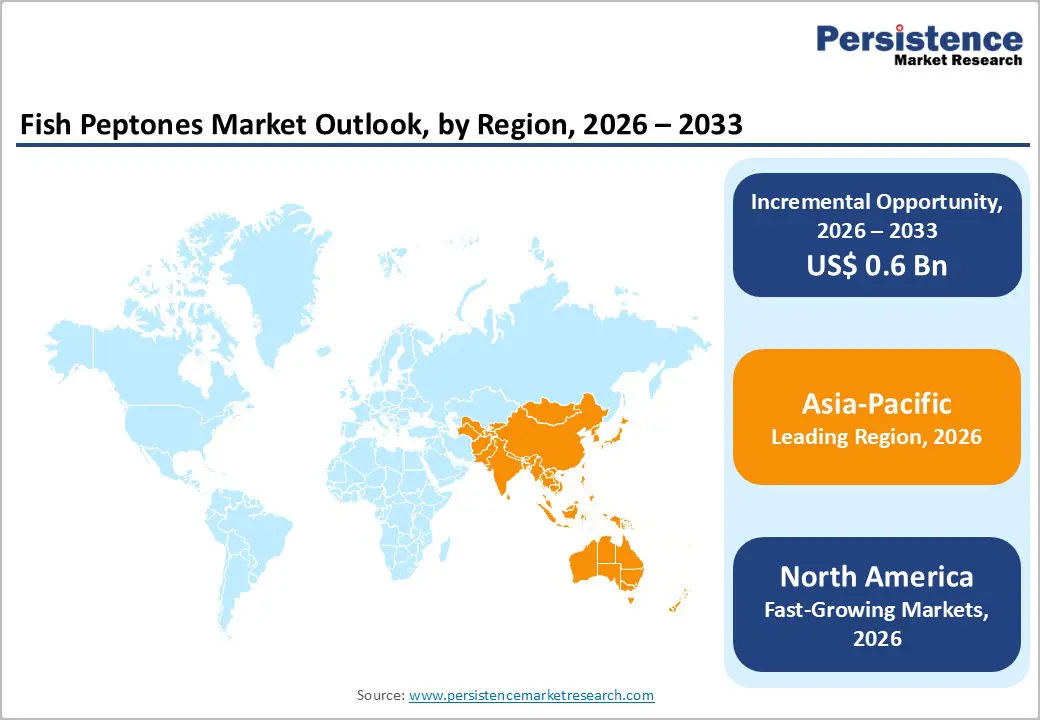
- Dominant Region: Asia-Pacific leads the fish peptones market in 2025 with 38.1%, supported by expanding biopharmaceutical production, rising research activity, and increasing life sciences investments. Strong government support, growing biotechnology infrastructure, and cost-efficient manufacturing capabilities drive regional dominance. Meanwhile, North America remains a significant market, backed by advanced R&D capabilities and established pharmaceutical industries.
- Growth Indicator: Growing demand for high-quality culture media, expansion of biopharmaceutical manufacturing, increasing vaccine and enzyme production, rising microbiology research, and technological advancements in protein hydrolysis processes are key growth drivers.
- Market Opportunity: Opportunities include the development of customized and high-purity peptone formulations, expansion into emerging biotechnology hubs, increasing applications in probiotics and nutraceuticals, sustainable marine sourcing initiatives, and strategic collaborations with pharmaceutical and research institutions.
| Key Insights | Details |
|---|---|
| Fish Peptones Market Size (2026E) | US$ 1.8 Bn |
| Market Value Forecast (2033F) | US$ 2.3 Bn |
| Projected Growth (CAGR 2026 to 2033) | 4.1% |
| Historical Market Growth (CAGR 2020 to 2025) | 3.4% |
Market Dynamics
Driver: Expanding Biopharmaceutical and Vaccine Production
The global biopharmaceutical industry has expanded rapidly over the past decade, driven by increasing approvals of biologics and vaccines. According to the U.S. Food and Drug Administration (FDA), biologics license applications (BLAs) have steadily increased, with biologics accounting for a substantial portion of new drug approvals in recent years. The U.S. National Institutes of Health (NIH) reported annual biomedical research funding exceeding USD 47 billion in 2023, reflecting strong public investment in life sciences innovation. Additionally, global vaccine manufacturing capacity expanded significantly during and after the COVID-19 pandemic, with the World Health Organization (WHO) reporting production capacity reaching billions of doses annually, strengthening biologics infrastructure worldwide.
Fish peptones play a critical role in supporting this expansion because they serve as organic nitrogen and growth factor sources in microbial fermentation and cell culture systems. These processes are essential for producing recombinant proteins, enzymes, antibiotics, and certain vaccines. Regulatory agencies such as the U.S. FDA and the European Medicines Agency emphasize stringent quality control in upstream bioprocessing, increasing demand for reliable, high-performance culture media ingredients. As governments across Asia-Pacific, North America, and Europe continue investing in domestic biologics manufacturing capacity, demand for fermentation nutrients, including fish-derived peptones, is expected to remain structurally strong.
Restraints: Fluctuating Raw Material Supply from Marine Sources
Fish peptones are produced from fish proteins obtained primarily from marine byproducts such as viscera, heads, and processing waste. While this repurposes underutilized biomass, the availability of consistent and high-quality fish waste feedstock fluctuates with seasonal fishing patterns, regulatory quotas, and ecosystem health. Unlike casein or soy sources, marine catch volumes can vary due to weather, stock management policies, and global demand for seafood, introducing supply variability that complicates large-scale, dependable sourcing for industrial hydrolysis.
Additionally, production processes for marine peptones involve complex steps such as enzymatic or thermal hydrolysis of heterogeneous raw materials, which can lead to batch inconsistency without robust quality controls. This variability affects amino acid profiles and overall media performance, making standardization more difficult than with peptones derived from controlled livestock sources. As a result, producers may face higher procurement and processing costs, reduced predictability in output quality, and logistical challenges in securing year-round fish byproduct streams, especially where fishing seasons are regulated or disrupted. This supply volatility restrains the broader adoption and scaling of fish peptone products in sensitive bioprocess environments.
Opportunity: Development of Customized and High-Purity Peptone Formulations
The trend toward specialized cell culture formats and advanced bioprocessing has created demand for high-performance, defined media constituents. The global cell culture media market, expected to grow to over US$10 billion by 2030, is increasingly focused on performance, reproducibility, and low-contaminant profiles, particularly in serum-free and chemically defined applications. This shift presents an opportunity for customized peptone formulations tailored to precise nutrient specifications, reliability, and regulatory compliance for therapeutic biologics production.
Customized fish peptone products can address niche requirements in microbial fermentation, probiotic production, or proprietary cell line growth, offering greater consistency in amino acid composition than crude extracts. Advances in fractionation, selection of enzymatic hydrolysis, and purification technologies enable producers to isolate peptones with predictable performance and lower batch-to-batch variability. The growth of contract development and manufacturing organizations (CDMOs) and the increasing outsourcing of cell culture media components further incentivize formulation innovation. Firms that develop premium, application-specific fish peptone solutions can capture higher value within the broader culture media ecosystem and support bioprocesses aligned with modern quality standards.
Category-wise Analysis
By Product Type Insights
Enzymatic Hydrolysis Peptones holds a 44.8% share of the global market in 2025, as it offers greater control over peptide size, solubility, and functional properties compared with acid- or alkaline-based methods. By adjusting protease type, pH, temperature, and enzyme-to-substrate ratios, manufacturers can tailor the degree of hydrolysis and peptide composition to match specific fermentation and culture media requirements. This precision improves nutrient availability for microbes or cell cultures and reduces unwanted by-products that could affect growth performance.
Regulatory and laboratory standards also favor enzymatic methods because they avoid harsh chemical reagents and extreme processing conditions, improving safety and consistency. Protein hydrolysates generated this way are rich in readily bioavailable peptides and amino acids, enhancing microbial growth and recombinant protein production. Since peptones are used extensively as nitrogen sources in fermentation media across biotech, pharmaceutical, and research applications, the reliability and tailored performance afforded by enzymatic hydrolysis make this product type a dominant choice.
By Form Insights
Powder form is the most common format for peptones and other protein hydrolysates used in microbiological and bioprocessing applications because powders offer longer shelf life, stability, and easier transportation than liquid or paste formats. Dry powdered ingredients are less prone to microbial contamination and chemical degradation during storage, enabling laboratories and manufacturers to stock and reconstitute them on demand. Research on media preparation emphasizes that solid components, such as peptone powders, are rehydrated into sterile solutions before use, a standard practice in culture media formulation.
Furthermore, powders allow precise dosing and formulation control, which is critical when preparing defined media for sensitive cell cultures or high-value fermentation. Powder formats are also compatible with automated media preparation systems in industrial biotech facilities, where large batches are reconstituted in water before sterilization and use. The ease of handling, consistent solubility, and reduced logistics costs associated with powdered peptones contribute to their dominance in research and industrial settings.
Regional Insights
Asia-Pacific Fish Peptones Market Trends
Asia Pacific holds the largest share of the fish peptones market, accounting for approximately 38.1% of global market revenue, driven by expanding biotechnology, pharmaceutical manufacturing, and food fermentation sectors. Major economies like China, India, and Japan contribute significantly due to their large seafood processing industries and substantial availability of fish by-products, which support peptone production and lower input costs. China alone dominates regional peptone consumption, with robust biomanufacturing and research laboratories that rely on peptone-based media for fermentation and cell culture. The rise in local R&D activities and the growing demand from the industrial fermentation, probiotics, and nutraceutical segments further consolidate Asia Pacific’s leadership position in the use of fish peptones.
Europe Fish Peptones Market Trends
Europe is a key region for fish peptones due to its strong biotechnology and pharmaceutical research ecosystem. Countries such as Germany, France, and the UK host extensive bioprocessing facilities that utilize peptone-rich media for vaccine development, diagnostics, and microbial fermentation. Europe’s emphasis on food safety and quality, backed by regulatory frameworks like EU GMP standards, supports sustained adoption of high-quality peptones in laboratories and industrial fermentation. The region also has a significant fermentation-based food sector, including cheese, yogurt, and enzyme production, which relies on peptone as a microbial growth and quality-control substrate. European academic institutions and industry collaborations further drive innovative applications of peptones across life sciences and industrial biotech, making the region a vital contributor to global demand.
North America Fish Peptones Market Trends
North America is among the fastest-growing regions for fish peptones due to its advanced biotech and biopharmaceutical infrastructure. The region leads global biotechnology revenue, with North America accounting for around 42% of total biotech revenue, reflecting high demand for culture media and fermentation inputs in research and manufacturing. The United States conducts a significant share of clinical trials and bioprocessing activity, requiring consistent supplies of peptones for biologics, vaccines, and diagnostics. High R&D expenditure by both public and private sectors supports the adoption of innovative media components, including fish peptones. Expansion of contract manufacturing organizations (CMOs) and biologics production facilities also accelerates regional growth. Additionally, strong regulatory frameworks and a dense network of research labs enhance market penetration and growth momentum for fish peptone applications.
Competitive Landscape
The fish peptones market competitive landscape features key players focusing on product innovation, quality differentiation, and strategic partnerships. Leading manufacturers invest in tailored peptone formulations and expand production capacity to meet rising demand across biotech, pharmaceutical, and food fermentation sectors. Competitive strategies include sustainability initiatives, global distribution networks, and collaborations to enhance market presence and technological capabilities.
Key Industry Developments:
- In October 2025, A scientific study highlighted that valorising fish head wastes into nitrogen-rich components like peptones generates lower greenhouse gas emissions than conventional plant or dairy sources, aligning with environmental and sustainability goals for bioprocessing inputs.
Companies Covered in Fish Peptones Market
- Kerry Group
- Titan Biotech Ltd.
- Hardy Diagnostics
- HiMedia Laboratories
- Solabia Group
- Copalis
- BioSpringer
- Biotecnica
- Bioibérica
- Biolink Group
- Others
Frequently Asked Questions
The global fish peptones market is projected to be valued at US$ 1.8 Bn in 2026.
Rising biopharmaceutical production, expanding fermentation applications, and increasing demand for high-quality culture media.
The global fish peptones market is poised to witness a CAGR of 4.1% between 2026 and 2033.
Customized formulations, emerging biotech hubs, sustainable sourcing, and expanding probiotic fermentation applications.
Kerry Group, Titan Biotech Ltd., Hardy Diagnostics, HiMedia Laboratories, Solabia Group, Copalis.


