




- Healthcare IT
- EPRO, E-patient Diaries and eCOA Market
EPRO, E-patient Diaries and eCOA Market Size, Share, Growth, and Regional Forecast, 2026 to 2033
EPRO, E-patient Diaries and eCOA Market by Type of Solution (ePROs (Patient Reported Outcomes), ClinROs (Clinician Reported Outcomes), ObsROs (Observer Reported Outcomes), PerfOs (Performance Outcomes)), Modality Type (Computer, Mobile Devices, Others), End User (Clinical Trial Sponsors, Contract Research Organizations (CROs), Hospitals, Academic Institutes, Pharmaceutical Companies, Medical Device Manufacturers), and Regional Analysis from 2026 to 2033

EPRO, E-patient Diaries and eCOA Market Size and Trends Analysis
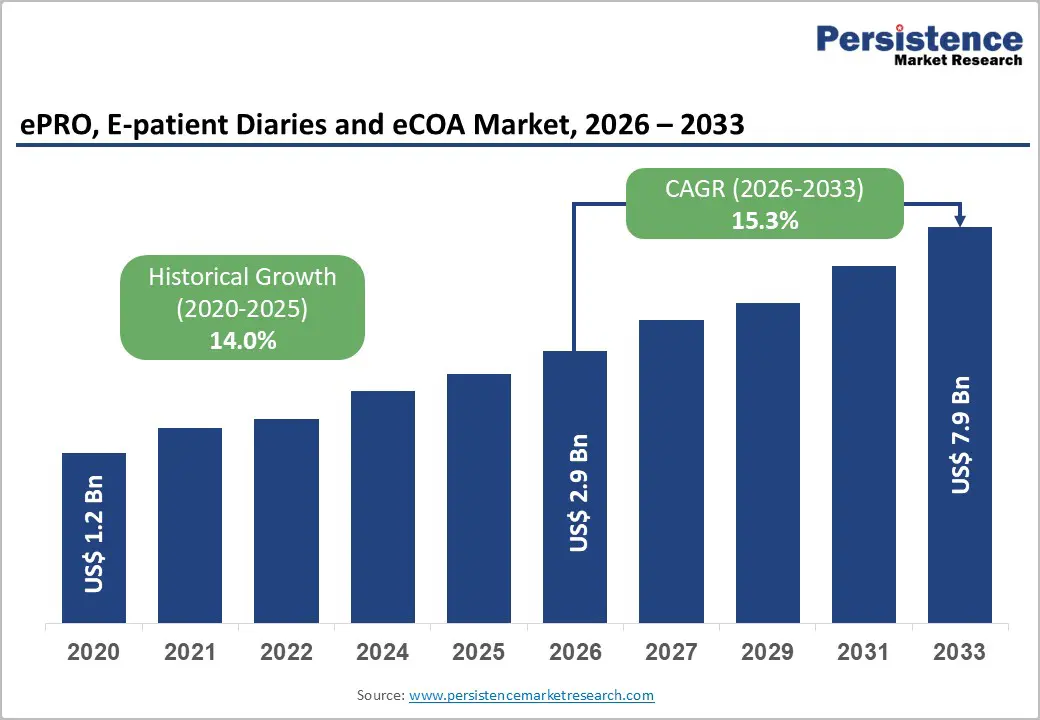
The global ePRO, E-patient Diaries and eCOA Market is estimated to grow from US$ 2.9 Bn in 2026 to US$ 7.9 Bn by 2033. The market is projected to record a CAGR of 15.3% during the forecast period from 2026 to 2033.
The global ePRO, e-patient diaries, and eCOA market is growing steadily, driven by rising clinical trial volumes, decentralized trials, and increasing adoption of digital health technologies. North America leads due to advanced research infrastructure and regulatory compliance, while Asia-Pacific is the fastest-growing region, supported by expanding trials, cost efficiency, and growing healthcare digitization.
Key Industry Highlights
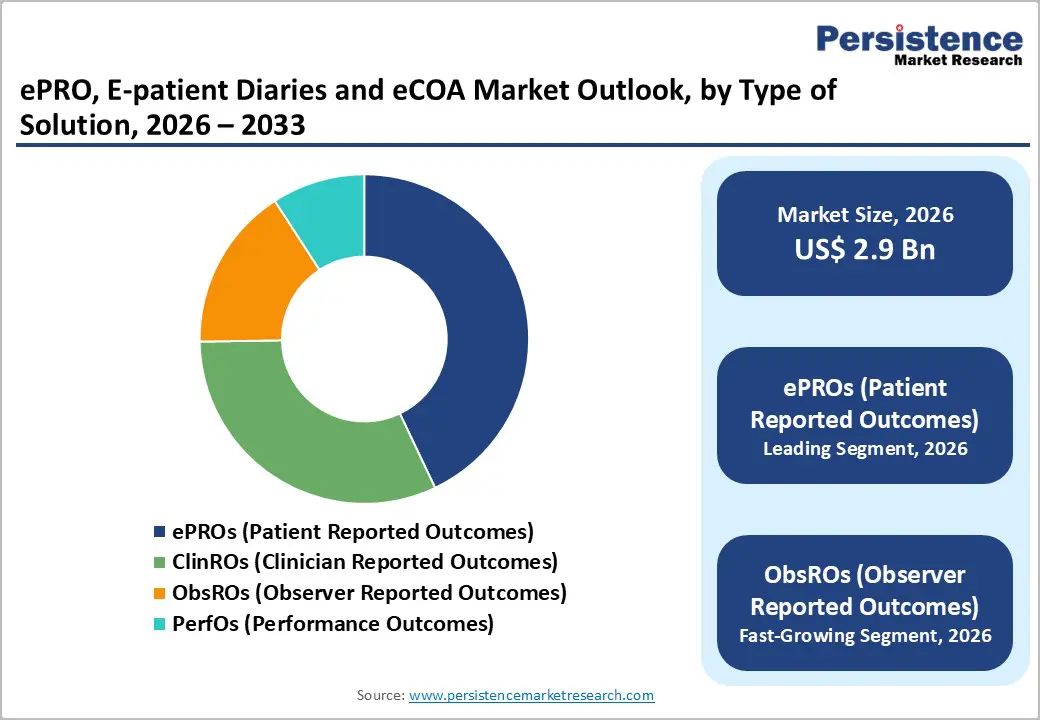
- Dominant Segment: ePRO solutions dominated the ePRO, e-patient diaries, and eCOA market in 2025 with 42.9% share, driven by widespread use in clinical trials, real-time patient data capture, regulatory acceptance, improved compliance, and growing adoption in decentralized and hybrid trial designs.
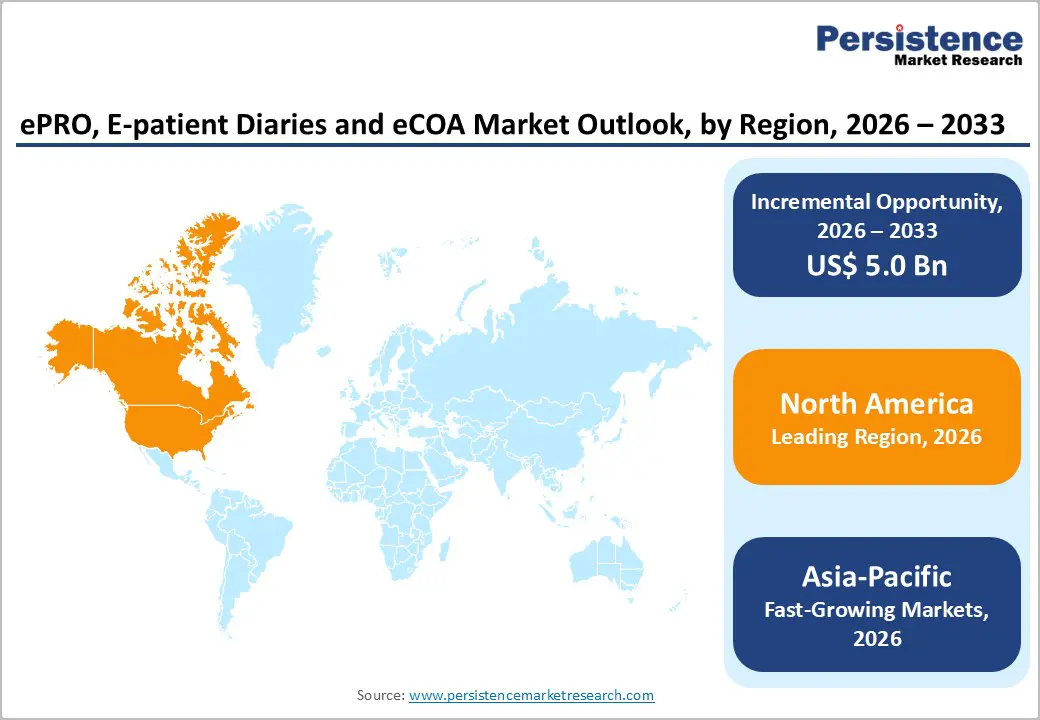
- Dominant Region: North America led due to high clinical trial activity, strong digital health infrastructure, FDA support for eCOA endpoints, and high R&D spending. Asia-Pacific was the fastest-growing region, supported by rising trial volumes, cost advantages, expanding CRO presence, and digitalization initiatives.
- Market Drivers: Increasing clinical trial complexity, growth of decentralized trials, demand for real-world evidence, regulatory push for patient-centric data, and adoption of mobile and cloud-based technologies.
- Market Opportunity: Opportunities include AI-enabled analytics, integration with wearables, expansion in emerging markets, multi-language platforms, and increased use in post-marketing and real-world studies.
| Global Market Attributes | Key Insights |
|---|---|
| Global EPRO, E-patient Diaries and eCOA Market Size (2026E) | US$ 2.9 Bn |
| Market Value Forecast (2033F) | US$ 7.9 Bn |
| Projected Growth (CAGR 2026 to 2033) | 15.3% |
| Historical Market Growth (CAGR 2020 to 2025) | 14.0% |
Market Dynamics
Driver: Rising adoption of decentralized and hybrid clinical trials
The growing shift toward decentralized and hybrid trial designs is a major driver for the ePRO, e-patient diaries and eCOA market. Digital outcome capture tools like ePRO and eCOA are now core to these models, enabling patient data submission directly from home without in-person visits. Industry surveys show that 79% of decentralized studies utilize eCOA/ePRO technologies, reflecting their central role in modern trial execution and real-time, remote patient engagement.
Regulatory agencies have also recognized these technologies as integral to decentralized trial frameworks, encouraging sponsors to embed them to improve trial quality and inclusivity. Before the pandemic only ~28% of organizations used decentralized approaches, but 87% now rapidly deploy DCT methodologies and 95% plan to increase them, pointing to sustained growth in ePRO/eCOA adoption aligned with global R&D transformation.
Restraints: High initial implementation and software licensing costs
A significant restraint for the ePRO, e-patient diaries and eCOA market is the high upfront cost of technology adoption. Reliable industry data indicates that clinical trial software deployments of which eCOA/ePRO systems are a part, often entail $150,000–$500,000+ in initial implementation costs, not including integration with existing clinical systems and validation activities.
These expenses include software licensing, customization, regulatory validation, and staff training. Smaller biotechnology firms and academic sponsors often struggle with these costs, leading many to delay or scale back implementation. Combined with ongoing maintenance and validation demands to satisfy regulatory standards (e.g., 21 CFR Part 11/HIPAA), these financial barriers slow market penetration and can limit adoption among cost-sensitive organizations.
Opportunity: Integration of wearables and remote patient monitoring devices
Integration with wearables and remote patient monitoring (RPM) devices presents a substantial opportunity for the ePRO, e-patient diaries and eCOA market. Industry research indicates that connected devices are already used in more than one-third of clinical studies, and this number is expected to rise as digital health technologies become standard trial components.
Wearables enhance trial data quality by providing continuous real-time measurements, such as activity levels, vitals, and biomarkers that complement subjective patient reports captured through ePRO/eCOA. This objective, longitudinal data can reduce reliance on recall-based reporting, improve patient engagement, and support decentralized designs that broaden participant inclusion. Regulatory guidance increasingly acknowledges remote device data as valid trial evidence, which further expands clinical trial sponsors’ willingness to integrate wearables into ePRO/eCOA workflows.
Category-wise Analysis
By Type of Solution, ePROs (Patient Reported Outcomes) Dominates the EPRO, E-patient Diaries and eCOA Market
ePROs (Patient Reported Outcomes) occupies 42.9% share of the global market in 2025, because they provide direct, standardized patient data that is crucial for assessing subjective endpoints like symptoms and quality of life in clinical research. Unlike paper diaries, ePROs reduce transcription errors and recall bias by capturing data that is timestamped and electronically validated, improving reliability and data integrity for sponsors and regulators. ePRO use also aligns with regulatory expectations: electronic capture is accepted as electronic source data under U.S. FDA guidance, supporting audit trails and real-time oversight.
Clinical evidence shows that ePRO tools can achieve compliance rates as high as 90% versus much lower historical compliance with paper, validating their effectiveness in ensuring complete outcome data in trials.
By Modality Type, Mobile Devices dominate due to accessibility, familiarity, real-time reporting, higher compliance, and seamless cloud integration
Mobile devices lead as the primary modality for ePRO and eCOA because they are widely accessible and user-friendly, enabling patients to report outcomes conveniently from home, at any time, which enhances engagement and study adherence. Research indicates that patients increasingly report outcomes using smartphones and tablets due to familiarity and mobility, supporting bring-your-own-device (BYOD) models that reduce burden and cost.
The flexibility of mobile technologies also supports real-time data capture and automated reminders, significantly improving protocol compliance compared with traditional methods. In addition, mobile platforms integrate seamlessly with cloud systems, enabling quick data transfer, remote monitoring, and regulatory compliance. These combined attributes make mobile devices the preferred modality for capturing patient-centric outcomes in modern clinical trials.
Regional Insights
North America EPRO, E-patient Diaries and eCOA Market Trends
North America dominates the ePRO, E-patient Diaries and eCOA Market with 43.3% share in 2025, primarily due to advanced healthcare IT infrastructure, high clinical trial volume, and robust regulatory support. The FDA’s proactive guidance on electronic data capture, including ePRO/eCOA, encourages adoption across decentralized and hybrid clinical trials, improving data integrity and accelerating drug development. In the U.S., ePRO/eCOA platforms are widely used in Phase III studies, with around 74% of these trials incorporating eCOA systems for real-time patient data reporting. Additionally, the concentration of major pharmaceutical and biotech companies in the region drives early technology uptake, making North America the global hub for digital outcome assessment solutions.
Europe EPRO, E-patient Diaries and eCOA Market Trends
Europe is a key regional market for ePRO, e-patient diaries, and eCOA solutions, the region’s mature clinical research ecosystem, supported by leading academic centers and multinational pharmaceutical operations, fuels demand for standardized electronic outcome assessments. Europe’s strong regulatory framework, including GDPR data privacy requirements, ensures secure patient data capture and compliance across trials, which encourages platform adoption across EU member states. Approximately 68% of large-scale clinical trials in Europe have integrated eCOA systems to harmonize data across multilingual sites, improving consistency in multinational studies. The European Medicines Agency’s emphasis on patient-centric trial methods further supports digital endpoint usage, making Europe the second-largest and highly strategic region for eCOA and ePRO adoption.
Asia-Pacific EPRO, E-patient Diaries and eCOA Market Trends
Asia-Pacific is the fastest-growing market for ePRO, e-patient diaries, and eCOA solutions, with the highest regional CAGR. Growth is driven by expanding clinical research activity in China, India, Japan, and South Korea, supported by increasing outsourcing of global trials to the region and rising healthcare digitization. Over 59% of new clinical trials in Asia-Pacific include digital data capture, including eCOA/ePRO, reflecting rapid adoption of mobile and cloud-based technologies. Governments are investing in digital health infrastructure, and high smartphone penetration enables broad BYOD participation, especially in remote and diverse populations.
Market Competitive Landscape
The competitive landscape of the ePRO, e-patient diaries, and eCOA market is driven by numerous established and emerging digital health technology vendors offering end-to-end patient outcome capture and analytics solutions. Key global players include Medidata Solutions (Dassault Systèmes), Signant Health, IQVIA Holdings, Inc., Clario (formerly ERT), Oracle Corporation, Parexel International Corporation, ICON plc, Kayentis, CRF Health, OmniComm Systems, and Medable Inc., all focusing on platform innovation, regulatory compliance, and decentralized trial enablement. These companies differentiate through cloud-based platforms, integrated mobile ePRO/eCOA interfaces, and AI-enhanced data capabilities, intensifying competition in patient-centric clinical endpoints and remote data capture solutions.
Key Industry Developments:
- In December 2025, A npj Digital Medicine article published in December 2025 outlined best practice recommendations for designing and implementing event driven electronic diaries (EDeDs) in clinical trials to enhance data quality and standardization. The guidance defined EDeDs, recommended aligning captured data with protocol endpoints, and stressed usability, compliance monitoring, and clear reporter responsibilities. It emphasized triggering diaries by clinical events, ensuring appropriate data entry windows, and incorporating reminders to reduce missing data.
Companies Covered in EPRO, E-patient Diaries and eCOA Market
- Bracket Global LLC
- CRF Health, Inc.
- ERT Clinical
- Medidata Solutions, Inc.
- ArisGlobal LLC
- Health Diary, Inc.
- ICON plc
- PAREXEL International Corporation
- OmniComm Systems, Inc.
- Kayentis, SAS
- Others
Frequently Asked Questions
The global ePRO, E-patient Diaries and eCOA Market is projected to be valued at US$ 2.9 Bn in 2026.
Growing decentralized trials, patient-centric research, regulatory acceptance, mobile technology adoption, and demand for real-time clinical data.
The global ePRO, E-patient Diaries and eCOA Market is poised to witness a CAGR of 15.3% between 2026 and 2033.
Integration with wearables, AI analytics, emerging markets expansion, multilingual platforms, real-world studies, and post-marketing applications.
Bracket Global LLC, CRF Health, Inc., ERT Clinical, Medidata Solutions, Inc., ArisGlobal LLC, Health Diary, Inc.


