




- Electrical Equipment & Services
- Energy Efficient Motor Market
Energy Efficient Motor Market Size, Share, and Growth Forecast, 2026 - 2033
Energy Efficient Motor Market by Motor Type (AC Motors, DC Motors, Others), Efficiency Level (IE3 (Premium Efficiency), IE4 (Super Premium Efficiency), Others), Application, End-user, and Regional Analysis for 2026 - 2033

Energy Efficient Motor Market Size and Trends Analysis
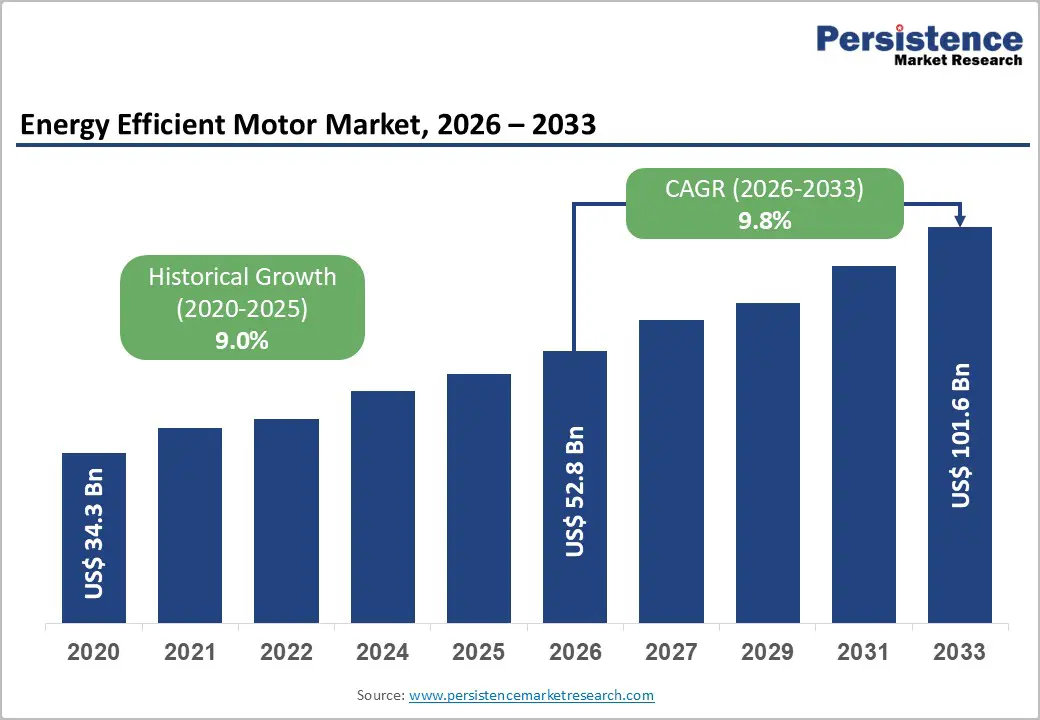
The global energy efficient motor market size is likely to be valued at US$52.8 billion in 2026 and is expected to reach US$101.6 billion by 2033, growing at a CAGR of 9.8% during the forecast period from 2026 to 2033, driven by the substantial electricity consumption of motor-driven systems, increasingly stringent energy-efficiency regulations, and the growing adoption of premium and super-premium efficiency motors.
Electric motor systems account for a significant share of global electricity consumption across industrial, commercial, agricultural, and transportation sectors, making efficiency improvements a critical priority for governments and end users. Rising electricity demand, industrial automation, and sustainability initiatives continue to support long-term market expansion.
Key Industry Developments:
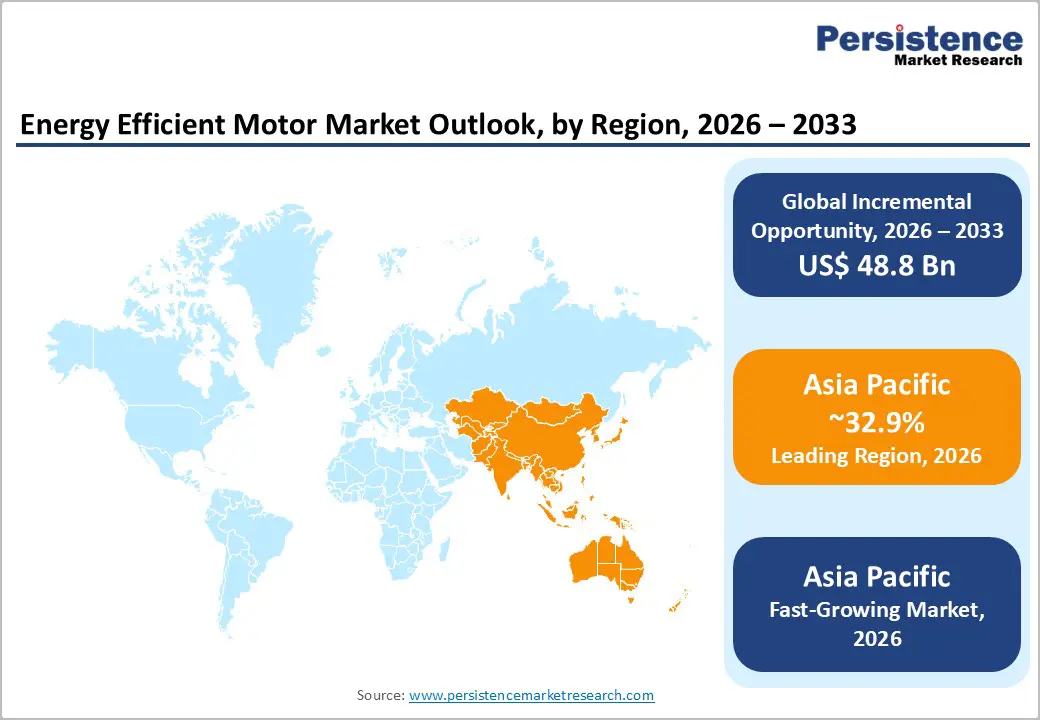
- Leading Region: Asia Pacific is projected to account for 32.9% of market share in 2026, driven by large-scale manufacturing activity, industrialization, infrastructure development, and strong demand from China, India, Japan, and ASEAN economies.
- Fastest-growing Region: Asia Pacific is anticipated to hold approximately 32.9% of the market share and is projected to record the highest growth through 2033, driven by rapid industrialization, manufacturing expansion, infrastructure development, and government-led energy-efficiency programs across China, India, Japan, and ASEAN countries.
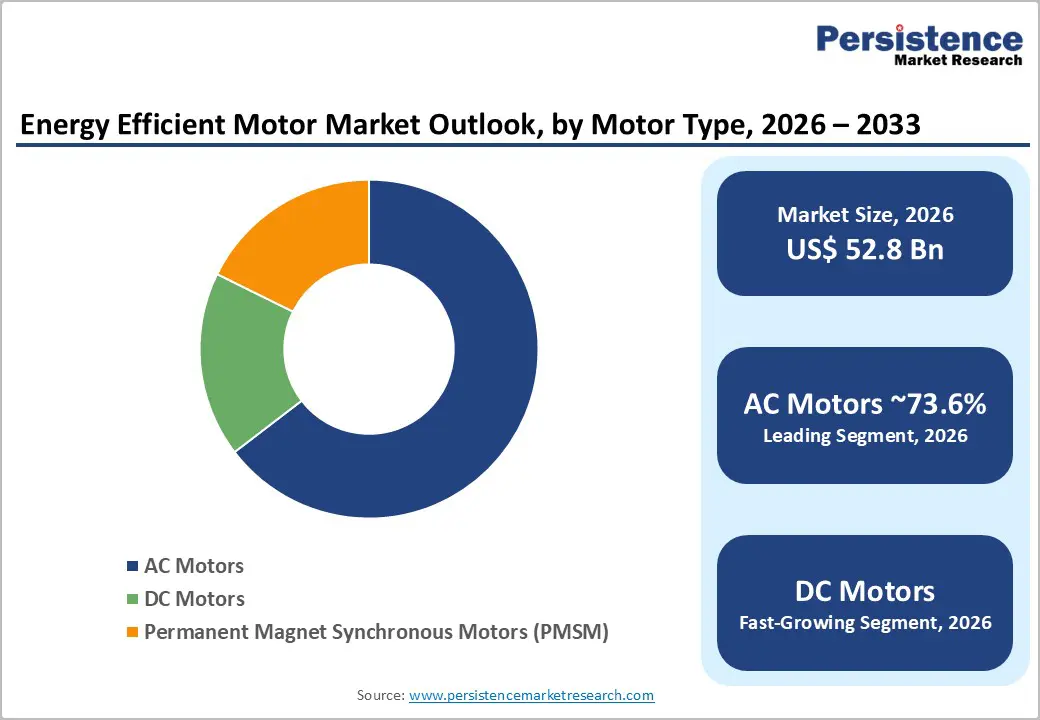
- Dominant Motor Type: AC motors are anticipated to account for approximately 73.6% of the market share in 2026, driven by widespread deployment across industrial machinery, pumps, compressors, HVAC systems, water treatment facilities, and manufacturing operations.
- Leading Efficiency Level: IE3 (Premium Efficiency) motors are anticipated to hold approximately 45.8% of the market share in 2026, supported by their balance of regulatory compliance, energy savings, operational reliability, and cost-effectiveness across industrial and commercial applications.
DRO Analysis
Drivers - Rising Energy Costs and Demand for System-Level Efficiency
Electric motors represent one of the largest sources of electricity consumption worldwide, particularly across industrial operations, commercial buildings, agricultural equipment, and transportation systems. As global electricity demand continues to increase, organizations are placing greater emphasis on reducing operating expenses through energy-efficient technologies. Energy-efficient motors offer substantial lifecycle cost savings by lowering electricity consumption, often generating returns that significantly outweigh their initial acquisition costs.
The growing focus on energy management, carbon reduction targets, and operational efficiency has accelerated replacement programs for conventional motors. Industrial facilities increasingly evaluate equipment purchases based on total cost of ownership rather than upfront capital expenditure. This shift is encouraging widespread adoption of premium-efficiency motors, variable speed drive systems, and digitally optimized motor solutions across energy-intensive applications.
Stringent Energy-Efficiency Regulations and Performance Standards
Government regulations remain a major catalyst for market growth. Regulatory agencies across North America, Europe, and Asia have implemented minimum energy performance standards (MEPS) designed to reduce industrial electricity consumption and improve energy productivity. These regulations increasingly favor higher-efficiency motor classifications such as IE3, IE4, and emerging IE5 technologies.
Mandatory efficiency standards have accelerated the retirement of legacy motors while encouraging manufacturers to expand their portfolios of premium and super-premium efficiency products. Regulatory frameworks covering industrial equipment, commercial infrastructure, water treatment systems, and manufacturing facilities continue to create sustained demand for advanced motor technologies. As governments pursue decarbonization objectives and industrial energy-efficiency targets, compliance requirements are expected to remain a key market growth driver throughout the forecast period.
Restraints - High Initial Investment Costs and Retrofit Challenges
Despite their long-term economic advantages, energy-efficient motors typically require higher upfront investments compared to conventional motor systems. For many small and medium-sized enterprises, budget constraints continue to delay replacement decisions, particularly when existing motors remain operational.
Retrofitting existing installations may also involve modifications to electrical systems, protection devices, controls, and supporting infrastructure. These integration requirements increase project complexity and implementation costs. In sectors where capital expenditure budgets are limited, organizations frequently adopt phased replacement strategies rather than large-scale upgrades. While energy-efficient motors provide compelling lifecycle savings, initial cost considerations continue to represent a significant barrier to market penetration.
Supply Chain Volatility and Regulatory Complexity
Manufacturers face ongoing challenges related to fluctuations in raw material costs, particularly for copper, electrical steel, rare-earth magnets, and power electronics. Variations in material availability and pricing can impact production costs and profit margins.
Although international efficiency standards have become more harmonized, regulatory requirements continue to vary across regions and product categories. Manufacturers operating globally must comply with multiple testing protocols, certification requirements, and performance standards. These complexities increase compliance costs and may extend product development timelines. Supply chain disruptions and regional regulatory differences remain important operational risks for market participants.
Opportunities - Accelerated Adoption of IE4 and IE5 Motor Technologies
The transition from IE3 to IE4 and IE5 efficiency classifications represents one of the most significant opportunities within the market. Super-premium and ultra-premium efficiency motors provide substantial reductions in energy losses, making them increasingly attractive for continuous-duty applications such as pumps, compressors, fans, and process equipment.
Organizations operating energy-intensive facilities are prioritizing technologies that deliver measurable reductions in electricity consumption and carbon emissions. As energy prices remain elevated and sustainability reporting requirements become more stringent, demand for advanced efficiency motors is expected to increase significantly. Manufacturers that combine high-efficiency motor platforms with digital monitoring, predictive maintenance, and variable speed drive technologies are particularly well positioned to capitalize on this trend.
Industrial Expansion and Manufacturing Growth across Asia Pacific
Asia Pacific presents substantial opportunities due to rapid industrialization, infrastructure development, urbanization, and manufacturing expansion. The region continues to attract significant investments in industrial production facilities, transportation infrastructure, water treatment projects, and commercial construction.
Governments across China, India, Japan, and Southeast Asia are actively promoting energy conservation initiatives and industrial modernization programs. These policies are creating favorable conditions for the adoption of energy-efficient motor technologies. Increasing localization of manufacturing operations and expanding regional production capacities further strengthen the market outlook. As industrial energy consumption continues to rise, demand for high-efficiency motors is expected to grow rapidly across the region.
Category-wise Analysis
Motor Type Insights
AC motors are anticipated to account for approximately 73.6% of the market share in 2026, making them the dominant motor type segment. Their leadership is driven by extensive use in industrial machinery, pumps, compressors, HVAC systems, conveyors, and water treatment facilities. Three-phase AC motors hold the largest share within the segment due to their high efficiency, reliability, and compatibility with variable speed drives.
For example, AC induction motors are widely deployed in manufacturing plants, municipal water pumping stations, and industrial processing facilities. Continued investments in industrial automation and energy optimization are expected to sustain the segment's market leadership throughout the forecast period.
DC motors, particularly brushless DC (BLDC) motors, are anticipated to register the fastest growth through 2033. Their superior energy efficiency, precise speed control, and compact design make them ideal for electric vehicles, robotics, automated manufacturing equipment, and smart appliances. BLDC motors are increasingly adopted in energy-efficient ceiling fans, HVAC systems, and industrial robots. Growing electrification trends and demand for intelligent motion-control systems continue to accelerate adoption across multiple industries.
Efficiency Level Insights
IE3 motors are anticipated to hold approximately 45.8% of the market share in 2026, making them the leading efficiency-level segment. Their dominance stems from an optimal balance of energy performance, regulatory compliance, and affordability. IE3 motors are widely used across manufacturing facilities, water treatment plants, food processing operations, and commercial infrastructure projects. Many industrial operators prefer IE3 motors because they deliver substantial energy savings without the higher investment associated with super-premium efficiency alternatives. Their broad acceptance under global energy-efficiency standards further reinforces their market leadership.
IE4 motors are anticipated to be the fastest-growing efficiency category during the forecast period. Increasing electricity costs, stricter energy-efficiency regulations, and corporate sustainability initiatives are accelerating adoption of super-premium efficiency technologies. IE4 motors are increasingly deployed in high-duty-cycle applications such as industrial pumps, compressors, fans, and material handling systems where energy consumption represents a significant operating expense.
For instance, chemical processing plants, wastewater treatment facilities, and large manufacturing complexes are actively upgrading to IE4 motors to reduce lifecycle energy costs and improve operational efficiency. Emerging IE5 technologies are also beginning to gain traction in specialized high-performance applications.
Regional Insights
North America Energy Efficient Motor Market Trends
North America represents a mature yet highly attractive market driven by regulatory compliance, industrial modernization, and technological innovation. Growth is driven by stringent energy-efficiency regulations, industrial modernization initiatives, and widespread adoption of automation technologies. Rising investments in data centers, smart manufacturing facilities, water infrastructure upgrades, and advanced HVAC systems continue to support demand for premium-efficiency motors.
U.S. Energy Efficient Motor Market Trends
The U.S. dominates the North America market, accounting for the majority of regional revenue. Demand is supported by federal energy-efficiency standards, industrial automation investments, and the modernization of manufacturing facilities. Energy-efficient motors are widely used across data centers, water treatment plants, oil and gas operations, and commercial buildings. Growing adoption of variable speed drive systems and smart factory technologies continues to accelerate motor replacement and upgrade activities.
Canada Energy Efficient Motor Market Trends
Canada represents a significant market driven by industrial energy-efficiency initiatives, mining operations, and infrastructure development projects. Investments in sustainable building technologies, water management systems, and renewable energy projects are supporting demand for high-efficiency motor solutions. The country's focus on reducing industrial energy consumption further strengthens market growth prospects.
Europe Energy Efficient Motor Market Trends
Europe remains one of the most advanced markets for energy-efficient motor technologies due to its strong regulatory framework and commitment to decarbonization. The region benefits from a well-established regulatory framework, aggressive decarbonization targets, and widespread adoption of advanced industrial technologies. Energy transition policies, digital manufacturing initiatives, and investments in sustainable infrastructure continue to create favorable conditions for the adoption of IE3, IE4, and emerging IE5 motor technologies.
Germany Energy Efficient Motor Market Trends
Germany leads the Europe market due to its large manufacturing sector, advanced industrial base, and strong emphasis on Industry 4.0 technologies. Demand for energy-efficient motors is particularly strong in automotive manufacturing, machinery production, chemicals, and industrial automation applications. Continuous investments in smart factories and industrial energy management support sustained market growth.
U.K. Energy Efficient Motor Market Trends
The U.K. is witnessing increasing adoption of energy-efficient motors across commercial buildings, manufacturing facilities, and water infrastructure projects. Net-zero commitments, energy-efficiency regulations, and investments in modern industrial facilities continue to drive demand for premium-efficiency motor systems.
France Energy Efficient Motor Market Trends
France remains an important market supported by industrial modernization programs, renewable energy projects, and investments in sustainable infrastructure. Demand is particularly strong in water treatment, transportation, food processing, and manufacturing sectors where energy-efficiency improvements can significantly reduce operating costs.
Asia Pacific Energy Efficient Motor Market Trends
Asia Pacific is anticipated to account for approximately 32.9% of the market share in 2026 and is expected to be the fastest-growing regional market throughout the forecast period. Rapid industrialization, urbanization, infrastructure development, and manufacturing expansion continue to drive demand for energy-efficient motor technologies. Government programs promoting energy conservation and industrial modernization are further supporting market growth.
China Energy Efficient Motor Market Trends
China dominates the Asia Pacific market and accounts for more than 49% of the region's market share. As the world's largest manufacturing hub, the country generates substantial demand for energy-efficient motors across industrial machinery, manufacturing facilities, transportation systems, and infrastructure projects. Government initiatives focused on industrial efficiency, carbon reduction, and advanced manufacturing continue to accelerate adoption of premium-efficiency motor technologies.
India Energy Efficient Motor Market Trends
India is emerging as one of the fastest-growing country markets due to rapid industrial expansion, infrastructure investments, and government-led energy-efficiency initiatives. Increasing adoption of energy-efficient motors across manufacturing, water treatment, HVAC systems, and agricultural applications is supporting market growth. Rising investments in industrial corridors, smart cities, and transportation infrastructure further strengthen demand prospects.
Japan Energy Efficient Motor Market Trends
Japan remains a technologically advanced market characterized by strong adoption of high-efficiency motors, industrial automation systems, and robotics. The country's focus on energy conservation, smart manufacturing, and precision engineering continues to drive demand for advanced motor technologies, particularly IE4 and IE5 efficiency classes.
Competitive Landscape
The global energy efficient motor market exhibits a moderately concentrated competitive structure characterized by the presence of several multinational manufacturers alongside regional specialists. Leading companies compete through product innovation, efficiency performance, global distribution networks, engineering expertise, and after-sales service capabilities.
Leading companies are focused on technology innovation, localization, digital integration, lifecycle service offerings, and geographic expansion. Competitive differentiation increasingly depends on the ability to combine high-efficiency motors with variable speed drives, predictive maintenance capabilities, industrial automation solutions, and comprehensive service programs. Manufacturers are also expanding regional production footprints to improve supply chain efficiency and support growing customer demand.
Key Industry Developments:
- In September 2025, ABB Ltd. expanded its IE5 SynRM (Synchronous Reluctance Motor) portfolio with additional frame sizes, enabling broader deployment of ultra-premium efficiency motors across industrial applications.
- In June 2025, Nidec Corporation inaugurated its Orchard Hub manufacturing campus in Hubli-Dharwad, Karnataka, India, to strengthen its position in high-efficiency motors, drives, generators, and electrification solutions.
Companies Covered in Energy Efficient Motor Market
- ABB Ltd.
- Siemens AG (Innomotics GmbH)
- Nidec Corporation
- WEG S.A.
- Schneider Electric SE
- Regal Rexnord Corporation
- Mitsubishi Electric Corporation
- Toshiba International Corporation
- Danfoss A/S
- TECO Electric & Machinery Co., Ltd.
- Bharat Bijlee Limited
- CG Power and Industrial Solutions Ltd.
- Wolong Electric Group Co., Ltd.
- Hitachi Industrial Equipment Systems Co., Ltd.
- Franklin Electric Co., Inc.
- Johnson Electric Holdings Limited
Frequently Asked Questions
The global energy efficient motor market is anticipated to be valued at US$52.8 billion in 2026.
The global energy efficient motor market is projected to reach US$101.6 billion by 2033.
Key trends include the growing adoption of IE4 and IE5 super-premium efficiency motors, increasing integration of variable speed drives (VSDs), rising industrial automation, expansion of smart manufacturing facilities, electrification of transportation systems, and stricter global energy-efficiency regulations.
AC Motors are the leading segment, anticipated to account for approximately 73.6% of the market share, driven by widespread deployment across industrial machinery, pumps, compressors, HVAC systems, and manufacturing facilities.
The energy efficient motor market is projected to grow at a CAGR of 9.8% between 2026 and 2033.
Major companies include ABB, Siemens/Innomotics, Nidec Corporation, WEG S.A., and Schneider Electric.


