




- Power Generation, Transmission, & Distribution
- Dynamic Vision Sensors Market
Dynamic Vision Sensors Market Size, Share, and Growth Forecast, 2026 - 2033
Dynamic Vision Sensors Market by Sensor Technology (Event-based (DVS/Event) sensors, Hybrid (Event + Frame) sensors, Others), Component (Hardware, Software, Others), Application, End-use Industry, and Regional Analysis for 2026 - 2033

Dynamic Vision Sensors Market Size and Trends Analysis
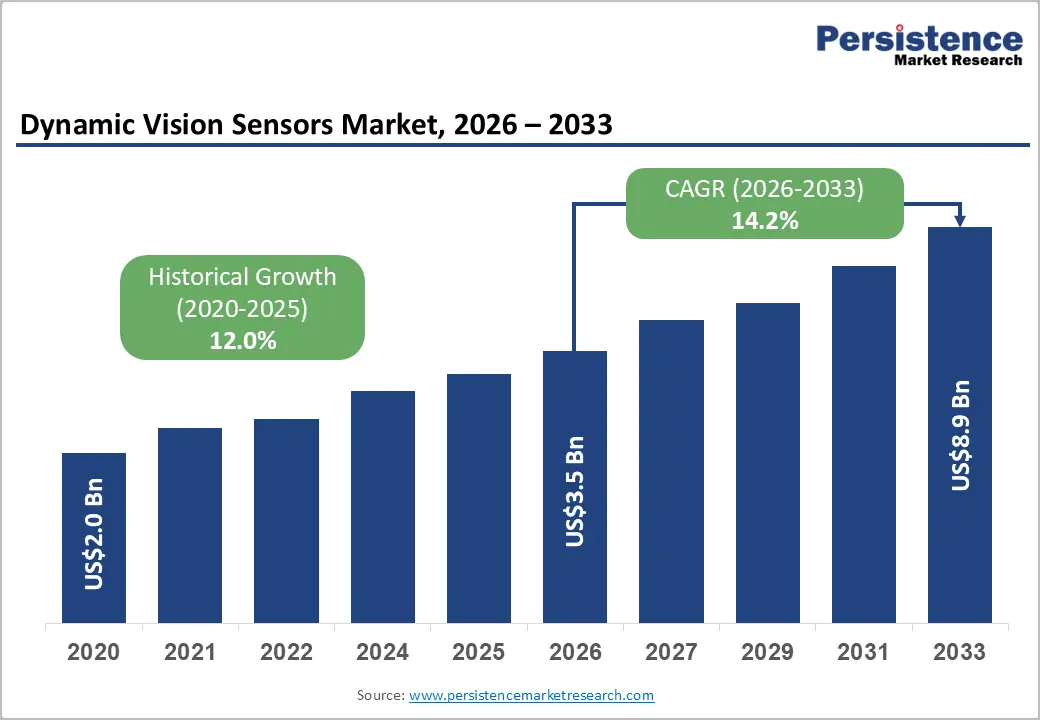
The global dynamic vision sensors market size is likely to be valued at US$ 3.5 billion in 2026 and is expected to reach US$ 8.9 billion by 2033, growing at a CAGR of 14.2% between 2026 and 2033, driven by the increasing need for high-speed, low-latency vision systems across a wide range of applications.
Unlike conventional image sensors that capture full frames at fixed intervals, Dynamic Vision Sensors (DVS) detect and transmit only changes in a visual scene in real time, enabling faster response times, lower power consumption, and more efficient data processing. Rising adoption of autonomous systems, robotics, advanced driver-assistance systems (ADAS), industrial automation, and edge AI applications is accelerating demand for DVS technology. As organizations seek more efficient perception solutions capable of operating in complex and rapidly changing environments, investments in event-based vision technologies are expected to continue increasing throughout the forecast period.
Key Industry Highlights:
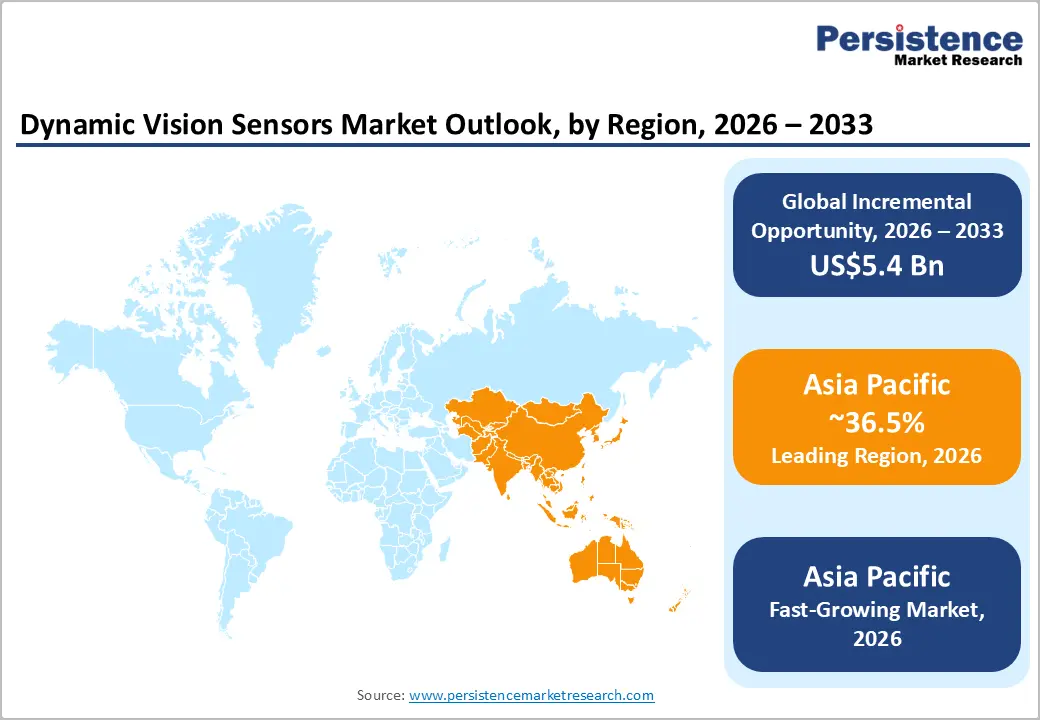
- Leading Region: Asia Pacific is anticipated to account for approximately 36.5% of the market share in 2026, supported by strong manufacturing capabilities, robotics adoption, and semiconductor production.
- Fastest-growing Region: Asia Pacific is projected to register the highest growth rate during the forecast period, driven by expanding industrial automation investments across China, South Korea, India, and ASEAN countries.
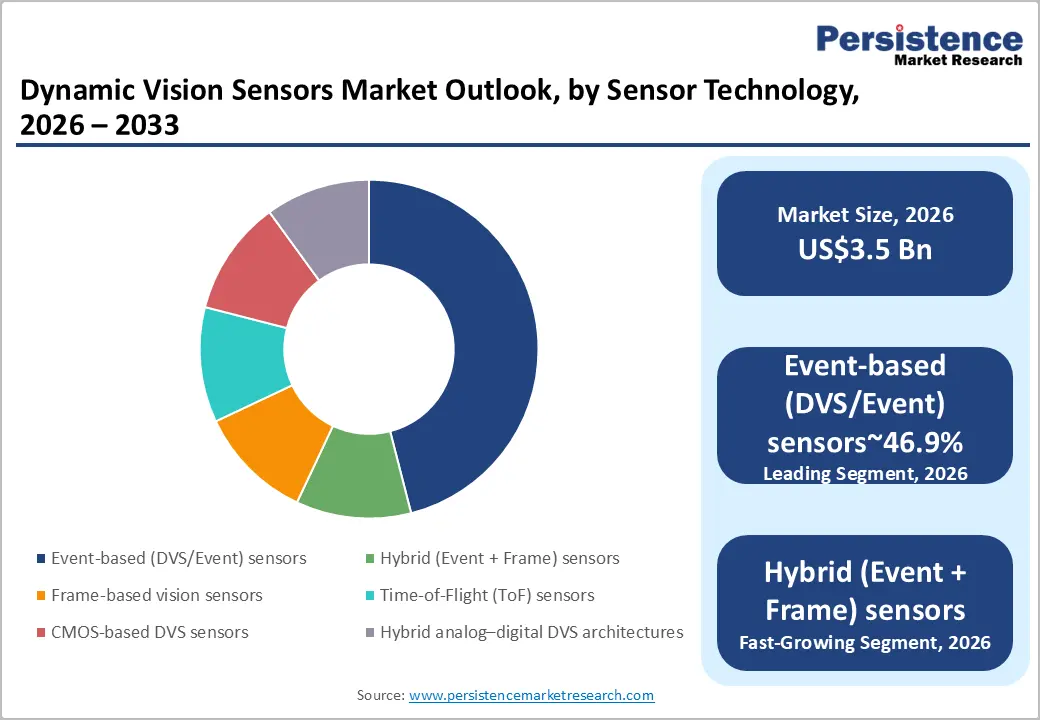
- Dominant Sensor Technology: Event-Based (DVS/Event) Sensors are anticipated to hold approximately 46.9% market share in 2026, owing to their low-latency operation, reduced data-processing requirements, and widespread adoption in robotics, industrial automation, and machine vision systems.
- Leading Component: The hardware segment is anticipated to account for approximately 60.6% market share in 2026, supported by strong demand for image sensors, camera modules, optics, processors, and edge-computing infrastructure across industrial, automotive, and surveillance applications.
DRO Analysis
Driver - Rising Adoption of Industrial Automation and Robotics
The rapid expansion of industrial automation remains one of the primary drivers of the dynamic vision sensors market. Manufacturing facilities increasingly rely on advanced machine vision systems to improve productivity, quality control, and operational efficiency. Dynamic vision sensors provide significant advantages in automated environments as they capture only relevant motion-based information, reducing data-processing requirements while delivering real-time responsiveness.
The growing deployment of industrial robots across manufacturing sectors has increased demand for high-performance sensing technologies capable of supporting precision operations. Applications such as robotic guidance, automated inspection, pick-and-place systems, autonomous mobile robots (AMRs), and warehouse automation benefit from the low-latency capabilities of event-based vision systems. As manufacturers continue investing in Industry 4.0 initiatives and smart factory infrastructure, demand for Dynamic Vision Sensors is expected to accelerate.
Logistics, e-commerce fulfillment centers, semiconductor fabrication facilities, and electronics assembly operations increasingly require advanced vision technologies capable of operating efficiently in high-speed environments, strengthening long-term demand for DVS solutions.
Expansion of Automotive Safety Systems and Edge AI Technologies
Automotive manufacturers are incorporating increasingly sophisticated sensing technologies to support Advanced Driver Assistance Systems (ADAS), autonomous driving functions, and intelligent vehicle perception platforms. Dynamic Vision Sensors provide advantages in challenging driving conditions as they offer high dynamic range, rapid response times, and efficient data processing.
Regulatory initiatives promoting vehicle safety technologies are encouraging broader adoption of advanced sensing architectures. Event-based vision systems can complement traditional cameras by improving object detection performance under varying lighting conditions and fast-moving scenarios. These capabilities are particularly valuable for collision avoidance systems, driver monitoring solutions, and autonomous navigation applications.
Simultaneously, advances in edge artificial intelligence are expanding deployment opportunities for DVS technologies. Organizations increasingly seek low-power, real-time sensing solutions capable of performing inference at the device level. The convergence of edge computing and event-based vision is creating new opportunities across automotive, industrial, consumer electronics, and smart infrastructure applications.
Restraint - Integration Complexity and Limited Standardization
Despite strong growth prospects, market expansion faces challenges related to integration complexity and the absence of universally accepted performance standards. Dynamic Vision Sensors require specialized software frameworks, calibration procedures, and processing algorithms that differ significantly from conventional frame-based vision systems.
Many organizations must invest in custom development efforts to integrate DVS technologies into existing machine vision architectures. These requirements can increase implementation costs, extend deployment timelines, and create uncertainty during technology evaluation processes. Small and medium-sized enterprises may be particularly sensitive to these barriers due to limited technical resources and budget constraints.
The market also faces challenges associated with workforce expertise. Event-based vision remains a relatively specialized field, creating demand for engineers and developers with experience in neuromorphic computing, AI-driven perception systems, and event-based data processing. These factors may slow adoption in certain industries despite the technology's long-term advantages.
Opportunity - Growth of Hybrid Vision Architectures in Automotive Applications
Hybrid sensing architectures that combine event-based and frame-based imaging technologies represent a significant growth opportunity for the market. While conventional cameras excel in capturing static scene information, event-based sensors deliver superior performance in high-speed and high-dynamic-range environments.
The combination of both technologies enables more comprehensive environmental perception systems, making hybrid architectures particularly attractive for automotive applications. Vehicle manufacturers are increasingly exploring integrated sensing platforms capable of supporting autonomous navigation, obstacle detection, and advanced safety functions.
As autonomous driving development progresses, hybrid vision systems are expected to gain broader acceptance due to their ability to improve situational awareness while reducing computational burdens. This trend creates opportunities for sensor manufacturers, software developers, and system integrators throughout the value chain.
Expansion of Software and Edge Computing Ecosystems
Software is emerging as a critical value-creation layer within the Dynamic Vision Sensors ecosystem. Organizations increasingly require complete solutions that include sensor hardware, data-processing software, AI algorithms, and deployment frameworks.
Demand for event-based analytics, machine learning integration, and edge computing capabilities is driving investment in software platforms specifically designed for DVS applications. These solutions enable users to convert event streams into actionable insights while minimizing latency and energy consumption.
As edge AI adoption continues to expand across industrial automation, healthcare, security, and transportation sectors, software and services are expected to generate substantial growth opportunities. Companies capable of delivering integrated hardware-software ecosystems are likely to strengthen their competitive positioning over the forecast period.
Category-wise Analysis
Sensor Technology
Event-based (DVS/Event) sensors are anticipated to account for approximately 46.9% of the market share in 2026, making them the leading technology segment. Their dominance is driven by asynchronous operation, which captures only changes in a scene rather than full image frames, reducing latency, power consumption, and data-processing requirements. These sensors are widely used in industrial robotics, automated inspection systems, autonomous mobile robots (AMRs), and smart surveillance applications where real-time response is critical. For example, manufacturers deploy event-based sensors in high-speed production lines for defect detection and robotic guidance, supporting continued market leadership.
Hybrid (Event + Frame) sensors are projected to be the fastest-growing technology segment during the forecast period. By combining event-based sensing with conventional frame-based imaging, these systems provide both motion sensitivity and full-scene contextual information. Growing adoption in autonomous vehicles, advanced driver assistance systems (ADAS), and next-generation robotics is driving demand for hybrid architectures. For example, automotive manufacturers are evaluating hybrid vision systems for obstacle detection and navigation in complex driving environments, while industrial users are leveraging them for precision inspection and machine vision applications.
Component Insights
Hardware is anticipated to account for approximately 60.6% of the market share in 2026, making it the largest component segment. The segment includes image sensors, camera modules, optics, processors, and edge-computing hardware. Strong investments in industrial automation, robotics, automotive perception systems, and intelligent surveillance infrastructure continue to drive demand. For example, manufacturers increasingly deploy advanced DVS camera modules in automated warehouses, semiconductor inspection systems, and robotic assembly lines to improve operational efficiency and real-time decision-making capabilities.
Software is expected to be the fastest-growing component segment over the forecast period. The increasing adoption of event-based vision systems requires advanced algorithms, AI-enabled analytics, event filtering, and machine learning frameworks to process sensor-generated data effectively. Organizations are prioritizing software platforms that enhance object tracking, anomaly detection, and edge AI deployment. For example, software solutions are being integrated into autonomous robots, smart traffic monitoring systems, and industrial quality-control platforms to transform event streams into actionable insights, supporting rapid segment growth.
Regional Insights
North America Dynamic Vision Sensors Market Trends
North America remains a significant market for Dynamic Vision Sensors (DVS), driven by strong investments in industrial automation, artificial intelligence, autonomous systems, and advanced manufacturing technologies. The region benefits from a mature innovation ecosystem, extensive R&D activities, and widespread deployment of machine vision solutions across automotive, aerospace, logistics, and semiconductor industries.
U.S. Dynamic Vision Sensors Market Trends
The U.S. is expected to account for approximately 87% of the North America DVS market in 2026, making it the dominant contributor to regional revenue. Market growth is supported by increasing investments in industrial automation, autonomous vehicles, defense applications, and smart manufacturing initiatives. The presence of leading semiconductor companies, AI developers, and robotics firms strengthens technology adoption. The growing deployment of automated warehouses, industrial robots, and intelligent surveillance systems is expected to sustain demand for Dynamic Vision Sensors over the forecast period.
Canada Dynamic Vision Sensors Market Trends
Canada is expected to contribute approximately 13% of the regional market share in 2026 and is experiencing steady growth due to the increasing adoption of AI-enabled manufacturing and robotics technologies. Government support for advanced manufacturing, innovation programs, and research partnerships is encouraging the deployment of machine vision systems. The country's expanding aerospace, logistics, and industrial automation sectors are expected to create additional opportunities for DVS suppliers.
Europe Dynamic Vision Sensors Market Trends
Europe represents a technologically advanced market characterized by strong manufacturing capabilities, extensive robotics adoption, and a robust automotive industry. The region benefits from stringent vehicle safety regulations, growing Industry 4.0 investments, and increasing deployment of intelligent transportation systems. Demand for machine vision technologies continues to rise as manufacturers seek greater operational efficiency and automation.
Germany Dynamic Vision Sensors Market Trends
Germany is expected to account for approximately 37% of the regional market share in 2026, making it the largest country-level market in the region. Its leadership is supported by a strong automotive sector, advanced manufacturing infrastructure, and widespread implementation of Industry 4.0 technologies. The country's extensive use of industrial robotics and automated inspection systems continues to drive demand for event-based vision solutions in manufacturing and logistics environments.
France Dynamic Vision Sensors Market Trends
France is expected to represent approximately 13% of the European market share and benefits from growing investments in artificial intelligence, smart mobility, and industrial automation. The country is actively expanding its advanced manufacturing capabilities while supporting innovation in machine vision and autonomous systems. Increasing adoption of intelligent transportation technologies and industrial robotics is expected to contribute to market growth.
U.K. Dynamic Vision Sensors Market Trends
The U.K. is expected to account for approximately 11% of regional demand in 2026 and is supported by ongoing investments in AI development, autonomous technologies, and advanced engineering. The country's research institutions and technology companies continue to explore next-generation sensing solutions for automotive, aerospace, and security applications. Demand for DVS technologies is expected to increase as automation initiatives expand across industrial sectors.
Asia Pacific Dynamic Vision Sensors Market Trends
Asia Pacific is expected to account for approximately 36.5% of the global market revenue in 2026, making it both the largest and fastest-growing regional market. Rapid industrialization, expanding robotics adoption, increasing semiconductor production, and strong investments in artificial intelligence are driving regional demand. The region's manufacturing ecosystem enables faster commercialization of emerging sensing technologies, positioning Asia Pacific as the primary growth engine for the global market.
China Dynamic Vision Sensors Market Trends
China is expected to account for approximately 46% of the Asia Pacific DVS market share in 2026, making it the largest country-level market in the region. Growth is driven by large-scale industrial automation initiatives, expanding robotics deployment, and strong government support for advanced manufacturing. The country's leadership in electronics production and smart factory development is accelerating adoption of event-based vision systems across industrial and automotive applications.
Japan Dynamic Vision Sensors Market Trend
Japan is expected to represent approximately 17% of the regional demand in 2026 and remains a global leader in robotics, semiconductor technology, and precision manufacturing. The country's strong focus on automation, intelligent robotics, and advanced imaging technologies supports the growing adoption of dynamic vision sensors. Demand is particularly strong in industrial automation, automotive manufacturing, and high-performance machine vision applications.
South Korea Dynamic Vision Sensors Market Trend
South Korea is expected to account for approximately 13% of the Asia Pacific market share in 2026 and is among the fastest-growing country markets in the region. The country's advanced semiconductor industry, strong consumer electronics sector, and growing investments in AI-powered automation are creating favorable conditions for DVS adoption. Increasing use of intelligent robotics and smart manufacturing technologies is expected to drive significant market growth.
Competitive Landscape
The global dynamic vision sensors market exhibits a moderately fragmented competitive structure characterized by a mix of semiconductor manufacturers, machine vision specialists, neuromorphic computing companies, and industrial imaging providers. Competition centers on sensor performance, software capabilities, ecosystem partnerships, and application-specific solutions. Technology leadership, intellectual property portfolios, and integration expertise remain critical differentiators. Companies are increasingly competing through complete hardware-software platforms rather than standalone sensor offerings.
Leading companies are pursuing innovation-driven growth strategies focused on hybrid sensing technologies, edge AI integration, software ecosystem development, and strategic partnerships. Market participants increasingly emphasize complete vision platforms that combine sensors, software, processing capabilities, and application-specific solutions to improve customer adoption and long-term revenue generation.
Key Industry Developments:
- In March 2025, IDS Imaging Development Systems GmbH announced the launch of its uEye EVS camera family featuring Sony’s IMX636HD event-based vision sensor developed in collaboration with Prophesee.
- In January 2025, Prophesee introduced its Stereo Hybrid Event-Frame (SHEF) camera technology for advanced 3D perception applications.
Companies Covered in Dynamic Vision Sensors Market
- Sony Semiconductor Solutions Corporation
- Prophesee SA
- iniVation AG
- Samsung Electronics Co., Ltd.
- SynSense AG
- Qualcomm Incorporated
- IDS Imaging Development Systems GmbH
- Basler AG
- FRAMOS GmbH
- Lucid Vision Labs, Inc.
- BrainChip Holdings Ltd.
- OMRON Corporation
- Teledyne Technologies Incorporated
- Advanced Micro Devices (AMD), Inc.
- Terranet AB
- Tobii AB
Frequently Asked Questions
The global dynamic vision sensors market is anticipated to be valued at US$3.5 billion in 2026.
The global dynamic vision sensors market is projected to reach US$8.9 billion by 2033.
Key trends include the growing adoption of industrial automation and robotics, increasing deployment of edge AI systems, rising demand for Advanced Driver Assistance Systems (ADAS), expansion of hybrid event-frame sensor technologies, and greater integration of machine vision solutions in smart manufacturing environments.
Event-Based (DVS/Event) Sensors are the leading sensor technology segment, anticipated to account for approximately 46.9% of the market share in 2026 due to their low-latency performance, high-speed motion detection, and reduced data-processing requirements.
The dynamic vision sensors market is expected to grow at a CAGR of 14.2% between 2026 and 2033.
Major companies include Sony Semiconductor Solutions, Prophesee, Samsung Electronics, iniVation AG, Qualcomm Incorporated.


