




- Power Generation, Transmission, & Distribution
- Gas Turbine Market
Gas Turbine Market Size, Share, and Growth Forecast 2026 - 2033
Gas Turbine Market by Product Type (Combined Cycle, Simple/Open Cycle), Capacity (Below 30 MW, 30 to 120 MW), Fuel Type (Natural Gas, Liquid Fuels), End-use Industry (Power, Oil and Gas), and Regional Analysis, 2026 - 2033

Gas Turbine Market Size and Trends Analysis
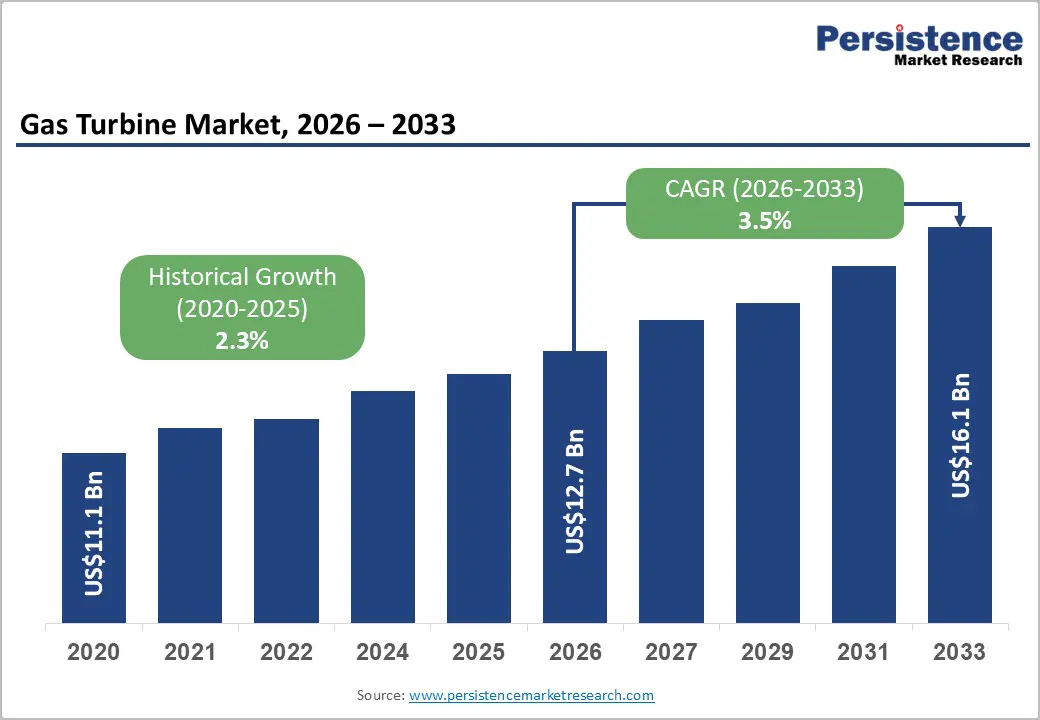
The global gas turbine market size is likely to be valued at US$12.7 billion in 2026 and is expected to reach US$16.1 billion by 2033, growing at a CAGR of 3.5% during the forecast period from 2026 to 2033, driven by rising demand for reliable and flexible power generation and increasing integration of renewable energy sources.
The shift from coal to clean natural gas-based power plants is also supporting market expansion, especially in North America and Europe.
Key Industry Highlights:
- Latest Acquisition: In February 2026, GE Vernova completed the acquisition of the remaining 50% stake in Prolec GE. The deal positions the former as the only company globally capable of supplying an integrated power-to-rack solution, right from gas turbine to distribution transformer, from a single supplier.
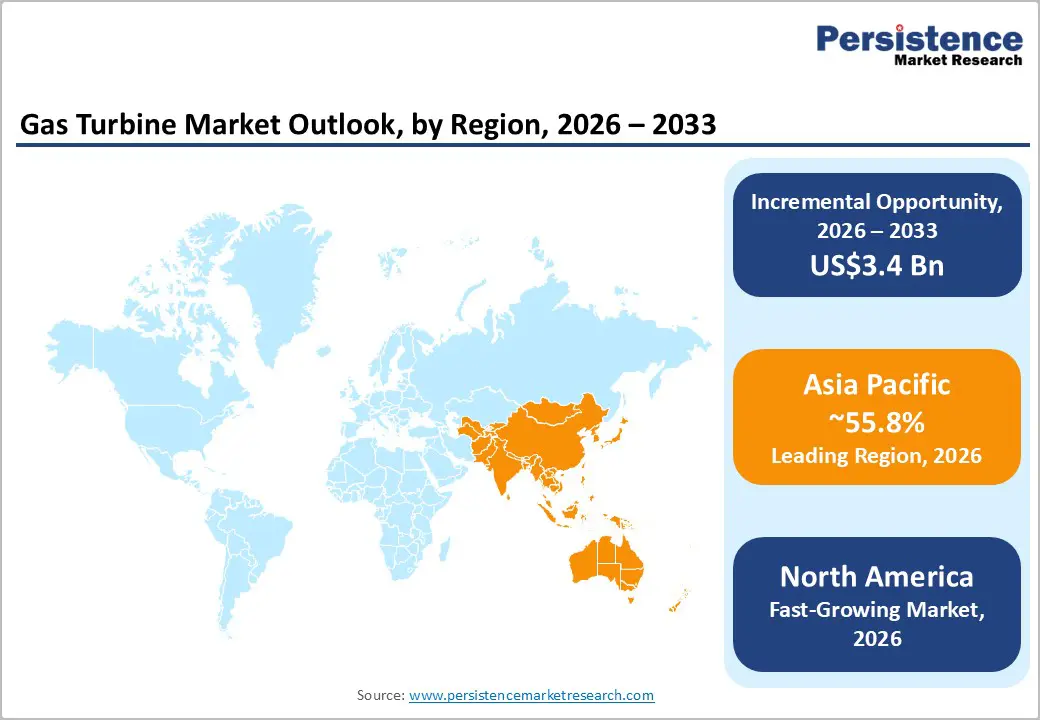
- Leading Region: Asia Pacific, with about 55.8% share in 2026, spurred by rising electricity demand from ongoing industrialization and urban expansion.
- Fast-growing Region: North America, boosted by increasing LNG exports and expansion of gas-fired plants.
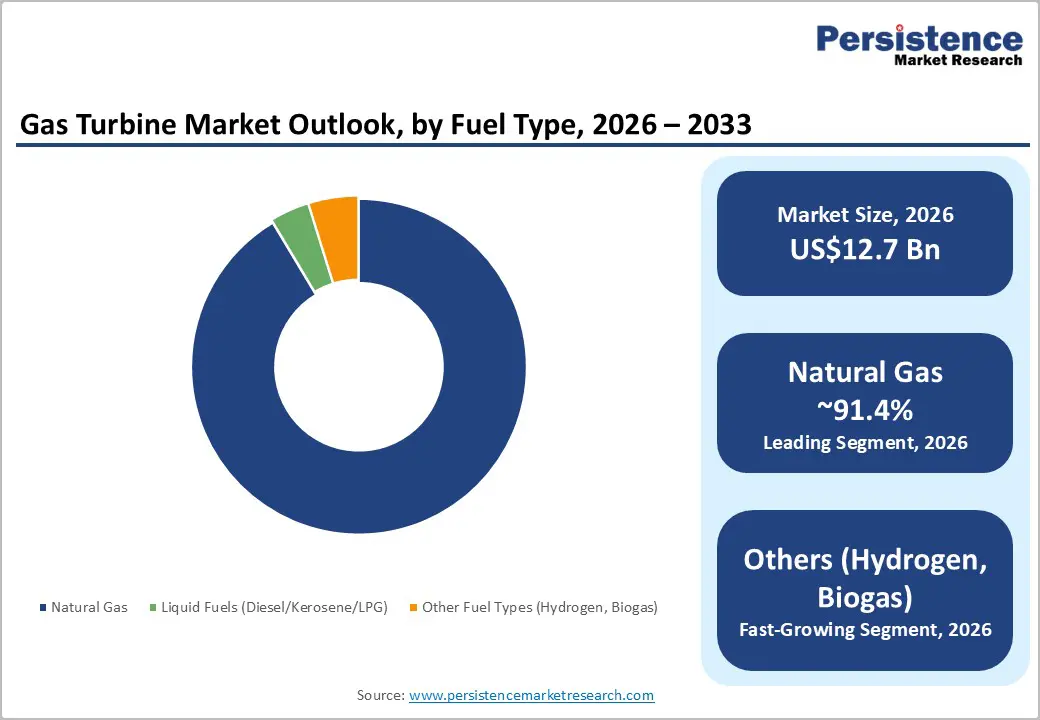
- Leading Fuel Type: Natural gas, approximately 91.4% share in 2026, backed by its well-established global supply network and compatibility with existing gas turbine infrastructure.
- Dominant End-use Industry: Power generation, nearly 70.2% in 2026, as gas turbines provide fast ramp-up capability, making them essential for balancing intermittent renewable energy sources.
DRO Analysis
Driver - Increasing Demand for Grid Stability and Fast Response
As solar and wind generation expand, grid operators face a serious problem, i.e., what to do when the sun sets or the wind drops suddenly. Gas turbines, especially simple-cycle units deployed as peaker plants, address this directly. They can go from cold to full output in under 10 minutes, compared to several hours for coal or nuclear plants.
Their ability to swiftly respond to fluctuating demand and bridge mismatches between peak energy production and consumption times is essential for grid stability. Oklahoma's Grand River Dam Authority is a good example. It introduced Mitsubishi Power's JAC gas turbine specifically as a peaker to complement rising renewable capacity on its grid.
Surging Electricity Consumption Worldwide
Global electricity demand is climbing fast, and AI-supported data centers are a key reason. Data center electricity consumption reached about 415 TWh in 2024 and has grown at 12% per year over the last five years. The U.S. Department of Energy estimates that data center power demand could represent 6.7 to 12% of U.S. electricity usage by 2028. Gas turbines are filling the gap as they can be deployed quickly.
Their comparatively short construction and commissioning timelines allow developers to bring new capacity online far more quickly than most alternatives. This is a critical benefit as long as grid connection queues push operators toward on-site generation that can be deployed in months. A 70% surge in gas turbine orders in 2025, as reported by the International Energy Agency (IEA), shows exactly how much pressure the AI boom is placing on power supply chains.
Restraint - Green Finance Rules May Leave Gas Out in Europe
Europe's sustainable finance framework is creating a funding barrier for gas turbine projects. Under the EU's Complementary Climate Delegated Act, gas-fired power plants can only qualify as ‘sustainable’ under strict conditions. Until end-2030, gas plants must emit less than 270g CO2e/kWh and meet additional conditions such as replacing a fossil fuel plant that cannot be cost-effectively substituted by renewables, committing to switch to low-carbon gas by 2035.
MSCI estimated that pure-play gas-fired power generators in its global index had an average direct emissions intensity of 480g CO2e/kWh, well above the 270g threshold. This means most new gas turbine projects cannot be labeled green under the EU Taxonomy. It makes them ineligible for sustainability-linked bonds, ESG-screened funds, and green loans. Banks and institutional investors now use taxonomy alignment as a lending filter, so projects that fall outside it face high financing costs or outright exclusion.
Opportunity - Turbine Leasing for Climate-Driven Power Outages in the Caribbean
Repeated hurricane damage has turned power resilience into a procurement priority across Caribbean island grids. The region's fragmented infrastructure and limited budgets make outright turbine purchases impractical, so leasing aeroderivative units has become the default recovery tool. In May 2025, for instance, GE Vernova announced that Bahamas Turbines Limited ordered two TM2500 mobile aeroderivative gas turbine packages to extend the Clifton Piers power plant in New Providence Island, Bahamas.
It was a fast-deployable solution targeting peak summer demand pushed by record tourist arrivals. The broad leasing trend is rising. The Bahamas and the Dominican Republic have structured regional turbine-sharing pools, allowing units to be redeployed across neighboring islands quickly after storm events. These short-term lease structures with steady redeployment clauses are changing how OEMs approach the Caribbean market.
Petrochemical Cogeneration Expansion in the Middle East
Rapidly expanding petrochemical complexes across Saudi Arabia and the UAE are embedding gas turbine-based cogeneration from day one of project design. These facilities require both electricity and high-pressure steam simultaneously, which makes combined heat and power (CHP) setups far more efficient than separate generation. In August 2024, Mitsubishi Power received an order for a 475 MW combined-cycle cogeneration plant in Jubail, Saudi Arabia, to supply electricity and steam to the Saudi Aramco Total Refining and Petrochemical Company (SATORP) Strategic Expansion.
It was one of the largest mixed-load steam crackers in the Gulf region. GE Vernova's Jafurah Cogeneration Independent Steam and Power Plant also achieved commercial operations in November 2025. GE Vernova provided its 7HA.01 gas turbine and a 20-year service agreement, making it the first H-Class gas turbine completed locally in the Kingdom. As Saudi Vision 2030 bolsters industrial diversification, this cogeneration buildout is set to deepen further.
Category-wise Analysis
Fuel Type Insights
Natural gas is predicted to lead with a share of approximately 91.4% in 2026, as it provides the best balance between efficiency, emissions, and operational flexibility. Modern combined-cycle gas turbines can achieve efficiency levels above 60%, which is much higher than coal-fired plants. This reduces fuel consumption per unit of electricity. According to the U.S. Energy Information Administration, natural gas accounts for the largest share of electricity generation in the U.S., mainly due to its efficiency and lower carbon intensity compared to coal. Another key driver is infrastructure maturity.
The U.S., Germany, and Japan already have extensive gas pipeline networks and LNG import terminals, which reduce the requirement for new investment.
Other fuel types, including hydrogen and biogas, are estimated to be the fastest-growing segment over the forecast period, as they help reduce emissions without replacing existing turbine infrastructure. Several OEMs are now developing turbines that can run on hydrogen blends. For instance, Siemens Energy announced that several of its turbines can already operate with up to 50% hydrogen, with a roadmap toward 100% hydrogen capability. This allows utilities to decarbonize gradually. The European Union also plans to install large-scale electrolyzers to produce renewable hydrogen for industrial and power use, which supports hydrogen-based gas turbine adoption.
End-use Industry Insights
The power generation segment is anticipated to dominate with a share of nearly 70.2% in 2026, as gas turbines are central to modern electricity systems. They are widely used in combined-cycle plants, which are among the most efficient power generation technologies. These plants are often chosen to replace aging coal plants. For example, the U.S. Environmental Protection Agency (EPA) has documented multiple coal-to-gas switching projects as part of emissions reduction strategies.
The oil and gas segment is expected to remain in the second position in 2026, as the industry uses gas turbines mainly for upstream and LNG operations. These turbines are used to power compressors, pumps, and offshore platforms. Their ability to operate in harsh environments makes them suitable for remote oil fields. For instance, Baker Hughes has deployed aeroderivative gas turbines in offshore platforms to improve efficiency and reduce maintenance downtime. Liquefaction plants also require large amounts of energy for gas compression and cooling. Gas turbines are widely used in these processes.
Regional Insights
Asia Pacific Gas Turbine Market Trends
Asia Pacific is anticipated to dominate in 2026, with a share of nearly 55.8%, as it has the world's largest concentration of electricity-hungry economies still building out their power infrastructure. Ongoing urbanization, industrialization, and energy infrastructure expansion are boosting demand across China, India, Japan, and Southeast Asia. The region is also drastically cutting coal dependence. This positions gas turbines as a practical middle ground.
Governments in Asia Pacific are launching policies and providing financial support to replace coal-fired power plants, responding to a significant surge in demand for clean power production. The spread of LNG import terminals across Vietnam, Thailand, Malaysia, and the Philippines is further opening up new gas-fired generation capacity that augments turbine procurement.
China Gas Turbine Market Trends
China is actively switching away from coal to meet its 2060 carbon neutrality pledge. On the other hand, intermittent solar and wind capacity, which already surpassed thermal power in installed capacity for the first time in Q1 2025, as per Greenpeace, requires flexible gas backup. GE Vernova has two HA gas power projects in progress in Zhoushan and Anji. The Zhoushan project is advancing Zhejiang Province's 14th Five-Year Plan goals around green and low-carbon development.
In August 2024, CHN Energy Investment Group ordered two 9HA.02 turbines for the Anji combined-cycle plant. It is expected to deliver over 1.6 GW when it enters commercial operation in 2026. China's market is being further strengthened by government initiatives to build a balanced and sustainable energy mix, along with strict emission standards and rising demand for flexible generation assets.
India Gas Turbine Market Trends
India's market is more constrained than its neighbors due to low-cost coal, and falling renewable costs continue to squeeze gas out of the power mix. According to the Institute for Energy Economics and Financial Analysis (IEEFA), in FY2025, 31 gas-fired power plants with a combined capacity of nearly 8 GW did not generate any electricity at all, rendering them stranded assets. In April 2025, 5.3 GW of this was retired due to inoperability. The fundamental problem is cost. In the power sector, gas has been almost entirely squeezed out of the generation mix due to uncompetitive prices.
India's National Electricity Plan also confirms no new gas-fired power capacity through at least 2032. Gas turbines still have a role to play in peak demand management. The government invoked the Electricity Act's Section 11 powers in 2024 to compel gas plants to operate during summer heat-wave crises. The industrial segment, especially city gas and fertilizers, continues to use gas engines steadily.
North America Gas Turbine Market Trends
North America is predicted to account for a share of approximately 21.6% in 2026. The region’s market has essentially been reignited by the AI data center boom. Grid connection queues are long, renewable projects face permitting delays, and hyperscale operators require power now. This has turned gas turbines into the default solution. OEMs are experiencing demand they haven't seen in decades. Siemens Energy's U.S. demand is at record highs, with 35% of its turbine orders in fiscal Q3 2025 coming from the U.S. alone. Gas turbine orders also totaled 14 GW through June 2025, with 65% of those earmarked for data centers.
U.S. Gas Turbine Market Trends
The U.S. is the single largest national market in North America and is experiencing a structural shift in how gas turbines are deployed. They are no longer just utility peakers, but are becoming embedded infrastructure for AI campuses. Developers currently plan 18.7 GW of newly constructed combined-cycle gas turbine capacity through 2028. The EIA projects the strongest four-year growth in U.S. electricity use since 2000, propelled by expanding data center loads for AI and cloud computing.
Middle East & Africa Gas Turbine Market Trends
The Middle East & Africa is estimated to register a share of about 10.8% in 2026, spurred by two distinct dynamics. In the Gulf, governments are using gas turbines to replace oil-fired power generation and support massive industrial buildouts. Africa is being propelled by chronic power shortages and the demand for a reliable electricity supply in under-electrified economies. Saudi Arabia's Giga projects and industrial zones are bolstering combined-cycle power plants that often exceed 1 GW in capacity.
The UAE continues to invest in advanced power generation through independent power producer models. In Qatar, the expansion of LNG production capacity from 77 to 126 million tons per annum is creating parallel demand for gas turbines in processing as well as compression applications.
Saudi Arabia Gas Turbine Market Trends
Saudi Arabia's dominance comes down to one strategic imperative, i.e., to stop burning crude oil for electricity and start exporting it instead. Analysis from Rystad Energy shows the Jafurah shale gas field, set to start production in 2025 and the largest unconventional gas field globally, could displace up to 350,000 barrels per day of crude burn by 2030. This fuel-switching is translating into gas turbine orders. Saudi Arabia has made significant investments in greenfield gas-fired power plants totaling as much as 25 GW in new capacity additions by 2030. The country is also localizing manufacturing.
South Africa Gas Turbine Market Trends
South Africa's relationship with gas turbines is influenced by its electricity crisis rather than a long-term strategy. Eskom, the state utility, has historically run open-cycle gas turbines on diesel as emergency peakers during load-shedding events, which is now changing. Between April 2025 and February 2026, the company generated 1,049 GWh from open-cycle gas turbine plants at a diesel cost of R6.23 billion, which was a 42% reduction in OCGT energy generation compared to the same period the previous year.
However, the country faces a structural capacity cliff ahead. Eskom is scheduled to retire 8.4 GW of coal-fired capacity by 2030. The system operator's outlook includes the addition of 6 GW of combined-cycle gas turbine capacity by 2030 to fill the gap. This is a buildout that will likely change South Africa's market over the forecast period if project timelines hold.
Competitive Landscape
The global gas turbine market is moderately consolidated, with a handful of multinational OEMs controlling most large-scale utility and industrial turbine orders. The competitive landscape is dominated by GE Vernova, Siemens Energy, and Mitsubishi Heavy Industries, mainly in heavy-duty turbines used in combined-cycle power plants. Together, these companies account for more than 60% of global market revenues and an even larger share of production capacity for high-output turbines.
Competition has shifted beyond turbine sales toward long-term service agreements (LTSAs), digital monitoring, and hydrogen-ready systems. In several projects, lifetime maintenance contracts generate more revenue than the turbine itself. Siemens Energy and GE Vernova are now integrating AI-based predictive maintenance, remote diagnostics, and digital twins to secure recurring service income.
Key Industry Developments
- In March 2026, IHI Corporation and GE Vernova announced the successful demonstration of 100% ammonia combustion using full-scale components at pressures, temperatures, and flows matching full-load conditions for GE Vernova's F-class gas turbines.
- In February 2026, Siemens Energy announced a US$1 billion investment to broaden manufacturing capacity and workforce across multiple U.S. states, covering grid equipment, large gas turbines, and related components.
- In February 2026, Xcel Energy and GE Vernova signed a Strategic Alliance Agreement aimed at supporting Xcel's generation and grid projects well into the 2030s. As part of the deal, Xcel executed a reservation agreement for five F-class gas turbines and a capacity reservation for multiple gigawatts of wind projects.
Companies Covered in Gas Turbine Market
- Wartsila
- BHEL
- Mitsubishi Hitachi Power Systems
- Harbin Electric International Company
- Siemens Energy
- Man Diesel & Turbo
- General Electric
- NPO Saturn
- Kawasaki Heavy Industries
- Solar Turbines
- Capstone Turbine
- Vericor Power Systems
- Cryostar
- AnsaldoEnergia
- Opra Turbines
- Zorya-Mashproekt
Frequently Asked Questions
The global gas turbine market is projected to be valued at US$12.7 billion in 2026.
The gas turbine market is expected to reach US$16.1 billion by 2033.
Key market trends include the development of hydrogen-ready turbines and increasing use of digital monitoring as well as predictive maintenance.
Natural gas is expected to be the leading fuel type with a share of nearly 91.4% in 2026, owing to its higher efficiency and lower carbon emissions compared to coal.
The gas turbine market is expected to grow at a CAGR of 3.5% from 2026 to 2033.
Wartsila, BHEL, Mitsubishi Hitachi Power Systems, and Harbin Electric International Company are a few key market players.


