




- Power Generation, Transmission, & Distribution
- DC Circuit Breaker Market
DC Circuit Breaker Market Size, Share, and Growth Forecast, 2026 - 2033
DC Circuit Breaker Market by Voltage (Low Voltage (Up to 1000V), Medium Voltage (1001V-7kV), Others), Product Type (Mechanical Circuit Breakers, Hybrid Circuit Breakers, Others), End-user, and Regional Analysis for 2026 - 2033

DC Circuit Breaker Market Size and Trends Analysis
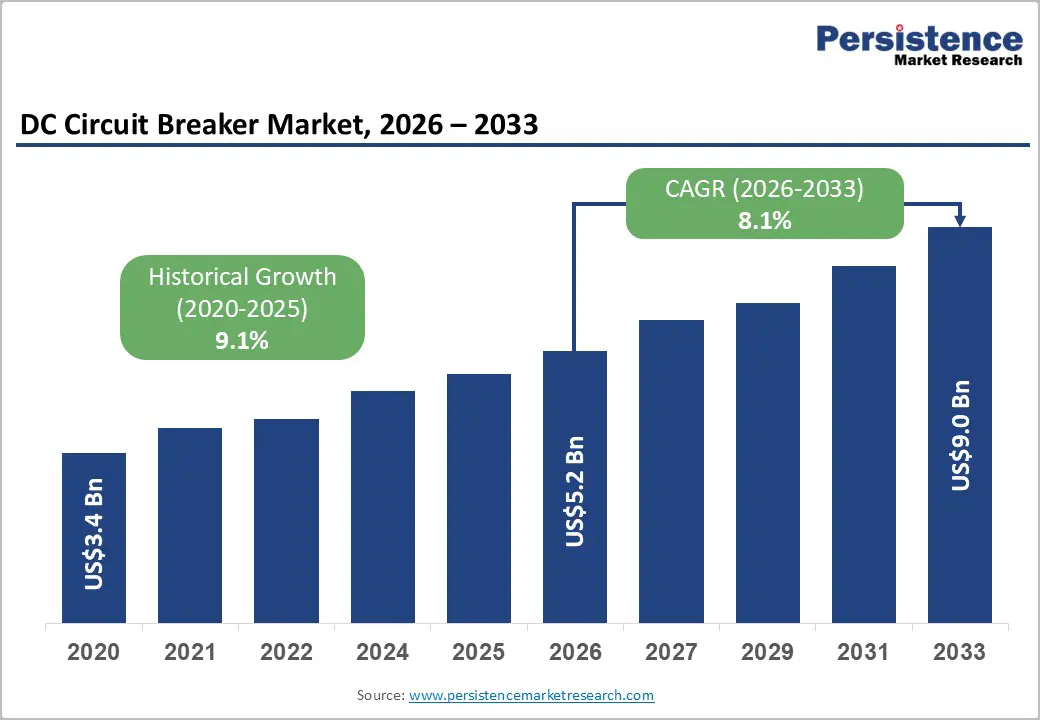
The global DC circuit breaker market size is likely to be valued at US$5.2 billion in 2026 and is expected to reach US$9.0 billion by 2033, growing at a CAGR of 8.1% during the forecast period from 2026 to 2033, driven by increasing deployment of high-voltage direct current (HVDC) transmission networks, rapid expansion of renewable energy installations, growing investments in electric vehicle charging infrastructure, and rising power demand from data centers.
As utilities and industrial operators prioritize grid resilience, energy efficiency, and fault protection capabilities, DC circuit breakers are becoming essential components within modern power systems.
Key Industry Highlights:
- Leading Region: Asia Pacific is expected to account for approximately 39.8% of the market share in 2026, supported by large-scale renewable energy deployment, HVDC transmission investments, and expanding industrial infrastructure across China, Japan, India, and ASEAN countries.
- Fastest-growing Region: Asia Pacific is projected to remain the fastest-growing regional market through 2033, driven by accelerating grid modernization initiatives, transportation electrification, battery energy storage deployments, and renewable energy expansion.
- Dominant Voltage: Medium Voltage (1001V-7kV) is anticipated to account for 47.3% of the market share in 2026, supported by widespread adoption across utility substations, renewable energy facilities, railway electrification projects, industrial power systems, and EV charging networks.
- Leading Product Type: Hybrid circuit breakers are anticipated to hold 58.4% of the market share in 2026, owing to their ability to combine the reliability of mechanical switching with the speed and performance advantages of power electronics.
DRO Analysis
Driver - Growing Investments in HVDC Transmission and Grid Modernization
The expansion of HVDC transmission infrastructure is a major driver of the DC circuit breaker market. Power utilities worldwide are investing heavily in long-distance transmission corridors to improve grid stability, facilitate renewable energy integration, and reduce transmission losses. HVDC systems offer superior efficiency over long distances compared with conventional AC networks and enable interconnection between asynchronous grids.
The increasing deployment of offshore wind farms, cross-border electricity transmission projects, and large-scale renewable energy facilities has significantly increased demand for advanced DC protection equipment. DC circuit breakers play a critical role in protecting converter stations, transmission lines, and substations from fault currents. As governments continue to modernize aging electrical infrastructure and strengthen grid reliability, utilities are expected to accelerate investments in medium- and high-voltage DC protection systems, creating sustained demand throughout the forecast period.
Electrification of Transportation, Renewable Energy, and Data Centers
Global electrification trends are creating substantial demand for DC circuit breakers. Renewable energy installations continue to expand rapidly, while electric vehicle adoption is driving significant investments in charging infrastructure and battery energy storage systems. At the same time, data centers are consuming increasing amounts of electricity due to artificial intelligence, cloud computing, and digital transformation initiatives.
Modern renewable energy systems, battery storage facilities, EV charging networks, and data centers operate with extensive DC architectures that require reliable fault interruption and protection capabilities. DC circuit breakers provide rapid fault isolation, minimize equipment damage, and improve system uptime. The growing emphasis on energy efficiency and operational reliability is encouraging utilities, commercial operators, and industrial facilities to deploy advanced hybrid and solid-state DC protection technologies.
Restraint - High Installation Costs and Technical Complexity
Despite favorable market fundamentals, adoption of DC circuit breakers remains constrained by high implementation costs and technical challenges. Unlike AC systems, DC circuits lack natural current zero-crossing points, making fault interruption significantly more complex. Consequently, DC circuit breakers require advanced switching technologies, specialized components, and sophisticated control systems.
Solid-state and hybrid circuit breakers often involve higher capital expenditures compared with conventional protection equipment. Installation, testing, certification, and maintenance requirements further increase project costs. In addition, varying regulatory requirements across regions can lengthen approval processes and delay deployments. These factors create barriers for cost-sensitive industrial facilities and commercial projects, particularly in developing economies where budget constraints remain significant.
Opportunity - Expansion of Solid-State Protection Technologies
The emergence of solid-state circuit breaker technologies presents a significant growth opportunity for market participants. Solid-state breakers offer ultra-fast fault interruption, reduced arc flash risks, enhanced safety, and improved operational efficiency compared with conventional mechanical alternatives.
Demand for these technologies is increasing across mission-critical applications such as hyperscale data centers, battery energy storage systems, EV charging stations, industrial automation facilities, and marine electrical networks. As semiconductor costs decline and performance capabilities improve, solid-state breakers are expected to gain broader commercial adoption. Manufacturers investing in advanced semiconductor technologies, digital monitoring capabilities, and intelligent protection solutions are well positioned to capitalize on this high-growth segment.
Manufacturing Localization across Asia Pacific
The Asia Pacific region presents substantial opportunities for manufacturers seeking long-term growth. Rapid industrialization, expanding renewable energy capacity, rising electricity demand, and government-led infrastructure programs continue to drive investments in power distribution systems.
Localization strategies involving regional manufacturing facilities, engineering centers, and service networks can provide significant competitive advantages. Local production reduces supply chain risks, shortens delivery timelines, and improves compliance with domestic procurement requirements. Companies establishing strong regional footprints across China, India, Japan, and Southeast Asia are expected to benefit from growing demand across utility, transportation, renewable energy, and industrial sectors.
Category-wise Analysis
Voltage Insights
The medium voltage (1001V-7kV) segment is anticipated to account for 47.3% of the market share in 2026, making it the leading voltage segment. Its dominance is driven by widespread deployment across renewable energy plants, industrial facilities, railway electrification systems, and EV charging infrastructure. For example, medium-voltage DC breakers are extensively used in utility-scale solar farms, battery energy storage systems (BESS), and metro rail networks where reliable fault isolation is critical.
The high voltage (>72kV) segment is anticipated to be the fastest-growing voltage segment through 2033. Growth is supported by increasing investments in HVDC transmission corridors, offshore wind connections, and cross-border power interconnection projects. Examples include long-distance renewable power transmission networks and offshore wind grid integration projects that require advanced high-voltage DC protection solutions to ensure system reliability and operational safety.
Product Type Insights
Hybrid circuit breakers are anticipated to hold 58.4% of the market share in 2026, making them the dominant product category. These breakers combine mechanical switching technology with power electronics, offering an effective balance of performance, reliability, and cost. They are widely deployed in utility substations, renewable energy facilities, and industrial power systems where fast fault interruption is required without the higher costs associated with fully solid-state solutions.
Solid-state circuit breakers are anticipated to be the fastest-growing product segment during the forecast period. Their ability to detect faults within microseconds makes them highly suitable for mission-critical applications. Examples include hyperscale data centers, EV fast-charging stations, battery energy storage systems, and advanced manufacturing facilities, where ultra-fast protection helps minimize downtime and protect sensitive equipment.
Regional Insights
North America DC Circuit Breaker Market Trends
North America represents a mature yet rapidly evolving market for DC circuit breakers. The region benefits from significant investments in grid modernization, renewable energy integration, battery energy storage systems, electric vehicle infrastructure, and hyperscale data centers. Strong regulatory standards, advanced utility networks, and growing demand for reliable power transmission continue to support market expansion.
U.S. DC Circuit Breaker Market Trends
The U.S. is expected to account for approximately 70% of regional demand in 2026, making it the primary growth engine for the North American market. The U.S. dominates the regional market due to extensive investments in HVDC transmission projects, renewable energy deployment, and data center expansion. Growing adoption of AI-driven computing infrastructure is increasing demand for advanced DC protection systems capable of supporting high-density power environments. Federal incentives supporting clean energy, grid resilience, and EV charging infrastructure are further accelerating demand for DC circuit breakers across utility and commercial applications.
Canada DC Circuit Breaker Market Trends
Canada is witnessing increasing adoption of DC circuit breakers through investments in renewable energy projects, hydroelectric transmission networks, and cross-border power interconnections. Utility companies are modernizing transmission infrastructure to improve grid reliability and support long-distance power delivery, creating opportunities for medium- and high-voltage DC protection solutions.
Europe DC Circuit Breaker Market Trends
Europe remains a strategically important market driven by ambitious decarbonization goals, renewable energy investments, and cross-border electricity interconnection projects. The region's focus on energy transition initiatives continues to support the deployment of HVDC transmission systems, offshore wind projects, and smart grid infrastructure. Growing investments in transportation electrification and industrial automation further strengthen market demand.
Germany DC Circuit Breaker Market Trends
Germany represents the largest market in Europe due to its leadership in renewable energy generation and grid modernization initiatives. The country's substantial investments in offshore wind connectivity, HVDC transmission corridors, and industrial electrification continue to drive demand for advanced DC protection technologies.
U.K. DC Circuit Breaker Market Trends
The U.K. is a key market supported by large-scale offshore wind developments and investments in transmission infrastructure. The country's commitment to net-zero targets is encouraging utilities to deploy advanced protection equipment capable of supporting renewable energy integration and long-distance power transmission.
France DC Circuit Breaker Market Trends
France benefits from ongoing investments in power transmission upgrades, renewable energy projects, and transportation electrification. The modernization of utility infrastructure and the increasing deployment of battery storage systems are contributing to steady demand for DC circuit breakers.
Spain DC Circuit Breaker Market Trends
Spain is emerging as an important market due to rapid solar energy expansion and growing investment in energy storage facilities. Increasing renewable energy penetration is creating demand for reliable DC protection systems across utility-scale and distributed energy applications.
Asia Pacific DC Circuit Breaker Market Trends
Asia Pacific is both the largest and fastest-growing regional market, accounting for approximately 39.8% of the market share. Rapid industrialization, infrastructure development, renewable energy expansion, and transportation electrification are driving substantial demand across the region. Strong manufacturing capabilities and supportive government policies continue to reinforce market growth.
China DC Circuit Breaker Market Trends
China is set to account for approximately 61% of the Asia Pacific market, making it the dominant regional contributor. Extensive deployment of HVDC transmission networks, large-scale renewable energy projects, battery storage installations, and EV charging infrastructure continues to support market leadership. The country's focus on grid modernization and electrification creates significant demand for medium- and high-voltage DC circuit breakers.
Japan DC Circuit Breaker Market Trends
Japan is estimated to represent approximately 8% of regional demand in 2026 and benefits from its advanced industrial base and emphasis on power system reliability. Investments in renewable energy integration, smart grid technologies, and energy storage systems are supporting the adoption of advanced DC protection solutions.
India DC Circuit Breaker Market Trends
India is expected to contribute approximately 7% of regional demand in 2026 and is one of the fastest-growing national markets. Rapid expansion of solar and wind energy capacity, increasing EV adoption, and major investments in transmission infrastructure are driving demand for DC circuit breakers across utility and industrial applications.
Competitive Landscape
The global DC circuit breaker market exhibits a moderately consolidated structure characterized by the presence of several large multinational electrical equipment manufacturers alongside specialized protection technology providers. Competition is increasingly focused on innovation, digital monitoring capabilities, response speed, and integration with intelligent power management systems.
Key market participants are prioritizing technological innovation, geographic expansion, localized manufacturing, and digital integration. Competitive differentiation increasingly depends on ultra-fast fault interruption capabilities, intelligent monitoring systems, sustainability-focused product development, and comprehensive service offerings across utility, industrial, and renewable energy applications.
Key Industry Developments:
- In April 2026, Eaton Corporation expanded its Breaktor® high-voltage circuit protection portfolio with a new single-pole circuit protection solution designed for next-generation electric vehicle platforms.
- In March 2025, Siemens announced the deployment of its Spectrum Power 7 grid management platform for DB Energie, Germany’s railway energy operator, to modernize transmission grid operations.
Companies Covered in DC Circuit Breaker Market
- ABB Ltd.
- Siemens AG
- Hitachi Energy Ltd.
- Schneider Electric SE
- Eaton Corporation plc
- Mitsubishi Electric Corporation
- GE Vernova Inc.
- Fuji Electric Co., Ltd.
- Toshiba Energy Systems & Solutions Corporation
- LS ELECTRIC Co., Ltd.
- Littelfuse, Inc.
- Rockwell Automation, Inc.
- Legrand SA
- Hager Group
- SCHURTER Holding AG
- Sensata Technologies, Inc.
Frequently Asked Questions
The global DC circuit breaker market is estimated to be valued at US$5.2 billion in 2026.
The DC circuit breaker market is expected to reach US$9.0 billion by 2033.
Key trends include increasing deployment of HVDC transmission systems, rapid expansion of renewable energy projects, growing adoption of battery energy storage systems (BESS), rising investments in EV charging infrastructure, and the commercialization of solid-state circuit breaker technologies.
Medium voltage (1001V-7kV) is the leading voltage segment, anticipated to account for 47.3% of the global market in 2026, while hybrid circuit breakers lead the product type segment with an anticipated 58.4% market share.
The DC circuit breaker market is projected to grow at a CAGR of 8.1% between 2026 and 2033.
Major companies include ABB Ltd., Siemens AG, Schneider Electric SE, Eaton Corporation plc, and Hitachi Energy Ltd.


