




- Clothing, Footwear, & Accessories
- Decorated Apparel Market
Decorated Apparel Market Size, Trends, Share, and Growth Forecast 2026 - 2033
Decorated Apparel Market by Product Type (Embroidery, Screen Printing, Dye Sublimation, Digital Printing, Others), by End-user (Men, Women, Kids), by Distribution Channel (Online, Offline), by Regional Analysis, 2026-2033

Decorated Apparel Market Size and Trend Analysis
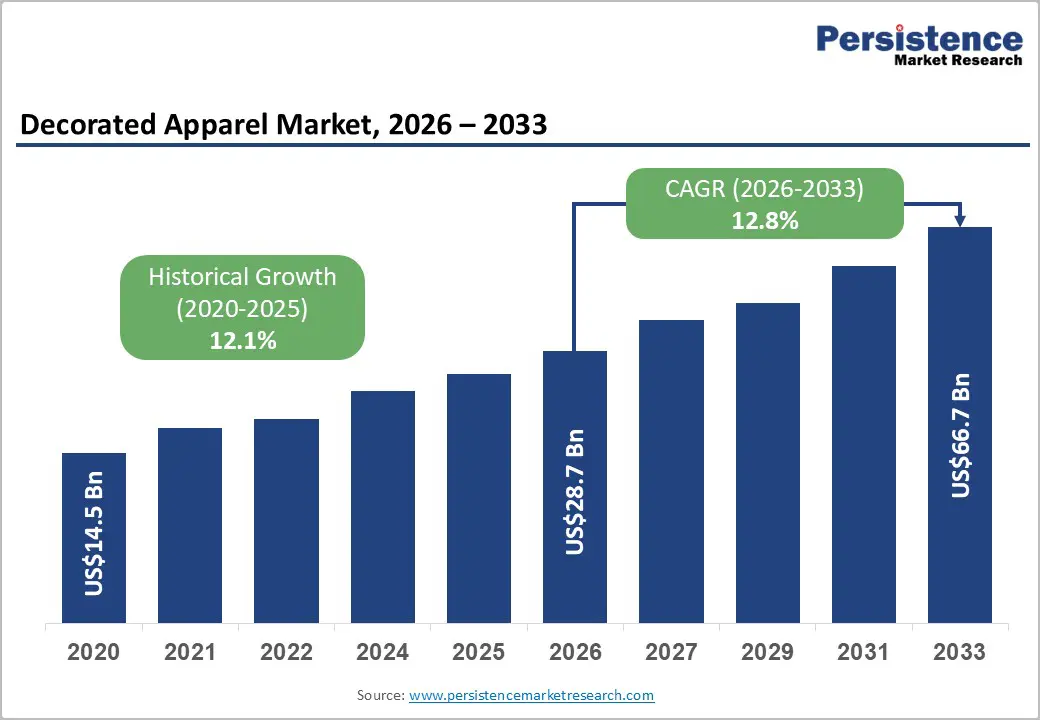
The global decorated apparel market size is expected to be valued at US$ 28.7 billion in 2026 and projected to reach US$ 66.7 billion by 2033, growing at a CAGR of 12.8% between 2026 and 2033. Market expansion is primarily driven by the rise in consumer demand for personalized and unique clothing items reflecting individual identity and self-expression, particularly among millennials and Gen Z demographics.
The rise of social media influencer culture and digital-first marketing has substantially amplified demand for custom-designed apparel aligned with individual lifestyle preferences.
According to the PRINTING United Alliance, sales in the decorated apparel industry demonstrated growth with evolving consumer preferences toward bespoke designs, and technological advancements in decoration methods have dramatically enhanced production efficiency, quality consistency, and design customization capabilities, enabling manufacturers to rapidly fulfill personalized orders across diverse customer segments.
Key Industry Highlights:
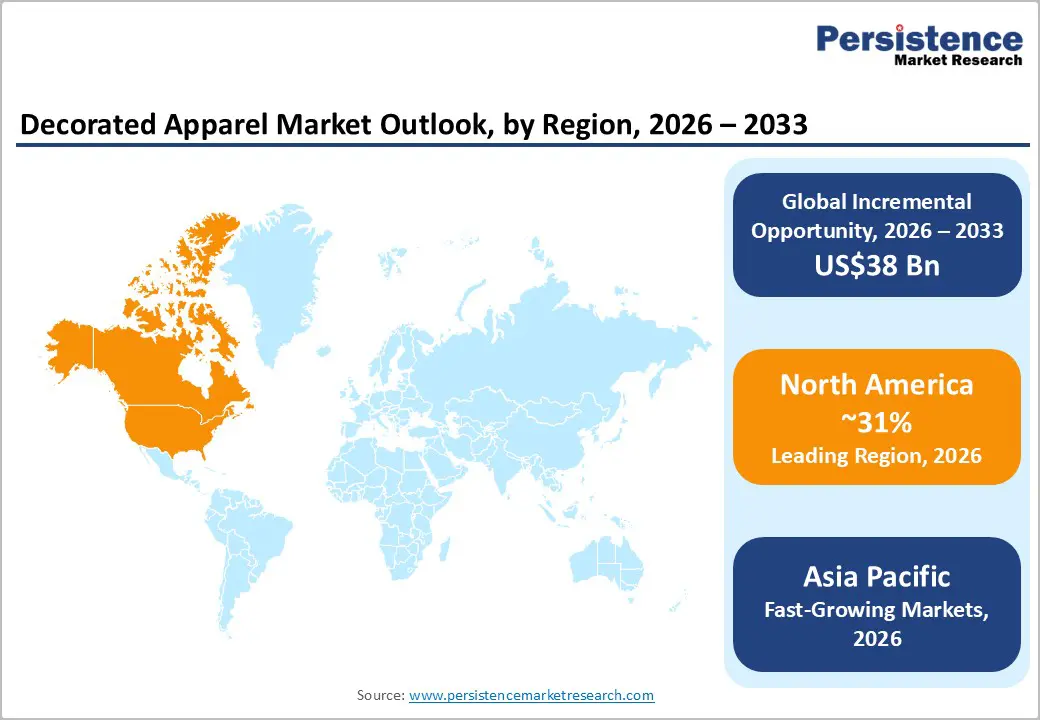
- Leading Region: North America leads the global Decorated Apparel Market with approximately 31% share in 2025, supported by robust consumer spending, an established promotional products industry, and substantial corporate investment in branded merchandise and personalized apparel.
- Fastest Growing Region: Asia Pacific is the fastest-growing region, expected to post approximately 14.2% CAGR through 2033, driven by expanding middle-class populations, rising disposable incomes, accelerating e-commerce adoption, and manufacturing advantages supporting domestic and export markets.
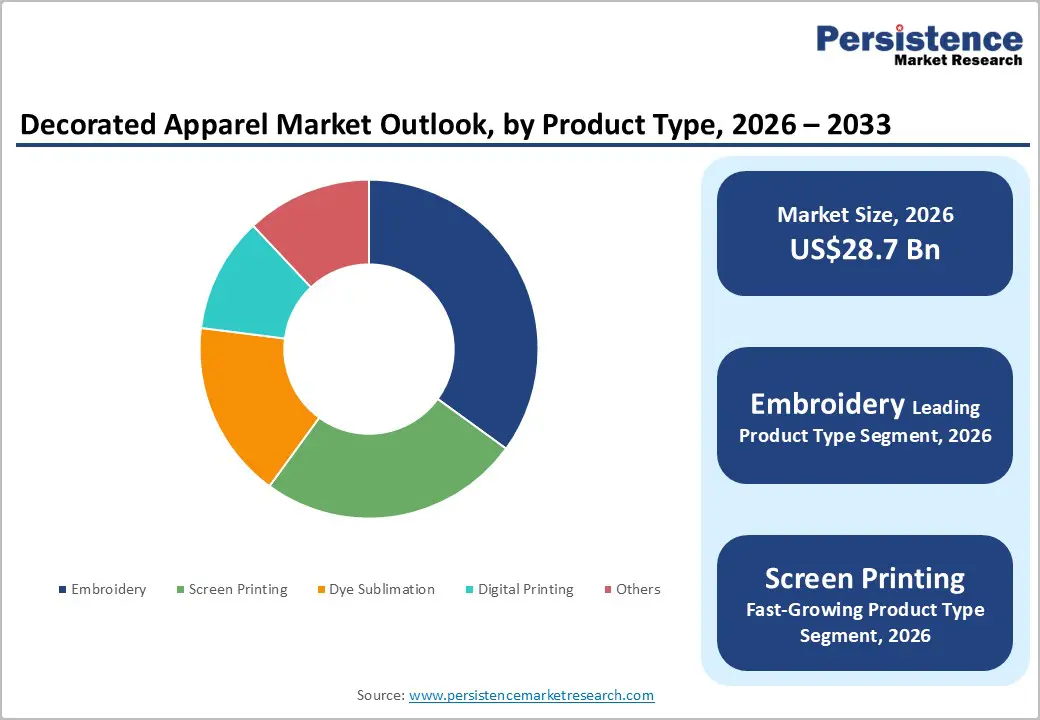
- Dominant Segment from Product Type: Embroidery dominates with roughly 35% share in 2025, reflecting premium positioning, exceptional durability, and universal appeal across corporate uniforms, promotional wear, and premium fashion segments.
- Fastest Growing Segment from End-user: Kids is the fastest-growing segment, with an estimated 13.8% CAGR through 2033, driven by parental investment in personalized apparel, custom school uniforms, sports team merchandise, and character-themed designs.
- Key Market Opportunity: Direct-to-consumer and omnichannel distribution models offer a significant opportunity for establishing vertical integration, premium positioning, and sustainable competitive advantages through customer relationship building and advanced personalization technologies.
| Key Insights | Details |
|---|---|
|
Decorated Apparel Market Size (2026E) |
US$ 28.7 billion |
|
Market Value Forecast (2033F) |
US$ 66.7 billion |
|
Projected Growth CAGR (2026-2033) |
12.8% |
|
Historical Market Growth (2020-2025) |
12.1% |
Market Dynamics
Drivers - Surging Demand for Personalized and Custom-Designed Apparel
Consumer preference for personalized apparel has emerged as the most significant market growth catalyst, driven by the desire for unique clothing items enabling individual self-expression and lifestyle alignment. Modern consumers increasingly reject mass-produced garments, seeking bespoke designs, custom graphics, and individualized touches reflecting personal identity and values. According to PRINTING United Alliance State of Decorated Apparel (SODA) Survey Fall 2023/Winter 2024, consumer spending patterns indicate robust demand for customized clothing across diverse demographic segments.
The rise of digital natives and Gen Z consumers, who prioritize uniqueness and authenticity in their purchasing decisions, has fundamentally reshaped apparel consumption patterns. Social media platforms and influencer culture have accelerated this trend, with platforms like Instagram, TikTok, and Pinterest driving viral demand for custom-designed graphic t-shirts, personalized hoodies, and branded event apparel. E-commerce platforms and print-on-demand solutions have democratized access to custom apparel production, enabling independent creators, small businesses, and individual consumers to design and order personalized garments with minimal inventory investment and rapid turnaround times.
Expansion of E-Commerce Platforms and Print-on-Demand Technologies
The exponential growth of e-commerce infrastructure and digital customization platforms has fundamentally transformed decorated apparel market accessibility and consumer purchasing behaviors. According to PRINTING United Alliance, 44.4% of surveyed apparel decorators identified e-commerce solutions as their highest investment priority, reflecting industry recognition of digital channels’ critical importance for market growth. Online customization platforms enable seamless design experimentation, visualization, and ordering processes, removing traditional barriers to custom apparel adoption.
Print-on-demand business models have eliminated inventory risks and manufacturing constraints, enabling rapid market entry for emerging businesses and supporting hyper-localized, niche designs targeting specific consumer communities. The integration of advanced body-scanning technology, virtual fitting systems, and digital textile printing capabilities has enhanced personalization accuracy while reducing material waste and production complexity. Companies including Printify, Printful, and Merchandise by Amazon have demonstrated substantial business success through print-on-demand platforms, with platforms like Etsy and Amazon facilitating significant marketplace growth. The accessibility of e-commerce infrastructure has enabled small businesses and entrepreneurs to participate in the decorated apparel market without substantial upfront capital investment, supporting market democratization and expansion.
Restraint - High Setup Costs and Capital Investment Requirements for Advanced Decoration Technologies
Decorated apparel manufacturing requires substantial capital investment in specialized equipment, creating barriers to entry for smaller manufacturers and constraining market expansion. Advanced embroidery machines, automatic screen-printing presses, direct-to-garment printing systems, and dye sublimation equipment require significant upfront capital expenditures, with setup costs for complete production facilities often exceeding US$ 100,000 to US$ 500,000 depending on production scale and technology sophistication. Traditional screen printing requires substantial investment in screen fabrication, storage infrastructure, and manual labor, particularly for complex multi-color designs.
Smaller manufacturers and emerging businesses struggle to justify equipment investments for limited production volumes, constraining competitive participation. Equipment maintenance, operational training, and technical expertise requirements further elevate total cost of ownership. The transition toward sustainable production methods, incorporating eco-friendly inks and alternative materials, necessitates additional investment in equipment upgrades and process modifications, raising financial barriers for cost-constrained manufacturers.
Raw Material Price Volatility and Supply Chain Complexity
Decorated apparel manufacturers confront significant supply chain challenges stemming from dependence on diverse raw materials including cotton, polyester, specialty fabrics, inks, threads, and equipment components subject to price volatility and intermittent supply constraints. Fluctuations in cotton and polyester prices impact production costs significantly, with cotton prices varying substantially based on seasonal production, weather conditions, and geopolitical factors.
Specialty fabrics required for premium decorated apparel exhibit higher price volatility and supply scarcity compared to standard textiles. Ink and chemical supply constraints, particularly for eco-friendly and sustainable alternatives, create production bottlenecks and cost pressures. Global supply chain disruptions, including shipping delays, port congestion, and raw material shortages, have increased production complexity and timeline uncertainties, requiring manufacturers to maintain substantial safety stock and working capital reserves.
Opportunity - Integration of Sustainable Production Methods and Eco-Friendly Materials
Significant growth opportunities exist for decorated apparel manufacturers developing sustainable production practices and environmentally responsible material alternatives aligning with evolving consumer environmental consciousness and regulatory pressures. Environmental sustainability has emerged as a competitive differentiator, particularly among millennial and Gen Z consumers actively seeking products with minimal environmental footprints. Manufacturers adopting water-based inks, organic cotton, recycled polyester, and low-energy dyeing processes can capture premium market segments willing to pay elevated prices for environmentally responsible products.
Sustainable apparel represents one of the fastest-growing market segments, with consumer surveys indicating significant price premiums for certified eco-friendly products. Circular fashion initiatives, including garment rental programs and recycling infrastructure, create opportunities for innovative business model development. Certifications including GOTS (Global Organic Textile Standard) and Fair Trade enhance product differentiation and brand positioning. Manufacturers investing in sustainable technology development, renewable energy integration, and waste reduction can establish competitive advantages while supporting long-term market positioning aligned with evolving environmental regulations and consumer expectations.
Emerging Opportunities in Direct-to-Consumer and Omnichannel Distribution Models
The shift toward direct-to-consumer business models and omnichannel distribution strategies presents substantial growth opportunities for decorated apparel manufacturers establishing vertical integration across design, production, and retail channels. Direct-to-consumer models eliminate distributor markups, enabling premium pricing for customized products while maintaining customer relationships and gathering real-time market intelligence. Omnichannel strategies combining e-commerce platforms, physical retail locations, pop-up experiences, and social media commerce enable comprehensive customer engagement across diverse touchpoints.
Advanced digital technologies including augmented reality (AR) virtual try-on systems, AI-powered design recommendations, and personalization engines enhance customer experience while reducing return rates. According to PRINTING United Alliance, digital technology adoption is accelerating, with 47.1% of decorated apparel production expected to incorporate digital methods by 2026. Companies developing integrated omnichannel capabilities, investing in customer experience technology, and building direct brand relationships can capture higher profit margins while establishing sustainable competitive advantages against traditional wholesale-dependent manufacturers.
Category-wise Analysis
Product Type Insights
Within the product type category, embroidery remains the dominant segment, accounting for approximately 35% market share in 2025. Its leadership is supported by premium positioning, superior durability, and broad acceptance across corporate uniforms, promotional merchandise, and high-end fashion apparel. Embroidery delivers a tactile finish and visual depth that enhances perceived product value, allowing brands to command higher price points. The segment benefits from strong versatility, ranging from classic corporate logos to intricate contemporary patterns.
Technological advancements in computerized and AI-enabled embroidery machines have improved precision, speed, and customization capabilities, reinforcing embroidery’s role as the preferred technique for premium and luxury decorated apparel.
End-user Insights
Women represent the leading end-user segment, holding around 58% market share in 2025, driven by higher spending on fashion-oriented and personalized apparel. Female consumers show strong preference for customized clothing that reflects individual identity, lifestyle, and aesthetic expression. This segment spans a wide product mix, including graphic t-shirts, embroidered jackets, hoodies, and personalized accessories, supporting consistent demand across casual and premium categories.
Rising female workforce participation and increasing disposable incomes have further strengthened purchasing power for discretionary fashion items. Additionally, social media influence and trend-driven consumption patterns continue to amplify demand for decorated apparel among women, sustaining long-term market leadership.
Distribution Channel Insights
The online distribution channel dominates the decorated apparel market, accounting for approximately 61% share in 2025. Its leadership is driven by widespread e-commerce adoption, convenience of digital purchasing, and rapid growth of print-on-demand business models. Online platforms enable real-time design customization, transparent pricing, faster order processing, and doorstep delivery, aligning well with consumer expectations. Large marketplaces and specialized print-on-demand platforms have significantly lowered entry barriers for brands and independent creators.
Integration of social commerce features further strengthens online reach by enabling direct-to-consumer engagement, impulse purchases, and personalized marketing, positioning online channels as the primary growth engine for decorated apparel sales.
Regional Insights
North America Decorated Apparel Market Trends and Insights
North America accounts for approximately 31% of global decorated apparel market share in 2025, supported by strong consumer spending on personalized clothing, a well-established promotional products industry, and consistent corporate investment in branding and merchandising. The United States remains the core market, with widespread adoption across corporate uniforms, collegiate merchandise, sports apparel, event branding, and individual customization. Consumers in the region demonstrate a high willingness to pay for premium, customized apparel that reflects personal identity and lifestyle preferences.
The rapid expansion of e-commerce and print-on-demand platforms has broadened market participation, enabling small brands and independent creators to reach end-users efficiently. Technological leadership in digital printing and embroidery continues to strengthen regional competitiveness, while growing emphasis on sustainable materials and ethical production practices is reshaping supplier strategies. Strong brand utilization of decorated apparel for engagement and marketing ensures steady demand across both corporate and consumer segments.
Europe Decorated Apparel Market Trends and Insights
Europe represents around 26% of the global decorated apparel market in 2025, driven by fashion-conscious consumers, strong design heritage, and a pronounced focus on quality and sustainability. Key markets including Germany, Italy, France, and the United Kingdom benefit from mature fashion ecosystems that support premium and design-led decorated apparel offerings. European consumers prioritize craftsmanship, aesthetic differentiation, and ethical sourcing, encouraging manufacturers to adopt advanced decoration techniques and environmentally responsible production processes.
Regulatory frameworks across the European Union, particularly those addressing chemical usage and waste reduction, have accelerated innovation in sustainable apparel decoration. Demand for personalized and limited-edition clothing continues to rise, supported by designer-led collections and small-batch production models. The region also benefits from cultural diversity, with growing interest in contemporary interpretations of traditional garments, further expanding opportunities for decorated apparel across both mainstream and niche consumer segments.
Asia Pacific Decorated Apparel Market Trends and Insights
Asia Pacific leads the global decorated apparel market and remains the fastest-growing region, driven by expanding middle-class populations, rising disposable incomes, and rapid digital commerce adoption. Major markets such as China, India, and Japan combine strong domestic consumption with extensive export-oriented manufacturing capacity. The region benefits from cost-efficient production, skilled labor availability, and highly integrated supply chains, positioning it as the global manufacturing hub for decorated apparel.
Urbanization and social media influence are accelerating demand for customized and fashion-forward apparel among younger consumers. Governments across Asia Pacific continue to support textile and apparel manufacturing through policy incentives and infrastructure investment, strengthening long-term growth prospects. Additionally, the integration of modern decoration techniques into traditional garments is fueling fusion wear demand, enhancing both domestic consumption and global appeal for Asia Pacific–produced decorated apparel.
Competitive Landscape
The global decorated apparel market is characterized by a moderately fragmented competitive structure, with participation from large integrated manufacturers, regional suppliers, and a rapidly growing base of digital-first and print-on-demand operators. Market structure reflects a balance between scale-driven players with vertically integrated production and smaller, agile firms specializing in customization and short-run orders. Business strategies increasingly prioritize technology-driven differentiation, including investment in advanced digital printing, automated embroidery, and design software to improve turnaround times and customization depth.
Sustainability has emerged as a core strategic pillar, with players adopting eco-friendly inks, recycled fabrics, and responsible sourcing to align with evolving regulatory and consumer expectations. E-commerce enablement and omnichannel models are central to growth strategies, allowing firms to expand reach while reducing dependence on traditional wholesale channels. Competitive positioning is further shaped by supply chain efficiency, flexible production models, and direct-to-consumer engagement, enabling companies to address both mass-volume and niche, premium demand segments effectively.
Key Developments:
- November 2024: Gildan raised $500 million to accelerate sustainability initiatives, expand offerings, and improve efficiencies across 30 locations in 12 countries, building on 20 years of sustainable practices for ethical apparel production.
- August 2025: Gildan to acquire HanesBrands in $2.2B all-equity deal (enterprise value $4.4B incl. debt), offering 0.102 Gildan shares plus $0.80 cash per share at 24% premium. It doubles revenues, is accretive to EPS, targets $200M synergies.
- December 2025: PODpartner launched upgraded production infrastructure for high-end fashion brands, featuring up to 18 print positions, combined DTG printing and embroidery, 48-hour fulfillment, and zero-inventory customization to streamline operations.
Companies Covered in Decorated Apparel Market
- Gildan
- Fruit of the Loom, Inc.
- Downtown Custom Printwear
- Hanes Brands Inc.
- Master Printwear
- Delta Apparel
- Target Decorated Apparel
- Advance Printwear Limited
- Lynka
- New England Printwear
- Printify
- Printful
- Merchandise by Amazon
- Kornit Digital
- Embroxi
Frequently Asked Questions
The decorated apparel market is projected to reach approximately US$ 28.7 billion in 2026.
Rising demand for personalized apparel, social media influence, e-commerce expansion, and growth of print-on-demand models are the key drivers.
North America leads the market with around 31% share in 2025.
Direct-to-consumer and omnichannel distribution models represent the most attractive opportunity.
Key players include Gildan, Hanes Brands Inc., Fruit of the Loom, Inc., Delta Apparel, Master Printwear, Printify, Printful, Merchandise by Amazon, Kornit Digital, etc.


