




- Hardware & Software IT Services
- Complaint Management Software Market
Complaint Management Software Market Size, Share, and Growth Forecast, 2026 – 2033
Complaint Management Software Market by Product Type (Integrated, Stand-alone), Component Type (Software, Services), Deployment Mode (Cloud-based, On-premises), and Regional Analysis for 2026 – 2033

Complaint Management Software Market Size and Trends Analysis
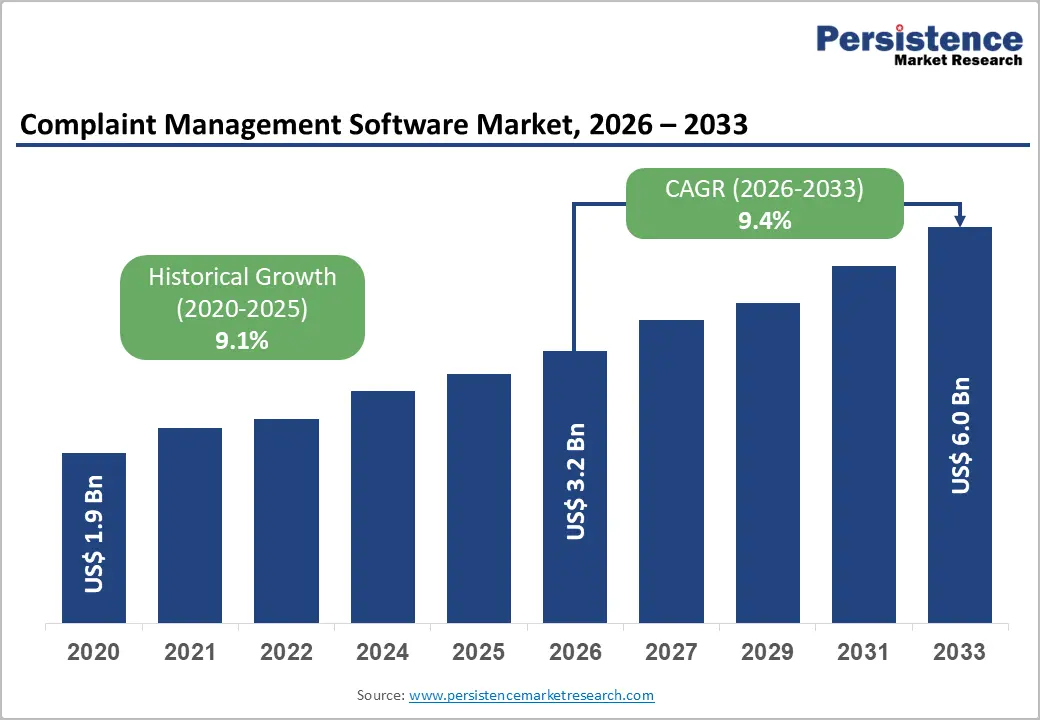
The global complaint management software market size is likely to be valued at US$3.2 billion in 2026 and is expected to reach US$6.0 billion by 2033, growing at a CAGR of 9.4% during the forecast period from 2026 to 2033, driven by organizations’ increasing focus on enhancing customer experience, brand reputation, and service transparency amid rising digital touchpoints and omnichannel customer engagement. Enterprises in BFSI, healthcare, telecom, retail, government, and manufacturing are adopting complaint management platforms to streamline grievance handling, speed up resolution, and ensure regulatory compliance. AI and analytics, such as automated categorization, sentiment analysis, root-cause detection, and predictive insights, are boosting efficiency and informed decision-making.
Key Industry Highlights:
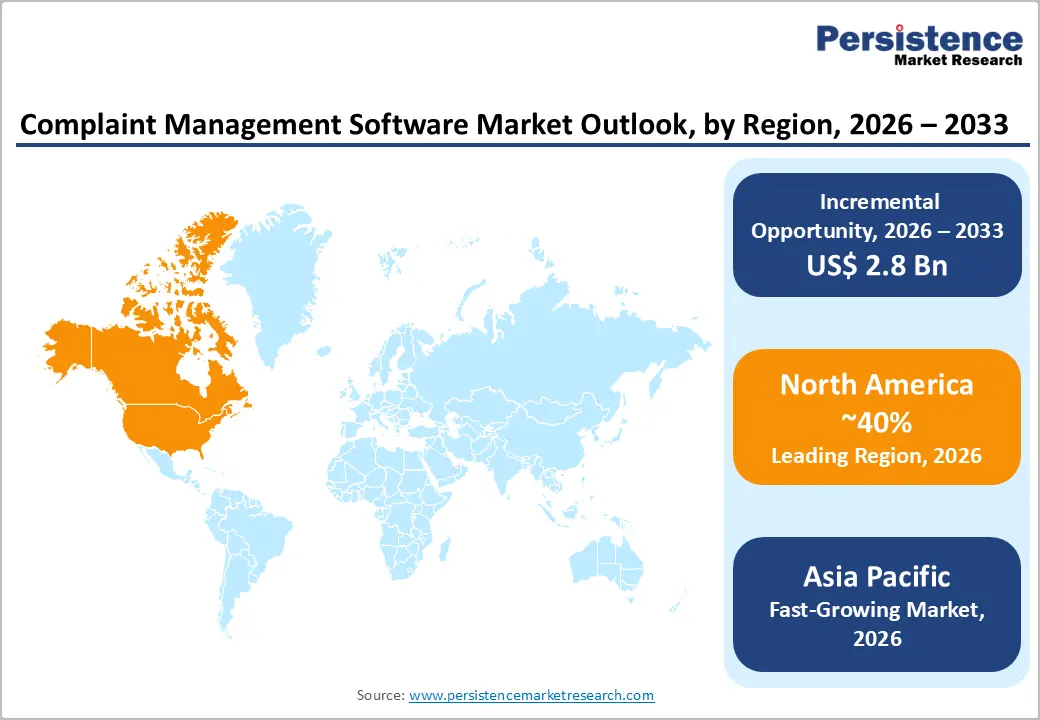
- Leading Region: North America is anticipated to be the leading region, accounting for a market share of 40% in 2026, driven by U.S. leadership in customer experience innovation, strong regulatory frameworks, advanced technology adoption, and the presence of major consolidated vendors.
- Fastest-growing Region: Asia Pacific is likely to be the fastest-growing region in the complaint management software in 2026, driven by rapid digitalization, expanding e-commerce activity, evolving consumer protection regulations, and strong adoption across China, Japan, India, and ASEAN economies.
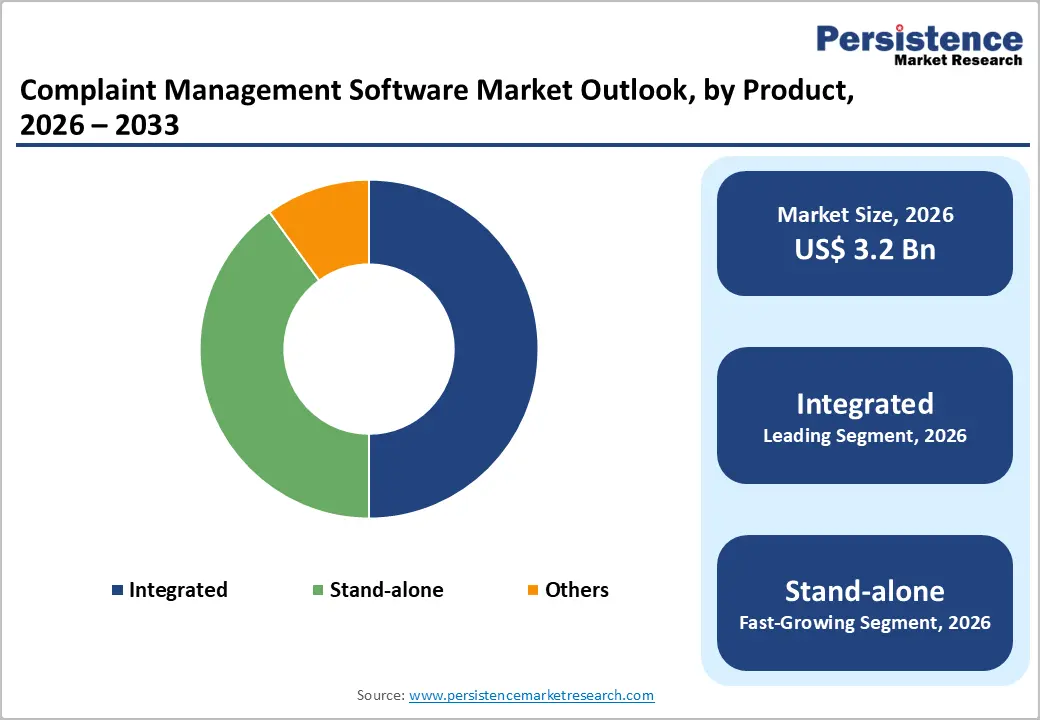
- Leading Product Type: Integrated solutions are projected to represent the leading product type in 2026, accounting for 60% of the revenue share, driven by seamless CRM and ERP integration and strong enterprise adoption.
- Leading Component Type: Software is anticipated to be the leading component type, accounting for over 70% of the revenue share in 2026, supported by higher investments in core complaint management platforms.
- Leading Deployment Mode: Cloud-based is anticipated to be the leading deployment mode, accounting for over 60% of the revenue share in 2026, supported by scalability, flexibility, and lower total cost of ownership
| Key Insights | Details |
|---|---|
| Complaint Management Software Market Size (2026E) | US$3.2 Bn |
| Market Value Forecast (2033F) | US$6.0 Bn |
| Projected Growth (CAGR 2026 to 2033) | 9.4% |
| Historical Market Growth (CAGR 2020 to 2025) | 9.1% |
Market Factors – Growth, Barriers, and Opportunity Analysis
Rising Need to Improve Customer Experience and Protect Brand Image
The complaint management software market is strongly driven by organizations that increasingly recognize customer satisfaction as a critical competitive differentiator. With the expansion of digital channels such as social media, mobile apps, and online platforms, customer complaints are more visible and can rapidly influence public perception. Complaint management software enables organizations to capture, track, and resolve grievances across multiple touchpoints in a structured and timely manner. Features such as automated case routing, real-time dashboards, and analytics help reduce response times and improve service consistency, directly enhancing customer trust and loyalty.
Protecting brand image and reputation has become equally important in an environment where negative customer experiences can quickly escalate and spread online. Complaint management platforms help organizations monitor recurring issues, identify root causes, and implement corrective actions before problems damage brand credibility. Advanced capabilities such as sentiment analysis, AI-driven insights, and compliance reporting allow businesses to proactively manage customer feedback and demonstrate accountability. By ensuring consistent handling of complaints and regulatory adherence, organizations can mitigate reputational risks, strengthen brand equity, and maintain long-term customer relationships.
Data Privacy and Regulatory Compliance Challenges
These platforms handle highly sensitive customer information, including personal, financial, and sometimes healthcare data. Organizations must comply with evolving data protection regulations such as GDPR, CCPA, and sector-specific compliance standards, which increases implementation complexity and operational risk. Ensuring secure data storage, controlled access, encryption, and audit trails requires continuous investment in cybersecurity infrastructure. For cloud-based deployments, concerns around data residency, cross-border data transfer, and third-party access complicate adoption, particularly for enterprises operating across multiple regions with differing regulatory requirements.
Frequent regulatory updates demand constant software upgrades and compliance monitoring, increasing the total cost of ownership for end users. Smaller organizations and SMEs often face challenges due to limited legal, IT, and compliance expertise, delaying adoption or leading to a preference for manual or fragmented systems. Vendors must invest heavily in compliance certifications, data governance frameworks, and risk management capabilities, which can slow innovation cycles. These factors collectively restrain market growth, especially in highly regulated industries where non-compliance risks can result in financial penalties and reputational damage.
Adoption of AI and Automation Technologies
Organizations increasingly look to modernize customer service operations and handle rising complaint volumes efficiently. AI-driven features such as automated complaint categorization, sentiment analysis, and intelligent case routing enable faster identification of high-priority issues and reduce reliance on manual processes. This improves response times, enhances service consistency, and helps organizations meet growing customer expectations for quick and accurate resolutions across multiple digital channels.
Automation also enables organizations to move from reactive to proactive complaint management. Advanced analytics and machine learning models can identify recurring patterns, predict complaint trends, and support root-cause analysis, allowing businesses to address systemic issues before they escalate. AI-powered chatbots and virtual assistants support self-service options, reducing operational costs while maintaining customer engagement. As cloud adoption expands and AI tools become more accessible, both large enterprises and SMEs are increasingly investing in intelligent complaint management platforms.
Category-wise Analysis
Product Type Insights
The integrated segment is expected to lead the complaint management software market, accounting for approximately 60% of total revenue in 2026, driven by strong adoption among large enterprises seeking centralized, end-to-end customer grievance handling. These platforms seamlessly integrate with existing CRM, ERP, and customer support systems, enabling unified workflows, real-time data visibility, and consistent service delivery across channels. For example, Salesforce Complaint Management, which integrates tightly with Salesforce CRM, enables enterprises to manage complaints alongside sales, service, and compliance operations.
The stand-alone segment is likely to represent the fastest-growing segment in 2026, particularly in regions and industries seeking rapid deployment and operational flexibility. These solutions appeal to SMEs, local governments, and mid-sized service providers that require focused complaint-handling capabilities without complex system integration. Their modular architecture allows organizations to implement complaint tracking, reporting, and resolution workflows independently, resulting in faster ROI and lower upfront costs. For example, HappyFox offers a stand-alone, easy-to-deploy complaint and ticketing system tailored for small and mid-sized organizations.
Component Type Insights
Software is projected to lead the market, capturing around 70% of the total revenue share in 2026, driven by the investments in core complaint management platforms. Organizations primarily allocate budgets toward software licenses that enable complaint capture, case tracking, workflow automation, analytics, and compliance reporting. These tools form the backbone of customer grievance operations and are essential for managing high complaint volumes efficiently. Advanced software features such as AI-driven categorization, sentiment analysis, and dashboard reporting further strengthen demand across regulated industries. For example, Zendesk, whose complaint and ticketing software provides scalable, AI-enabled tools used widely across retail, technology, and public sector organizations.
Services are likely to be the fastest-growing component type in 2026, driven by rising demand for implementation, customization, training, and ongoing maintenance. As complaint management platforms become more sophisticated and integrated with enterprise systems, organizations increasingly require professional support to ensure smooth deployment and optimal utilization. Services are critical for tailoring workflows, ensuring regulatory compliance, and aligning software functionality with industry-specific requirements. For example, MasterControl provides extensive implementation and compliance consulting services alongside its complaint management solutions.
Deployment Mode Insights
The cloud-based segment is projected to lead the market, capturing around 60% of the total revenue share in 2026, driven by scalability, cost efficiency, and ease of access. Organizations increasingly prefer cloud deployments due to lower upfront investment, faster implementation, and automatic updates. Cloud platforms enable remote access, real-time collaboration, and seamless integration with email, social media, and mobile channels, making them ideal for managing distributed teams and omnichannel complaints while driving strong adoption of SaaS-based deployments. For example, Zoho Desk, a cloud-based platform widely adopted by SMEs and enterprises for its affordability, scalability, and integrated complaint management capabilities.
The on-premises segment is likely to be the fastest-growing deployment mode in 2026, in specific regulated industries where data security, privacy, and control are critical priorities. Organizations operating in sectors such as banking, healthcare, defense, and government prefer on-premises systems to maintain full ownership of sensitive customer data and comply with strict regulatory frameworks. These deployments offer enhanced control over data residency, internal access policies, and customized security configurations. Growth is particularly evident in regions with stringent compliance mandates or limited cloud adoption. For example, Sparta Systems provides on-premises complaint management solutions tailored for life sciences and highly regulated environments.
Regional Insights
North America Complaint Management Software Market Trends
North America is expected to lead the market, capturing a 40% share by 2026, driven by a strong emphasis on customer experience and digital service excellence. Enterprises in the U.S. and Canada are increasingly implementing advanced platforms to manage rising volumes of customer complaints across email, social media, web portals, and mobile apps. Key sectors, such as BFSI, telecom, retail, and healthcare, are at the forefront due to high customer interaction and reputational sensitivity. For instance, Freshworks’ AI-powered customer service and complaint management solutions are widely adopted in North America to enable omnichannel engagement and enhance service efficiency at scale.
Growing focus on regulatory compliance, data security, and governance is also fueling adoption. Strict consumer protection and data privacy regulations are prompting organizations to implement complaint management systems with robust audit trails, reporting, and role-based access controls. This trend is driving investments in secure cloud and hybrid deployments. The market is experiencing consolidation, with leading vendors expanding portfolios through acquisitions and platform enhancements.
Europe Complaint Management Software Market Trends
Europe is likely to be a significant market for complaint management software in 2026, driven by stringent data protection regulations and rising customer experience expectations. Regulations such as GDPR impose strict requirements on data handling, storage, transparency, and auditability, pushing organizations across banking, insurance, utilities, and public services to adopt compliant and secure complaint management platforms. For example, SAP Customer Experience (CX) is widely used by European financial institutions and public sector organizations to manage customer complaints while meeting GDPR compliance, audit, and reporting requirements.
Europe is adopting cloud-based and hybrid deployment models, driven by the need for scalability, flexibility, and cost optimization. While larger corporations are rapidly moving to SaaS platforms for their agility and remote collaboration benefits, organizations in highly regulated industries sometimes prefer hybrid deployments to balance cloud innovation with strict data residency requirements. There is growing interest in AI-enabled features, such as sentiment analysis and automated routing, which help reduce manual workload and improve complaint resolution times.
Asia Pacific Complaint Management Software Market Trends
The Asia Pacific region is likely to be the fastest-growing region in 2026, driven by increasing digital adoption, rising consumer awareness, and growth in customer-centric industries such as e-commerce, banking, telecom, and transportation across China, India, Japan, and ASEAN countries. Organizations are investing in complaint management platforms to handle high complaint volumes generated through mobile apps, online marketplaces, and social media channels. The demand for omnichannel complaint capture, real-time visibility, and faster resolution is particularly strong among large enterprises and fast-growing digital businesses.
The region is seeing an increasing preference for cloud-based and AI-enabled solutions. Companies are adopting cloud deployments for scalability, lower costs, and faster rollout, while AI technologies are being used to automate complaint categorization, prioritization, and analytics. These capabilities help organizations reduce manual effort and improve service quality. Regional governments’ digital transformation programs and the rise of localized software providers are further strengthening adoption. For example, Tata Consultancy Services (TCS) provides complaint and grievance management solutions to enterprises and public sector organizations across Asia Pacific.
Competitive Landscape
The global complaint management software market exhibits a moderately fragmented structure, driven by the coexistence of large enterprise vendors, specialized software providers, and emerging players, each offering varied capabilities such as AI-enabled automation, omnichannel complaint capture, analytics, and cloud integration. Established CRM and service platform giants have leveraged their broad ecosystems to embed complaint management within wider customer service suites.
With key leaders including Salesforce, Zendesk, Freshworks, Zoho, SAP, Oracle, and ServiceNow, the competition focuses on innovation, scalability, and ease of integration to capture broader enterprise workloads and support digital transformation strategies. These players compete through continuous product enhancements, strategic partnerships, acquisitions, and expanding AI/automation features that improve complaint resolution times and customer insights.
Key Industry Developments:
- In September 2025, the Anti-Red Tape Authority (ARTA), in partnership with the Department of Information and Communications Technology (DICT), launched the Electronic Complaint Management System (eCMS). The digital platform is designed to streamline, standardize, and enhance the handling of public complaints related to inefficiencies or corruption in government service delivery, improving transparency and accountability.
- In March 2025, Zendesk unveiled the Agentic AI-powered Zendesk Resolution Platform at its annual Relate conference, aiming to transform customer experience through faster and more effective issue resolution. The platform integrates Zendesk AI Agents, a comprehensive knowledge graph, automated actions and integrations, governance tools, and analytics, enabling businesses to combine AI efficiency with human expertise for improved service outcomes. Zendesk launched the Employee Service Suite, an intelligent solution designed to optimize internal employee service processes.
Companies Covered in Complaint Management Software Market
- AssurX Inc.
- EtQ LLC
- Freshworks Inc.
- HappyFox Inc.
- Intelex Technologies (Industrial Scientific Corporation)
- MasterControl Inc.
- Quantivate LLC
- Salesforce.com Inc.
- Sparta Systems Inc.
- Zendesk Inc.
- Zoho Corporation Pvt. Ltd.
Frequently Asked Questions
The global complaint management software market is projected to reach US$3.2 billion in 2026.
The rising need to enhance customer experience, ensure faster grievance resolution, and maintain brand reputation across industries.
The complaint management software market is expected to grow at a CAGR of 9.4% from 2026 to 2033.
Adoption of AI and automation technologies, cloud-based deployments, omnichannel complaint handling, and expansion in emerging markets with growing digital and customer service needs.
AssurX Inc., EtQ LLC, Freshworks Inc., HappyFox Inc., and Intelex Technologies are the leading players.


