




- Food Ingredients & Additives
- Banana Blossom Market
Banana Blossom Market Size, Share, Growth, and Regional Forecast, 2026 - 2033
Banana Blossom Market by Product Type (Fresh Banana Blossom, Frozen Banana Blossom, Canned Banana Blossom, Dried Banana Blossom, and Powdered Banana Blossom), by Age Group (Organic and Conventional), Application (Food & Beverage, Nutraceuticals & Dietary Supplements, Animal Feed, and Cosmetics & Personal Care) Distribution Channel (Supermarkets/Hypermarkets, Convenience Stores, Specialty Stores, and Online Retail), and Regional Analysis from 2026 - 2033

Banana Blossom Market Share and Trend Analysis
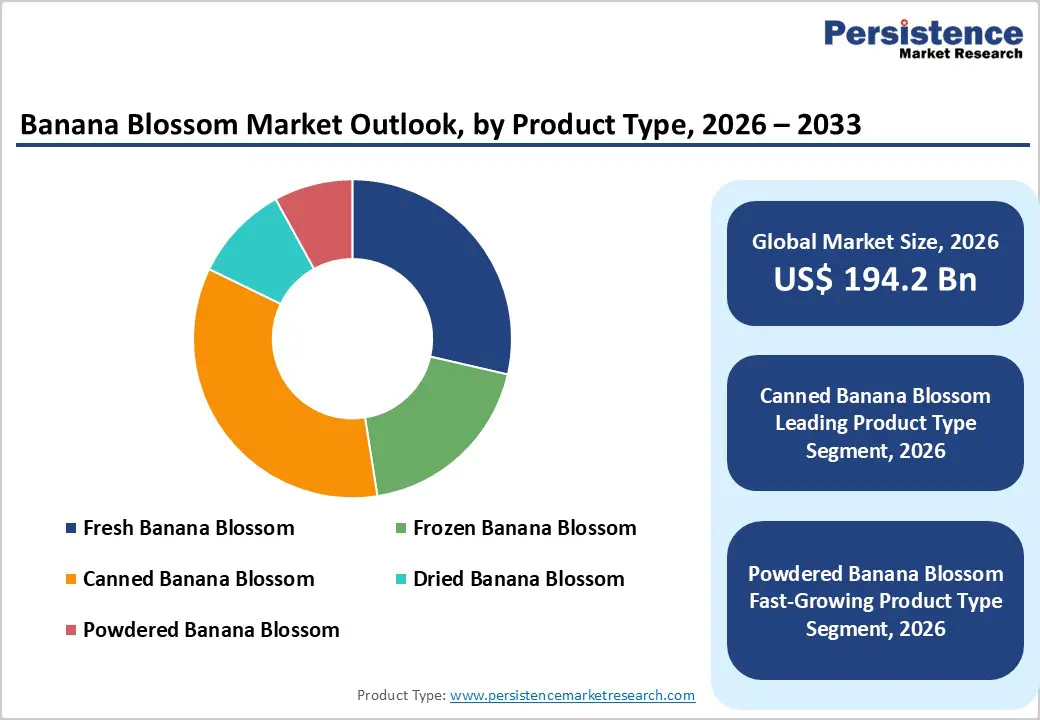
The global banana blossom market size is estimated to grow from US$ 194.2 billion in 2026 to US$ 319.0 billion by 2033, it is projected to record a CAGR of 5.8% during the forecast period from 2026 to 2033. Growing consumer shift toward plant-based diets, along with rising awareness of natural, fiber-rich food ingredients, is playing a critical role in accelerating demand for banana blossom globally. Traditionally used in Asian cuisines, banana blossom is gaining traction as a meat alternative due to its fibrous texture and ability to mimic seafood and poultry in vegan recipes.
Increasing focus on clean-label, minimally processed foods is further supporting its integration into modern diets. Additionally, expanding interest in functional foods with digestive and metabolic health benefits is encouraging wider adoption. The availability of processed formats such as canned and ready-to-cook variants, combined with evolving retail and e-commerce channels, is enhancing accessibility and consumer acceptance across global markets.
Key Industry Highlights:
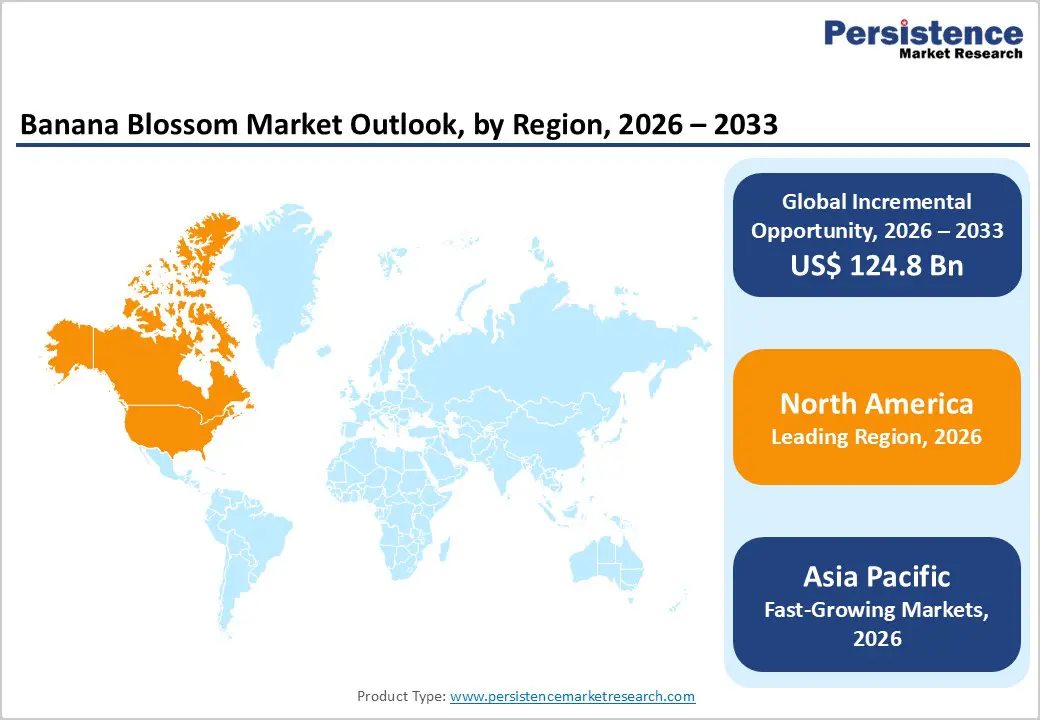
- Leading Region: North America holds 46.7%, supported by strong adoption of plant-based diets, premium product positioning, advanced retail infrastructure, and high consumer awareness of alternative food ingredients.
- Fastest-Growing Region: Asia Pacific is witnessing the highest growth, driven by abundant raw material availability, rising disposable incomes, increasing export demand, and growing awareness of plant-based nutrition.
- Leading Product Type Segment: Fresh banana blossom accounts for 28.6%, attributed to its widespread use in traditional cooking, natural nutritional profile, and preference for unprocessed food ingredients.
- Leading Distribution Channel Segment: Supermarkets / hypermarkets capture 38.4%, benefiting from wide product assortment, strong in-store visibility, and consumer preference for organized retail formats offering convenience and reliability.
Market Dynamics
Drivers - Surging Demand for Plant-Based Foods and Functional Ingredients Fueling Market Expansion
Increasing global inclination toward plant-based diets is a primary force accelerating demand for banana blossom as a versatile meat alternative. Its fibrous texture and neutral flavor profile make it suitable for seafood and meat analog applications, aligning with the rising vegan and flexitarian population. Additionally, growing consumer awareness regarding the health benefits of banana blossom—rich in dietary fiber, antioxidants, and essential micronutrients—is strengthening its adoption in everyday diets. The shift toward clean-label and minimally processed food ingredients is further enhancing its appeal, particularly among health-conscious consumers.
Urbanization and changing dietary habits are also driving demand for convenient, ready-to-cook plant-based products, where banana blossom is increasingly used in packaged and canned formats. Food manufacturers are leveraging its functional properties to develop innovative offerings across ready meals, snacks, and specialty vegan products. Expanding global retail networks and e-commerce platforms have significantly improved product accessibility beyond traditional markets in Asia. Additionally, increasing investments in plant-based food innovation and rising interest from foodservice chains are amplifying product visibility. These combined factors are creating sustained momentum for banana blossom adoption across both developed and emerging economies.
Restraints - Limited Shelf Life and Supply Chain Constraints Hindering Large-Scale Commercialization
One of the key challenges impacting market growth is the perishable nature of fresh banana blossom, which limits its shelf life and complicates storage and transportation. Unlike processed formats, fresh variants require efficient cold-chain infrastructure, which remains underdeveloped in several emerging markets. This increases the risk of spoilage and restricts long-distance trade, thereby affecting overall market scalability. Additionally, processing banana blossom into canned, dried, or powdered forms involves additional costs and technological requirements, which can limit adoption among smaller manufacturers.
Supply chain fragmentation, particularly in major producing regions, also creates inconsistencies in quality and availability. Seasonal production patterns and dependence on agricultural outputs further contribute to price volatility. Moreover, limited consumer awareness in Western markets acts as a barrier, as banana blossom is still perceived as a niche or ethnic ingredient rather than a mainstream food option. The presence of alternative plant-based ingredients such as jackfruit and soy-based proteins intensifies competition. These factors, combined with logistical challenges and relatively higher costs of processed variants, continue to constrain widespread market penetration and consistent revenue growth.
Opportunity - Growing Innovation in Plant-Based Alternatives and Value-Added Formats Unlocking Growth Potential
The growing demand for sustainable and innovative plant-based food solutions presents significant opportunities for banana blossom across global markets. Its unique texture and adaptability position it as a strong candidate for next-generation meat and seafood substitutes, particularly in ready-to-eat and frozen product categories. Manufacturers are increasingly focusing on value-added formats such as marinated, pre-seasoned, and ready-to-cook banana blossom products to enhance convenience and consumer acceptance.
There is also notable potential in expanding its application within nutraceuticals and functional foods, leveraging its high fiber content and bioactive compounds for digestive and metabolic health benefits. The increasing penetration of online retail and direct-to-consumer channels is enabling brands to reach niche consumer segments and educate them about the product’s versatility. Emerging markets offer untapped opportunities due to abundant raw material availability and evolving dietary preferences. Furthermore, advancements in food processing technologies are improving product shelf life and quality, making banana blossom more suitable for global distribution. Strategic collaborations, product diversification, and targeted marketing are expected to drive long-term growth and competitive differentiation.
Category-wise Analysis
By Product Form, Fresh Banana Blossom Dominates Driven by Culinary Authenticity and Direct Consumption Demand
Fresh banana blossom is expected to hold the largest share of 28.6% in 2026, supported by its strong presence in traditional cuisines across Asia Pacific and increasing adoption in plant-based cooking globally. Its natural texture, flavor profile, and minimal processing make it highly preferred among consumers seeking authentic and clean-label food ingredients. Unlike processed variants, fresh forms retain higher nutritional value, including fiber, antioxidants, and essential micronutrients, which enhances their appeal in health-focused diets.
Rising popularity of home cooking, vegan recipes, and functional foods is further strengthening demand. Additionally, widespread availability in banana-producing countries ensures consistent supply at competitive pricing. Foodservice establishments and specialty restaurants are increasingly incorporating fresh banana blossom into menus as a meat substitute, particularly in seafood analog dishes. Despite shorter shelf life, strong local consumption patterns and cultural familiarity continue to sustain its leadership position in the global market.
By Application, Food & Beverage Segment Leads Supported by Expanding Plant-Based Food Adoption
The food & beverage segment is projected to account for 62.5% of total market revenue in 2026, maintaining its dominant position due to the versatile usage of banana blossom across multiple culinary applications. Its fibrous structure closely resembles meat, making it a preferred ingredient in plant-based seafood and meat alternatives. Increasing consumer inclination toward vegan, vegetarian, and flexitarian diets is significantly driving its inclusion in ready-to-cook and ready-to-eat products.
Additionally, banana blossom is widely utilized in traditional dishes, salads, and snacks, particularly in Asian markets, ensuring a stable consumption base. Food manufacturers are leveraging its functional benefits, such as high fiber and low calorie content, to develop innovative products targeting health-conscious consumers. Growing penetration in global retail chains and foodservice outlets is further enhancing visibility. The segment’s adaptability across cuisines and product formats continues to reinforce its leading share in the market.
By Distribution Channel, Supermarkets Maintain Leadership Through Wide Product Availability and Retail Trust
Supermarkets and hypermarkets are anticipated to capture 38.4% of the total market revenue in 2026, positioning them as the leading distribution channel. Their dominance is attributed to extensive shelf space, diverse product offerings, and strong consumer trust associated with organized retail environments. These outlets provide easy access to fresh, canned, and packaged banana blossom products, enabling consumers to compare quality and pricing across brands.
Established procurement systems and efficient supply chains ensure consistent product availability, particularly in urban and semi-urban areas. Promotional campaigns, in-store visibility, and strategic product placement further influence purchase decisions. Additionally, supermarkets act as key entry points for new product launches, especially in premium and plant-based categories. While online channels are expanding at a faster pace, physical retail continues to lead due to immediate product access and reliability. The combination of accessibility, assortment, and purchasing convenience sustains their dominant market position.
Regional Insights
North America Banana Blossom Market Trends
North America is projected to account for 45.4% of the global banana blossom market value in 2026, driven by strong demand for plant-based seafood alternatives and clean-label food products. High consumer awareness, dietary shifts in vegan foods, and adoption of premium products is accelerating growth. The region benefits from an advanced retail infrastructure and widespread availability of canned and ready-to-cook formats. E-commerce expansion and product innovation in meat substitutes continue to strengthen market penetration. The U.S. dominates regional revenue, while Canada is emerging steadily with increasing organic product demand.
U.S. Banana Blossom Market Trends
The U.S. leads the North American market, contributing approximately 78.2% of regional share and expected to grow at a CAGR of 6.8% by 2033. Growing adoption of plant-based diets and increasing demand for vegan seafood substitutes. Strong presence of innovative food brands and expansion across supermarkets and online platforms are supporting market growth.
Canada Banana Blossom Market Insights
Canada accounts for nearly 21.8% of the regional market and is projected to reach a CAGR of 6.0%. Growth is supported by increasing consumer preference for organic and sustainable food products. Rising vegan population, coupled with expanding specialty retail stores and e-commerce platforms, is improving product accessibility and driving steady market expansion.
Europe Banana Blossom Market Trends
Europe represents a mature, sustainability-driven market, accounting for approximately 27.6% of global market share in 2026. Growth is supported by strong demand for plant-based and allergen-free food salternatives. Strict regulatory frameworks and emphasis on traceability are shaping product innovation. Consumers prefer ethically sourced and clean-label products, encouraging companies to invest in sustainable sourcing and packaging. Germany and the UK are key contributors, with increasing penetration of banana blossom in vegan ready meals and foodservice sectors.
Germany Banana Blossom Market Insights
Germany holds around 31.5% regionally and is anticipated a CAGR of 6.2%. The demand for banana blossom is driven by strong consumer preference for organic and sustainable food products. Well-established retail networks and growing vegan population are supporting product adoption, particularly in ready-to-cook and canned formats.
UK Banana Blossom Market Trends
The UK accounts for approximately 24.3% of the regional market reach a CAGR of 6.7%. Rise in demand for plant-based convenience foods and increasing adoption of vegan diets. Expansion of online grocery platforms and innovative product launches are further supporting market penetration.
Asia Pacific Banana Blossom Market Trends
Asia Pacific is the fast-growing market expected to result in a positive growth, accounting for nearly 19.8% of the global market share in 2026. Growth is driven by abundant raw material availability, traditional consumption patterns, and increasing export demand.
Rising urbanization, expanding middle-class population, and growing awareness of plant-based diets are accelerating market growth. India and China are key markets, supported by strong domestic consumption and improving supply chain infrastructure.
China Banana Blossom Market Insights
China holds approximately 36.4% of the regional market and is projected to grow at a CAGR of 8.6% by 2033. Growth is supported by increasing demand for plant-based food products and the expanding food processing industry. Rising focus on health and functional foods is further driving adoption.
India Banana Blossom Market Insights
India accounts for nearly 28.7% of the Asia Pacific market and is expected to grow at a CAGR of 8.5%–9.3%. Growth is driven by the widespread availability of banana crops and traditional consumption of banana blossom in regional cuisines. Increasing awareness of its nutritional benefits and expanding retail distribution channels are further boosting market penetration.
Competitive Landscape
The global banana blossom market is highly competitive, with strong participation from Theppadungporn Coconut Co., Ltd., Thai Agri Foods Public Company Limited, Asco Foods Ltd, Ceres Organics Limited, and Cooks & Co (RH Amar & Co Ltd). These companies leverage integrated supply chains, strong sourcing networks, and product innovation capabilities to enhance quality and consumer appeal. Rising demand for plant-based foods, clean-label ingredients, and meat alternatives is accelerating innovation.
Market players are expanding product portfolios, strengthening global distribution channels, forming strategic partnerships, and increasing investments to develop convenient, ready-to-use, and functional banana blossom products aligned with evolving dietary preferences.
Key Developments:
- In April 2026, Papyrus Australia introduced a technology that transforms banana plantation waste into pulp for producing food containers, trays, and packaging materials. The process utilizes residual biomass such as stalks, leaves, and stems that would otherwise decompose and emit methane. This waste stream is estimated to generate emissions equivalent to around 900,000 tons of carbon dioxide annually, highlighting the environmental impact addressed by the innovation.
- In May 2023, Singapore-based startup Jungle Kitchen entered the vegan food market with a range featuring regional ingredients such as jackfruit, banana blossom, and cobra chili. Its portfolio includes Jungle Jack, a plant-based mince made from vegetables, roots, and herbs, Jungle Fire hot sauce, and Coconut Sambol, a Sri Lankan-style coconut relish, all designed to showcase the diversity of Southeast and South Asian cuisines while catering to rising demand for plant-based foods.
Global Banana Blossom Market Report – Key Insights & Details
| Key Insights | Details |
|---|---|
|
Historical Market Value (2020) |
US$ 146.9 Bn |
|
Current Market Value (2026) |
US$ 194.2 Bn |
|
Projected Market Value (2033) |
US$ 319.0 Bn |
|
CAGR (2026-2033) |
5.8% |
|
Leading Region |
North America, 45.4% share |
|
Dominant Nature |
Conventional, 58.7%share |
|
Top-ranking Product Type |
Fresh Banana Blossom, 28.6% |
|
Incremental Opportunity |
US$ 124.8 Mn |
Companies Covered in Banana Blossom Market
- Theppadungporn Coconut Co., Ltd.
- Thai Agri Foods Public Company Limited
- Asco Foods Ltd
- Ceres Organics Limited
- Cooks & Co (RH Amar & Co Ltd)
- Biona Organic (Venture Foods UK Ltd)
- FreshPoint, Inc.
- EcoTokari (Eco Tokari Private Limited)
- Nature’s Charm (Vegan Food House Co., Ltd.)
- Edward & Sons Trading Co., Inc.
- S.W. Food Co., Ltd.
- Urbani Foods Inc.
- The FoodSource Ltd
- GreenDNA India Private Limited
- Waitrose & Partners (Waitrose Limited)
- Others
Frequently Asked Questions
The global banana blossom market is projected to be valued at US$ 194.2 Bn in 2026.
Rising demand for plant-based, nutrient-rich food alternatives and increasing health awareness are driving banana blossom adoption globally.
The global banana blossom market is poised to witness a CAGR of 5.8% between 2026 and 2033.
Expansion into plant-based products, nutraceuticals, and global retail channels alongside product innovation (ready-to-eat/processed forms) offers key growth opportunities.


