




- Chemicals and Materials
- Airbag Fabrics Market
Airbag Fabrics Market Size, Share, and Growth Forecast, 2026 - 2033
Airbag Fabrics Market by Product Type (Front Airbag, Side Airbag, Knee Airbag, Curtain Airbag), Coating (Neoprene Coated, Silicon Coated, Uncoated), Vehicle (Passenger Cars, Light Commercial Vehicle, Heavy Trucks, Others), and Regional Analysis for 2026 - 2033

Airbag Fabrics Market Size and Trends Analysis
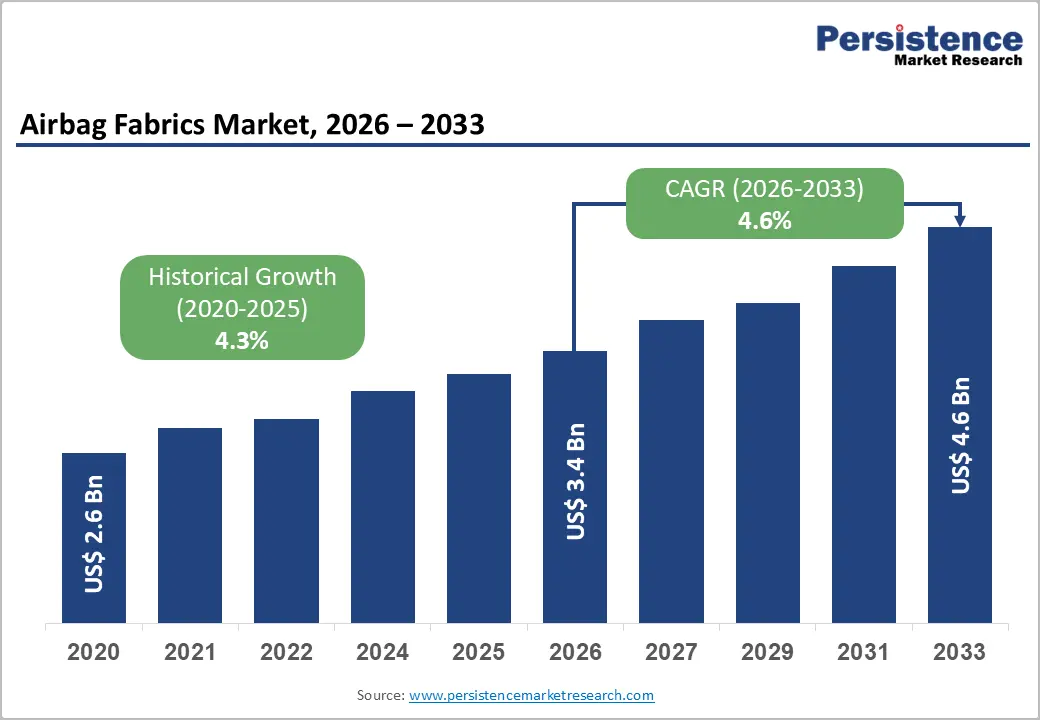
The global airbag fabrics market size is likely to be valued at US$3.4 billion in 2026 and is expected to reach US$4.6 billion by 2033, growing at a CAGR of 4.6% during the forecast period from 2026 to 2033, driven by the increasing integration of advanced occupant safety systems across all vehicle categories, supported by stringent automotive safety regulations that require the installation of multiple airbag systems in both passenger and commercial vehicles.
Growth is reinforced by the continuous expansion of automotive production, particularly in emerging economies, where rising vehicle ownership and safety awareness are accelerating demand for multi-airbag configurations, including front, side, curtain, and knee airbags.
The market is also supported by the shift toward lightweight and high-performance technical textiles, where manufacturers are focusing on high-tenacity fibers and advanced weaving technologies to improve durability, heat resistance, and controlled gas permeability during rapid deployment. The increasing penetration of electric and autonomous vehicles is creating new requirements for enhanced occupant protection systems, strengthening the role of airbag fabrics in next-generation vehicle architectures.
Key Industry Highlights:
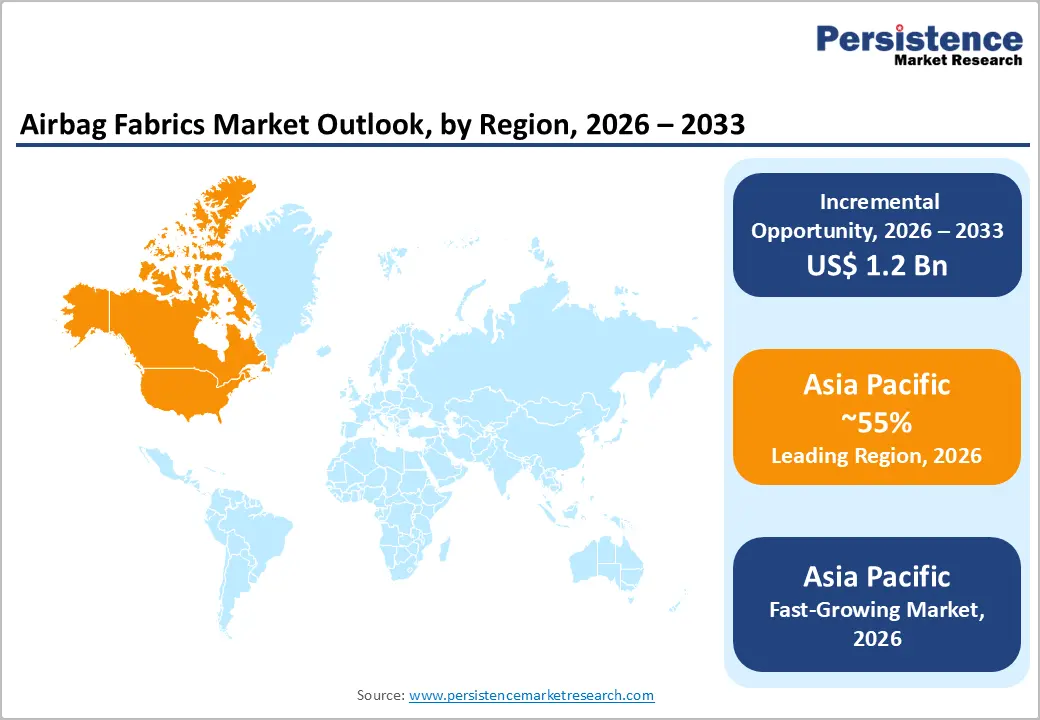
- Leading Region: Asia Pacific is anticipated to be the leading region, accounting for a market share of 55% in 2026, driven by large-scale automotive production and cost-efficient manufacturing ecosystems supporting supply chains.
- Fastest-growing Region: Asia Pacific is likely to be the fastest-growing region, supported by rising vehicle ownership, tightening safety regulations, and increasing adoption of multi-airbag systems across passenger and commercial vehicles.
- Leading Product Type: Front airbag is projected to represent the leading product type in 2026, accounting for 45% of the revenue share, driven by its mandatory installation across most vehicle types, strong safety compliance standards, and long-established adoption in automotive production.
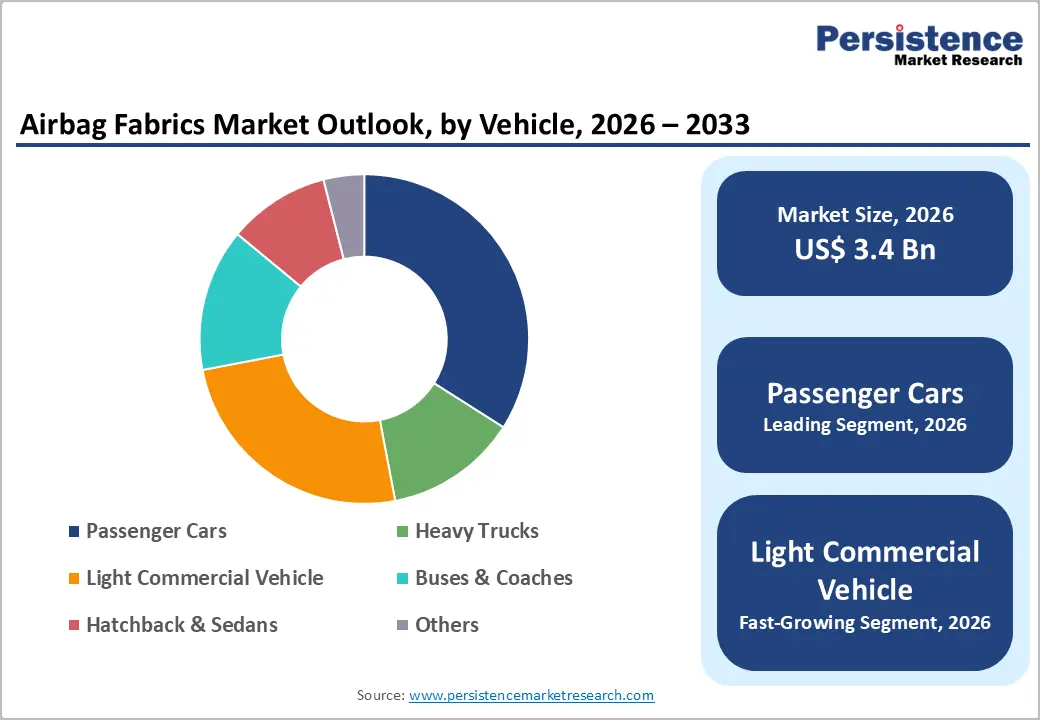
- Leading Vehicle Type: Passenger cars are expected to be the leading vehicle type, accounting for over 60% of revenue in 2026, supported by high production volumes, widespread integration of multiple airbag systems, and strong consumer demand for advanced safety features.
| Key Insights | Details |
|---|---|
|
Airbag Fabrics Market Size (2026E) |
US$3.4 Bn |
|
Market Value Forecast (2033F) |
US$4.6 Bn |
|
Projected Growth (CAGR 2026 to 2033) |
4.6% |
|
Historical Market Growth (CAGR 2020 to 2025) |
4.3% |
DRO Analysis
Driver - Increasing Side and Curtain Airbag Adoption
The growing adoption of side and curtain airbags is significantly strengthening demand for advanced airbag fabrics, as automakers focus on enhancing occupant protection beyond frontal collisions. Safety assessment programs such as Euro NCAP and NHTSA increasingly emphasize side-impact and rollover protection, encouraging OEMs to standardize curtain and thorax airbags across vehicle segments. Rising SUV and crossover sales contribute to this trend, as these vehicles require extended head protection coverage, thereby increasing the use of high-performance woven fabrics.
Increasing consumer awareness regarding vehicle safety and the shift toward multi-airbag systems are encouraging manufacturers to include side and curtain airbags even in mid-range and entry-level vehicles. This trend is accelerating the use of high-strength, lightweight fabrics capable of ensuring fast and reliable deployment. As vehicle safety expectations continue to evolve, the demand for advanced fabric materials supporting these airbag systems is expected to grow steadily across markets.
Advancements in Material Technology and Vehicle Lightweighting
Continuous advancements in high-tenacity fibers, such as nylon and polyester, are significantly enhancing the performance characteristics of airbag fabrics, enabling greater tensile strength, tear resistance, and thermal stability.
These innovations are critical for ensuring precise deployment during high-speed collisions while maintaining structural integrity. The automotive industry’s focus on lightweighting to improve fuel efficiency and electric vehicle range is driving the development of thinner, stronger, and more efficient fabric constructions without compromising safety performance.
Technological progress in weaving techniques, including one-piece woven (OPW) designs, is reducing production complexity while improving deployment efficiency and packaging flexibility. Coating technologies are also evolving to optimize gas retention and folding behavior, ensuring faster and more reliable inflation. These material innovations improve safety performance while also supporting the industry’s focus on sustainability and efficiency.
Restraint - Technological and Integration Challenges in Evolving Vehicle Architectures
Modern vehicle architectures, particularly in electric and autonomous vehicles, are introducing new complexities in integrating airbag systems effectively. Changing cabin layouts, alternative seating configurations, and the absence of traditional structural components in some EV platforms create challenges for airbag placement and deployment timing. These factors require highly specialized fabric designs capable of adapting to non-conventional geometries while maintaining safety performance under diverse crash scenarios.
The integration of advanced sensing systems and multi-stage deployment mechanisms increases the technical requirements for airbag fabrics. Ensuring compatibility between electronic control units, sensors, and fabric performance adds layers of complexity to system design and validation.
Manufacturers must invest heavily in R&D and testing to meet these evolving requirements, which can increase costs and extend development timelines. These technological challenges may slow adoption in certain vehicle segments, particularly where cost sensitivity remains high.
Limited Aftermarket Penetration and Standardization Issues
The airbag fabrics market is predominantly OEM-driven, with limited aftermarket presence due to strict safety regulations and certification requirements. Airbag systems are highly specialized components that must meet rigorous testing standards, making replacement and retrofitting complex and tightly controlled. This limits opportunities for aftermarket growth, as most airbag fabric demand is tied directly to new-vehicle production rather than replacement cycles.
Variations in safety standards across regions create challenges in standardizing airbag fabric specifications. Differences in regulatory frameworks, testing protocols, and performance benchmarks require manufacturers to customize products for specific markets, increasing operational complexity. This lack of uniformity can hinder economies of scale and slow down the adoption of standardized solutions. Market expansion is somewhat constrained by regulatory fragmentation and limited aftermarket dynamics.
Opportunity - Technological Convergence with Sustainable and Smart Fabrics
The growing emphasis on sustainability in the automotive industry is creating opportunities to develop eco-friendly airbag fabrics, including recycled fibers and low-impact coating technologies. Manufacturers are increasingly exploring biodegradable and recyclable materials to reduce environmental impact while maintaining high safety standards. This shift aligns with sustainability goals and regulatory pressures to lower carbon footprints across automotive supply chains.
The integration of smart textiles and sensor-enabled fabrics is opening new avenues for innovation. Advanced materials capable of monitoring deployment conditions or interacting with vehicle safety systems can enhance performance and reliability. These developments are particularly relevant in next-generation vehicles, where intelligent safety systems are becoming more prevalent. The combination of sustainability and smart features is driving advancements in airbag fabric technology.
Growth in Multi-Airbag Systems for Premium and Autonomous Vehicles
The increasing adoption of multi-airbag systems in premium vehicles is significantly expanding the demand for airbag fabrics. Modern vehicles are incorporating a wide range of airbags, including side, curtain, knee, and even center airbags, to enhance occupant protection. This trend is driven by both regulatory requirements and consumer expectations for higher safety standards, particularly in luxury and high-end vehicle segments.
Autonomous and semi-autonomous vehicles are amplifying this opportunity by introducing new safety challenges related to flexible seating arrangements and diverse occupant positions. These evolving configurations require innovative airbag designs and specialized fabrics capable of protecting in unconventional scenarios. As the automotive industry moves toward higher levels of automation, the demand for advanced and adaptable airbag fabric solutions is increasing, supporting continued market growth.
Category-wise Analysis
Product Type Insights
Front airbags are expected to lead the airbag fabrics market, accounting for approximately 45% of revenue in 2026, driven by their mandatory presence across most vehicle categories and consistent integration in automotive production. These airbags form the foundation of occupant protection systems, ensuring safety in frontal collisions, which remain the most common crash type. For example, compact passenger cars across developing markets are consistently equipped with dual front airbags as a baseline safety feature, ensuring continuous and stable demand for airbag fabrics in this segment.
Curtain airbags are likely to represent the fastest-growing segment, supported by increasing focus on side-impact and rollover protection, along with rising consumer demand for enhanced occupant safety. These airbags require greater surface area coverage, extending along the side windows to protect passengers across multiple seating rows, significantly increasing fabric consumption per vehicle. For example, modern SUVs commonly feature full-length curtain airbags that cover both front and rear passengers, demonstrating the shift toward comprehensive safety systems.
Application Insights
Passenger cars are projected to lead the market, capturing around 60% of revenue in 2026, supported by high production volumes and the widespread adoption of advanced safety systems in personal mobility. This segment benefits from strong consumer demand for safer vehicles, increasing urbanization, and the growth of the middle class in emerging markets.
Automakers are equipping passenger cars with multiple airbags, including front, side, and curtain variants, to enhance safety and meet consumer expectations. For example, popular mid-size sedans are now equipped with multiple airbags as standard, demonstrating the increasing penetration of advanced safety systems in this segment and reinforcing their leadership position in the market.
Light commercial vehicles are likely to be the fastest-growing application, driven by the rapid expansion of e-commerce, logistics, and last-mile delivery services. The increasing demand for efficient urban transportation and fleet operations is driving manufacturers to enhance safety features in these vehicles, including the integration of multiple airbag systems.
Fleet operators are prioritizing driver safety and vehicle reliability, leading to greater adoption of advanced safety technologies previously limited to passenger cars. For example, delivery vans used in urban logistics are increasingly being equipped with driver and passenger airbags, highlighting the transition toward safer commercial fleets.
Regional Insights
North America Airbag Fabrics Market Trends
North America is likely to be a significant market for airbag fabrics, driven by strong adoption of advanced safety technologies and high penetration of multi-airbag systems across passenger vehicles and light trucks. Automakers in the region are integrating front, side, curtain, and knee airbags as standard features, driven by consumer preference for safer vehicles and heightened awareness of occupant protection. The market benefits from technological advancements in high-strength fabrics that ensure reliable deployment and durability under extreme conditions.
The region also shows steady innovation in airbag module design and fabric engineering, supported by strong collaboration between automotive manufacturers and safety system suppliers. Companies such as Autoliv, Inc. are actively advancing airbag technologies and expanding production capabilities to meet rising demand for high-performance safety systems. The increased focus on vehicle safety ratings and the ongoing improvement in crash protection standards are encouraging automakers to adopt more sophisticated airbag systems.
Europe Airbag Fabrics Market Trends
Europe is likely to be a significant market for airbag fabrics, driven by stringent safety standards and a strong emphasis on vehicle crash performance, which is leading to widespread adoption of advanced airbag systems. Automakers across the region are prioritizing the integration of multiple airbags to enhance occupant protection, particularly in premium and mid-range vehicles.
The demand for high-quality, durable fabric materials is supported by the need for reliable deployment in diverse crash scenarios, including frontal, side-impact, and rollover conditions. The growing popularity of electric vehicles is influencing the development of lightweight and efficient airbag fabric solutions, aligning with sustainability goals and emission reduction targets.
The region is also witnessing increased innovation in fabric coating technologies and weaving techniques to improve performance and reduce overall system weight. For example, Toray Industries, Inc. plays a key role in supplying high-performance fibers and textiles for airbag applications, supporting the region’s focus on advanced materials solutions. Rising consumer demand for enhanced safety features and premium vehicle offerings is encouraging automakers to expand multi-airbag configurations.
Asia Pacific Airbag Fabrics Market Trends
The Asia Pacific region is anticipated to be the leading region, accounting for 55% market share in 2026, driven by high automotive production volumes and the rapid expansion of safety feature adoption across emerging economies. Countries such as China, India, and ASEAN nations are witnessing increasing integration of multiple airbags in both passenger and commercial vehicles.
The region benefits from cost-efficient manufacturing, strong supply chain networks, and growing investments in automotive safety technologies. Rising middle-class income levels and greater awareness of vehicle safety are encouraging automakers to incorporate advanced airbag systems, thereby increasing demand for airbag fabrics.
The market is also experiencing rapid growth due to expanding production capacities and the localization of high-performance fabric manufacturing. For example, Hyosung Advanced Materials is strengthening its presence by investing in advanced airbag fabric production to cater to rising regional demand. Increasing production of compact cars and SUVs is driving higher adoption of curtain and side airbags, leading to greater fabric consumption per vehicle. Continuous improvements in material technology and manufacturing efficiency are supporting the strong growth of the airbag fabrics market across Asia Pacific.
Competitive Landscape
The global airbag fabrics market is moderately fragmented, driven by the presence of both large multinational material manufacturers and specialized textile suppliers operating across regional automotive hubs. While a few dominant players control a significant share of the market, competition remains intense due to ongoing technological advancements, stringent safety requirements, and strong demand from automotive OEMs. High entry barriers, such as capital-intensive manufacturing, stringent certification standards, and long qualification cycles with automakers, limit new entrants, reinforcing the position of established companies.
With key leaders including Autoliv, Inc., Toray Industries, Inc., Hyosung Advanced Materials, Toyoda Gosei Co., Ltd., and Kolon Industries, Inc., the competitive landscape is shaped by strong R&D capabilities and long-term partnerships with automotive OEMs and airbag module suppliers. These players compete through innovation in high-tenacity yarns, advanced weaving and coating technologies, cost optimization, and sustainability initiatives such as recycled materials and energy-efficient production processes.
Key Industry Developments:
- In January 2026, Toyoda Gosei Co., Ltd. announced that its curtain airbag system was adopted for the first time by a Chinese automaker, IM Motors, for its LS9 electric vehicle. The newly developed airbag is more compact while maintaining high protection performance, highlighting advancements in airbag fabric design, light weighting, and deployment efficiency to meet evolving EV safety requirements.
- In December 2025, Toyoda Gosei Co., Ltd. developed a new self-supporting front center airbag, designed to adapt to next-generation vehicle interiors without requiring traditional structural support. This innovation reflects increasing demand for flexible airbag fabric structures that can support evolving automotive architectures, especially in autonomous and electric vehicles.
Companies Covered in Airbag Fabrics Market
- Global Safety Textiles (Hyosung Advanced Materials)
- Autoliv, Inc.
- Joyson Safety Systems
- Toyoda Gosei Co., Ltd.
- Toray Industries, Inc.
- Kolon Industries, Inc.
- Teijin Limited
- Asahi Kasei Corporation
- Milliken & Company
- HMT (Xiamen) New Material Technology Co., Ltd.
Frequently Asked Questions
The global airbag fabrics market is projected to reach US$3.4 billion in 2026.
The airbag fabrics market is driven by increasing vehicle safety regulations, rising automotive production, and growing adoption of multi-airbag systems across vehicle segments.
The airbag fabrics market is expected to grow at a CAGR of 4.6% from 2026 to 2033.
Key market opportunities lie in the rising adoption of multi-airbag systems, growing demand for lightweight and sustainable fabrics, and increasing integration in electric and autonomous vehicles.
Global Safety Textiles (Hyosung Advanced Materials), Autoliv, Inc., Joyson Safety Systems, and Toyoda Gosei Co., Ltd. are the leading players.


