




- Chemicals and Materials
- Molecular Sieve Desiccant Market
Molecular Sieve Desiccant Market Size, Share, Trends, Growth, Regional Forecasts, 2026 to 2033
Molecular Sieve Desiccant Market by Product Type (3A, 4A, 5A, 13X, Others), Form (Granular, Powder, Pelletized, Beaded, Sheet), End-User (Pharmaceutical, Electronics, Oil & Gas, Food & Beverage, Petrochemical, Automotive, Others), and Regional Analysis for 2026 - 2033

Molecular Sieve Desiccant Market Share and Trends Analysis
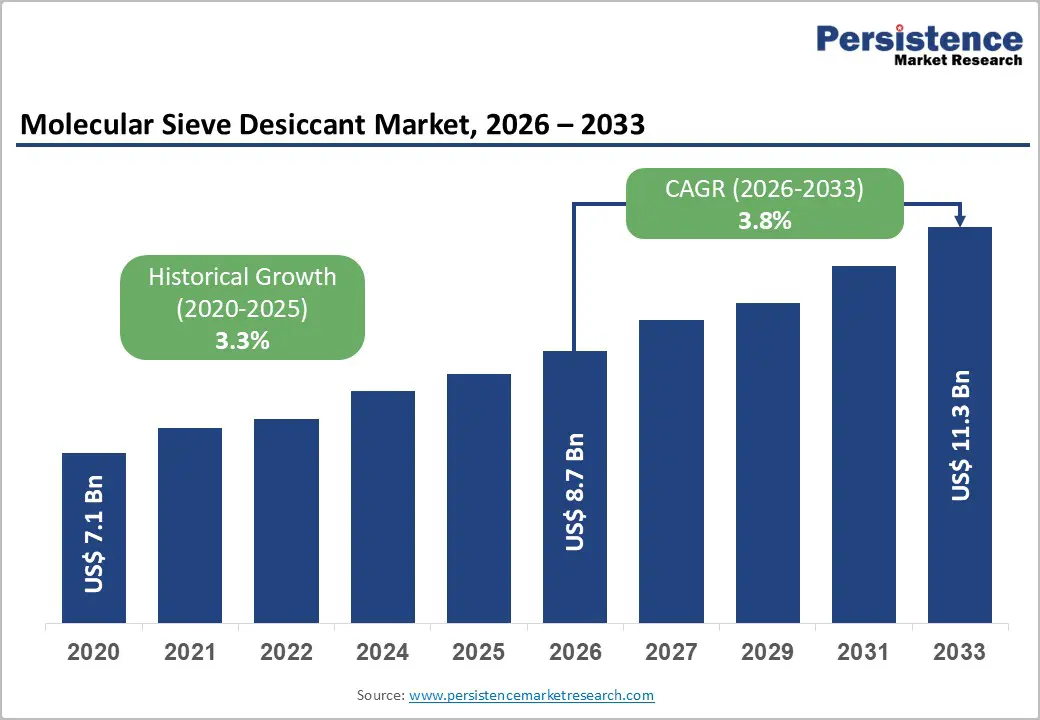
The global molecular sieve desiccant market size is likely to be valued at US$ 8.7 billion in 2026, and is projected to reach US$ 11.3 billion by 2033, growing at a CAGR of 3.8% during the forecast period 2026 - 2033.
Sustained growth in the molecular sieve desiccant market is driven by expanding industrial applications requiring precise humidity control, notably in pharmaceuticals, electronics, oil and gas, and food processing. Adoption of moisture control technologies in manufacturing and laboratory settings ensures consistent product quality and operational efficiency.
Advances in adsorption and regeneration systems improve desiccant performance, reduce costs, and enable large-scale industrial deployment. Growth in emerging economies and urbanization boosts demand for high-performance desiccants. Compliance with stringent quality and regulatory standards in pharmaceuticals and electronics, combined with innovations in desiccant formats and regeneration methods, expands scalable applications across continuous and batch processes.
Key Industry Highlights
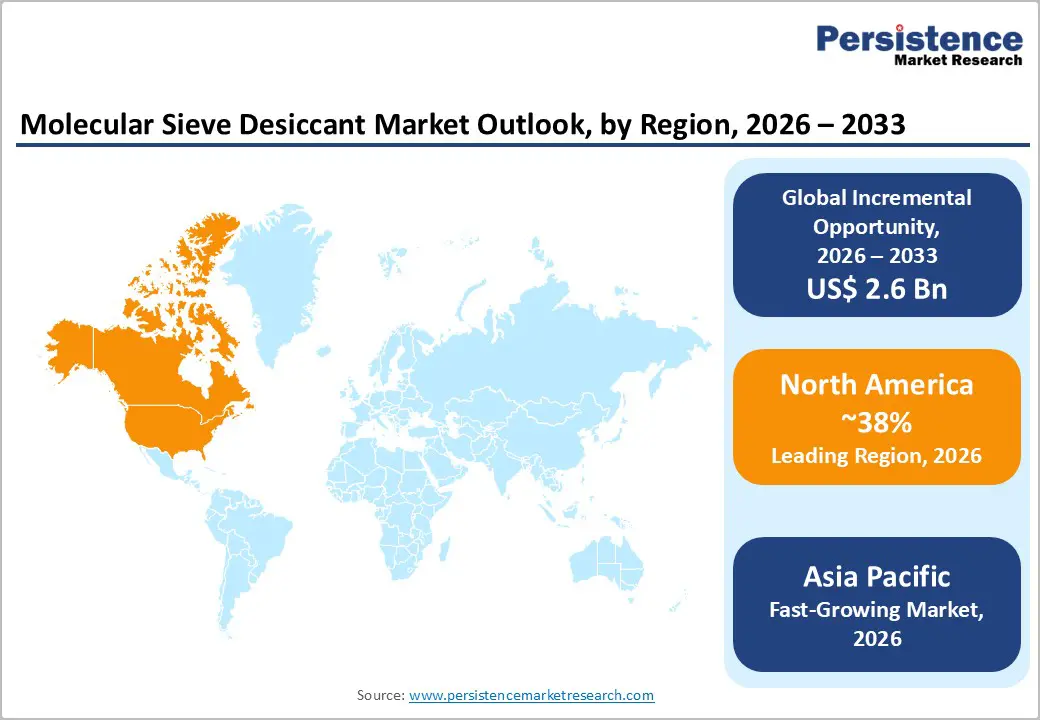
- Dominant Region: North America is projected to hold nearly 38% of the market share in 2026, supported by advanced industrial infrastructure.
- Fastest-growing Regional Market: The Asia Pacific market is expected to grow the fastest between 2026 and 2033, driven by expanding manufacturing clusters.
- Leading Form: Granular molecular sieves are set to hold about 45% revenue share in 2026 due to their operational reliability and regulatory compliance.
- Fastest-Growing Form: Beaded forms are forecasted to record the fastest growth between 2026 and 2033, owing to their superior flow characteristics and automation integration.
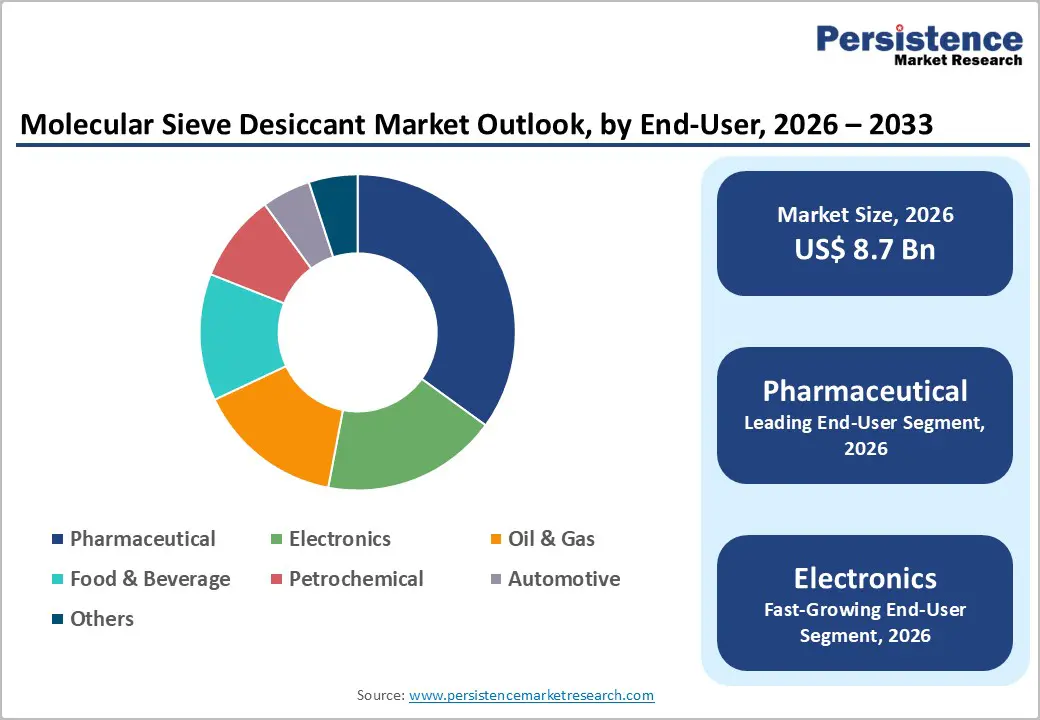
- Leading End-User: The pharmaceutical segment is poised to capture around 35% revenue share in 2026, reflecting critical moisture control requirements and regulatory alignment.
- Fastest-Growing End-User: Electronics segment is slated to be the fastest-growing through 2033 due to increasing production of semiconductors, batteries, and moisture-sensitive components.
| Key Insights | Details |
|---|---|
| Molecular Sieve Desiccant Market Size (2026E) | US$ 8.7 Bn |
| Market Value Forecast (2033F) | US$ 11.3 Bn |
| Projected Growth (CAGR 2026 to 2033) | 3.8% |
| Historical Market Growth (CAGR 2020 to 2025) | 3.3% |
DRO Analysis
Rising Use of Moisture Control in Manufacturing and Labs
Manufacturing and laboratory processes often require stable atmospheric conditions to maintain product integrity and ensure accurate results. Precise control of moisture levels prevents defects such as corrosion, microbial contamination, product clumping, and static discharge that can disrupt production yields and quality standards. For example, laboratories in the United States must maintain specific temperature and humidity limits such as a typical relative humidity range of 35 %-50 % for proper instrument performance and test validity according to U.S. Food and Drug Administration (FDA) facility guidelines. Consistent moisture control also supports compliance with regulatory environmental standards set by agencies that mandate environmental monitoring and risk mitigation in sensitive processes.
In industrial settings, improper humidity can accelerate corrosion, reduce equipment lifespan, and compromise stored materials. Maintaining target humidity levels improves operational efficiency and reduces rework and waste due to moisture-related failures. Stable humidity supports energy-efficient production environments and helps meet internal quality assurance metrics. Precise moisture control is essential for sterile environments in pharmaceutical production, cleanrooms in electronics manufacturing, and laboratory testing chambers where even minor variations can skew data, trigger non-conformance issues, and increase operational risk.
Improved Adsorption and Regeneration Technologies
Precise adsorption and efficient regeneration improve moisture removal and reuse cycles in drying systems. High internal surface area and uniform pore structures allow rapid water capture and release, ensuring low humidity levels essential for sensitive industrial processes. Enhanced material stability extends service life and cuts replacement frequency, lowering overall operational costs. Better regeneration reduces energy use per cycle and supports consistent performance in high-demand environments such as cleanrooms and production lines. Improved throughput and repeatability support uptime targets and predictable maintenance scheduling for manufacturing and laboratory facilities.
Government emphasis on advanced materials underscores technical progress in adsorption science. The U.S. National Science Foundation (NSF) supports fundamental materials research that expands capabilities of engineered adsorbents used in moisture control and separation applications, reflecting investment in advanced material discovery and application development in 2025. This focus enables development of more efficient adsorbent structures that sustain performance with lower cost and energy input. Enhanced regeneration methods maintain structural integrity and enable tighter humidity control, increasing uptake of advanced moisture-management solutions in regulated and production-intensive sectors.
Competition from Silica Gel and Activated Alumina
Silica gel and activated alumina offer lower-cost alternatives to molecular sieve desiccants. These materials are widely available and can be easily sourced, making them attractive for companies with tight operational budgets. Silica gel provides effective moisture adsorption in moderate humidity conditions. Activated alumina performs well in various industrial drying applications. Their established supply chains reduce procurement complexity and inventory costs. Manufacturers often select these desiccants for standard drying processes where extreme precision is not required. Price sensitivity in end-use industries increases adoption of these alternatives. This limits the market share expansion of molecular sieves in cost-driven segments.
Molecular sieves require higher initial investment and specialized regeneration equipment. Silica gel and activated alumina demand simpler handling and energy requirements. Their performance is sufficient for many conventional applications, reducing urgency for molecular sieve adoption. Industries with low to medium moisture sensitivity can achieve operational efficiency using these alternatives. Market players often weigh cost versus performance when selecting desiccants. High availability of substitutes encourages switching among end users. This competitive landscape restrains pricing power and slows penetration of molecular sieve desiccants across price-sensitive markets. Manufacturers must differentiate through efficiency or specialized applications to compete.
Contamination or Mishandling Causing Efficiency Losses
Contamination and mishandling reduce the adsorption capacity of molecular sieve desiccants. Exposure to moisture before installation saturates active sites, limiting water absorption during operations. Dust, oils, and chemical residues can block pores, decrease efficiency and cause uneven drying in industrial processes. Improper storage or transport in humid or dirty environments accelerates degradation and reduces lifespan. Operators may fail to follow handling protocols, leading to physical damage such as cracking or crushing of desiccant beads. Saturated or damaged desiccants require frequent replacement, increasing operational costs and downtime for production facilities.
Incorrect regeneration processes impair performance. Overheating or insufficient drying during regeneration alters pore structure, lowering adsorption efficiency. Cross-contamination from other chemicals during repeated use changes molecular selectivity, impacting sensitive applications in pharmaceuticals and electronics. Industrial equipment exposure to debris or particulate matter accelerates fouling, limiting airflow and reducing desiccant effectiveness. Improper handling during installation or maintenance further exposes desiccants to environmental hazards. These factors raise operational complexity and maintenance requirements for industrial users relying on precise humidity control.
Growth in Biopharmaceuticals and Advanced Electronics
The biopharmaceutical sector demands strict control of moisture during drug manufacturing, packaging, and storage to protect sensitive active ingredients. Many biologics and complex therapies degrade rapidly when exposed to excess humidity, risking product quality, potency, and compliance with quality guidelines. Government data shows that as of 2025, over 53% of brand drug products distributed in the U.S. are manufactured outside domestic facilities, highlighting rising global production and regulatory attention on quality control in diverse climates. Integrated moisture control solutions play a vital role in meeting this demand, supporting stable drug formulation and longer shelf life.
The advanced electronics industry relies on tightly controlled environmental conditions throughout semiconductor fabrication and component assembly to reduce defects and maintain performance. Semiconductor chips and precision electronic components are highly sensitive to moisture, which can trigger corrosion and electrical failures during production or in end-use devices. A strong manufacturing outlook for semiconductors in 2025 is underscored by government-linked projections showing that chipmaking capacity and investment initiatives continue to expand under policies aimed at domestic resilience and technological leadership. This creates demand for robust moisture control in fabs, cleanrooms, and packaging environments where ultra-dry conditions are essential.
Demand in Food and Beverage Processing
Moisture influences food safety, quality, and regulatory compliance in processing environments. Uncontrolled humidity creates conditions that support microbial growth, spoilage, and texture degradation, making precise humidity control essential to maintain safe water activity levels and prevent biological hazards. The U.S. FDA guidance on Hazard Analysis Critical Control Point (HACCP) principles lists humidity and moisture level as critical parameters that must be controlled within defined limits during processing to prevent unsafe conditions in food products. It notes that critical limits for controlling biological hazards can include moisture and water activity thresholds that are scientifically established to ensure food safety and reduce risks of contamination during processing.
Moisture also impacts product consistency and shelf life under manufacturing conditions. High relative humidity in processing or storage can lead to condensation on surfaces, affecting packaging integrity and increasing contamination risk during handling or bottling operations, as noted in industry humidity control discussions. Controlling environmental moisture stabilizes drying processes, minimizes mold growth, and supports uniform production standards. Maintaining optimal humidity ensures that raw materials and finished goods meet quality expectations and comply with safety requirements throughout the production line.
Category-wise Analysis
Form Insights
Granular extracts are poised to dominate with a forecasted market share of over 45% in 2026, powered by widespread industrial and laboratory adoption across pharmaceuticals, electronics, and oil and gas sectors. They provide consistent flow, high adsorption efficiency, and easy integration into batch and continuous processes. Physical stability allows repeated regeneration without performance loss, reducing operational costs. In pharmaceuticals, granular forms maintain controlled humidity aligned with U.S. FDA and European Medicines Agency (EMA) standards. Electronics manufacturers rely on them to prevent moisture defects. Compatibility with automated systems, predictable pressure drop, and scalable deployment enhance adoption. Strong distribution and technical support reinforce reliability.
Beaded molecular sieve is estimated to be the fastest-growing segment from 2026 to 2033, fueled by increasing demand for precise humidity control in high-value applications such as pharmaceuticals, electronics, and advanced petrochemical processes. Beads offer improved flowability, uniform adsorption, and lower pressure drop. Spherical shape enhances regeneration efficiency and reduces attrition, supporting energy savings. Digital monitoring and automated handling enable predictive maintenance. Emerging markets benefit from easy integration into modern infrastructure. Regulatory focus on quality and moisture control drives adoption. Innovations in bead size and thermal stability expand applications, boosting market penetration and strategic growth potential.
End-User Insights
Pharmaceutical is likely to be the leading segment with a projected 35% of the molecular sieve desiccant market revenue share in 2026, due to its critical role in maintaining controlled humidity during synthesis, storage, and packaging of moisture-sensitive compounds. Molecular sieves stabilize active pharmaceutical ingredients, preventing degradation and contamination. Compliance with FDA and EMA standards drives demand. Integration with automated storage, cleanrooms, and predictive monitoring improves efficiency. Granular, beaded, and sheet forms offer flexibility across production formats. Provider referrals and industrial adoption reinforce usage. Benefits include extended shelf life, reduced waste, and regulatory compliance.
Electronics is anticipated to be the fastest-growing segment from 2026 to 2033, fueled by increasing demand for moisture-sensitive components, including semiconductors, batteries, and display technologies. Molecular sieves protect devices from corrosion, oxidation, and performance loss. Integration into automated manufacturing and humidity-controlled storage ensures consistent output and fewer defects. Rising digital electronics and energy storage adoption in emerging markets expands demand. Beaded and granular desiccants optimized for precision air and gas drying support high-throughput facilities. Regulatory standards on component quality and environmental protection drive adoption. IoT-enabled monitoring and predictive systems improve operational efficiency, positioning the segment for rapid growth.
Regional Insights
North America Molecular Sieve Desiccant Market Trends and Insights
North America is expected to lead with an estimated 38% of the molecular sieve desiccant market share in 2026, supported by extensive adoption in pharmaceuticals, electronics, and petrochemical sectors. Industrial and laboratory facilities prioritize precise humidity control to ensure product stability and operational efficiency. Advanced manufacturing infrastructure allows integration of granular, beaded, and sheet molecular sieves into automated systems. Regulatory standards from agencies such as the U.S. FDA reinforce demand for reliable desiccant solutions. Established technical support and distribution networks enable rapid deployment across production and storage environments. Investment in energy-efficient regeneration and predictive monitoring systems further strengthens operational performance.
Strong presence of leading industrial players drives technology adoption and market penetration. Large-scale pharmaceutical and electronics manufacturing operations require consistent moisture control, supporting repeat orders and long-term partnerships. Industrial clusters in chemical processing, oil and gas, and high-value manufacturing sectors create concentrated demand for molecular sieves. Expertise in automated storage and cleanroom management ensures compliance and reduces risk of product loss. Expansion of research and development facilities encourages innovation in desiccant forms and regeneration techniques. Operational reliability, technical support, and access to advanced infrastructure underpin market dominance and sustained growth.
Europe Molecular Sieve Desiccant Market Trends and Insights
Europe demonstrates strong adoption of molecular sieve desiccants, driven by advanced manufacturing in pharmaceuticals, chemicals, and electronics. Industrial facilities require precise humidity control to maintain product stability and meet European Medicines Agency standards. Automation infrastructure enables integration of granular, beaded, and sheet desiccants into continuous and batch processes. Chemical and petrochemical clusters demand reliable moisture management to reduce operational losses. Energy-efficient regeneration technologies support cost optimization. Technical support and distribution networks facilitate rapid deployment across laboratories and production plants. High-value component manufacturing sustains steady demand.
High research and development activity drives innovation in adsorption efficiency, thermal stability, and desiccant lifecycle performance. Automated storage and cleanroom systems improve operational reliability and reduce product degradation. Industrial players use predictive monitoring to optimize regeneration and energy consumption. Specialty pharmaceutical and advanced electronics production contribute to concentrated desiccant demand. Supplier-manufacturer partnerships streamline procurement and installation for scalability. Environmental standards and sustainability initiatives encourage high-performance desiccant adoption, while industrial infrastructure supports broader penetration and alignment with evolving process needs.
Asia Pacific Molecular Sieve Desiccant Market Trends and Insights
Asia Pacific is forecasted to be the fastest-growing market for molecular sieve desiccants between 2026 and 2033, stimulated by rapid industrial expansion and increasing pharmaceutical and electronics manufacturing activities. China is investing in modern chemical and petrochemical facilities with advanced humidity control systems. India is expanding pharmaceutical production and laboratory infrastructure to meet rising domestic and export demand. Japan emphasizes precision manufacturing for semiconductors and energy storage devices, driving adoption of high-performance desiccants. South Korea focuses on advanced electronics and battery production, integrating molecular sieves into automated lines. Emerging Southeast Asian economies increase industrial output and require scalable moisture control solutions for consistent product quality.
Growing regulatory focus on environmental protection and product quality supports desiccant adoption in industrial processes. Expansion of research and development facilities encourages innovation in granular, beaded, and sheet molecular sieve formats. Automated storage, cleanroom, and predictive monitoring systems improve operational efficiency and reduce product loss. Industrial clusters in chemical, electronics, and pharmaceutical sectors create concentrated demand for reliable desiccants. Investment in energy-efficient regeneration and high-capacity desiccant systems supports large-scale deployment. Technical support networks and supplier partnerships further enable accessibility and consistent supply, reinforcing growth across production and laboratory environments.
Competitive Landscape
The global molecular sieve desiccant market exhibits a moderately consolidated structure, with a few global companies holding significant influence while regional suppliers serve localized demand. Key players including Honeywell International, BASF, W.R. Grace, Arkema Group, and Zeochem dominate production and distribution. They leverage strong technical expertise, established supply chains, and regulatory compliance capabilities. Competitive advantage depends on product innovation, adsorption efficiency, and regeneration technology. Smaller regional manufacturers compete on price, customization, and local support.
Market differentiation focuses on specialized molecular sieve grades, advanced form factors, and integration with automated or digital monitoring systems. Market entry requires technical proficiency, investment in production infrastructure, and adherence to environmental and safety standards. Regional players capture niche segments while global companies drive innovation and scalability. The overall structure balances innovation-led leadership with localized adoption, supporting strategic investment, operational efficiency, and sustained long-term growth.
Key Industry Developments
- In March 2026, Xi’an Lvneng Purification Technology Co. launched a next-generation 3A molecular sieve desiccant delivering 15% higher dehydration efficiency and about 20% lower regeneration energy, enhancing moisture removal performance and cutting operational energy use in industrial drying applications.
- In July 2025, WiseSorbent showcased advanced moisture-control solutions at ADLM 2025, including high-performance and polymer-based desiccants designed for diagnostic and pharmaceutical packaging. These innovations emphasize precise humidity control, extended shelf life, and integration with automated packaging systems.
Companies Covered in Molecular Sieve Desiccant Market
- Honeywell International Inc.
- BASF SE
- W.R. Grace & Co.
- Arkema Group
- Zeochem AG
- Tosoh Corporation
- Axens S.A.
- KNT Group
- Caledon Laboratories Limited
- Sorbead India
- JIUZHOU Chemicals
- Merck KGaA
- Shanghai Hengye Chemical Industry Co., Ltd.
- Zhejiang Fulong New Materials Co., Ltd.
- Van Air Inc.
Frequently Asked Questions
The global molecular sieve desiccant market is projected to reach US$ 8.7 billion in 2026.
Expansion of industrial applications requiring precise humidity control across pharmaceuticals, electronics, petrochemicals, and food processing is driving the market.
The market is poised to witness a CAGR of 3.8% from 2026 to 2033.
Development of innovative desiccant formats, smart monitoring systems, and expansion in emerging industrial and pharmaceutical sectors presents key market opportunities.
Some of the key market players include Honeywell International, BASF SE, W.R. Grace & Co., Arkema Group, and Zeochem AG.


