Cinnamon Market Size, Share, and Growth Forecast 2026 - 2033

Cinnamon Market by Product Type (Ceylon, Saigon, Cassia, Korintje), Source (Organic, Conventional), Form (Whole, Ground, Oil, Liquid Extract), End-use, Sales Channel, and Regional Analysis, 2026 - 2033

ID: PMRREP20272
Calendar

March 2026

220 Pages

Author : Amol Patil

Cinnamon Market Size and Trend Analysis

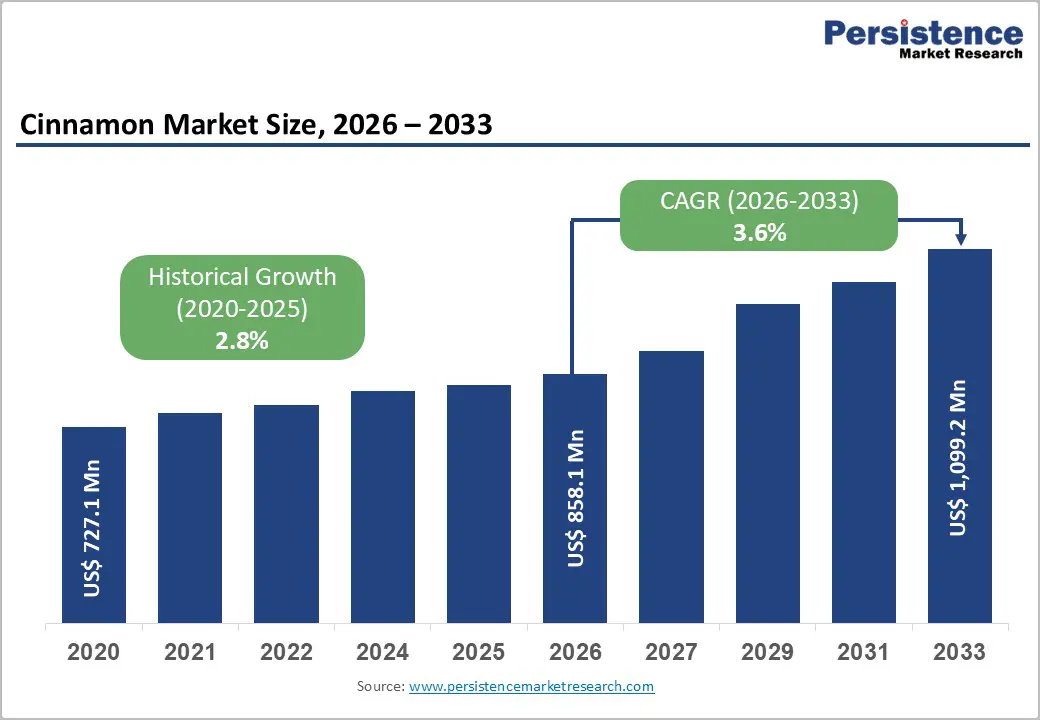
The global cinnamon market size is expected to be valued at US$ 858.1 million in 2026 and projected to reach US$ 1,099.2 million by 2033, growing at a CAGR of 3.6% between 2026 and 2033

The market is experiencing steady growth driven by its widespread use across the food, beverage, pharmaceutical, and personal care industries. Derived from the inner bark of trees belonging to the Cinnamomum genus, cinnamon is valued for its distinct flavor, aroma, and health benefits. Increasing consumer preference for natural ingredients and functional foods has boosted their demand globally. It is extensively used in bakery products, confectionery, beverages, and traditional medicines due to its antioxidant and anti-inflammatory properties. Additionally, rising awareness of clean-label products and herbal remedies is further supporting market expansion. Growing exports from key producing countries such as Sri Lanka, Indonesia, and Vietnam continue to strengthen the global supply chain.

Key Industry Highlights:

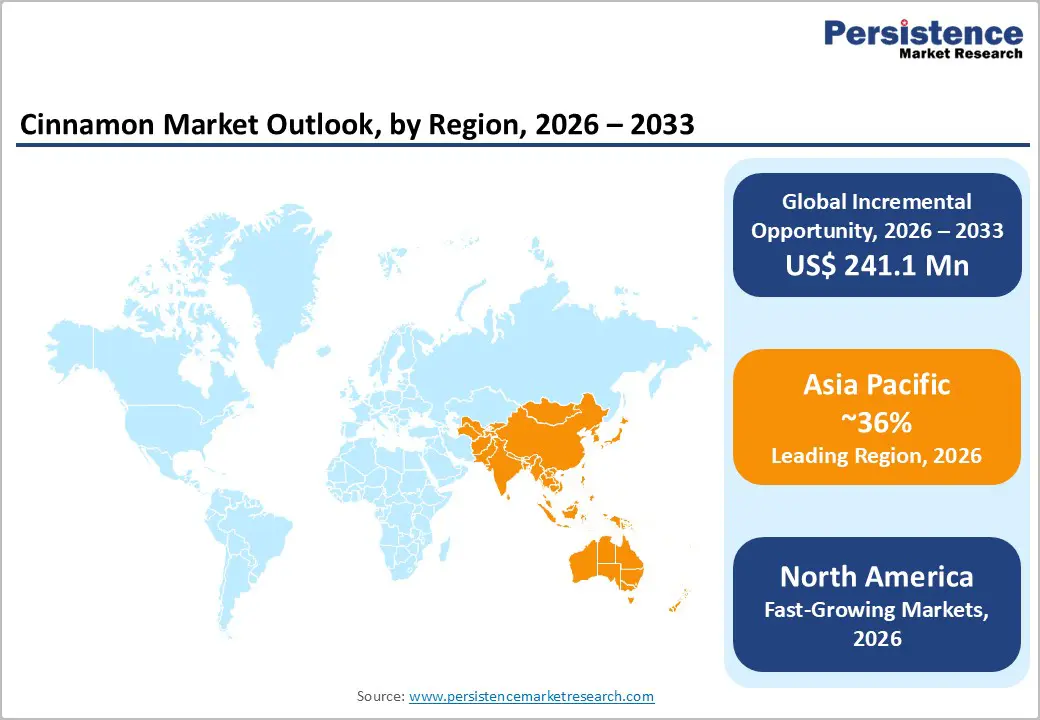
  • Asia Pacific leads global cinnamon consumption with 36% share in 2025, powered by massive regional production from Indonesia, Sri Lanka, and Vietnam that supplies both domestic processing and exports.
  • North America posts fastest regional growth through 2032, driven by functional food innovation, ethnic cuisine adoption, and premium Ceylon demand in supplements and clean-beauty products.
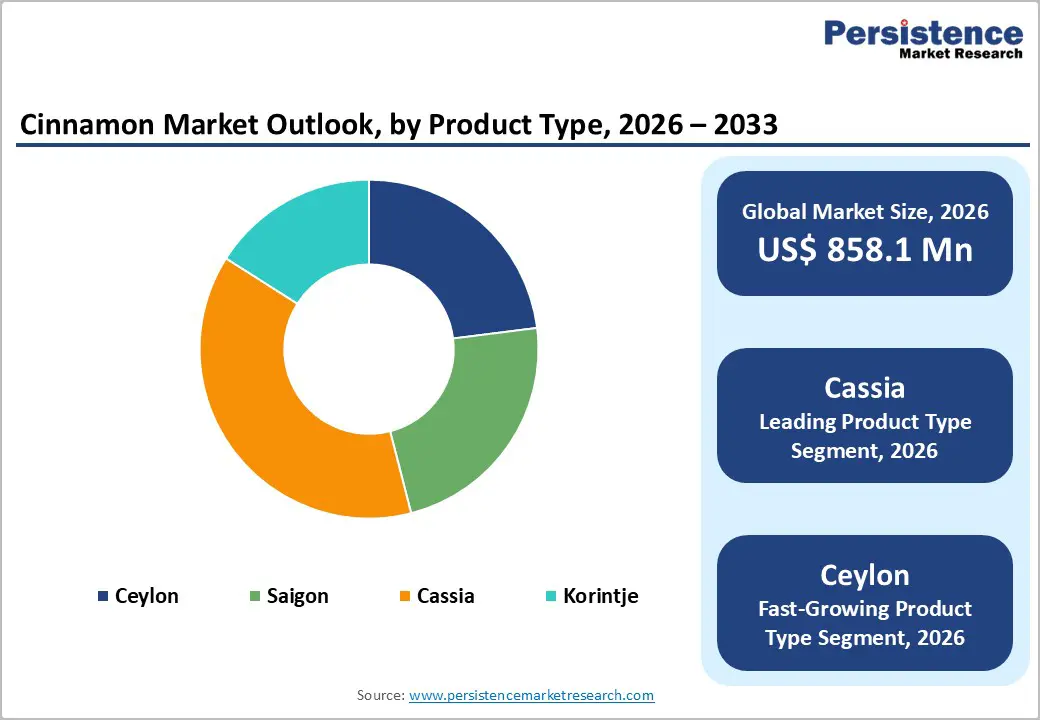
  • Cassia cinnamon dominates product types at 38% share in 2025, favored for bold flavor, affordability, and scalability in mass-market bakery and snack applications.
  • Organic cinnamon grows fastest across sources, capturing health-conscious consumers through premium pricing and clean-label positioning in retail and industrial channels.
  • A key opportunity exists in pharmaceutical and cosmetic applications, where cinnamon bioactives enable natural antimicrobial claims amid regulatory momentum favoring spice-derived actives.
Key Insights Details

Cinnamon Market Size (2026E)

US$ 858.1 million

Market Value Forecast (2033F)

US$ 1,099.2 million

Projected Growth CAGR (2026–2033)

3.6%

Historical Market Growth (2020–2025)

2.8%

cinnamon-market-size-2026-2033

DRO Analysis

Drivers - Rising Demand for Natural Flavorings in Processed Foods

The primary growth driver for the cinnamon market remains the expanding use of natural flavorings in processed foods and beverages, where cinnamon provides warm, versatile notes essential for bakery goods, snacks, cereals, and ready meals. The Food and Agriculture Organization (FAO) reports steady growth in global spice consumption, tied to urbanization and the proliferation of packaged foods, particularly in emerging markets where Western-style baking and flavored beverages are gaining popularity. Cinnamon's stability in thermal processing and ability to mask off-notes in reduced-sugar formulations make it indispensable for manufacturers pursuing clean-label claims, directly boosting procurement volumes across industrial and artisanal segments alike.

Health and Wellness Positioning in Functional Products

A second key driver is cinnamon's established role in health and wellness products, supported by extensive research on its antioxidant, anti-inflammatory, and blood-sugar-regulating properties. The World Health Organization (WHO) highlights the global rise in diabetes prevalence, affecting over 422 million adults, which has led to heightened interest in functional spices and herbal remedies. Cinnamon extracts and powders feature prominently in supplements, teas, and fortified foods targeting metabolic health, while pharmaceutical applications leverage its cinnamaldehyde content for antimicrobial effects. This dual utility in mainstream food and premium nutraceuticals creates compounding demand, particularly as consumers integrate functional ingredients into daily diets amid rising chronic disease burdens.

Restraints - Lengthy Maturation Period

One major challenge in the cinnamon market is the long maturation period of Cinnamomum verum (Ceylon cinnamon), which takes two to three years to become harvest-ready. This delay between investment and return is financially cumbersome for small-scale farmers with limited access to credit. For these instances, farmers must cover costs such as land upkeep, labor, irrigation, and pest control without earning revenue. The long gestation time also reduces flexibility, making it difficult to adapt to rapid market changes. Additionally, poor environmental conditions such as inadequate rainfall, extreme temperatures, or poor soil can hinder growth or reduce yields, resulting in wasted time and resources. These challenges collectively limit scalability and discourage new entrants into the cinnamon cultivation sector.

Opportunities - Demand for Cinnamon-Based Oral Care Products

Cinnamon-based oral care products present a compelling opportunity in the rapidly growing natural health and wellness market. Cinnamon, especially Ceylon cinnamon, has antibacterial, antifungal, and anti-inflammatory properties, making it a powerful natural ingredient for oral hygiene. Incorporating cinnamon into products such as toothpaste, mouthwash, or breath fresheners offers consumers a plant-based alternative to chemical-laden options. It helps reduce oral bacteria, combat bad breath, and help prevent gum disease and tooth decay, all while offering a naturally pleasant and spicy flavor profile. The demand for clean-label personal care products is soaring as health-conscious consumers increasingly avoid synthetic additives such as fluoride, sulfates, and artificial sweeteners.

Expansion into Pharmaceuticals and Cosmetics Applications

Cinnamon's bioactive compounds unlock substantial opportunities in pharmaceuticals and cosmetics, where demand for natural antimicrobials and actives accelerates. Clinical studies document cinnamon's efficacy against oral pathogens and skin irritants, supporting its integration into toothpaste, mouthwash, and anti-acne formulations. The Cosmetics Ingredient Review affirms safety for topical use, while essential oil exports from Sri Lanka and Madagascar already serve global fragrance houses. As clean beauty trends converge with microbiome research, cinnamon oils and extracts can penetrate high-margin segments, bolstered by regulatory momentum around natural preservatives that favor spice-derived solutions over synthetics.

Category-wise Analysis

Product Type Insights

Cassia dominates the Product Type category with approximately 38% global market share in 2025, driven by its bold flavor profile, affordability, and widespread cultivation in Indonesia, China, and Vietnam. Production data indicate that cassia volumes exceed 500,000 metric tons annually, dwarfing Ceylon output and enabling economies of scale for industrial food applications such as bakery mixes, beverages, and spice blends. Its higher oil content delivers an intense aroma at lower inclusion rates, suiting cost-sensitive mass-market products while maintaining superior shelf stability compared to milder varieties.

Form Insights

The whole cinnamon segment leads the form category due to its versatility, longer shelf life, and high demand across culinary, retail, and industrial applications. Whole cinnamon, typically sold as sticks or quills, is preferred in traditional cooking, especially in the Asia Pacific, the Middle East, and parts of Europe, where it is used to slowly infuse flavor into curries, stews, beverages, and desserts. This form maintains its essential oils and aromatic intensity longer than ground cinnamon, making it ideal for premium culinary uses and export markets that prioritize freshness and authenticity.

End-use Analysis

The food & beverage industry dominates the cinnamon market as the leading application segment, driven by the spice’s deep-rooted presence in global cuisine and its expanding role in health-conscious food trends. Cinnamon's warm, aromatic profile makes it a versatile ingredient across sweet and savory dishes, from baked goods and cereals to curries and beverages. Its widespread culinary acceptance, paired with its natural preservative and antioxidant properties, has made it a preferred choice for both traditional recipes and modern food innovations. Consumers are increasingly seeking clean-label, plant-based, and functional food ingredients, and cinnamon aligns perfectly with the need for natural flavoring and health enhancement.

Sales Channel Analysis

Supermarkets/Hypermarkets lead Sales Channel distribution with approximately 45% share in 2025, aggregating bulk and branded cinnamon for mass-market consumers through dedicated spice aisles and baking sections. Organized retail's scale enables promotional stacking with seasonal baking campaigns and multi-packs, driving impulse and pantry-stocking purchases. Private-label growth within hypermarkets further cements dominance, offering competitive pricing on ground and whole formats that capture value-conscious shoppers seeking everyday flavor staples.
cinnamon-market-outlook-by-product-type-2026-2033

Regional Insights

North America Cinnamon Market Trends and Insights

North America is emerging as the fastest-growing region in the cinnamon market, driven by strong demand from the food, beverage, and nutraceutical sectors. The United States leads regional growth, supported by a well-established processed food industry and increasing consumption of functional ingredients. Cinnamon is widely used in bakery products, beverages, dietary supplements, and flavored snacks. Regulatory support, including GRAS status, enables its extensive application across food and pharmaceutical formulations. Additionally, the growing popularity of global cuisines such as Mexican and Indian has expanded cinnamon's use in everyday cooking and in specialty beverages such as chai lattes.

Another key trend is the rising demand for premium and organic cinnamon varieties, particularly Ceylon cinnamon, due to its perceived health benefits and superior quality. Consumers are increasingly prioritizing clean-label and non-GMO products, prompting manufacturers to invest in certified sourcing and transparent supply chains. Innovation in functional foods, including blood sugar management products, is further driving demand. Moreover, the expansion of e-commerce and specialty retail channels is enhancing product accessibility, supporting continued growth across the region.

Europe Cinnamon Market Trends and Insights

The European cinnamon market is shaped by strong cultural traditions and evolving consumer preferences for quality and safety. Cinnamon has long been an essential ingredient in regional cuisines, particularly in baked goods and seasonal products, across countries such as Germany, Sweden, and the Netherlands. This established demand base ensures steady consumption across the region. At the same time, the food industry continues to innovate by incorporating cinnamon into a wider range of products, including beverages, confectionery, and health-focused formulations.

A significant trend in Europe is the growing emphasis on clean-label, traceable, and sustainably sourced ingredients. Consumers are highly conscious of product origin, safety, and regulatory compliance, leading them to prefer Ceylon cinnamon for its lower coumarin content. Stringent European Union food safety regulations further reinforce demand for high-quality, certified products. In addition, increasing awareness of natural health ingredients is encouraging the use of cinnamon in functional foods and wellness products, supporting gradual market expansion. 

Asia Pacific Cinnamon Market Trends and Insights

Asia Pacific is a key region in the global cinnamon market, driven by both strong production capabilities and rising domestic demand. Countries such as Sri Lanka, Indonesia, and Vietnam dominate global supply, with Sri Lanka’s Ceylon cinnamon recognized as a premium variety. The region benefits from favorable climatic conditions and established agricultural practices, enabling large-scale cultivation and export. This strong supply base positions the Asia Pacific as a critical hub in the global cinnamon value chain.

On the demand side, increasing health awareness and changing dietary patterns are fueling the use of cinnamon in food, beverages, and personal care products. Traditional medicinal systems such as Ayurveda and Traditional Chinese Medicine continue to promote cinnamon for its therapeutic properties, further supporting consumption. Rapid urbanization, rising disposable incomes, and growing demand for natural and functional ingredients are also contributing to market growth. Additionally, expanding food processing industries and export opportunities are strengthening the region’s overall market outlook.
cinnamon-market-outlook-by-region-2026-2033

Competitive Landscape

The global cinnamon market features a moderately fragmented competitive landscape, with key players focusing on quality differentiation, sustainable sourcing, and product innovation. The competition is shaped by rising demand for organic and low-coumarin cinnamon, prompting companies to invest in certifications, traceability, and value-added products such as oils and extracts. Companies compete on quality, origin certification, pricing, and sustainable sourcing. Packaging innovations such as resealable pouches, eco-friendly containers, and bulk export formats are becoming vital for market differentiation.

Key Developments:

  • In July 2024, The Sri Lankan government has set up a Department for Cinnamon Development to promote the cultivation, production, and export of cinnamon. This new department is designed to support cinnamon producers, suppliers, and exporters, while also improving the quality and diversity of cinnamon products through value-added initiatives.
  • In March 2023, McCormick & Company, Inc. redesigned its core red cap-branded products and introduced a new look for its core line of herbs and spices, including Cinnamon, Garlic Powder, Paprika, Parsley, and Crushed Red Pepper.

Companies Covered in Cinnamon Market

  • McCormick & Company
  • Cinnatopia
  • G.P. de Silva & Sons International (Pvt) Ltd.
  • Ceylon Spice Company
  • Elite Spice
  • FutureCeuticals
  • Kahawatte Plantations PLC
  • High Plains Spice Company
  • Natural Spices of Grenada
  • Lemur International, Inc
  • New Lanka Cinnamon Pvt. Ltd
  • Great American Spice Co
  • Risun Bio-Tech Inc.
  • Monterey Bay Spice Company
  • Others
Frequently Asked Questions

The global cinnamon market will reach US$ 858.1 million in 2026.

Cinnamon is being used more frequently in natural cosmetics, oral care, and traditional medicine products, driven by its antimicrobial and antioxidant properties.

Asia Pacific leads with 36% share in 2025, anchored by dominant production from Indonesia, Sri Lanka, China, and Vietnam supplying both regional consumption and world exports.

Creative uses of cinnamon in plant-based drinks, protein bars, gourmet sauces, and ethnic fusion foods offer product innovation potential.

Key players include McCormick & Company, Cinnatopia, Ceylon Spice Company, and Elite Spice.

Global Cinnamon Market Report Scope
Report Attribute Details

Historical Data/Actuals

2020 - 2025

Forecast Period

2026 - 2033

Market Analysis Units

Value: US$ Mn/Bn, Volume: As Applicable

Geographical Coverage

  • North America
  • Europe
  • East Asia
  • South Asia & Oceania
  • Latin America
  • Middle East & Africa

Segmental Coverage

  • Product Type
  • Source
  • Form
  • End-use
  • Sales Channel

Competitive Analysis

  • McCormick & Company
  • Cinnatopia
  • G.P. de Silva & Sons International (Pvt) Ltd.
  • Ceylon Spice Company
  • Elite Spice
  • FutureCeuticals
  • Kahawatte Plantations PLC
  • High Plains Spice Company
  • Natural Spices of Grenada
  • Lemur International, Inc
  • New Lanka Cinnamon Pvt. Ltd
  • Great American Spice Co
  • Risun Bio-Tech Inc.
  • Monterey Bay Spice Company
  • Others

Report Highlights

  • Market Forecast and Trends
  • Competitive Intelligence and Share Analysis
  • Growth Factors and Challenges
  • Strategic Growth Initiatives
  • Pricing Analysis
  • Future Opportunities and Revenue Pockets
  • Market Analysis Tools
Market Segmentation

By Product Type

  • Ceylon
  • Saigon
  • Cassia
  • Korintje

By Source

  • Organic
  • Conventional

By Form

  • Whole
  • Ground
  • Oil
  • Liquid Extract

By End-user

  • Food & Beverage Industry
  • Pharmaceuticals
  • Cosmetics & Personal Care
  • Household Products

By Sales Channel

  • Supermarkets/Hypermarkets
  • Specialty Stores
  • Convenience Stores
  • Online Retail

By Region

  • North America
  • Europe
  • East Asia
  • South Asia & Oceania
  • Latin America
  • Middle East & Africa

Related Reports

  1. Executive Summary
    1. Global Cinnamon Market Snapshot, 2026 and 2033
    2. Market Opportunity Assessment, 2026 - 2033, US$ Mn
    3. Key Market Trends
    4. Future Market Projections
    5. Premium Market Insights
    6. Industry Developments and Key Market Events
    7. PMR Analysis and Recommendations
  2. Market Overview
    1. Market Scope and Definition
    2. Market Dynamics
      1. Drivers
      2. Restraints
      3. Opportunity
      4. Challenges
      5. Key Trends
    3. COVID-19 Impact Analysis
    4. Forecast Factors - Relevance and Impact
  3. Value Added Insights
    1. Value Chain Analysis
    2. Trade Statistics (HS code: 090620)
    3. Key Market Players
    4. Regulatory Landscape
    5. PESTLE Analysis
    6. Porter’s Five Force Analysis
    7. Consumer Behavior Analysis
  4. Price Trend Analysis, 2020 - 2033
    1. Key Factors Impacting Product Prices
    2. Pricing Analysis, By Product Type
    3. Regional Prices and Product Preferences
  5. Global Cinnamon Market Outlook
    1. Key Highlights
      1. Market Volume (Tons) Projections
      2. Market Size (US$ Mn) and Y-o-Y Growth
      3. Absolute $ Opportunity
    2. Market Size (US$ Mn) Analysis and Forecast
      1. Historical Market Size (US$ Mn) Analysis, 2020-2025
      2. Market Size (US$ Mn) Analysis and Forecast, 2026-2033
    3. Global Cinnamon Market Outlook: Type
      1. Historical Market Size (US$ Mn) and Volume (Tons) Analysis, By Product Type, 2020-2025
      2. Market Size (US$ Mn) and Volume (Tons) Analysis and Forecast, By Product Type, 2026-2033
        1. Ceylon
        2. Saigon
        3. Cassia
        4. Korintje
      3. Market Attractiveness Analysis: Type
    4. Global Cinnamon Market Outlook: Source
      1. Historical Market Size (US$ Mn) and Volume (Tons) Analysis, By Source, 2020-2025
      2. Market Size (US$ Mn) and Volume (Tons) Analysis and Forecast, By Source, 2026-2033
        1. Organic
        2. Conventional
      3. Market Attractiveness Analysis: Source
    5. Global Cinnamon Market Outlook: Form
      1. Historical Market Size (US$ Mn) and Volume (Tons) Analysis, By Form, 2020-2025
      2. Market Size (US$ Mn) and Volume (Tons) Analysis and Forecast, By Form, 2026-2033
        1. Whole
        2. Ground
        3. Oil
        4. Liquid Extract
      3. Market Attractiveness Analysis: Form
    6. Global Cinnamon Market Outlook: End Use
      1. Historical Market Size (US$ Mn) and Volume (Tons) Analysis, By End Use, 2020-2025
      2. Market Size (US$ Mn) and Volume (Tons) Analysis and Forecast, By End Use, 2026-2033
        1. Food & Beverage Industry
        2. Pharmaceuticals
        3. Cosmetics & Personal Care
        4. Household Products
      3. Market Attractiveness Analysis: End Use
    7. Global Cinnamon Market Outlook: Sales Channel
      1. Historical Market Size (US$ Mn) and Volume (Tons) Analysis, By Sales Channel, 2020-2025
      2. Market Size (US$ Mn) and Volume (Tons) Analysis and Forecast, By Sales Channel, 2026-2033
        1. Supermarkets/Hypermarkets
        2. Specialty Stores
        3. Online Retail
        4. Convenience Stores
      3. Market Attractiveness Analysis: Sales Channel
  6. Global Cinnamon Market Outlook: Region
    1. Historical Market Size (US$ Mn) and Volume (Tons) Analysis, By Region, 2020-2025
    2. Market Size (US$ Mn) and Volume (Tons) Analysis and Forecast, By Region, 2026-2033
      1. North America
      2. Latin America
      3. Europe
      4. East Asia
      5. South Asia and Oceania
      6. Middle East & Africa
    3. Market Attractiveness Analysis: Region
  7. North America Cinnamon Market Outlook
    1. Historical Market Size (US$ Mn) and Volume (Tons) Analysis, By Market, 2020-2025
      1. By Country
      2. By Product Type
      3. By Source
      4. By Form
      5. By End Use
      6. By Sales Channel
    2. Market Size (US$ Mn) and Volume (Tons) Analysis and Forecast, By Country, 2026-2033
      1. U.S.
      2. Canada
    3. Market Size (US$ Mn) and Volume (Tons) Analysis and Forecast, By Product Type, 2026-2033
      1. Ceylon
      2. Saigon
      3. Cassia
      4. Korintje
    4. Market Size (US$ Mn) and Volume (Tons) Analysis and Forecast, By Source, 2026-2033
      1. Organic
      2. Conventional
    5. Market Size (US$ Mn) and Volume (Tons) Analysis and Forecast, By Form, 2026-2033
      1. Whole
      2. Ground
      3. Oil
      4. Liquid Extract
    6. Market Size (US$ Mn) and Volume (Tons) Analysis and Forecast, By End Use, 2026-2033
      1. Food & Beverage Industry
      2. Pharmaceuticals
      3. Cosmetics & Personal Care
      4. Household Products
    7. Market Size (US$ Mn) and Volume (Tons) Analysis and Forecast, By Sales Channel, 2026-2033
      1. Supermarkets/Hypermarkets
      2. Specialty Stores
      3. Online Retail
      4. Convenience Stores
    8. Market Attractiveness Analysis
  8. Europe Cinnamon Market Outlook
    1. Historical Market Size (US$ Mn) and Volume (Tons) Analysis, By Market, 2020-2025
      1. By Country
      2. By Product Type
      3. By Source
      4. By Form
      5. By End Use
      6. By Sales Channel
    2. Market Size (US$ Mn) and Volume (Tons) Analysis and Forecast, By Country, 2026-2033
      1. Germany
      2. France
      3. U.K.
      4. Italy
      5. Spain
      6. Russia
      7. Rest of Europe
    3. Market Size (US$ Mn) and Volume (Tons) Analysis and Forecast, By Product Type, 2026-2033
      1. Ceylon
      2. Saigon
      3. Cassia
      4. Korintje
    4. Market Size (US$ Mn) and Volume (Tons) Analysis and Forecast, By Source, 2026-2033
      1. Organic
      2. Conventional
    5. Market Size (US$ Mn) and Volume (Tons) Analysis and Forecast, By Form, 2026-2033
      1. Whole
      2. Ground
      3. Oil
      4. Liquid Extract
    6. Market Size (US$ Mn) and Volume (Tons) Analysis and Forecast, By End Use, 2026-2033
      1. Food & Beverage Industry
      2. Pharmaceuticals
      3. Cosmetics & Personal Care
      4. Household Products
    7. Market Size (US$ Mn) and Volume (Tons) Analysis and Forecast, By Sales Channel, 2026-2033
      1. Supermarkets/Hypermarkets
      2. Specialty Stores
      3. Online Retail
      4. Convenience Stores
    8. Market Attractiveness Analysis
  9. East Asia Cinnamon Market Outlook
    1. Historical Market Size (US$ Mn) and Volume (Tons) Analysis, By Market, 2020-2025
      1. By Country
      2. By Product Type
      3. By Source
      4. By Form
      5. By End Use
      6. By Sales Channel
    2. Market Size (US$ Mn) and Volume (Tons) Analysis and Forecast, By Country, 2026-2033
      1. China
      2. Japan
      3. South Korea
    3. Market Size (US$ Mn) and Volume (Tons) Analysis and Forecast, By Product Type, 2026-2033
      1. Ceylon
      2. Saigon
      3. Cassia
      4. Korintje
    4. Market Size (US$ Mn) and Volume (Tons) Analysis and Forecast, By Source, 2026-2033
      1. Organic
      2. Conventional
    5. Market Size (US$ Mn) and Volume (Tons) Analysis and Forecast, By Form, 2026-2033
      1. Whole
      2. Ground
      3. Oil
      4. Liquid Extract
    6. Market Size (US$ Mn) and Volume (Tons) Analysis and Forecast, By End Use, 2026-2033
      1. Food & Beverage Industry
      2. Pharmaceuticals
      3. Cosmetics & Personal Care
      4. Household Products
    7. Market Size (US$ Mn) and Volume (Tons) Analysis and Forecast, By Sales Channel, 2026-2033
      1. Supermarkets/Hypermarkets
      2. Specialty Stores
      3. Online Retail
      4. Convenience Stores
    8. Market Attractiveness Analysis
  10. South Asia & Oceania Cinnamon Market Outlook:
    1. Historical Market Size (US$ Mn) and Volume (Tons) Analysis, By Market, 2020-2025
      1. By Country
      2. By Product Type
      3. By Source
      4. By Form
      5. By End Use
      6. By Sales Channel
    2. Market Size (US$ Mn) and Volume (Tons) Analysis and Forecast, By Country, 2026-2033
      1. India
      2. Indonesia
      3. Thailand
      4. Singapore
      5. ANZ
      6. Rest of South Asia & Oceania
    3. Market Size (US$ Mn) and Volume (Tons) Analysis and Forecast, By Product Type, 2026-2033
      1. Ceylon
      2. Saigon
      3. Cassia
      4. Korintje
    4. Market Size (US$ Mn) and Volume (Tons) Analysis and Forecast, By Source, 2026-2033
      1. Organic
      2. Conventional
    5. Market Size (US$ Mn) and Volume (Tons) Analysis and Forecast, By Form, 2026-2033
      1. Whole
      2. Ground
      3. Oil
      4. Liquid Extract
    6. Market Size (US$ Mn) and Volume (Tons) Analysis and Forecast, By End Use, 2026-2033
      1. Food & Beverage Industry
      2. Pharmaceuticals
      3. Cosmetics & Personal Care
      4. Household Products
    7. Market Size (US$ Mn) and Volume (Tons) Analysis and Forecast, By Sales Channel, 2026-2033
      1. Supermarkets/Hypermarkets
      2. Specialty Stores
      3. Online Retail
      4. Convenience Stores
    8. Market Attractiveness Analysis
  11. Latin America Cinnamon Market Outlook:
    1. Historical Market Size (US$ Mn) and Volume (Tons) Analysis, By Market, 2020-2025
      1. By Country
      2. By Product Type
      3. By Source
      4. By Form
      5. By End Use
      6. By Sales Channel
    2. Market Size (US$ Mn) and Volume (Tons) Analysis and Forecast, By Country, 2026-2033
      1. Brazil
      2. Mexico
      3. Rest of Latin America
    3. Market Size (US$ Mn) and Volume (Tons) Analysis and Forecast, By Product Type, 2026-2033
      1. Ceylon
      2. Saigon
      3. Cassia
      4. Korintje
    4. Market Size (US$ Mn) and Volume (Tons) Analysis and Forecast, By Source, 2026-2033
      1. Organic
      2. Conventional
    5. Market Size (US$ Mn) and Volume (Tons) Analysis and Forecast, By Form, 2026-2033
      1. Whole
      2. Ground
      3. Oil
      4. Liquid Extract
    6. Market Size (US$ Mn) and Volume (Tons) Analysis and Forecast, By End Use, 2026-2033
      1. Food & Beverage Industry
      2. Pharmaceuticals
      3. Cosmetics & Personal Care
      4. Household Products
    7. Market Size (US$ Mn) and Volume (Tons) Analysis and Forecast, By Sales Channel, 2026-2033
      1. Supermarkets/Hypermarkets
      2. Specialty Stores
      3. Online Retail
      4. Convenience Stores
    8. Market Attractiveness Analysis
  12. Middle East & Africa Cinnamon Market Outlook:
    1. Historical Market Size (US$ Mn) and Volume (Tons) Analysis, By Market, 2020-2025
      1. By Country
      2. By Product Type
      3. By Source
      4. By Form
      5. By Sales Channel
    2. Market Size (US$ Mn) and Volume (Tons) Analysis and Forecast, By Country, 2026-2033
      1. GCC Countries
      2. Egypt
      3. South Africa
      4. Northern Africa
      5. Rest of Middle East & Africa
    3. Market Size (US$ Mn) and Volume (Tons) Analysis and Forecast, By Product Type, 2026-2033
      1. Ceylon
      2. Saigon
      3. Cassia
      4. Korintje
    4. Market Size (US$ Mn) and Volume (Tons) Analysis and Forecast, By Source, 2026-2033
      1. Organic
      2. Conventional
    5. Market Size (US$ Mn) and Volume (Tons) Analysis and Forecast, By Form, 2026-2033
      1. Whole
      2. Ground
      3. Oil
      4. Liquid Extract
    6. Market Size (US$ Mn) and Volume (Tons) Analysis and Forecast, By End Use, 2026-2033
      1. Food & Beverage Industry
      2. Pharmaceuticals
      3. Cosmetics & Personal Care
      4. Household Products
    7. Market Size (US$ Mn) and Volume (Tons) Analysis and Forecast, By Sales Channel, 2026-2033
      1. Supermarkets/Hypermarkets
      2. Specialty Stores
      3. Online Retail
      4. Convenience Stores
    8. Market Attractiveness Analysis
  13. Competition Landscape
    1. Market Share Analysis, 2025
    2. Market Structure
      1. Competition Intensity Mapping By Market
      2. Competition Dashboard
    3. Company Profiles (Details - Overview, Financials, Strategy, Recent Developments)
      1. McCormick & Company
        1. Overview
        2. Segments and Type
        3. Key Financials
        4. Market Developments
        5. Market Strategy
      2. Cinnatopia
      3. G.P. de Silva & Sons International (Pvt) Ltd.
      4. Ceylon Spice Company
      5. Elite Spice
      6. FutureCeuticals
      7. Kahawatte Plantations PLC
      8. High Plains Spice Company
      9. Natural Spices of Grenada
      10. Lemur International, Inc
      11. New Lanka Cinnamon Pvt. Ltd
      12. Great American Spice Co
      13. Risun Bio-Tech Inc.
      14. Monterey Bay Spice Company
      15. The Organic Cinnamon
      16. Others
  14. Appendix
    1. Research Methodology
    2. Research Assumptions
    3. Acronyms and Abbreviations

Research Methodology Framework for Market Research Excellence

At Persistence Market Research, we implement a comprehensive, validated, and multi-dimensional approachto market analysis that delivers actionable insights across complex market landscapes. Our methodology combines the analytical rigor of leading consulting firms with innovative research techniques, ensuring robust market assessments that guide strategic decision-making with confidence.

Core Research Philosophy

Our methodology is built on four foundational pillars:

Research Philosophy Image

At Persistence Market Research, our methodology is designed to transcend conventional market studies by combining analytical rigor, multi-source validation, and future-focused insights.

We integrate advanced research frameworks, robust data collection strategies, cutting-edge analytics, and innovative technologies to deliver a 360-degree view of complex markets.

We integrate advanced research frameworks, robust data collection strategies, cutting-edge analytics, and innovative technologies to deliver a 360-degree view of complex markets.

Each stage spanning from strategic scoping and hypothesis-building to competitive intelligence, quality validation, and actionable recommendations is engineered to provide clients with unmatched clarity, precision, and confidence in decision-making.

By embedding innovation and technology at the core, our approach ensures that insights are not only comprehensive but also predictive, empowering businesses to seize opportunities, mitigate risks, and achieve sustainable growth

Research Philosophy Image

Capturing Key Information and Events

During this phase, key research objectives focus on essential information and data points for assessing the market, including:

Research Philosophy Image

TAM-SAM-SOM Framework Implementation

We employ both top-down and bottom-up approaches to ensure accurate market sizing.

Top-Down Market SizingBottom-Up Market Sizing
Universe Definition: Total global/regional market identificationUnit Economics: Average transaction values, purchase frequencies, customer lifecycle
Segmentation Filters: Geographic, demographic, and behavioral constraintsCustomer Segmentation: Detailed buyer persona development and sizing
Market Share Analysis: Competitive landscape assessment and share allocationPenetration Analysis: Market penetration rates by segment and geography
Growth Rate Application: Historical trends and forward-looking growth assumptionsScaling Methodology: Extrapolation techniques with confidence intervals

Validation & Cross-Verification

  • Triangulation: Comparing top-down and bottom-up results for consistency
  • Sensitivity Analysis: Testing key assumptions and parameter variations
  • Peer Benchmarking: Comparison with analogous markets and industry benchmarks
  • Expert Review: External validation through industry specialist consultation

Research Philosophy Image

Forecasting & Projection Modeling

Our proprietary forecasting models incorporate multiple variables and scenarios.

Forecasting Components

  • Historical Trend Analysis: 10-year historical growth patterns and cyclical variations
  • Driver-Based Modeling: Economic indicators, demographic shifts, technology adoption
  • Scenario Planning: Base case, optimistic, and conservative projections
  • Monte Carlo Simulations: Probability-weighted outcomes and risk assessments

Model Validation

  • Back-Testing: Historical accuracy assessment over 3–5-year periods
  • Cross-Validation: Multiple modeling approaches for result comparison
  • External Benchmarking: Comparison with established market forecasts
  • Continuous Calibration: Quarterly model updates based on new data

Comprehensive Data Collection Strategy

Our secondary research phase establishes a robust knowledge base utilizing diverse, credible sources.

Secondary Data Sourcess

  • Industry Publications & Reports
  • Government & Regulatory Data
  • Financial Intelligence (filings & reports)
  • Academic Research & Digital Intelligence

Quality Assurance Protocol

  • Source credibility assessment and publication date validation
  • Data consistency checks across multiple sources
  • Bias identification and neutralization techniques
  • Information gap tracking for primary research prioritization

Research Philosophy Image

Primary Research Excellence

Our primary research methodology employs best-in-class techniques to capture unique market insights.

Quantitative Research Methods

  • Large-Scale Surveys: Statistically representative samples with 95% confidence intervals
  • Survey Methodology: Multi-channel deployment (online, telephone, in-person)
  • Question Architecture and Response Optimization

Qualitative Research Methods

  • Executive Interviews
  • Focus Groups
  • Expert Consultations

Quality Assurance & Validation Framework

Multi-Stage Validation Process

  • Source Verification and Consistency Testing
  • Outlier Detection and Bias Assessment
  • Peer Review Process and External Validation
  • Sensitivity Analysis and Confidence Intervals

Research Philosophy Image

Methodology Validation & Credibility

Our research methodology has been extensively validated through:

  • Academic Partnerships: Collaborations with top-tier business schools and research institutions
  • Client Success Stories: Documented case studies demonstrating research impact and ROI
  • Continuous Benchmarking: Performance comparison with leading global research firms

This comprehensive methodology framework positions Persistence Market Research at the forefront of market intelligence, combining the analytical sophistication of top-tier consulting firms with innovative research techniques. Our approach ensures that every market assessment delivers precise, actionable, and strategically valuable insights that drive business success in competitive market environments.

Ready to unlock your market potential? Contact our research experts to discuss how our validated methodology can transform your strategic decision-making with data-driven market intelligence.

Copyright © 2026 Persistence Market Research. All Rights Reserved

Connect With Us -