




- LED & Lighting (Optoelectronics)
- UV Curing Systems Market
UV Curing Systems Market Size, Share, and Growth Forecast 2026 - 2033
UV Curing Systems Market by Technology (Mercury Lamp, UV LED Curing Systems, Electron Beam (EB), Conventional), System Type (Spot Curing Systems, Flood Curing Systems, Conveyor/Inline Systems, Handheld/Portable Systems, Integrated/OEM Systems), Industry (Electronics & Semiconductor, Automotive, Packaging, Industrial Manufacturing, Healthcare, Aerospace & Defense, Construction, Cosmetics & Personal Care) and Regional Analysis, 2026 - 2033

UV Curing Systems Market Size and Trend Analysis
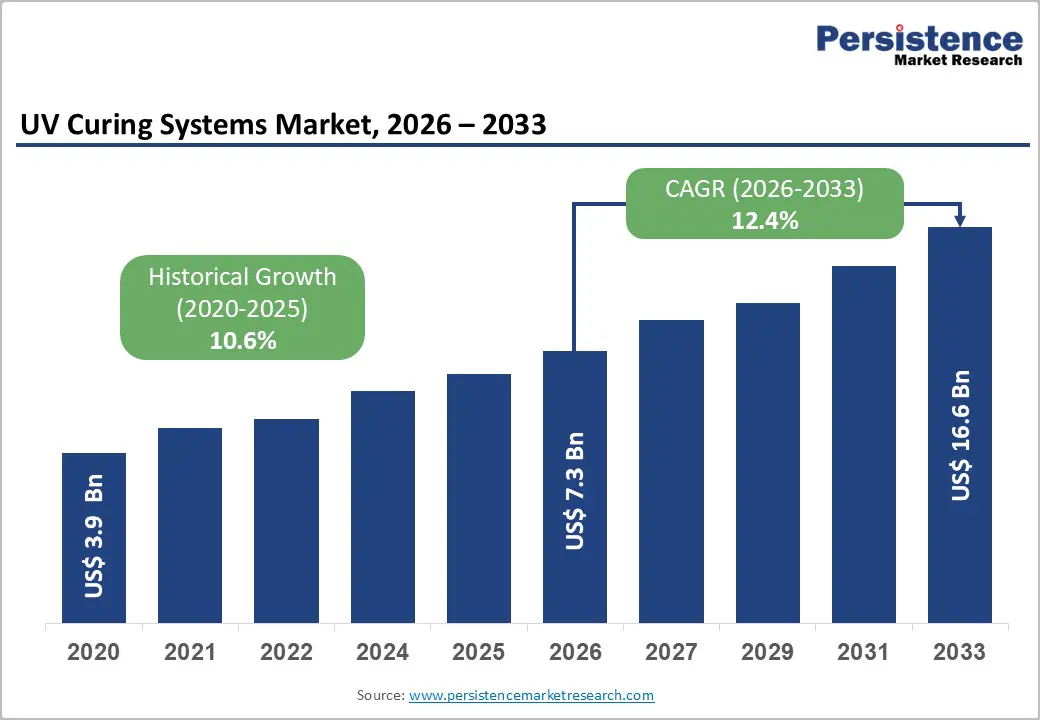
The global uv curing systems market size is likely to be valued at US$ 7.3 billion in 2026 and is projected to reach US$ 16.6 billion by 2033, growing at a CAGR of 12.4% between 2026 and 2033.
The market recorded a historical value of US$ 3.9 billion in 2020 highlighting sustained growth trajectories across the broader industrial equipment sector. Four primary forces underpin this trajectory: the rapid commercial transition from mercury-based UV lamps to energy-efficient UV LED technology, tightening global regulatory frameworks governing volatile organic compound emissions and hazardous material use in manufacturing, accelerating adoption of precision UV curing across electronics, automotive, and packaging value chains, and structural demand for faster, cleaner curing solutions that reduce total cost of ownership and energy consumption.
Key Industry Highlights:
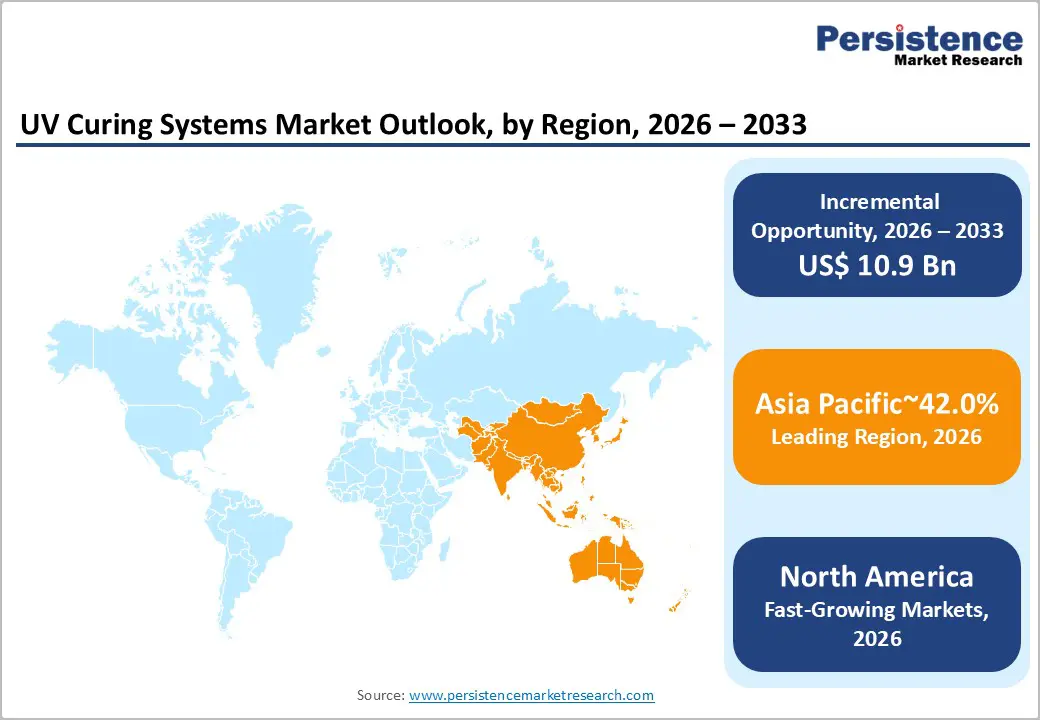
- Leading Region: Asia Pacific dominates the UV Curing Systems Market with 42% share, driven by large-scale electronics manufacturing in China, South Korea, and Japan, along with India’s rapidly expanding semiconductor and electronics ecosystem supported by US$ 17 Bn PLI schemes and strong packaging and PCB production growth.
- Fast-growing Region: North America holds 28% share, supported by the U.S. CHIPS Act (US$ 52.7 Bn semiconductor investments), strong aerospace & defense demand (US$ 995 Bn industry activity), and advanced electronics manufacturing clusters driving high-value UV curing adoption.
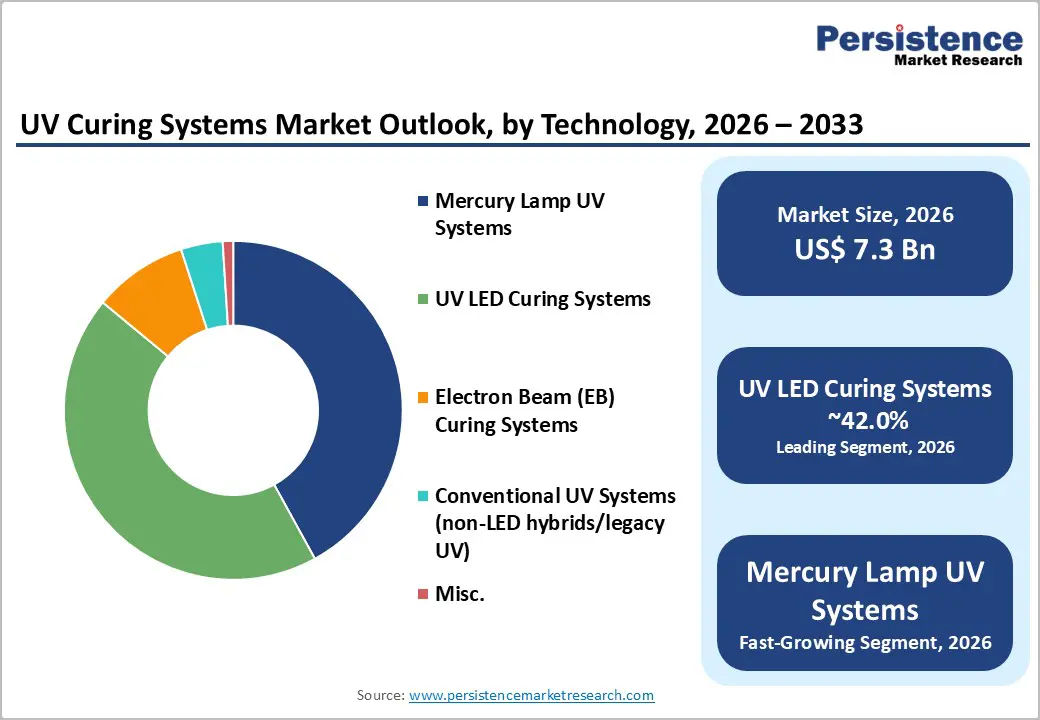
- Leading Technology Segment: UV LED Curing Systems dominate with 44% share, driven by 20-50% lower energy consumption, mercury-free compliance, and increasing adoption in electronics, printing, and medical device manufacturing, with over 55% of new installations now LED-based.
- Fastest Growing Technology Segment: UV LED Curing Systems are also the fastest-growing segment, driven by rapid replacement of mercury lamps, sustainability regulations, and precision wavelength control enabling defect-free curing in advanced semiconductors and medical applications.
- Leading Industry: Electronics & Semiconductor leads with 32% share, supported by global semiconductor sales of US$ 75.3 Bn (Nov 2025) and increasing demand for PCB fabrication, display manufacturing, and advanced packaging processes.
- Fastest Growing Industry: Industrial Manufacturing is the fastest-growing segment, driven by expanding UV curing adoption in coatings, adhesives, metal finishing, and general industrial automation, replacing solvent-based and thermal curing systems.
DRO Analysis
UV LED Technology Adoption as a Structural Disruptor in the UV Curing Systems Market
The commercial transition from conventional mercury vapor lamps to UV LED curing technology represents the single most transformative structural driver in the UV Curing Systems Market, reshaping both the competitive and regulatory environment simultaneously. UV LED systems deliver approximately 20 to 50% lower energy consumption compared to mercury lamps, operate with a lifespan often exceeding 20,000 hours, materially reducing maintenance downtime and capital replacement cycles and eliminate mercury, addressing both environmental compliance and worker safety mandates.
Precision wavelength control enabled by UV LED technology, typically in the UV-A range of 365 nm to 405 nm, allows manufacturers to engineer substrate-specific curing profiles that eliminate over-exposure, heat damage, and defects in sensitive electronic assemblies and medical device components. In energy benchmarking against mercury arc spot lamps, comparable LED units demonstrate approximately 80% power consumption reduction from 250 W to 55 W a directly quantifiable advantage that accelerates procurement decisions across cost-sensitive production environments.
Regulatory Pressure on Mercury and VOC Emissions Driving Technology Transition
Tightening regulatory frameworks across the European Union, North America, and Asia Pacific are structurally redirecting procurement in the UV Curing Systems Market away from conventional mercury-based systems toward compliant, mercury-free UV LED alternatives. The EU's Restriction of Hazardous Substances Directive actively restricts mercury use in electrical and electronic equipment, with the existing Annex III exemption for UV-curing mercury lamps renewed only through early 2027, creating a defined procurement transition horizon that is already accelerating LED capital expenditure among European manufacturers.
Simultaneously, strict VOC emission regulations in the United States, enforced by the Environmental Protection Agency's National Emission Standards for Hazardous Air Pollutants, incentivize the adoption of UV curing as an alternative to solvent-based coating and adhesive systems, as UV-curable formulations are commonly 100% solids or water-based, with negligible VOC output. In certain regions, switching to energy-efficient LED UV systems qualifies manufacturers for utility rebates, tax credits, and sustainability certifications, reinforcing both financial and regulatory incentives for adoption.
Electronics Manufacturing Expansion and Semiconductor Fabrication Demand
The structural acceleration of global electronics manufacturing activity, spanning printed circuit board assembly, conformal coating, component bonding, and display panel fabrication, is generating sustained procurement demand within the UV Curing Systems Market, with UV curing used across virtually every board-level and device-level assembly step in modern electronics production.
India's electronics industry scaled from US$ 29 Bn in FY2015 to US$ 101 Bn in FY2023, contributing 3.4% to GDP, with the government allocating US$ 17 Bn across four Production Linked Incentive schemes targeting semiconductors, smartphones, IT hardware, and components, directly expanding the domestic electronics manufacturing base that requires UV curing infrastructure.
The global semiconductor industry reported record monthly sales of US$ 75.3 Bn in November 2025 a 29.8% year-over-year advance driven by AI data center deployments, automotive electronics, and advanced computing, all of which consume UV curing systems for wafer-level and package-level processing. India's electronics exports reached US$ 29.12 Bn in FY2024, a 23.6% annual increase, signaling the emergence of new geographies as material UV curing demand centers.
Restraints - High Initial Capital Investment and Integration Complexity
Advanced UV LED curing systems require substantially higher upfront capital expenditure than legacy mercury-based installations, creating a cost barrier particularly pronounced among small- to mid-sized manufacturers in price-sensitive emerging markets. System integration into existing production lines frequently requires specialized engineering expertise, process requalification and changes to photoinitiator formulations, adding hidden costs beyond equipment purchase that extend payback periods. While the total cost of ownership modeling strongly favors LED systems over a 3 to 5 year horizon due to energy and maintenance savings, the initial capital commitment remains a structural adoption constraint for budget-limited manufacturing operators.
Supply Chain Concentration and Component Sourcing Vulnerabilities
The UV curing systems supply chain is dependent on a concentrated base of UV LED chipset manufacturers, high-purity quartz glass suppliers, and advanced photoinitiator chemistry providers, predominantly concentrated in Japan, South Korea, and Germany, creating geopolitical and logistics exposure that can disrupt equipment production timelines and cost structures. Disruptions in LED chip supply or in the availability of rare-earth phosphors directly translate into system delivery delays and price volatility that procurement teams must account for when planning large-scale capital projects. The limited number of qualified suppliers for ultra-high-power UV LED arrays further constrains manufacturers' ability to ramp production capacity rapidly in response to demand surges.
Opportunities - Aerospace, Defense, and Advanced Manufacturing as High-Value Verticals for the UV Curing Systems Market
The global aerospace and defence sector presents a structurally underserved high-value opportunity for UV curing system manufacturers, given the industry's stringent requirements for precision bonding, conformal coating, and composite assembly all application domains where UV curing's speed, dimensional accuracy, and absence of thermal stress offer decisive technical advantages over conventional alternatives. The U.S. aerospace and defense industry generated nearly US$ 995 Bn in total business activity in 2024, combining US$ 556 Bn in direct output with US$ 439 Bn from supply chain activities, representing a formidable procurement base.
European aerospace and defense companies achieved a turnover of €325.7 Bn in 2024, reflecting a 10.1% year-on-year increase, with R&D investment reaching €25.2 Bn a 9.4% annual advance and defense-specific military R&D accounting for 61% of that total. As the aerospace sector accelerates composite airframe adoption, lightweight adhesive bonding, and avionics miniaturization, the UV Curing Systems Market is positioned to capture growing capital expenditure from Tier 1 and Tier 2 aerospace component manufacturers across North America, Europe, and India's rapidly developing defence industrial ecosystem.
Automotive Electrification and EV Component Manufacturing Driving New UV Curing Demand
The structural shift toward electric vehicle production is generating an entirely new category of UV curing demand spanning battery cell assembly, power electronics bonding, inverter conformal coating, and sensor module encapsulation that did not exist at the material scale in the conventional internal combustion vehicle production environment. Global car registrations reached 74.6 million units in 2024, a 2.5% annual increase, with China sustaining close to 23 million units, representing 31% of global sales and Europe registering 3.9% growth to 16.1 million units together forming the two largest automotive UV curing end-user markets globally.
Japan's investment in UV systems for electric vehicle inverters and optical components is specifically cited as a national manufacturing priority, while India's automotive sector posted 4.8% sales growth in 2024, driven by festive-season demand and government incentives, further widening the UV Curing Systems Market addressable base within Asia Pacific's automotive manufacturing corridor. UV curing adhesives' capacity for high bond strength, chemical resistance, and customizable formulations positions them as essential materials in battery pack and power module assembly for next-generation EVs.
Emerging Market Industrialization and Government-Led Manufacturing Expansion
Rapid industrialization across South and Southeast Asia, underpinned by coordinated government industrial policy, is creating new geographic demand centers for the UV Curing Systems Market that were minimally represented in earlier market cycles. India's electronics manufacturing sector is projected to reach US$ 300 Bn by FY2026, supported by US$ 17 Bn in PLI scheme allocations and the Semicon India Program's commitments totaling INR 76,000 crore in semiconductor infrastructure investment, all of which require UV curing systems for PCB fabrication, component bonding, and advanced packaging operations.
Vietnam, Thailand, and Indonesia are simultaneously attracting manufacturing relocations from China-centric supply chains across electronics, automotive, and consumer goods, creating greenfield UV curing equipment procurement opportunities for system manufacturers with established regional distribution networks. India's IT sector is projected to surpass US$ 300 to 350 Bn by 2025, reinforcing upstream PCB and electronics component demand that directly translates into UV curing system capital expenditure as domestic production scales.
Category-wise Analysis
Technology Insights
UV LED curing systems command a 44.0% share of the global UV Curing Systems Market by technology type, establishing this format as the dominant and fastest-commercializing technology platform across all major end-use verticals. The adoption advantage is structurally driven by UV LEDs' superior energy efficiency, consuming 20 to 50% less power than mercury lamps, combined with a lifespan exceeding 20,000 operational hours, mercury-free compliance with EU RoHS and the Minamata Convention, and precise wavelength control that eliminates substrate thermal damage in heat-sensitive electronics assembly.
Over 55% of all new UV curing systems shipped globally are now LED-based, compared to less than 35% five years ago, confirming an accelerating technology substitution cycle that is progressively marginalizing conventional mercury systems in all new-build procurement decisions.
While UV LED dominates new installations, Mercury Lamp UV Systems retain the fastest near-term volume recovery characteristic within the installed base maintenance and legacy upgrade cycle, particularly in applications where high-power broadband UV output remains technically unmatched by current LED alternatives.
The EU's RoHS Annex III exemption for mercury UV curing lamps renewed through early 2027 has preserved a protected procurement window for mercury lamp replacement parts and system upgrades in existing European installations. However, this trajectory is structurally time-limited, as the exemption timeline and tightening environmental mandates across the U.S. and Asia Pacific progressively close the regulatory window for mercury lamp system procurement.
System Type Insights
Conveyor and inline UV curing systems nearly account for 38% of the global market by system type, reflecting their dominant role in high-volume, continuous manufacturing processes across electronics, PCB assembly, packaging converting lines, and automotive coating operations. These systems deliver the process throughput consistency and scalability required by modern inline manufacturing environments, integrating directly into conveyor-fed production flows without interrupting cycle times. Their position as the default UV curing architecture for electronics assembly in China's dense manufacturing clusters, spanning conformal coating and mobile phone component assembly, and their broad deployment in European printing and packaging converting lines collectively anchor their market leadership.
Spot curing systems are the fast-growing within the UV curing systems market, propelled by the rapid proliferation of precision assembly applications in medical device manufacturing, microelectronics bonding, and semiconductor package-level processing all of which require targeted, substrate-specific UV dose delivery rather than broad-area curing. The transition to UV LED spot heads has dramatically reduced the size, cost, and thermal output of spot curing units, enabling their integration into robotic assembly cells, semiconductor bonding equipment, and benchtop medical device assembly stations that were previously incompatible with legacy mercury spot lamps. The development of compact, portable UV curing units for niche markets cited as a strategic priority by leading equipment OEMs further reinforces the spot curing segment's expansion trajectory.
Industry Insights
Electronics and semiconductors are the single largest end-use industry segment, commanding approximately 32% of the global UV curing systems market demand, driven by the technology's critical role in PCB conformal coating, component bonding, display panel fabrication, and semiconductor packaging. Global semiconductor monthly sales reached a record US$ 75.3 Bn in November 2025, reflecting a 29.8% year-over-year advance, with AI data center deployments and automotive electronics as the primary demand catalysts all requiring UV curing at multiple points in the value chain from wafer-level processing through final module assembly. India's domestic electronics production reaching US$ 101 Bn in FY2023, combined with exports of US$ 29.12 Bn in FY2024, underscores the geographic expansion of electronics manufacturing, creating new UV curing procurement centers.
Industrial manufacturing is the fastest-growing end-use segment in the UV Curing Systems Market, driven by the technology's expanding deployment across wood finishing, metal coating, plastic bonding, and general-purpose adhesive assembly operations that are progressively replacing solvent-based and thermal curing processes. UV curing's ability to deliver high bond strength, chemical resistance, and customizable formulation performance across metal, plastic, and composite substrates is directly applicable to precision manufacturing across defense, energy, and general industrial equipment sectors.
Regional Insights
Asia Pacific UV Curing Systems Market Trends and Insights
Asia Pacific holds 42% of the global UV curing systems market, with China accounting for US$ 1.5 Bn and India at US$ 0.4 Bn the latter representing one of the highest-growth emerging market UV curing demand centers. China dominates as the world's largest electronics and automotive manufacturing hub, sustaining UV curing demand across consumer electronics PCB assembly, automotive component coating, and industrial adhesive processing at an unmatched scale.
The Asia Pacific region logged approximately 19.4% CAGR through recent forecast periods, anchored by dense electronics clusters in China, South Korea, and Vietnam that deploy UV curing lines for conformal coating and mobile phone assembly. India's electronics sector growth from US$ 29 Bn in FY2015 to US$ 101 Bn in FY2023 combined with US$ 17 Bn in PLI scheme allocations across electronics manufacturing, is expanding the domestic UV curing installed base for PCB fabrication and semiconductor packaging applications.
North America UV Curing Systems Market Trends and Insights
North America holds 28% of global UV curing systems market value, with the United States accounting for US$ 1.7 Bn of regional demand, underpinned by the world's most advanced electronics, aerospace, medical device, and automotive manufacturing ecosystems. The U.S. CHIPS and Science Act's US$ 52.7 Bn investment in domestic semiconductor fabrication is generating capital expenditure in UV curing systems for advanced packaging and wafer-level processing as new U.S. fabs commence operations with U.S. fabrication capacity projected to triple by 2032.
Strict EPA regulations on VOC emissions have structurally redirected North American printing, coatings, and industrial adhesive manufacturers toward UV curing systems as a compliant alternative to solvent-based processes, creating a regulatory tailwind that has sustained market penetration across multiple end-use sectors.
The U.S. A&D industry's nearly US$ 995 Bn in total business activity in 2024 generating a trade surplus of US$ 73.9 Bn in aerospace and defence products creates a high-value procurement base for precision UV curing systems in aircraft component bonding, avionics assembly, and composite structure manufacturing.
Europe UV Curing Systems Market Trends and Insights
Europe accounts for 23% regional share of the global UV curing systems industry, supported by an advanced industrial base spanning automotive, packaging, printing, aerospace, and precision electronics manufacturing, all of which deploy UV curing across key production processes. Germany, France, and the United Kingdom collectively anchor European UV curing demand, with leading system manufacturers IST Metz GmbH, GEW Limited, Heraeus Noblelight, and Dr. Hönle AG headquartered in the region and supplying both domestic and global markets.
The EU's RoHS Directive, which restricts mercury in electrical and electronic equipment and has the UV curing lamp exemption renewed only through early 2027, is driving a defined procurement transition cycle that is accelerating capital expenditure on UV LED system upgrades across European production facilities.
Competitive Landscape
The global UV curing systems market exhibits a consolidated yet moderately fragmented structure, with the top six players, Excelitas Technologies Corp., Nordson Corporation, IST Metz GmbH, Dymax Corporation, GEW Limited, and Dr. Hönle AG, collectively accounting for approximately 47 to 57% of global market revenue.
The market is characterized by simultaneous consolidation at the premium UV LED technology tier and fragmentation among regional and niche spot-cure, handheld, and specialty system providers. High technical barriers, customer qualification requirements, and application-specific engineering expertise sustain incumbent advantages while limiting rapid new entrant penetration at scale
Leading players in the global UV Curing Systems Market pursue UV LED technology differentiation and application-specific system engineering as their primary competitive strategy, combined with OEM integration partnerships that embed UV curing modules directly into customer production lines. Modular, scalable system architectures enabling customers to upgrade from mercury to LED within existing mechanical infrastructure represent the dominant product strategy, while geographic expansion into India, Southeast Asia, and Eastern Europe addresses the emerging-market industrialization opportunity.
Key Developments:
- In April 2025, IUV (China) launched its next-generation LED UV curing systems, introducing Economy, Smart, and Super series to address different printing scale requirements, marking a major step in the commercialization of energy-efficient LED UV curing technology. The systems reduce energy consumption by up to 70%, eliminate mercury usage, and enable curing of heat-sensitive substrates, strengthening the global shift toward sustainable, high-speed LED UV curing in printing and packaging applications.
- In April 2026, PPG Industries (USA) expanded its radiation-curable coatings R&D capabilities by installing an advanced UV, electron beam (EB), and infrared curing testing line in France, enabling simulation of real production environments to accelerate coating development cycles. The investment reinforces the growing integration of UV and EB curing technologies in industrial coatings, improving sustainability by reducing carbon emissions by up to 65% while enhancing curing speed and production efficiency across automotive and industrial applications.
- In May 2025, Kyocera Corporation (Japan) introduced the G7A Series air-cooled UV LED curing system, delivering an ultra-compact design with industry-leading irradiance performance of 20W/cm², enabling high-speed curing comparable to water-cooled systems without external cooling infrastructure. The launch highlights the increasing demand for compact, energy-efficient, and mercury-free UV curing solutions in industrial printing, adhesion, and manufacturing applications.
UV Curing Systems Market Report - Key Insights & Details
| Key Insights | Details |
|---|---|
| Historical Market Value (2020) | US$ 3.9 Bn |
| Current Market Value (2026) | US$ 7.3 Bn |
| Projected Market Value (2033) | US$ 16.6 Bn |
| CAGR (2026 - 2033) | 12.4% |
| Leading Region | Asia Pacific, 42.0% share |
| Dominant Technology | Mercury Lamp UV Systems, 42% share |
| Top-ranking System type | Conveyor / Inline Systems, 38% |
| Incremental Opportunity | US$ 9.3 Bn |
Companies Covered in UV Curing Systems Market
- Excelitas Technologies Corp.
- Nordson Corporation
- IST Metz GmbH and Co. KG
- GEW (EC) Limited
- Dymax Corporation
- Dr. Hönle AG (Honle UV America, Inc.)
- Miltec UV Corporation
- Phoseon Technology, Inc.
- American Ultraviolet Corporation
- Panacol-Elosol GmbH
- Baldwin Technology Company Inc.
- Heraeus Noblelight GmbH
- Panasonic Holdings Corporation
- UVitron International, Inc.
Frequently Asked Questions
The global UV Curing Systems Market is projected to be valued at US$ 7.3 Bn in 2026.
Electronics & Semiconductor leads with a 32% share, supported by strong semiconductor sales of US$ 75.3 Bn (Nov 2025) and rapid electronics manufacturing expansion in Asia, while Industrial Manufacturing remains the fastest-growing segment.
UV LED Curing Systems dominate with 44% market share and account for over 55% of new system shipments, driven by 20-50% energy savings, mercury-free compliance, and superior operational efficiency.
The market is expected to witness a CAGR of 12.4% from 2026 to 2033.
The UV Curing Systems market is driven by the rapid shift toward UV LED technology, stringent environmental regulations restricting mercury and VOC emissions, and strong expansion of electronics and semiconductor manufacturing globally.
The key market opportunities in the UV Curing Systems market are driven by rising adoption in aerospace and defense high-precision manufacturing, accelerating demand from automotive electrification and EV component production, and rapid industrialization and government-led electronics manufacturing expansion across emerging economies such as India and Southeast Asia.
Key players in the UV Curing Systems Market include Excelitas Technologies Corp., Nordson Corporation, IST Metz GmbH, Dymax Corporation, GEW Limited, and Dr. Hönle AG.


