




- LED & Lighting (Optoelectronics)
- Navigation Lighting Market
Navigation Lighting Market Size, Share, and Growth Forecast, 2026 - 2033
Navigation Lighting Market by Light Type (Sidelights, Masthead Light, Others), Installation Type (Portable, Fixed, Others), Technology, Application, and Regional Analysis for 2026 - 2033

Navigation Lighting Market Size and Trends Analysis
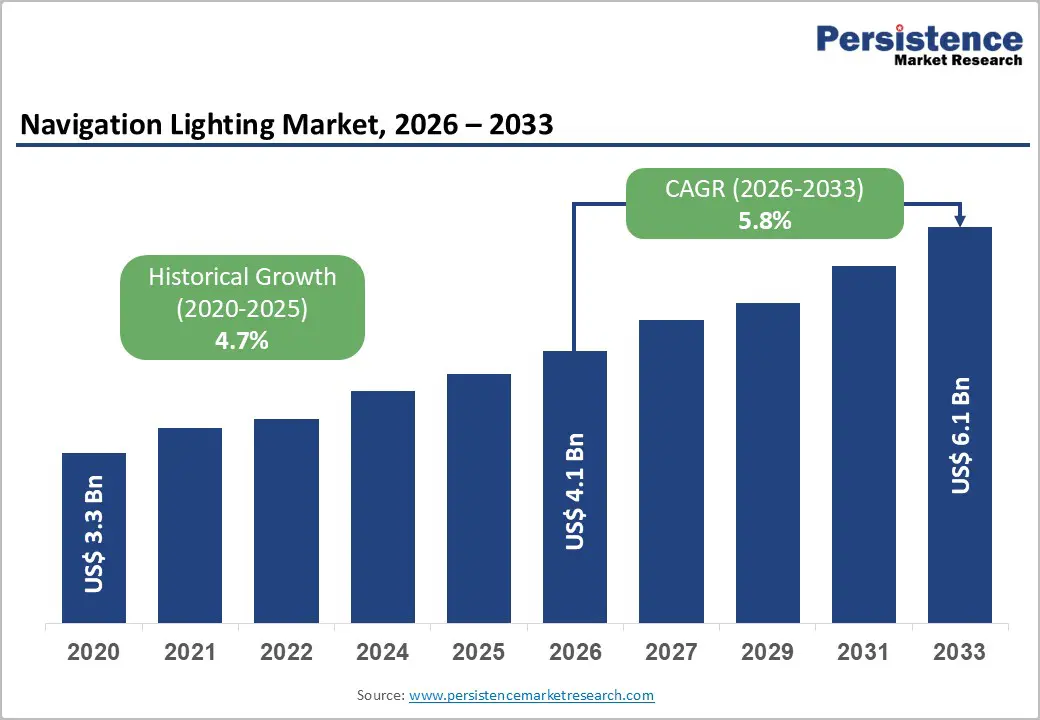
The global navigation lighting market size is likely to be valued at US$4.1 billion in 2026 and is expected to reach US$6.1 billion by 2033, growing at a CAGR of 5.8% between 2026 and 2033, driven by regulatory compliance requirements, increasing marine and aviation activity, and the transition toward LED-based lighting systems. Marine shipping remains the dominant demand base, as over 80% of global trade volume is transported via maritime routes, while aviation and infrastructure applications are expanding under stricter safety mandates.
Key Industry Highlights:
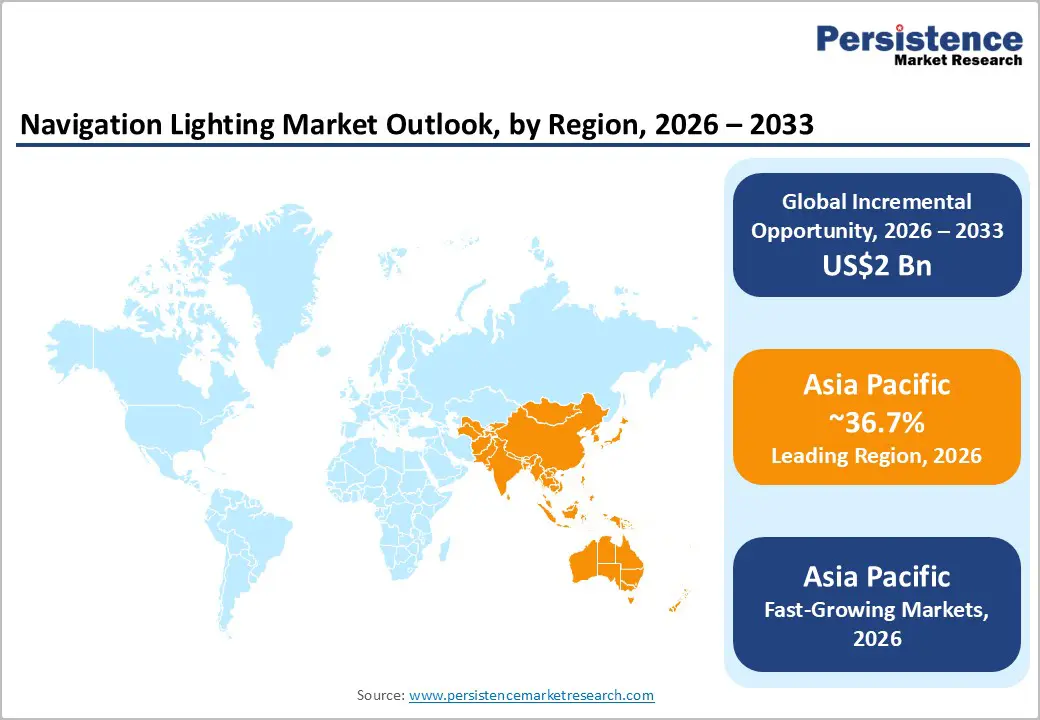
- Leading Region: Asia Pacific is projected to account for approximately 36.7% of the market share, driven by strong shipbuilding activity, expanding maritime trade, and large-scale infrastructure development across China, Japan, India, and ASEAN countries.
- Fastest-growing Region: Asia Pacific is also the fastest-growing region, supported by the rapid expansion of the aviation sector, increased port modernization initiatives, and the rising adoption of energy-efficient lighting systems across emerging economies.
- Investment Plans: Significant investments are being directed toward port infrastructure modernization, naval fleet expansion, offshore energy projects, and airport development, with a strong focus on LED upgrades, smart monitoring systems, and solar-powered lighting solutions to enhance operational efficiency and regulatory compliance.
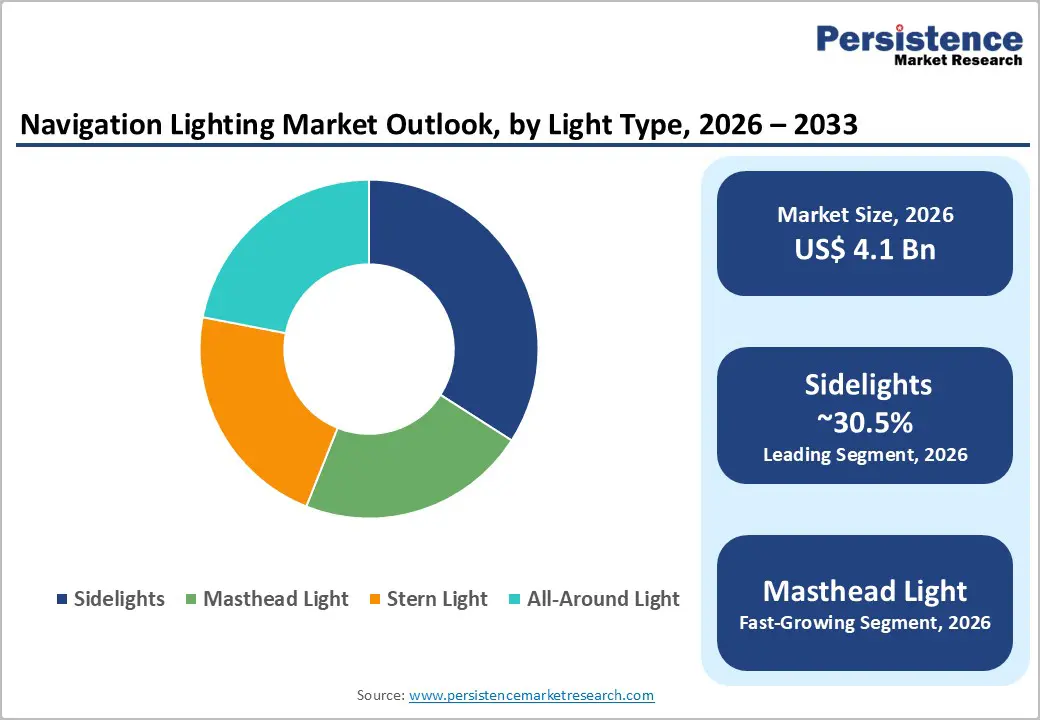
- Dominant Light Type: Sidelights dominate, holding an estimated 30.5% market share, as they are essential for vessel visibility and are mandated across all vessel categories, ensuring consistent demand and replacement cycles.
- Leading Installation Type: Portable installation systems lead, accounting for approximately 40.4% share, due to their flexibility, ease of deployment, and strong adoption in temporary operations, small vessels, and emergency applications.
| Key Insights | Details |
|---|---|
|
Navigation Lighting Market Size (2026E) |
US$4.1 Bn |
|
Market Value Forecast (2033F) |
US$6.1 Bn |
|
Projected Growth (CAGR 2026 to 2033) |
5.8% |
|
Historical Market Growth (CAGR 2020 to 2025) |
4.7% |
DRO Analysis
Driver Analysis - Regulatory Compliance as a Core Demand Catalyst
Navigation lighting systems are mandated safety equipment across marine and aviation sectors, making compliance a fundamental driver of demand. International maritime regulations define specific lighting requirements for different vessel categories, ensuring consistent replacement and upgrade cycles. Similarly, aviation authorities require aircraft and infrastructure to maintain strict lighting standards for visibility and collision avoidance. This regulatory framework creates non-discretionary demand, insulating the market from economic fluctuations. As compliance standards evolve, operators are required to upgrade legacy systems, favoring certified and high-performance products. This environment benefits manufacturers with proven compliance capabilities and strengthens long-term supplier relationships.
LED Technology Adoption Driving Value Growth
LED lighting is transforming the navigation lighting landscape due to its superior efficiency and durability. LEDs consume significantly less energy and offer longer operational lifespans than traditional lighting technologies. These advantages reduce maintenance frequency and operational costs, which is critical in marine and aviation environments where accessibility can be limited. Regulatory policies promoting energy efficiency further accelerate LED adoption. As a result, operators are increasingly replacing incandescent and halogen systems with LED-based solutions, driving higher average selling prices and expanding the market value beyond volume growth.
Expansion of Global Maritime Trade and Fleet Activity
Rising maritime trade volumes directly increase the installed base of navigation lighting systems. Global seaborne trade continues to expand steadily, supported by international commerce, industrial output, and supply chain integration. Increased vessel deployment and longer shipping routes elevate the need for reliable and durable lighting systems. Additionally, harsher operating environments demand corrosion-resistant, high-performance lighting solutions, encouraging upgrades to advanced technologies. This growth in fleet size and utilization creates sustained demand for both original equipment and replacement lighting products.
Restraints Analysis - High Certification and Installation Complexity
Navigation lighting systems must comply with strict performance and installation standards, which vary by application and geography. Certification processes involve rigorous testing and documentation, increasing development timelines and costs. For end users, compliant systems often require specialized installation and integration, raising upfront investment requirements. These factors can slow adoption, particularly among cost-sensitive operators and smaller fleet owners. Procurement delays and compatibility challenges further complicate system upgrades, especially in legacy infrastructure environments.
Price Sensitivity and Supply Chain Constraints
The market faces pressure from low-cost alternatives and conventional lighting technologies, particularly in price-sensitive segments. While LED systems offer long-term savings, their higher initial cost can limit adoption. In parallel, global supply chain disruptions continue to affect component availability, logistics, and production timelines. These challenges can increase manufacturing costs and delay project execution. Smaller suppliers are particularly vulnerable due to reliance on external component sourcing, which impacts competitiveness and profitability.
Opportunity Analysis - Strong Retrofit Demand across Existing Fleets
Retrofitting legacy lighting systems presents a major growth opportunity, particularly as a large share of global marine and small-vessel fleets continues to rely on outdated incandescent and halogen technologies. Transitioning to LED-based navigation lighting provides immediate gains in energy efficiency, reduced maintenance frequency, and improved compliance with evolving safety regulations. This is especially critical for commercial shipping operators and offshore service providers, where downtime and maintenance costs directly impact profitability. Retrofit demand is also strong in recreational boating and inland waterways, where cost-effective upgrade kits and plug-and-play LED solutions are gaining traction. For example, vessel owners are increasingly adopting pre-certified LED retrofit modules that simplify installation while ensuring regulatory compliance. This opportunity extends beyond initial upgrades to include aftermarket services, spare parts, and long-term maintenance contracts, creating a recurring revenue stream for manufacturers and service providers.
Growth of Solar and Portable Lighting Solutions
Portable and solar-powered navigation lighting systems are gaining traction, particularly in applications where flexibility and independence from grid infrastructure are essential. These systems are widely used in remote ports, offshore energy projects, temporary construction sites, emergency response operations, and military logistics, where rapid deployment is critical. Solar-powered lighting reduces reliance on fuel-powered generators or fixed electrical connections, significantly lowering operating costs while supporting sustainability goals. Advances in battery storage, photovoltaic efficiency, and lightweight materials have improved the reliability and performance of these systems, making them viable even in challenging environmental conditions. For instance, portable solar navigation lights are increasingly deployed for temporary buoy marking, disaster-relief operations, and short-term harbor expansions. As infrastructure development expands into remote and underserved regions, demand for self-sufficient, low-maintenance lighting solutions is expected to rise steadily.
Integration of Smart Monitoring and Control Systems
The integration of smart monitoring and control technologies is creating new value streams within the navigation lighting market. Modern systems now incorporate real-time performance monitoring, automated fault detection, and predictive maintenance capabilities, enabling operators to proactively manage lighting infrastructure. These features are particularly valuable in large commercial fleets, offshore platforms, and aviation infrastructure, where system reliability and compliance are critical. Smart lighting solutions can be integrated with broader vessel management or airport control systems, allowing centralized monitoring and faster response to failures. For example, advanced navigation lighting networks can send alerts in the event of a malfunction, reducing inspection requirements and minimizing operational disruptions. This shift toward connected and intelligent lighting ecosystems not only improves efficiency but also supports higher-margin offerings, including software integration, remote diagnostics, and service-based contracts, ultimately enhancing long-term customer value.
Category-wise Analysis
Light Type Insights
Sidelights are anticipated to lead the market with a 30.5% share in 2026, reflecting their essential role in vessel visibility and collision avoidance under international navigation rules. These lights are mandatory across a wide range of vessel categories, including commercial cargo ships, fishing vessels, offshore support vessels, and recreational boats. Their consistent usage across vessel types ensures stable baseline demand, particularly in regions with dense maritime traffic. The segment also benefits from frequent replacement cycles, as operators transition from traditional incandescent or halogen systems to energy-efficient LED alternatives. For instance, modern LED sidelights are increasingly adopted in coastal shipping fleets and leisure boating markets due to their compact design, corrosion resistance, and longer operational lifespan. This combination of regulatory necessity and upgrade-driven demand reinforces the segment’s dominant position.
Masthead lights are anticipated to be the fastest-growing segment, supported by ongoing fleet modernization and stricter visibility requirements in high-traffic shipping corridors. These lights are critical for forward visibility and are particularly important for larger vessels operating in congested or low-visibility conditions. Growth is driven by the integration of LED masthead lights in new vessel builds and by retrofitting activities in aging fleets seeking compliance with updated safety standards. For example, container ships and offshore vessels are increasingly installing combined masthead and all-round LED units that reduce installation complexity while improving performance. Technological advancements, such as enhanced beam precision and modular designs, further support adoption. The segment is also gaining traction in naval and specialized vessels, where reliability and durability are critical.
Installation Type Insights
Portable lighting systems are anticipated to dominate the segment with a 40.4% market share in 2026, driven by their flexibility, ease of deployment, and cost-effectiveness. These systems are widely used in temporary maritime operations, including dredging projects, harbor maintenance, and emergency response scenarios. Their ability to function without complex wiring or permanent installation makes them highly suitable for small vessels, barges, and inland waterway operations. Portable navigation lights are also increasingly used in defense and disaster-relief applications, where rapid deployment is essential. For instance, battery-powered and solar-assisted portable lights are commonly deployed in remote coastal regions and temporary docking sites. The growing demand for modular and easily transportable lighting solutions continues to reinforce the segment’s leadership.
Fixed installations are anticipated to be the fastest-growing segment, supported by rising demand for long-term, durable, and integrated lighting solutions in commercial and infrastructure applications. Fixed systems are typically installed on large commercial vessels, offshore platforms, and airport infrastructure, where reliability and compliance are critical. These systems are increasingly integrated with advanced monitoring and control technologies, enabling real-time performance tracking and predictive maintenance. For example, modern cargo vessels and cruise ships are adopting permanently mounted LED navigation lighting systems that offer extended service life and reduced maintenance requirements. Additionally, fixed installations are gaining traction in aviation infrastructure, such as runway and obstruction lighting, where consistent performance is essential. The shift toward automation and smart vessel management systems further accelerates the adoption of fixed lighting solutions.
Regional Insights
North America Navigation Lighting Market Trends - Compliance-Driven LED Retrofit Demand across Marine, Aviation & Defense
North America remains a significant market due to its large maritime base, advanced aviation infrastructure, and strong regulatory enforcement framework. The U.S. leads the region, supported by strict compliance standards and ongoing investments in modernizing ports, naval fleets, and airport systems. Demand is driven by recreational boating activity, defense procurement programs, and continuous airport upgrades, particularly in obstruction lighting and runway safety systems. The region also benefits from early adoption of LED-based navigation lighting, supported by energy-efficiency initiatives and lifecycle cost considerations.
Recent developments reinforce this trajectory. Companies such as Perko Inc. continue to expand their LED navigation lighting portfolio, targeting both commercial and recreational marine segments with retrofit-friendly solutions. Similarly, Flash Technology LLC has strengthened its presence in aviation and infrastructure lighting through advanced obstruction lighting systems used in telecommunications towers and wind energy projects. In the defense segment, contracts awarded to Glamox AS for U.S. Navy vessels highlight ongoing investments in high-performance marine lighting systems. These developments collectively indicate a strong replacement-driven market, where compliance upgrades and modernization initiatives sustain long-term demand.
Europe Navigation Lighting Market Trends - Energy-Efficient, High-Spec Navigation Lighting for Maritime & Offshore Sectors
Europe represents a mature yet technologically advanced market, characterized by stringent energy-efficiency regulations and a strong maritime and offshore industrial base. Countries such as Germany, the U.K., France, and Spain play central roles in shaping demand, supported by shipbuilding activity, offshore wind expansion, and aviation infrastructure investments. Regulatory harmonization across the European Union ensures consistent adoption of compliant navigation lighting systems, particularly as energy-efficiency mandates accelerate the transition toward LED technologies.
Industry developments highlight the region’s focus on innovation and sustainability. Companies such as Lopolight ApS are advancing compact, high-performance LED navigation lights with integrated monitoring systems for both commercial and naval applications. Meanwhile, Dialight plc continues to expand its industrial and hazardous-area lighting solutions, supporting offshore platforms and port infrastructure. In the aerospace and defense industry, Oxley Developments Company Ltd plays a key role in supplying lighting systems for military aircraft and naval vessels. These developments reflect Europe’s emphasis on high-specification, energy-efficient, and technologically advanced lighting systems, reinforcing its position as a leader in premium navigation lighting solutions.
Asia Pacific Navigation Lighting Market Trends - Shipbuilding-Led Growth & Expansion of Aviation and Port Infrastructure
Asia Pacific is projected to lead the market with approximately 36.7% market share in 2026 and is the fastest-growing region, driven by strong shipbuilding activity, expanding maritime trade, and rapid growth in the aviation sector. China, Japan, India, and ASEAN countries are key contributors, supported by large-scale manufacturing capabilities, export-oriented shipyards, and ongoing infrastructure investments. The region’s growing middle class and increasing trade volumes further contribute to higher vessel deployment and aviation traffic, directly supporting navigation lighting demand.
Recent industry activity underscores the region’s growth momentum. Japanese manufacturer Koito Manufacturing Co., Ltd. continues to expand its presence in aviation and transportation lighting, leveraging advanced optical technologies. In the marine segment, companies such as Hella Marine have strengthened their footprint across Asia Pacific markets by offering durable LED solutions tailored for harsh marine environments. Additionally, increasing adoption of solar-powered and portable lighting systems, supported by companies such as Avlite Systems, is enabling deployment in remote ports and developing infrastructure zones. Government-led port modernization initiatives in countries such as India and Southeast Asia are also accelerating the shift toward compliant, energy-efficient lighting systems. These developments position Asia Pacific as the primary growth engine, combining cost competitiveness with large-scale demand and rapid infrastructure expansion.
Competitive Landscape
The global navigation lighting market is fragmented, with a mix of global and regional players serving diverse applications. Competition is based on compliance, product reliability, technological innovation, and cost efficiency. While larger companies maintain strong positions in marine and aviation segments, smaller players compete in niche and regional markets. The absence of standardized global market share data limits precise quantification, but the competitive environment remains dynamic and innovation-driven. Key players focus on LED innovation, regulatory compliance, product durability, and geographic expansion. Differentiation is achieved through certified product portfolios, advanced materials, and integrated monitoring solutions. The market is gradually shifting toward system-based offerings and lifecycle service models, enhancing long-term customer value.
Key Industry Developments
- In March 2026, Glamox AS introduced advanced wireless lighting control systems and high-efficiency LED luminaires, supporting the industry shift toward connected and energy-efficient lighting solutions across industrial and marine environments.
Companies Covered in Navigation Lighting Market
- Glamox AS
- Perko Inc.
- Lopolight ApS
- Koito Manufacturing Co., Ltd.
- Dialight plc
- Sealite Pty Ltd
- Avlite Systems
- Flash Technology LLC
- Hella Marine
- Oxley Developments Company Ltd
- Aqualuma LED Lighting
- Luminell AS
- Orga BV
- Carmanah Technologies Corp.
- International Tower Lighting LLC
- Tideland Signal Corporation
Frequently Asked Questions
The global navigation lighting market is estimated to be valued at US$4.1 billion in 2026.
The navigation lighting market is projected to reach US$6.1 billion by 2033.
Key trends include the transition toward LED technology, rising demand for smart monitoring and control systems, increased adoption of solar and portable lighting solutions, and strong retrofit demand across existing marine and aviation infrastructure.
The sidelights segment leads the market within light type, accounting for approximately 30.5% share, due to its mandatory usage across vessel categories for navigation and collision avoidance.
The navigation lighting market is expected to grow at a CAGR of 5.8% from 2026 to 2033.
Major players include Glamox AS, Perko Inc., Lopolight ApS, Koito Manufacturing Co., Ltd., and Dialight plc.


