




- LED & Lighting (Optoelectronics)
- Programmable Stage Lighting Market
Programmable Stage Lighting Market Size, Share, and Growth Forecast 2026 - 2033
Programmable Stage Lighting Market by Light Type (Laser Light, LED Light, Halogen, Others), Product Type (Moving Head Lights, Strip Lights, PAR Can Lights, Others), Technology (Bluetooth, Wi-Fi, Others), Application (Entertainment Places, Theaters, Others), and Regional Analysis, 2026 - 2033

Programmable Stage Lighting Market Size and Trend Analysis
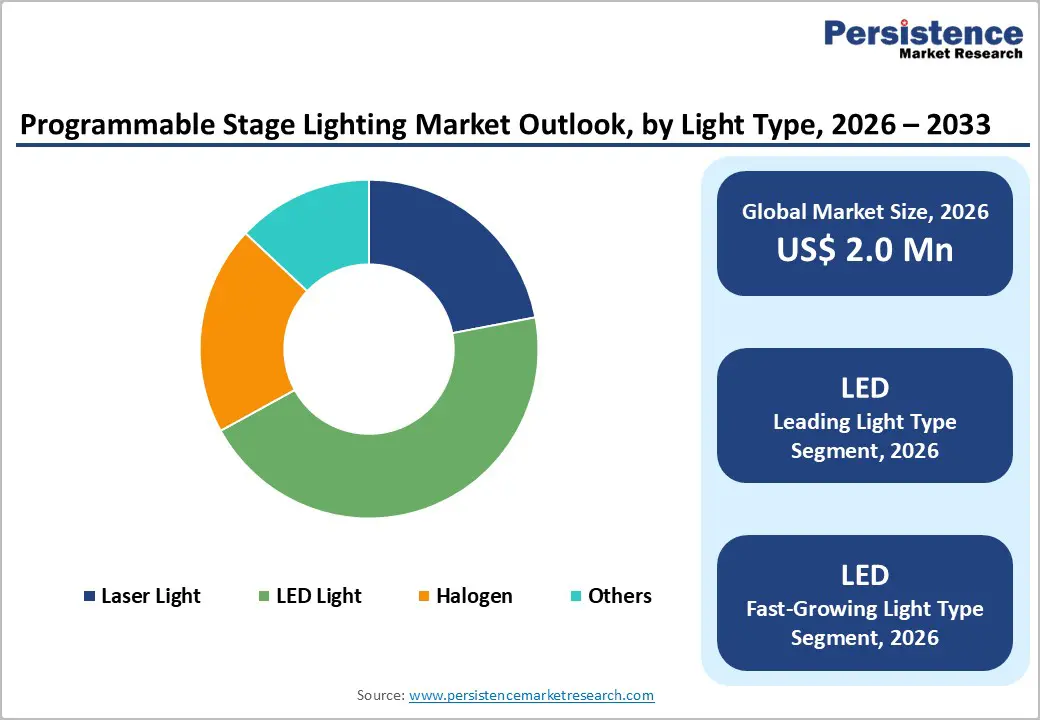
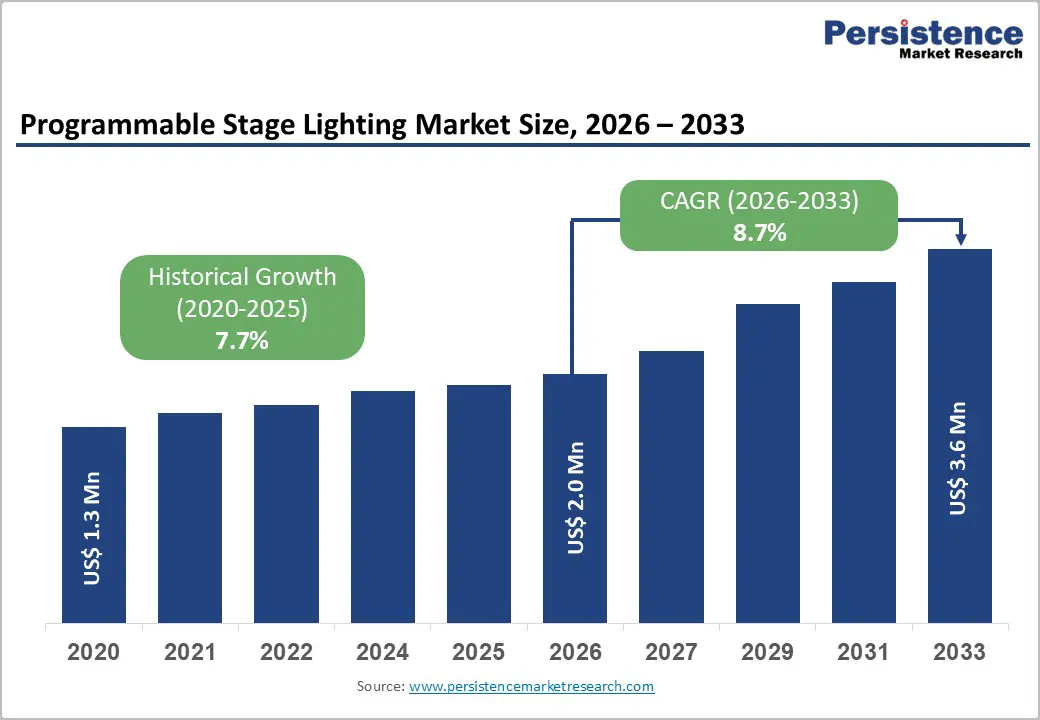
The global Programmable Stage Lighting market size is expected to be valued at US$ 2.0 billion in 2026 and projected to reach US$ 3.6 billion by 2033, growing at a CAGR of 8.7% between 2026 and 2033. The expansion is primarily driven by the global resurgence of live entertainment, spanning concerts, large-scale music festivals, theatrical productions, and immersive experiential events, where sophisticated programmable lighting has become central to audience engagement and production value.
The widespread transition from energy-intensive halogen and discharge lamp systems to efficient LED-based programmable fixtures, combined with the growing integration of intelligent wireless control protocols such as DMX512, Art-Net, and sACN, is simultaneously reducing total cost of ownership while expanding creative possibilities for lighting designers. Sustained investment in new entertainment venues across Asia Pacific and increasing adoption of IoT-enabled smart stage lighting ecosystems across corporate events and themed attractions further reinforce the market’s upward trajectory through 2033.
Key Industry Highlights:
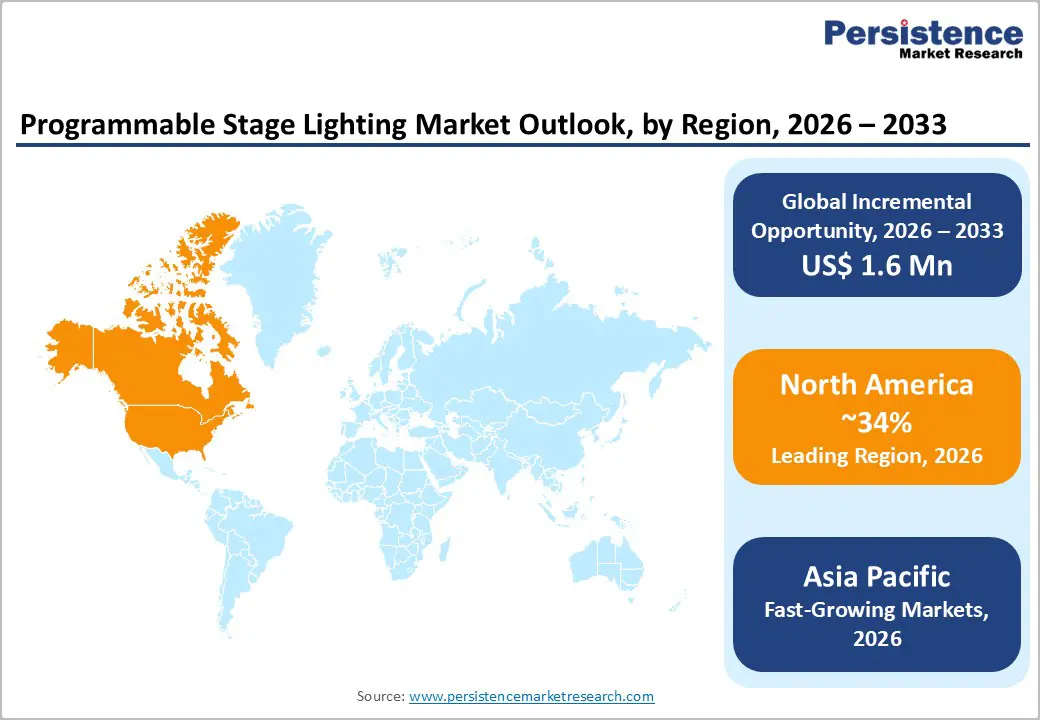
- Leading Region: North America leads the global Programmable Stage Lighting market with approximately 34% revenue share in 2025, supported by a mature live entertainment infrastructure, influential domestic manufacturers, and regulatory frameworks actively accelerating LED technology adoption across venue categories.
- Fastest Growing Region: Asia Pacific is the market’s fastest-growing region through 2033, driven by China’s cultural tourism sector exceeding 6 trillion RMB, accelerating entertainment venue construction across India and ASEAN, and strong government incentives reducing LED programmable system acquisition costs.
- Dominant Segment: LED Light leads the Light Type category with approximately 45% market share in 2025, reflecting its decisive advantages in energy efficiency, extended 50,000-hour operational lifespan, and seamless integration with professional DMX and wireless lighting control protocols.
- Fastest Growing Segment: Bluetooth mesh-enabled wireless lighting technology is the fastest-growing connectivity segment, driven by declining node hardware costs, smartphone-based programming convenience, and rapidly expanding adoption in small venues, rehearsal spaces, and portable event production environments.
- Key Opportunity: Integration of AI-driven lighting automation, IoT connectivity, and augmented reality platforms with next-generation programmable stage systems represents the market’s most compelling growth opportunity, with over 60 new entertainment venues under active construction across Asia Pacific and Latin America by 2026 creating substantial greenfield demand.
| Key Insights | Details |
|---|---|
|
Programmable Stage Lighting Market Size (2026E) |
US$ 2.0 Billion |
|
Market Value Forecast (2033F) |
US$ 3.6 Billion |
|
Projected Growth CAGR (2026–2033) |
8.7% |
|
Historical Market Growth (2020–2025) |
7.7% |
Market Dynamics
Drivers - Rising Demand for Immersive Live Entertainment Experiences
The global live entertainment industry has witnessed a spectacular post-pandemic resurgence, with concerts, music festivals, and theatrical productions attracting record-breaking audiences worldwide. According to the U.S. Bureau of Economic Analysis, the U.S. live entertainment sector registered a 13% growth rate in 2022, establishing a strong baseline for continued investment in high-quality visual production. GL Events’ Live division recorded a 35% revenue increase to EUR 820.6 million in the first half of 2024, underscoring the explosive global appetite for experiential, visually spectacular events. This surge is directly translating into heightened procurement of sophisticated programmable lighting systems, particularly RGBW LED moving heads and pixel-mapping fixtures, that enable lighting designers to craft fully immersive, synchronized environments. With music festivals increasingly weaving programmable light shows into premium ticket justifications and marketing strategies, demand for advanced stage lighting is expected to remain structurally robust through the forecast period.
Rapid Adoption of Energy-Efficient LED Technology
The accelerating industry-wide transition from conventional halogen and high-intensity discharge lamps to LED-based programmable fixtures represents a defining structural growth driver for the market. LED systems consume approximately 80% less energy than traditional incandescent sources while delivering superior color rendering, a broader spectral gamut encompassing full RGBW mixing, operational lifespans exceeding 50,000 hours, and near-silent performance that is critical in theatrical environments. According to the U.S. Department of Energy, LEDs now account for over 51% of the broader outdoor lighting market, validating their mainstream adoption across lighting categories. Government energy efficiency mandates, including the EU Ecodesign Directive and U.S. Department of Energy efficacy standards, are accelerating venue upgrade cycles. Furthermore, average LED driver IC package costs declined by approximately 12% in 2025, improving cost economics and incentivizing replacement of legacy systems across concert halls, theaters, and entertainment complexes globally.
Restraints - High Initial Capital Outlay and Extended Payback Periods
Despite compelling energy and maintenance savings, the high upfront capital investment associated with professional-grade programmable stage lighting systems remains a meaningful barrier to adoption, particularly for smaller venues, community theaters, and academic institutions. Premium-specification RGBW moving head fixtures are typically priced 200–300% above entry-level LED PAR alternatives, placing considerable pressure on capital budgets. Even with 80% energy savings factored into total cost of ownership calculations, typical payback periods remain in the 3–5 year range, prompting cost-sensitive buyers to defer upgrade decisions. Semiconductor supply disruptions in 2024 caused LED driver IC quotes to rise by 15–20%, compounding affordability challenges, particularly in emerging markets where currency volatility further inflates the landed cost of sophisticated imported lighting rigs.
Complexity of Networked Protocol Integration and Technical Skills Gaps
Large-scale programmable lighting installations increasingly require simultaneous management of multiple control protocols, including DMX512, Art-Net, sACN, and various proprietary wireless standards, each with distinct addressing schemas, network configuration requirements, and cybersecurity considerations. Deploying hybrid network backbones necessitates VLAN segmentation, protocol bridge hardware, and highly specialized commissioning expertise, significantly elevating both installation costs and project timelines. A persistent global shortage of trained lighting control engineers and programmers capable of deploying and maintaining complex networked systems creates operational friction, particularly for mid-market venues seeking to transition from legacy analogue systems. This technical complexity can act as a meaningful deterrent, slowing adoption cycles among venues that lack in-house technical teams qualified to manage advanced DMX and IP-based lighting ecosystems.
Opportunity - Expanding Wireless and IoT-Enabled Lighting Control Ecosystems
The rapid maturation and cost reduction of wireless lighting control technologies is creating transformative growth opportunities across the programmable stage lighting market. Radio-frequency-based lighting node prices declined by approximately 22% year-on-year in 2025, driving adoption of wireless systems into mid-market nightclub installations, corporate event setups, and temporary outdoor festival configurations where physical reconfiguration flexibility is paramount. The growing reliability of encrypted Bluetooth mesh and Wi-Fi-based control links, featuring automatic frequency-hopping protocols that mitigate interference in crowded radio-frequency environments, is overcoming historical skepticism about wireless performance in demanding live production contexts.
The convergence of IoT-connected stage lighting with AI-driven scene generation platforms, where systems dynamically adapt to music beats, performer movement data, and real-time audience engagement metrics, is opening entirely new application frontiers. Over 60 new entertainment venues are scheduled for completion across India, Brazil, and Southeast Asia by 2026, representing a significant greenfield wireless lighting installation pipeline in the fastest-growing global entertainment markets.
Integration with Artificial Intelligence, Augmented Reality, and Smart Venue Platforms
The convergence of programmable stage lighting with artificial intelligence (AI), augmented reality (AR), and cloud-based smart venue management platforms represents the most strategically compelling growth opportunity for market participants through 2033. AI-driven lighting consoles capable of autonomously pre-visualizing complete scenes, compressing rehearsal timelines by 30–40%, and dynamically synchronizing with audio, video, and performer tracking cues are gaining significant traction among large-scale touring production companies and permanent installation venues alike. IoT network integration within lighting systems enables real-time fixture health monitoring, predictive maintenance scheduling, and remote programming from centralized cloud platforms, capabilities increasingly demanded by cost-conscious venue operators seeking to reduce unplanned downtime.
As China’s cultural tourism revenue surpassed 6 trillion RMB in 2024, accelerating investments in technologically advanced entertainment venues are generating robust demand for next-generation smart lighting ecosystems. Market participants investing in open-protocol AI-integrated lighting platforms are strategically positioned to capture disproportionate value in this high-growth opportunity space.
Category-wise Analysis
Light Type Insights
The LED Light segment commands the leading position within the Light Type category, capturing approximately 45% of global Programmable Stage Lighting revenue in 2025. This dominant share is firmly anchored in LED technology’s compelling operational advantages: energy consumption approximately 80% lower than halogen equivalents, operational lifespans exceeding 50,000 hours, virtually silent operation that is essential for theatrical and broadcast environments, and the ability to achieve full-spectrum RGBW color mixing without the need for physical gels or mechanical color wheels. The U.S. Department of Energy confirms that LEDs now represent over 51% of the broader outdoor lighting market, validating their mainstream adoption trajectory across lighting categories. Critically, LED fixtures enable seamless integration with DMX512 and wireless lighting control protocols, facilitating granular pixel-level control that is fundamentally transforming live production design aesthetics. Declining LED package costs and government energy-efficiency incentives globally continue reinforcing the segment’s leadership.
Product Type Insights
Moving Head Lights represent the leading segment in the Product Type category, accounting for approximately 42% of global Programmable Stage Lighting market revenue in 2025. Their market leadership is driven by unmatched creative versatility, combining motorized pan-and-tilt movement with integrated gobo wheels, CMY/CTO color mixing systems, iris control, and variable beam-shaping optics within a single intelligent fixture platform. This multifunctionality makes moving heads indispensable for large-scale concerts, major television broadcast productions, and theatrical presentations where highly dynamic, rapidly reconfigurable lighting is non-negotiable. Leading touring productions and permanent venue operators universally deploy moving head rigs, with manufacturers including HARMAN International (Martin), Robe Lighting SRO, and Chauvet & Sons, Inc. continuously advancing the category through IP65-rated weatherproof outdoor variants and ultra-compact high-efficiency LED engines. The progressive transition from discharge lamp to LED sources within moving heads is further accelerating category adoption while substantially lowering running costs.
Technology Insights
Wi-Fi technology holds the leading position in the technology segment, commanding approximately 38% market share in 2025, underpinned by its superior data bandwidth capacity, broad device compatibility, and proven ability to support complex multi-fixture control environments across large-scale venues. Wi-Fi-based lighting control has become the preferred connectivity standard for medium-to-large entertainment venues, broadcast studios, and permanent installations requiring robust, low-latency data throughput to synchronize hundreds of fixtures in real time. The mature Wi-Fi infrastructure ecosystem, built on globally standardized IEEE 802.11 protocols and enterprise-grade access point hardware, provides the reliability and scalability that professional production teams demand. However, Bluetooth mesh technology is the fastest-growing connectivity segment within this category, rapidly capturing share in small venues, rehearsal spaces, and portable event environments where ease of smartphone-based configuration and minimal infrastructure investment are prioritized over raw bandwidth capacity.
Application Insights
Entertainment places, encompassing concert venues, nightclubs, music festivals, multi-purpose event arenas, and experiential attractions, represent the dominant application segment, accounting for approximately 48% of global programmable stage lighting revenue in 2025. This reflects the central role of immersive, dramatic lighting in elevating audience experiences, enabling premium ticket pricing, and generating the socially shareable visual moments that amplify event marketing reach in the digital era.
Music festivals are forecast to be among the fastest-growing sub-segments at nearly 9.0% CAGR through 2033, with organizers deploying 360-degree programmable light canvases as core competitive differentiators. Post-pandemic concert attendance recovery, with Live Nation reporting revenues exceeding US$ 22 billion in 2023, has driven substantial capital reinvestment in state-of-the-art venue lighting infrastructure, cementing entertainment places as the dominant and fastest-innovating application vertical within the programmable stage lighting ecosystem.
Regional Insights
North America Programmable Stage Lighting Market Trends and Insights
North America holds the leading regional position, commanding approximately 34% of global Programmable Stage Lighting market share in 2025. The United States functions as the nerve center of this dominance, supported by a deeply established live entertainment infrastructure spanning Broadway theaters, major arena concert venues, the country’s extensive festival circuit, and world-class television production facilities. Key domestic manufacturers including Chauvet & Sons, Inc., Elation Professional, ADJ Products, and LumenPulse foster a robust innovation ecosystem with close proximity to demanding end users, enabling rapid product iteration cycles.
Regulatory frameworks across North America are reinforcing market momentum, with energy codes mandating minimum luminous efficacy standards that effectively favor compliant LED programmable fixtures in all new venue constructions and major renovation projects. The U.S. Department of Energy actively promotes energy-efficient lighting technology through targeted incentive programs, accelerating the retirement of legacy halogen and metal halide systems. The convergence of programmable lighting with AI-driven console automation, Power-over-Ethernet (PoE) power distribution, and wireless DMX mesh architectures is particularly advanced in the U.S. market. Canada’s growing festival circuit and investment in cultural venue infrastructure, particularly in Toronto and Vancouver, further contribute to sustained regional market expansion.
Europe Programmable Stage Lighting Market Trends and Insights
Europe represents a sophisticated, high-value, and technologically mature market for programmable stage lighting, sustained by a rich performing arts heritage and a vibrant international concert touring circuit spanning Germany, the United Kingdom, France, and Spain. The region benefits from a globally respected cluster of world-class lighting manufacturers, including Robe Lighting SRO based in the Czech Republic, ROBERT JULIAT in France, and SGM Lighting A/S in Denmark, whose engineering excellence continuously shapes product and performance standards for the global industry. The EU Ecodesign Directive and the broader European Green Deal sustainability agenda are actively driving accelerated replacement of non-compliant energy-intensive stage lighting with LED alternatives across venues of all scales.
The United Kingdom is a particularly dynamic sub-market, with London’s West End, Europe’s most commercially successful theater district, continuously investing in programmable lighting innovation to sustain its global competitive positioning. Germany’s substantial cultural venue modernization programs and France’s vibrant festival ecosystem serve as additional structural demand drivers. Harmonization of energy efficiency compliance standards across EU member states is simplifying procurement logistics for multi-country touring productions, reducing regulatory complexity and encouraging pan-European venue upgrade initiatives. Emerging sub-markets in Eastern Europe, particularly Poland and the Czech Republic, are demonstrating accelerating demand as new entertainment complexes and cultural institutions come online.
Asia Pacific Programmable Stage Lighting Market Trends and Insights
Asia Pacific is firmly established as the fastest-growing regional market for Programmable Stage Lighting, propelled by China’s booming cultural tourism and entertainment sector, which surpassed 6 trillion RMB in 2024, alongside rapid entertainment infrastructure development in India, Japan, South Korea, and across ASEAN member nations. China commands the largest country-level share within the region, with government subsidies and domestic manufacturing incentives actively reducing LED component costs and encouraging venue operators to adopt advanced programmable systems. The region’s world-class manufacturing capabilities, exemplified by Guangzhou Chaiyi Light Co., Ltd (Fine Art) and GTD Lighting, enable highly cost-competitive product development that is accelerating market penetration across price-sensitive emerging markets throughout Southeast Asia.
India’s rapidly expanding entertainment ecosystem, energized by Bollywood film productions, growing international concert tour bookings, and the proliferating infrastructure of IPL cricket and major sports events, is generating significant incremental demand for sophisticated programmable stage lighting. Japan and South Korea are established technology adoption leaders, with broadcast and theatrical sectors deploying cutting-edge AI-integrated lighting automation for high-profile productions. The ASEAN region, particularly Thailand, Indonesia, and Vietnam, is witnessing a significant influx of new entertainment venue constructions targeting expanding middle-class consumer bases. Over 60 new entertainment facilities are scheduled for completion across the region by 2026, positioning Asia Pacific to sustain its leadership as the market’s fastest-growing region through 2033.
Competitive Landscape
The global Programmable Stage Lighting market exhibits a moderately fragmented competitive structure, with established multinational corporations competing alongside agile regional manufacturers across dimensions of product performance, technology innovation, and price positioning. Market leaders including HARMAN International (Martin), Robe Lighting SRO, Chauvet & Sons, Inc., and Osram GmbH differentiate primarily through advanced LED engine engineering, comprehensive multi-protocol ecosystem compatibility, and global service and distribution networks that are critical for touring productions. Strategic priorities among frontrunners include accelerating AI and IoT integration within intelligent lighting consoles, expanding IP-rated outdoor-capable fixture portfolios for festival applications, and pursuing selective acquisitions to broaden geographic reach. Emerging Chinese manufacturers are intensifying price-based competitive pressure, compelling established Western brands to emphasize brand equity, precision optics, and premium technical support as core differentiators.
Key Developments:
- December 2024: ADJ Products introduced the HYDRO FLEX L19 and L7 fixtures at LDI 2024, expanding its automated LED wash-zoom portfolio with enhanced IP-rated weatherproofing and improved creative flexibility for professional live production applications.
- December 2024: Vari-Lite unveiled the VLHive 151 Digital FX, the first fully digital entertainment lighting fixture, featuring pixel-level control and advanced digital shutter technology, establishing a new benchmark for precision stage performance lighting.
Companies Covered in Programmable Stage Lighting Market
- HARMAN International (Martin)
- Robe Lighting SRO
- ACME Lightning
- Elation Professional
- Osram GmbH
- Chauvet & Sons, Inc.
- ADJ Products
- LumenPulse
- PR Lightning Ltd
- Guangzhou Chaiyi Light Co., Ltd (Fine Art)
- Altman Lighting
- Luxium Lighting
- ROBERT JULIAT
- SGM Lighting A/S
- GTD Lighting
- Clay Paky (Arri Group)
- Electronic Theatre Controls (ETC)
- GLP – German Light Products
- Ayrton
- Vari-Lite (Signify)
Frequently Asked Questions
The programmable stage lighting market is valued at approximately US$ 2.0 billion in 2026 and is projected to reach US$ 3.6 billion by 2033.
Key drivers include the resurgence of live events, rapid LED adoption, and integration of IoT, wireless controls, and AI-based automation.
North America leads the market with around 34% revenue share due to strong entertainment infrastructure and key player presence.
Major opportunity lies in AI-driven automation, IoT integration, and new venue installations across Asia Pacific and Latin America.
Leading players include HARMAN International, Robe Lighting, Elation Professional, Osram, Chauvet, ADJ, Clay Paky, ETC, Ayrton, and Vari-Lite.


