




- Sensors & Controls
- U.S. Variable Frequency Drive Market
U.S. Variable Frequency Drive Market Size, Share, and Growth Forecast 2026 - 2033
U.S. Variable Frequency Drive Market by Product Type (AC Drive, DC Drive, Servo Drive), by Power Rating (Up to 5 kW, 6-40 kW, 41-200 kW, Above 200 kW), by Application (Pumps, Conveyors, Fans & Blowers, Compressors, Extruders, Elevators & Escalators, Others), by Industry and Zone Analysis, 2026 - 2033

U.S. Variable Frequency Drive Market Size and Trend Analysis
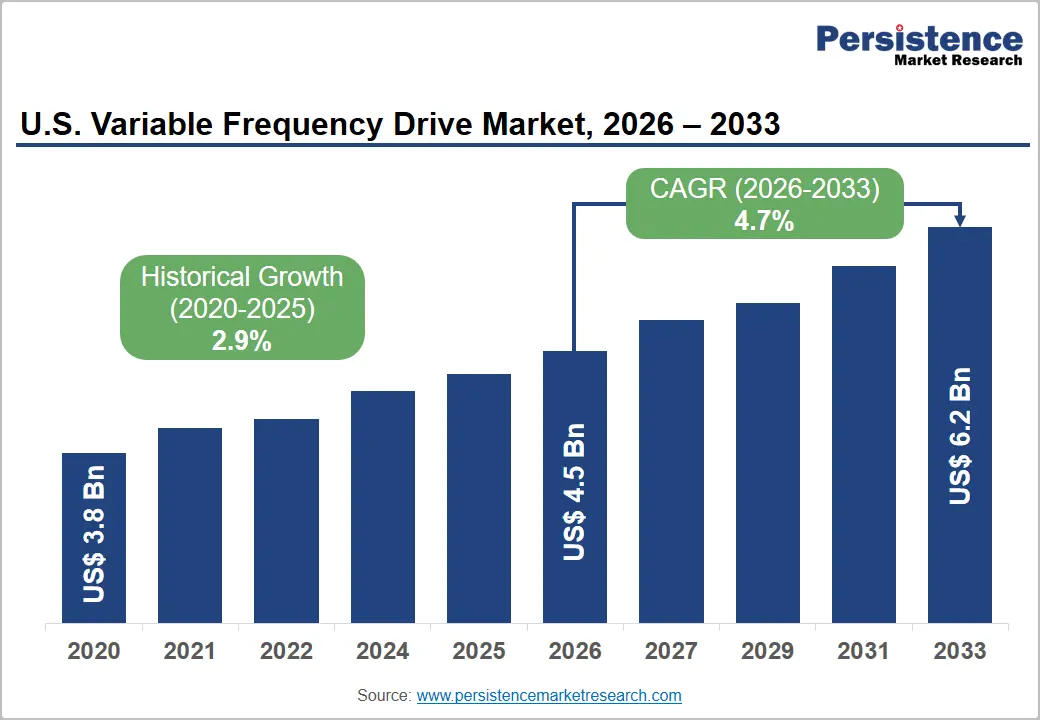
The U.S. variable frequency drive market is expected to be valued at US$ 4.5 billion in 2026 and is projected to reach US$ 6.2 billion, growing at a CAGR of 4.7% between 2026 and 2033.
Mandatory energy efficiency standards from the U.S. Department of Energy are pushing industries to retrofit fixed-speed motor systems with VFDs. The Inflation Reduction Act further accelerates adoption by incentivizing industrial decarbonization and energy efficiency upgrades. Given that electric motors account for nearly 70% of industrial electricity consumption, VFDs are becoming a critical solution for reducing energy use and operating costs. This creates a structurally sustained demand across manufacturing, utilities, and commercial sectors.
Key Industry Highlights:
- Leading Product Type: AC Drives dominate the market with over 67.0% share in 2026, valued at approximately US$ 3.02 Billion, driven by their wide compatibility with three-phase induction motors across industrial and commercial systems such as HVAC, water treatment, and oil & gas.
- Leading Power Rating: The 6-40 kW range leads the market, accounting for around 40.0% share in 2026, valued at nearly US$ 1.80 Billion, supported by extensive use in pumps, HVAC systems, and municipal infrastructure where variable-speed efficiency is critical.
- Leading Application: Pumps are likely to represent the largest application segment with nearly 30% share in 2026, valued at about US$ 1.35 billion, driven by widespread deployment in water treatment, industrial processing, and oil & gas systems requiring efficient flow control.
- Fast-Growing Application: Fans and blowers are the fastest-growing application, supported by rising demand from data centers, ventilation systems, and stricter air quality and energy efficiency regulations.
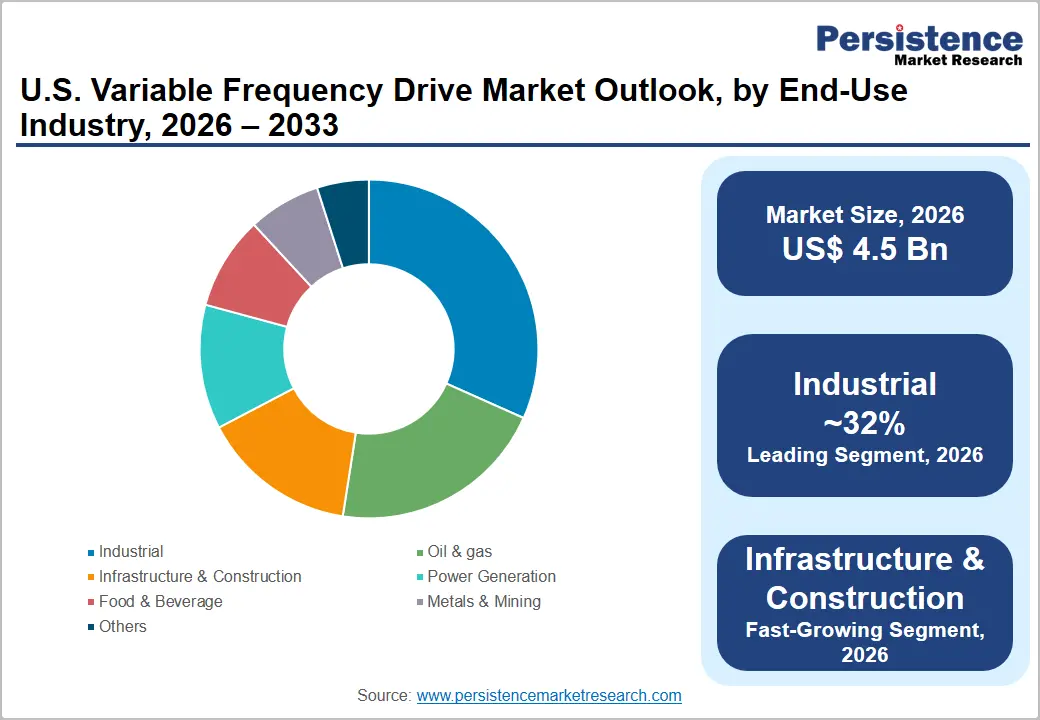
- Leading Industry: Industrial segment dominates with over 32.0% share in 2026, valued at more than US$ 1.44 Billion, supported by heavy use in manufacturing, automation, conveyors, and process control systems.
- Leading Zone: The Southeast U.S. leads the market with around 27% share, supported by the strong presence of petrochemical, pulp & paper, food processing, and automotive manufacturing industries, along with rising logistics infrastructure demand. The Midwest zone growth is driven by automotive production clusters and increasing hyperscale data center investments, which are significantly expanding demand for high-load, precision motor control systems.
Market Dynamics
Drivers - Mandatory Motor Efficiency Regulations Compelling Broad-Based VFD Adoption
The U.S. Department of Energy (DOE) has progressively tightened motor efficiency standards under EISA-aligned rulemakings, expanding coverage of general-purpose motors typically in the 1-500 horsepower range across successive updates and classifications to NEMA Premium efficiency levels. This has increased the economic unattractiveness of fixed-speed motor operation in pumps, fans, and compressor systems. As a result, industrial users are increasingly shifting toward VFD-based control to meet compliance and energy-saving targets.
HVAC and industrial retrofit activity are being further reinforced by ASHRAE 90.1 updates that continue to strengthen building energy performance requirements across commercial facilities.
Reshoring and Advanced Manufacturing Investment Creating Fresh Greenfield VFD Demand
Large-scale U.S. industrial policy initiatives such as the CHIPS and Science Act ~US$52 billion in semiconductor incentives and the Infrastructure Investment and Jobs Act are indirectly accelerating demand for precision motor control systems. These investments enabling a new wave of semiconductor fabs, EV supply chains, and advanced manufacturing facilities, all of which require VFDs for HVAC, process cooling, and automation systems from the design stage. Intel’s Ohio semiconductor campus investment is a representative example of such greenfield deployments. Between 2025 and 2028, these projects are expected to meaningfully shift VFD demand toward new installations rather than retrofits.
Restraints - High Upfront Capital Cost and Extended Payback Periods Suppressing Adoption in SME
VFD adoption remains constrained among small and mid-sized manufacturers, which account for nearly 90-95% of U.S. manufacturing establishments. These firms often require payback periods under 18-24 months for capital investments, while VFD retrofits typically deliver returns over 2-4 years, depending on load profiles. Limited access to consistent utility rebates further slows adoption, as incentive programs vary significantly across U.S. states. This uneven policy landscape reduces financial predictability and delays procurement decisions in cost-sensitive segments.
Supply Chain Constraints and Semiconductor Dependency Risks
VFD systems rely heavily on insulated-gate bipolar transistors (IGBTs), making them sensitive to semiconductor supply chain disruptions. During 2021-2023, global shortages significantly extended lead times, in some cases reaching 30-50 weeks. While conditions have improved, supply volatility remains a structural risk due to ongoing geopolitical restrictions on advanced semiconductor manufacturing equipment and capacity concentration in a few zones. Smaller distributors and OEMs remain disproportionately exposed, as they lack priority allocation with major semiconductor suppliers.
Opportunities - Grid-Interactive and Demand-Response Enabled VFD Systems
VFD manufacturers integrating communication protocols such as OpenADR 2.0 and IEEE 2030.5 position drives as grid-responsive assets rather than standalone efficiency tools. This enables industrial users to participate in demand-response programs and potentially generate additional revenue streams through grid services. The U.S. Department of Energy has identified grid-interactive efficient equipment as a priority pathway for industrial decarbonization. As standardization improves, VFD systems with embedded connectivity are expected to gain a pricing premium and wider adoption in utility-driven efficiency programs.
Data Center Expansion Driving Precision Cooling Demand
Rapid growth in hyperscale and enterprise data centers is creating sustained demand for high-efficiency VFDs in HVAC and chilled water systems. These facilities require continuous, precision-controlled cooling loads where variable speed operation significantly reduces energy consumption. While investment figures vary by operator and geography, major technology firms are collectively committing multi-billion-dollar capital expenditures toward U.S. data center expansion. Regions such as Virginia and the Midwest are emerging as key hubs, supporting long-term VFD demand from mechanical, electrical, and plumbing (MEP) system integration in large-scale facilities.
Category-wise Analysis
Product Type Insights
AC drives dominate the market, accounting for over 67% share in 2026, reaching US$ 3.02 billion, driven by compatibility with the large installed base of three-phase induction motors across industrial and commercial facilities. These drives are widely deployed in water and wastewater systems, HVAC networks, and oil and gas operations where stable and efficient speed control is essential. Their strong safety certifications, reliability, and ease of integration make them the default choice for capital-intensive projects. They also support energy optimization across continuously operating mechanical systems.
Servo drives represent the fast-growing segment, supported by rising deployment in robotics and precision manufacturing systems. They are increasingly used in automotive and electronics production lines requiring high-speed, accurate motion control. These drives enable sub-millisecond torque response, which is critical for advanced automation and flexible manufacturing setups. Growth is also supported by the shift toward smart factories and multi-axis coordinated motion systems. Their adoption is strongest where precision and productivity enhancement are prioritized.
Power Rating Insights
The 6-40 kW power rating band leads the U.S. variable frequency drive market, representing 40.0% of total market value in 2026, exceeding to US$ 1.80 Billion. This segment aligns closely with commonly deployed motor sizes in pumps, HVAC systems, and municipal infrastructure. It is extensively used in centrifugal pump applications where variable-speed operation improves efficiency under partial-load conditions. Its popularity is reinforced by broad product availability and faster procurement cycles. This range is also preferred for retrofit projects in commercial and public facilities.
The up to 5 kW segment is the fastest growing due to the expansion of smart buildings and distributed HVAC control systems. It is increasingly adopted in commercial retrofits aimed at improving energy efficiency and reducing operational expenditure. These drives integrate seamlessly with building automation platforms, supporting remote monitoring and control. The demand is further supported by compact system designs in modern infrastructure upgrades. Growth is strongest in commercial properties transitioning toward digital energy management systems.
Application Insights
Pumps constitute the leading application segment commanding nearly 30% share in 2026, equivalent to US$ 1.35 billion, driven by extensive use across water treatment plants, oil and gas pipelines, and industrial fluid systems. Variable-speed operation improves energy efficiency by optimizing flow control under varying load conditions. It also reduces mechanical wear, enhancing equipment lifespan and operational stability. Pumping systems remain the most consistent source of VFD deployment across utilities and process industries.
Fans and blowers represent the fast-growing application, supported by rising deployment in data centres and industrial ventilation systems. These systems require precise airflow regulation to maintain temperature stability and process efficiency. Regulatory pressures on emissions and air quality control further accelerate adoption. VFDs are widely used in forced-draft and cooling applications where continuous adjustment is required. The growth is particularly strong in infrastructure requiring high-efficiency thermal and air management systems.
Industry Insights
Industrial segment is expected to hold the market share over 32%, surpassing value of US$1.44 billion, supported by the extensive use of motor-driven systems in manufacturing, processing, and assembly operations. VFDs enhance operational consistency across conveyors, compressors, and automated production lines. They also contribute to improved energy utilization and reduced equipment stress in high-utilization environments. Industrial facilities rely on them for maintaining precision and productivity across diverse processes.
Infrastructure and construction represent the fast-growing industry, driven by large-scale modernization of transportation and utility systems. Applications include tunnel ventilation, escalators, pumping stations, and bridge mechanisms requiring controlled motor operation. Expansion of urban transit systems and public infrastructure upgrades is accelerating deployment. These systems prioritize efficiency, reliability, and operational control in continuously running equipment.
Zone-Wise Insights
West U.S. Variable Frequency Drive Market
West U.S. Variable Frequency Drive Market is expected to hold a share over 20% in 2026, led by California, Washington, and Oregon, represents one of the most regulation-driven VFD demand zones in the country. California’s Title 20 efficiency standards mandate variable-speed operation in applications such as pool pumps and commercial HVAC systems, structurally embedding VFD adoption. The zone semiconductor and advanced technology manufacturing ecosystem across Silicon Valley and the Pacific Northwest sustains continuous demand from cleanroom and precision-controlled facilities. California’s SB 100 clean energy mandate further accelerates renewable integration, reinforcing grid-interactive VFD deployment.
Midwest U.S. Variable Frequency Drive Market
The Midwest, covering Illinois, Ohio, Michigan, Indiana, and Wisconsin represents the densest concentration of heavy industrial VFD demand in the United States. Automotive manufacturing and supply chains anchored by Ford, General Motors, and Stellantis generate sustained deployment across conveyors, presses, and paint shop systems. Steel, food processing, and general manufacturing facilities further reinforce baseline demand for motor control efficiency upgrades. Emerging hyperscale data centre investments, including Microsoft’s US$ 3.3 Billion Wisconsin campus announced in 2024, are creating a new high-load digital infrastructure segment.
Southeast U.S. Variable Frequency Drive Market
The Southeast U.S. leads all zones with an estimated 27% share of the U.S. variable frequency drive market, underpinned by the region's concentration of pulp and paper mills, petrochemical complexes along the Gulf Coast, poultry and food processing facilities, and a growing automotive manufacturing base in Alabama, Tennessee, South Carolina, and Georgia. The Port of Savannah, the fastest-growing container port in the United States, according to U.S. Army Corps of Engineers data, is driving logistics and warehousing infrastructure investment that directly requires VFD-controlled conveyor and material handling systems. The zone relatively lower industrial electricity tariffs historically moderated retrofit urgency, but rising rates from Duke Energy and Southern Company are now shifting the cost calculus firmly toward variable-speed adoption.
Northeast U.S. Variable Frequency Drive Market
Northeast, including New York, New Jersey, Pennsylvania, Massachusetts, and Connecticut, sustains demand through high-density commercial infrastructure and regulated energy environments. Commercial HVAC systems across major metropolitan real estate markets represent a core adoption segment for VFDs. State-level climate policies such as New York’s CLCPA mandate a 70% renewable electricity supply by 2030, strengthening demand-side efficiency requirements and load management strategies.
Pharmaceutical and biotech manufacturing clusters across the New Jersey-Pennsylvania corridor rely heavily on VFD-controlled HVAC and process systems to meet strict environmental and compliance standards. Transit modernization and grid optimization initiatives further reinforce steady, regulation-backed VFD deployment.
Competitive Landscape
The U.S. variable frequency drive market is characterized by a moderately concentrated oligopolistic structure, with a small group of global industrial automation leaders accounting for a significant share of total revenues. These players maintain dominance through long-established relationships with industrial OEMs and extensive distributor ecosystems across key end-use sectors. Companies are also prioritizing lifecycle value by offering tools that optimize energy consumption and reduce the total cost of ownership for industrial users. A strong emphasis is being placed on developing solutions tailored for HVAC, water, and wastewater retrofit applications, where efficiency gains are highly measurable.
Key Developments:
- In March 2026, Invertek Drives will showcase its dedicated HVAC-R variable frequency drive (VFD) solutions at ARBS 2026, highlighting energy-efficient motor control technologies for heating, ventilation, air conditioning, and refrigeration applications. The company will feature its Optidrive range designed to improve system efficiency and performance in HVAC environments.
- In September 2025, INVT introduced a 30 MVA medium-voltage, water-cooled Variable Frequency Drive system designed for high-power industrial motor control applications. The solution is aimed at improving efficiency, reliability, and performance in heavy industries such as metallurgy, mining, and energy.
Companies Covered in U.S. Variable Frequency Drive Market
- ABB Ltd.
- Siemens AG
- Schneider Electric SE
- Danfoss A/S
- Rockwell Automation, Inc.
- Yaskawa Electric Corporation
- Mitsubishi Electric Corporation
- Fuji Electric Co., Ltd.
- TMEIC Corporation
- GE Vernova Inc.
- Nidec Corporation
- Delta Electronics, Inc.
- WEG S.A.
- Eaton Corporation plc
- Others
Frequently Asked Questions
The U.S. variable frequency drive market is valued at US$ 4.5 Billion in 2026 and is forecast to reach US$ 6.2 Billion, growing at a CAGR of 4.7% due to increasing demand for energy-efficient motor control driven by industrial decarbonization and mandatory efficiency standards.
The growth is primarily driven by the need to reduce industrial energy consumption and comply with tightening efficiency codes. Large-scale manufacturing expansion and stricter HVAC energy regulations are also pushing widespread adoption of VFD systems.
AC drives dominate with over 67.0% share due to their essential role in controlling widely used induction motors. Their continued dominance is driven by the need for cost-effective, reliable speed control across industrial and utility applications.
Southeast U.S. leads demand, supported by dense industrial operations and strong manufacturing expansion. Rising electricity costs and the need for operational efficiency are accelerating large-scale VFD retrofits in the zone.
A key opportunity lies in grid-responsive VFDs that help industries participate in demand-response programs. The need to monetise energy flexibility and improve grid efficiency is creating a shift toward software-enabled VFD solutions.
The leading companies include ABB Ltd., Siemens AG, Schneider Electric SE, Danfoss A/S, Rockwell Automation, Inc., Yaskawa Electric Corporation, Mitsubishi Electric Corporation, Fuji Electric Co., Ltd. among others.


