




- Specialty & Fine Chemicals
- U.S. Ion Exchange Resin Market
U.S. Ion Exchange Resin Market Size, Share, and Growth Forecast 2026 - 2033
U.S. Ion Exchange Resin Market by Resin Type (Cation Exchange Resin, Anion Exchange Resin, Misc.), Industry (Power, Chemicals & Petrochemicals, Water & Wastewater Treatment, Food & Beverages, Electrical & Electronics, Pharmaceuticals, Metals & Mining, Oil & Gas), and Regional Analysis, 2026 - 2033

U.S. Ion Exchange Resin Market Size and Trend Analysis
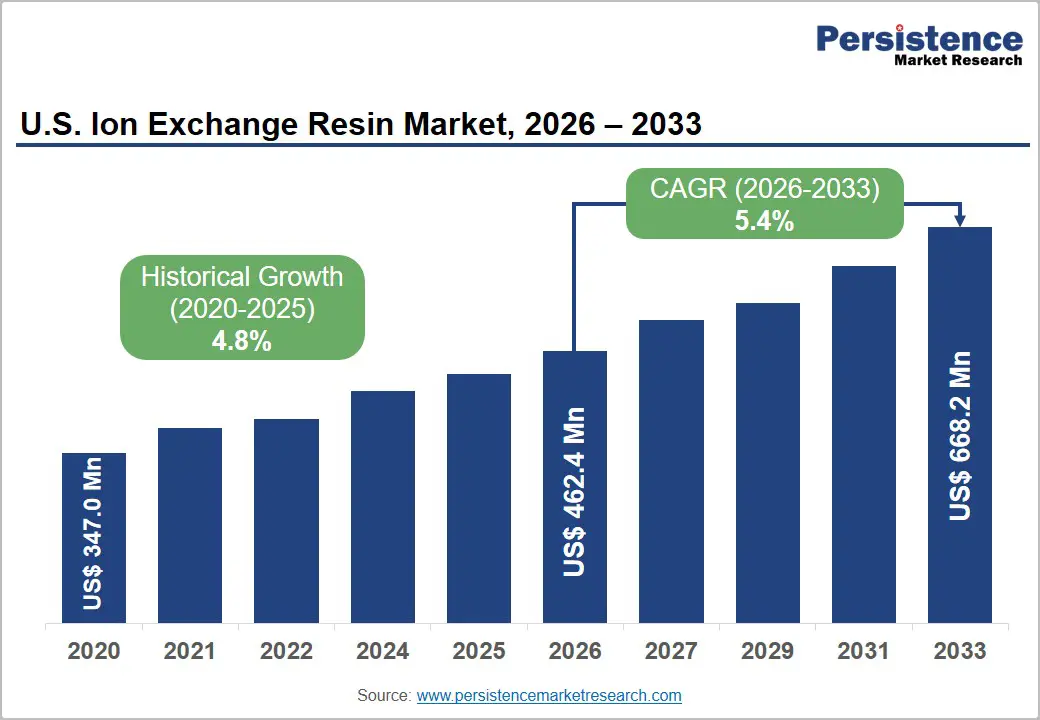
The U.S. Ion Exchange Resin market size is expected to be valued at US$ 464.6 Million in 2026 and projected to reach US$ 671.4 Million by 2033, growing at a CAGR of 5.4% between 2026 and 2033.
Demand expansion is being shaped by tightening federal drinking water standards, accelerating domestic semiconductor capacity, and the maturation of selective ion exchange as a commercial Direct Lithium Extraction technology.
The U.S. Environmental Protection Agency finalised enforceable Maximum Contaminant Levels for PFOA and PFOS at 4.0 parts per trillion in April 2024, anchoring a long procurement cycle for anion exchange media. Simultaneously, the CHIPS and Science Act has catalyzed more than US$540 billion in announced private fabrication investment, lifting ultrapure water demand across the West and Southwest, while the Inflation Reduction Act has unlocked a battery materials build-out that increasingly relies on selective resin chemistry.
Key Market Highlights
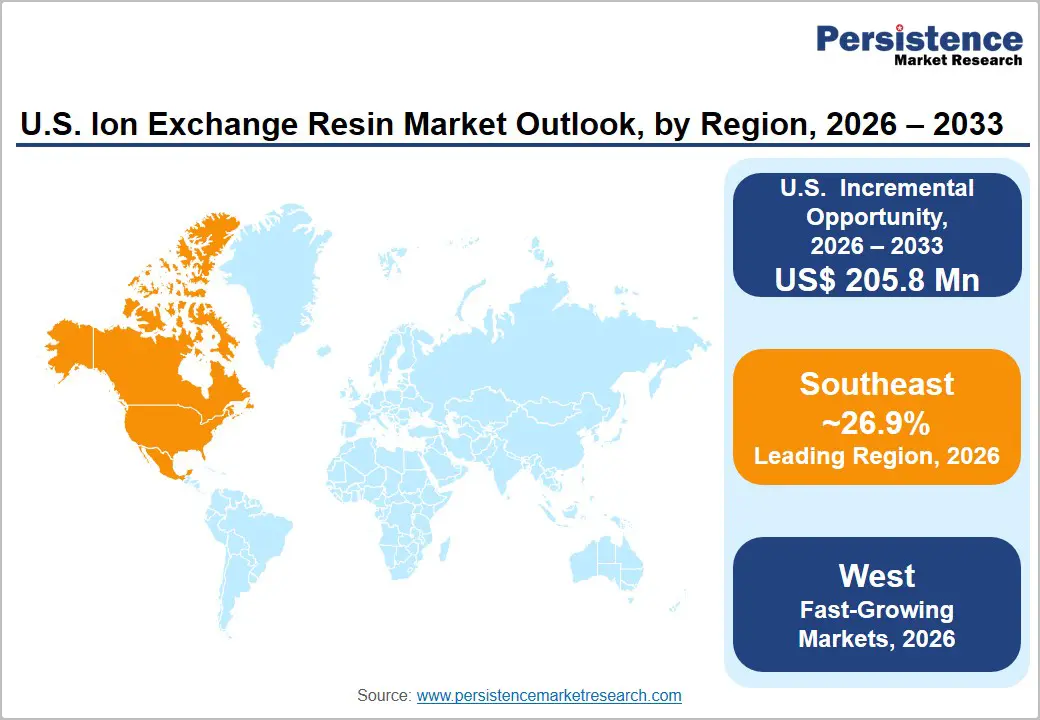
- Leading Region: Southeast U.S. leads the Ion Exchange Resin market with a 26.9% share in 2026, valued at US$ 124.4 Million, anchored by Gulf Coast petrochemicals, Florida surface water nitrate standards, and concentrated Southeast food, paper, automotive, and battery manufacturing operations.
- Fast-Growing Region: The West U.S. is the fastest-growing region, propelled by Arizona semiconductor fabs requiring 18.2 megohm-cm ultrapure water, California PFAS remediation mandates, and Nevada-California lithium Direct Lithium Extraction projects backed by federal critical minerals funding.
- Leading Resin Type: Cation Exchange Resin dominates the U.S. market with 50% share in 2026, supported by entrenched use across power plant condensate polishing, industrial demineralisation, municipal water softening, and high-fructose corn syrup decolourization applications operating nationwide.
- Fast Growing: Anion Exchange Resin is the fastest-growing resin type at 6% CAGR through 2033, propelled by EPA PFAS Maximum Contaminant Level enforcement, semiconductor ultrapure water polishing, nitrate removal, and lithium DLE adoption across western United States operators.
- Key Opportunity: Lithium brine extraction via selective ion exchange represents a transformative opportunity, with US$100 billion in Inflation Reduction Act battery investment and the Salton Sea geothermal reserves positioning U.S. operators to scale domestic critical minerals supply meaningfully.
DRO Analysis
Drivers - Federal PFAS Regulations Reshape Municipal Treatment Procurement
In April 2024, the U.S. Environmental Protection Agency finalised the National Primary Drinking Water Regulation, establishing enforceable Maximum Contaminant Levels of 4.0 parts per trillion for PFOA and PFOS, with compliance deadlines for public utilities by 2029. The Agency estimates more than 6,700 public water systems must deploy advanced treatment, and anion exchange resins are one of three EPA-listed Best Available Technologies for PFAS removal.
The Infrastructure Investment and Jobs Act has allocated US$9 billion specifically for PFAS and emerging contaminant remediation, of which approximately US$4 billion is channelled through the Drinking Water State Revolving Fund, anchoring multi-year procurement contracts for selective anion exchange media across California, New Jersey, Michigan, and North Carolina utilities.
Domestic Semiconductor Build-Out Anchors Ultrapure Water Demand
The CHIPS and Science Act, signed in August 2022, has catalyzed more than US$540 billion in announced private semiconductor investment across the United States as of December 2024, according to the Semiconductor Industry Association.
A single leading-edge fabrication facility consumes 5 to 10 million gallons of ultrapure water daily, and mixed-bed strong acid cation and strong base anion resins are essential to achieving the 18.2 megohm-cm resistivity required for wafer rinsing. With Intel commissioning its Ohio One campus, TSMC ramping Arizona Fab 21, Samsung advancing Taylor, Texas, and Micron preparing its Idaho and New York expansions, the Southwest and West have emerged as concentrated demand centres for electronic-grade ion exchange media procurement.
Restraints - Volatile Styrene and Divinylbenzene Feedstock Pricing Compresses Margins
Ion exchange resins are predominantly polystyrene-divinylbenzene copolymers, and the U.S. Energy Information Administration reports that styrene contract prices have fluctuated between US$ 800 and US$ 1,450 per metric ton during the 2022 to 2024 window. Divinylbenzene supply remains concentrated among a handful of global producers, exposing domestic converters to logistical disruption and tariff exposure on Asian imports.
Smaller U.S. speciality formulators that lack vertical integration into monomer production have absorbed margin compression, constraining capital expenditure on new capacity and slowing technology refresh across regional regenerators.
Spent Resin Disposal Liability Under CERCLA Complicates Operations
The U.S. EPA's April 2024 designation of PFOA and PFOS as hazardous substances under CERCLA has materially altered disposal economics for anion exchange resins used in PFAS removal. Spent media saturated with bioaccumulative contaminants now require incineration at temperatures above 1,100 degrees Celsius, with treatment costs ranging from US$ 2,000 to US$ 4,500 per cubic meter, according to research. Beyond cost, operators face long-tail liability under Superfund provisions, prompting several municipal utilities to delay procurement decisions until federal cost-recovery frameworks mature.
Opportunities - Direct Lithium Extraction Unlocks a New Commercial Application
The U.S. Inflation Reduction Act has triggered more than US$ 100 billion in announced battery and critical mineral investment, and selective ion exchange has emerged as a leading commercial Direct Lithium Extraction (DLE) pathway. The U.S. Geological Survey identifies the Salton Sea geothermal field in California as holding sufficient lithium-in-brine to supply approximately 10 times current U.S. battery demand, and operators including Controlled Thermal Resources and EnergySource Minerals have selected ion exchange-based DLE for commercial scale-up.
Beyond primary extraction, custom chelating resins are deployed for cobalt, nickel, and lithium recovery from spent battery streams, aligning with the U.S. Department of Energy's Battery Materials Processing Grant Program that allocated US$2.8 billion across 21 domestic projects.
Biopharmaceutical Downstream Processing Drives Premium Speciality Resin Demand
The U.S. Food and Drug Administration approved 55 novel drugs in 2023, with monoclonal antibodies, recombinant proteins, and cell therapies representing a sustained majority of the pipeline, according to the Center for Drug Evaluation and Research. Each gram of purified therapeutic protein requires approximately 5 to 15 grams of chromatography-grade ion exchange resin for capture and polishing steps.
The National Biotechnology and Biomanufacturing Initiative, established by executive order in September 2022, committed more than US$2 billion in federal funding to domestic biomanufacturing, encouraging the reshoring of contract development and manufacturing organisation capacity. Speciality resin suppliers, including Cytiva, Bio-Rad Laboratories, and Purolite, have commissioned U.S.-based GMP-grade resin production lines to serve this premium application segment.
Category-wise Analysis
Resin Type Insights
Cation exchange resin is likely to account for the leading position with an estimated 50% share of the U.S. Ion Exchange Resin market in 2026, anchored by entrenched use in industrial water softening, condensate polishing, and demineralisation across thermal and nuclear power generation. According to the U.S. Energy Information Administration, the United States operates 93 commercial nuclear reactors and approximately 215 GW of natural gas combined-cycle capacity, all of which deploy strong acid cation resins for makeup water treatment.
Cation resins also serve as the workhorse in food-grade applications such as high-fructose corn syrup demineralisation and sugar decolourisation, where the U.S. Department of Agriculture reports domestic HFCS production of nearly 7.1 million metric tons in 2023, sustaining recurring procurement volumes.
Industry Insights
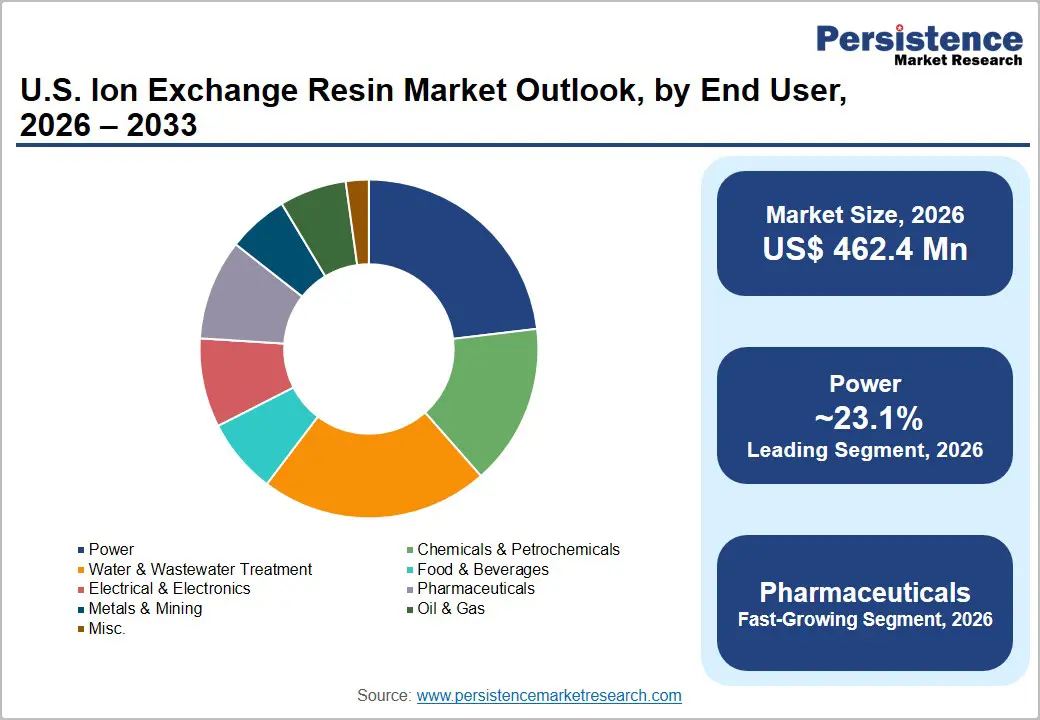
Water & Wastewater Treatment retains the dominant end-use position, accounting for approximately 32% of U.S. Ion Exchange Resin demand in 2026, supported by both municipal and industrial procurement cycles. The U.S. Environmental Protection Agency's Seventh Drinking Water Infrastructure Needs Survey, published in September 2023, identified a 20-year capital requirement of US$625 billion to maintain compliant drinking water service, a meaningful portion of which is directed toward contaminant removal trains relying on ion exchange. The American
Water Works Association estimates more than 30,000 community water systems must address nitrate, arsenic, uranium, or PFAS contamination, with ion exchange representing an EPA-listed Best Available Technology. Concurrent zero-liquid-discharge mandates in Texas and California reinforce industrial volumes.
Regional Insights
U.S. Ion Exchange Resin Market Trends and Insights
The U.S. Ion Exchange Resin market exhibits sharp regional differentiation shaped by industrial concentration, utility regulation, and proximity to feedstock chemistry hubs. Demand anchors in Gulf Coast chemical clusters, Southeast advanced manufacturing corridors, and emerging Southwest semiconductor hubs, while federal PFAS regulations and lithium Direct Lithium Extraction activity lift speciality procurement across western and southwestern utilities and operators nationwide.
The United States is likely to register 78% market share in 2026, reflecting the depth of domestic chemicals, power, semiconductor, and pharmaceutical operations that underpin recurring demand for both commodity and specialty ion exchange media. The regulatory tailwind from federal PFAS rules, combined with the CHIPS Act and Inflation Reduction Act capital cycles, positions the U.S. as the structurally largest and most innovation-intensive North American market for ion exchange technology.
Southeast Ion Exchange Resin Market Size
The Southeast U.S. ion exchange resin market is valued at US$ 124.4 Million in 2026, driven by the dense petrochemical and refining complex along the Louisiana Gulf corridor, Florida's stringent surface water nitrate and total organic carbon limits enforced by the Florida Department of Environmental Protection, and the concentrated cluster of pulp, paper, and food-and-beverage processing operations across Georgia, Alabama, and the Carolinas. Hyundai's Metaplant America in Bryan County, Georgia, and BMW's Plant Spartanburg expansion further anchor industrial-grade demineralisation and chromatography resin demand.
West Ion Exchange Resin Market Size
The West U.S. Ion Exchange Resin Market is valued at US$ 80.0 Million in 2026 and represents the fastest-growing region, propelled by Arizona's TSMC Fab 21 and Intel Ocotillo campus requiring ultrapure water at 18.2 megohm-cm resistivity, California's nitrate and PFAS remediation mandates enforced by the State Water Resources Control Board, and Nevada-California lithium DLE pilots at Thacker Pass and the Salton Sea geothermal field, supported by federal critical minerals funding under the U.S. Department of Energy.
Competitive Landscape
The U.S. ion exchange resin market exhibits a moderately consolidated structure, with the top five global producers estimated to account for 65%–70% of domestic supply. Key market participants include DuPont, Purolite, LANXESS, Mitsubishi Chemical Group, Thermax Limited, and ResinTech, which maintain a strong presence across industrial water treatment, power generation, food processing, pharmaceutical purification, and advanced manufacturing applications.
Multinational specialty chemical majors leverage vertically integrated polystyrene-divinylbenzene monomer pipelines, GMP-grade manufacturing certifications, and proprietary functionalization chemistries to defend premium positions in semiconductor, biopharmaceutical, and lithium extraction applications. Smaller regional regenerators compete on service-led models, including off-site resin regeneration, mobile demineralisation trailers, and performance contracting.
Recent strategic activity centres on capacity expansions on U.S. soil, acquisitions of speciality chelating resin portfolios, and joint development agreements with semiconductor fabs and DLE operators. Sustainability differentiation through bio-based monomer chemistry, halogen-free synthesis routes, and closed-loop regeneration is emerging as a key competitive lever shaping procurement decisions.
Key Developments:
- In September 2023, DuPont introduced AmberLite™ P2X110 Ion Exchange Resin, its first dedicated ion exchange resin solution developed specifically for green hydrogen production applications. The product was engineered for electrolyser loop chemistry and designed to improve contaminant removal efficiency while extending resin service life under challenging thermal and chemical operating conditions.
- In March 2026, Birchtech expanded its water treatment portfolio through the launch of its SEA-IX™ nuclear-grade ion exchange resin product line, marking the company’s entry into the high-purity ion exchange resin market. The portfolio includes strong acid cation (SAC), strong base anion (SBA), and mixed-bed resin formulations designed for nuclear power systems and other high-purity industrial applications.
Companies Covered in U.S. Ion Exchange Resin Market
- Mitsubishi Chemical Corporation
- LANXESS
- DuPont
- Thermax Limited
- Graver Technologies
- Purolite
- DOSHION POLYSCIENCE PVT. LTD.
- Aldex Chemical Company, Ltd.
- Asha Resins Ltd
- Cytiva
Frequently Asked Questions
The U.S. ion exchange resin market size is likely to be valued at US$ 464.6 Million in 2026, reflecting both replacement demand and new build activity across power, chemicals, and water utility end-uses. The forecast acceleration reflects regulatory step-changes and capital-intensive new-build activity in semiconductors and battery materials.
Federal PFAS drinking water rules finalised by the U.S. EPA in April 2024, combined with CHIPS Act-driven semiconductor ultrapure water demand, are the most influential demand drivers shaping near-term procurement cycles. The EPA has mandated 4.0 parts per trillion Maximum Contaminant Levels for PFOA and PFOS by 2029, while more than US$540 billion in announced semiconductor capacity is lifting ultrapure water resin demand in Arizona, Texas, Ohio, and New York. These two demand vectors together account for the majority of incremental procurement through the forecast horizon.
The Southeast U.S. leads with an estimated 26.9% market share in 2026, valued at US$ 124.4 Million, supported by Gulf Coast petrochemicals, Florida regulatory standards, and Southeast advanced manufacturing operations across automotive, electric vehicle battery assembly, and food-and-beverage processing.
Selective ion exchange for Direct Lithium Extraction at the Salton Sea and Nevada brine projects, supported by US$100 billion in Inflation Reduction Act battery investment, represents the most significant near-term growth opportunity. Concurrently, biopharmaceutical downstream processing for monoclonal antibodies and cell therapies, backed by the National Biotechnology and Biomanufacturing Initiative, is driving premium speciality resin demand from CDMOs reshoring manufacturing capacity to domestic facilities.
Major participants include Purolite (an Ecolab company), DuPont de Nemours, LANXESS AG, Mitsubishi Chemical Group, Dow Inc., Thermax Limited, ResinTech), and Others competing across commodity demineralisation, food-grade, semiconductor-grade, GMP pharmaceutical, and lithium-selective speciality segments.


