




- Specialty & Fine Chemicals
- Distearyl Amine Market
Distearyl Amine Market Size, Share, and Growth Forecast, 2026 - 2033
Distearyl Amine Market by Application (Personal Care & Cosmetics, Oilfield Chemicals, Industrial Coatings, Plastic & Polymer Additives, Textile & Fiber Processing), Form (Liquid Formulations, Solid/Flaked Products), And Regional Analysis for 2026 - 2033

Distearyl Amine Market Size and Trends Analysis
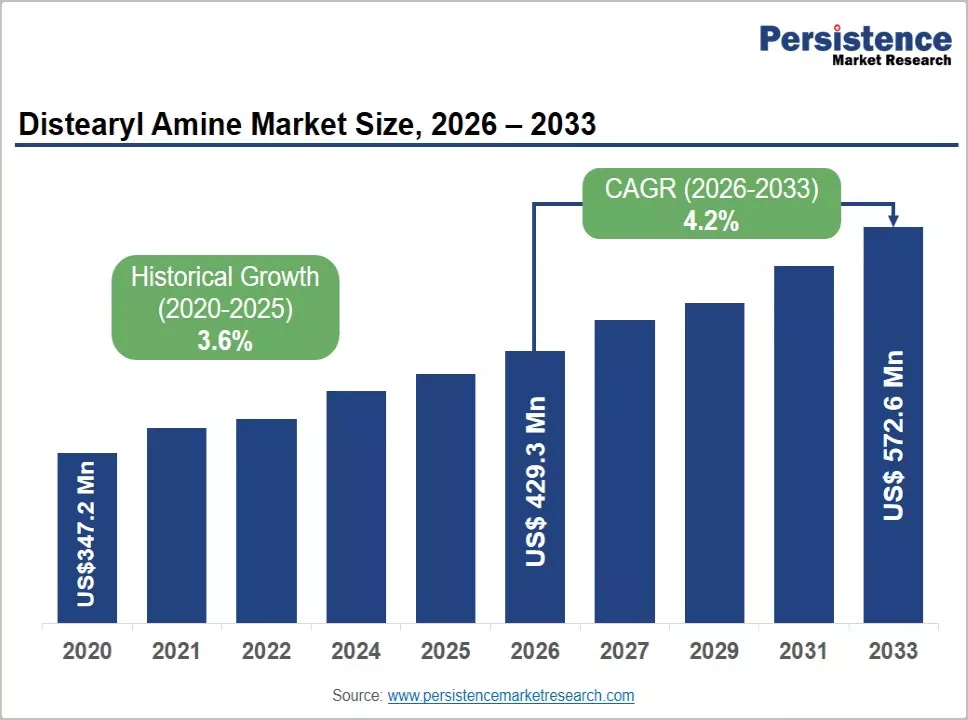
The global distearyl amine market size is likely to be valued at US$ 429.3 million in 2026 and is expected to reach US$ 572.6 million by 2033, growing at a CAGR of 4.2% during the forecast period from 2026 to 2033. This growth is driven by the use of this long-chain fatty amine as an intermediate and functional additive across conditioning, antistatic, corrosion inhibition, and surface treatment applications.
Producers derive it from stearic acid-based oleochemical feedstocks, linking supply to palm, tallow, and other fat and oil sources. Demand is supported by the personal care, oilfield, polymer, and textile industries, while capacity expansions in specialty amines are improving regional supply availability.
Key Industry Highlights
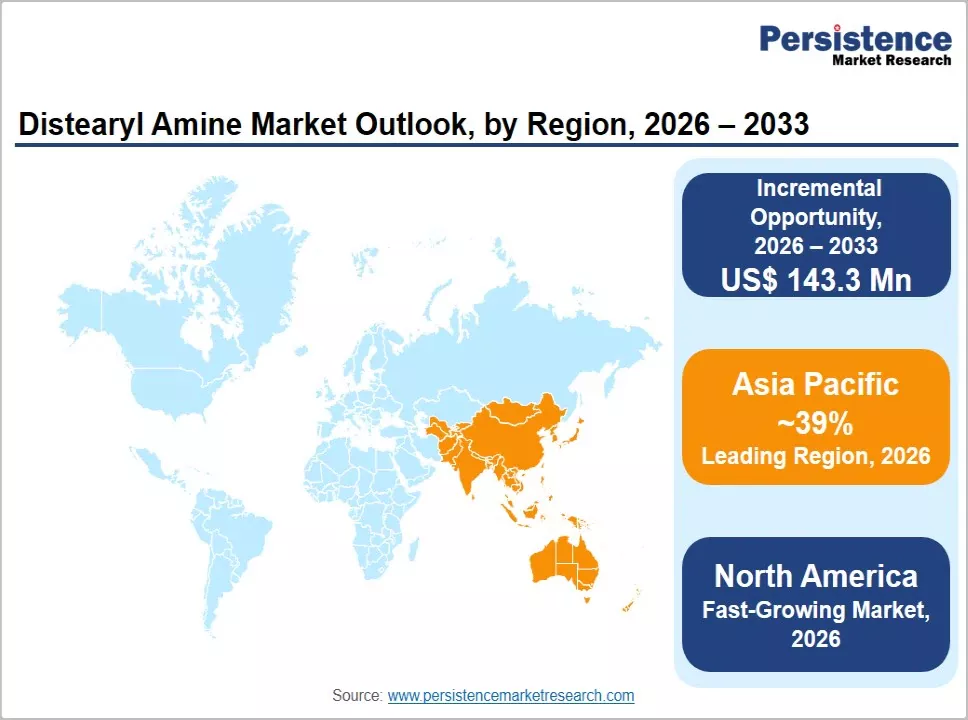
- Leading Region: Asia Pacific is anticipated to be the leading region, accounting for a market share of 39% in 2026, driven by a large oleochemical base and strong personal care and textile manufacturing industries.
- Fastest-Growing Region: North America is likely to be the fastest-growing region, supported by growing oil and gas activity, industrial investment, and expanding downstream chemical demand.
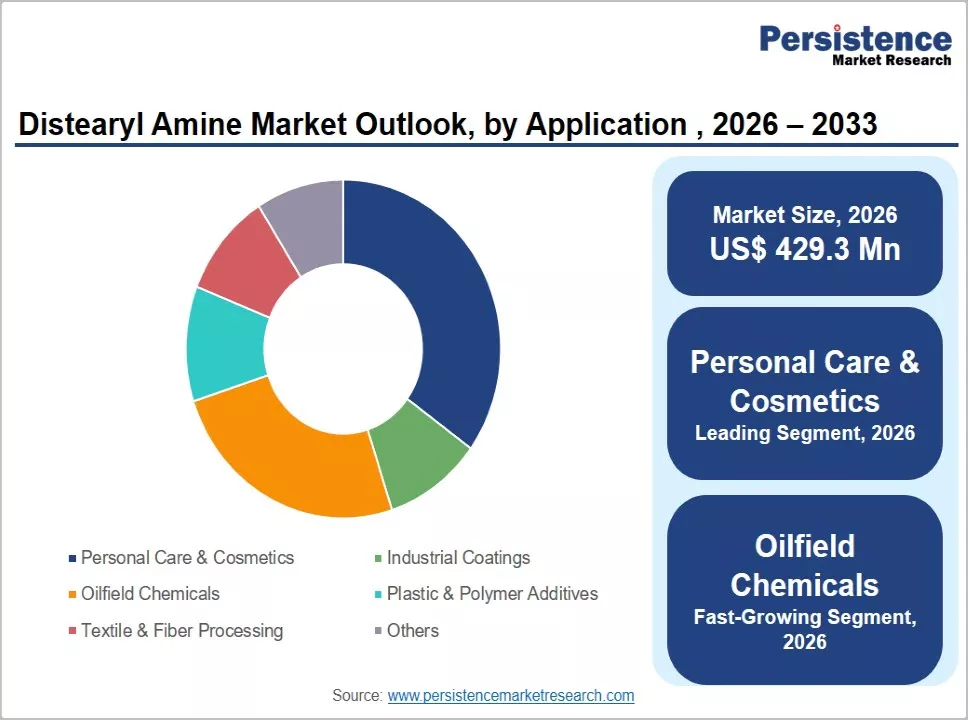
- Leading Application: Personal care & cosmetics represent the leading application, accounting for 32% of the market share in 2026, owing to the use of fatty amine derivatives in conditioners, emulsifiers, and cosmetic formulations.
- Leading Form: Solid/flaked products are anticipated to be the leading form, accounting for over 63% of the revenue share in 2026, as flakes are easier to store, transport, and use as intermediates for producing quaternary ammonium compounds.
- Key Opportunity: The key market opportunity lies in developing bio-based, high-purity, and application-specific distearyl amine grades for personal care, oilfield, and polymer additive applications, supported by regional production facilities located close to customers.
Market Dynamics
Driver - Growing Demand from Personal Care, Textile, and Industrial Additive Applications
Distearyl amine is a secondary fatty amine that can be converted into quaternary ammonium compounds and other derivatives that provide conditioning, softening, and antistatic properties. These functional benefits are valuable in hair and skin care, fabric treatment, and polymer processing. As consumers increasingly seek products with improved sensory properties and manufacturers focus on performance enhancement, demand for fatty amine intermediates remains steady.
Fatty amine producers are also investing in production capacity and regional supply networks. Kao opened a tertiary amine production plant in Pasadena, Texas, in August 2025, with an annual capacity of 20,000 tons, ramping up operations through the first quarter of 2026 to support North American demand. Although this expansion covers tertiary amines rather than distearyl amine specifically, it reflects broader investment in specialty amine production. Sustainability programs at large consumer goods companies are also influencing sourcing decisions, encouraging suppliers to document feedstock origin, energy consumption, and biodegradability data so that fatty amine derivatives meet retailer and regulatory expectations across global markets.
Industrial users add further demand diversity. Fatty amines function as corrosion inhibitors, emulsifiers, and mineral flotation agents and are used in asphalt and coating additives. Oilfield service companies use amine-based chemistries to protect pipelines and equipment, while plastics processors use them to reduce static buildup. This diversified customer base helps cushion the market against weakness in any single end-use industry. Growth in household products and fabric care also supports demand, as cationic conditioning agents derived from fatty amines remain widely used to provide softness, reduce static, and improve the handling of textiles and fibers during processing and finishing.
Restraint - Feedstock Price Swings, Regulatory Scrutiny, and Concentrated Supply
Production depends on fatty acids derived from palm, tallow, and other oils, making feedstock prices sensitive to agricultural commodity and energy cycles. Volatile feedstock costs can reduce margins and complicate pricing agreements with customers. Hydrogenation, ammonia, and catalyst requirements also add to production costs, while limited availability of certain feedstocks during poor harvests or trade disruptions can affect supply. Regulatory and sustainability expectations further influence market operations.
Amine derivatives used in personal care and cleaning products face evolving requirements related to biodegradability, aquatic toxicity, and labeling, while brand owners increasingly demand certified sustainable palm oil and traceable sourcing. Supply is concentrated among a limited group of specialty chemical companies, making plant outages and logistics disruptions potential sources of supply instability for smaller buyers. Handling requirements, including storage temperature control, corrosion-resistant equipment, and worker safety measures for amines, add costs for smaller converters and can discourage switching between suppliers or product grades.
Opportunity - Bio-Based Grades, Oilfield Growth, and Regional Capacity Additions
Producers can differentiate their offerings through bio-based and sustainably sourced grades. Arkema, for example, has continued developing its bio-based platform for fatty nitriles and fatty amines derived from castor oil, demonstrating how renewable feedstocks support premium product positioning. Certified sustainable palm sourcing and traceability systems also help suppliers meet brand requirements in personal care and household product applications.
Oilfield chemicals present another growth opportunity. Suppliers offering stable liquid formulations suited to field handling, alongside technical support, can establish long-term supply relationships with service companies and national operators. Regional capacity additions further strengthen market opportunities.
Local production reduces freight costs and lead times while supporting customers in Asia, the Middle East, and North America seeking greater supply security. Collaboration with downstream formulators on customized purity levels, flake sizes, and blends can create specialized products that command higher prices than commodity amines. Digital ordering, technical data support, and flexible packaging sizes further help suppliers serve small and medium-sized formulators, which often lack the purchasing volumes required to negotiate directly with large chemical manufacturers.
Category-Wise Analysis
Application Insights
Personal care & cosmetics represent the leading application segment, accounting for 32% of market share in 2026. Fatty amine derivatives are used in hair conditioners, skin care products, and emulsifier systems that provide softness, slip, and formulation stability. Formulators value consistent quality and low impurity levels, particularly for leave-on products. Growth in premium hair care and increasing demand for conditioning performance support steady purchases. Producers such as Kao and Croda supply surfactants and cationic ingredients to personal care manufacturers.
Oilfield chemicals are likely to be the fastest-growing application, supported by the use of amine-based compounds in corrosion inhibitors, drilling fluid additives, and emulsifiers. Industrial coatings, plastic and polymer additives, and textile and fiber processing continue to provide stable demand, with antistatic agents, softeners, and surface modifiers relying on fatty amine derivatives.
Form Insights
Solid/flaked products are projected to lead the market, capturing around 63% of the revenue share in 2026. Flakes are convenient to store, transport, and dose for downstream conversion into quaternary ammonium compounds and other derivatives. Their storage stability and relatively low transport costs make them preferable for large industrial customers, while consistent flake size and purity are important for maintaining uniform reaction performance.
Liquid formulations are likely to be the fastest-growing form, as customers increasingly seek ready-to-use blends that simplify handling and dosing, particularly in oilfield and coatings applications. Pre-dispersed or solvent-based formulations reduce heating and melting requirements, simplify handling, and allow faster incorporation into customer systems.
Regional Analysis
North America Distearyl Amine Market Trends
North America is likely to be the fastest-growing region in the distearyl amine market, supported by demand for specialty chemicals used in industrial formulations, chemical processing, corrosion inhibition, and surfactant production. Distearyl amine, a long-chain secondary amine, serves as a chemical intermediate in applications requiring hydrophobic properties and compatibility with selected formulation systems.
U.S. Distearyl Amine Market Trends
The U.S. is projected to dominate the North American market, holding around 88% of the regional market share in 2026, driven by demand for fatty amines and specialty intermediates used in industrial chemicals, water treatment, and lubricant formulations. Distearyl amine contributes to corrosion-control and surface-active formulations, depending on the application. Industrial buyers prioritize consistent purity, reliable supply, and compatibility with downstream processing. Rock Chemicals, Inc. lists distearylamine for industrial applications, including water treatment and corrosion inhibition, demonstrating an established North American supply channel.
Canada Distearyl Amine Market Trends
Canada is expected to hold a 12% share of the North American market in 2026, influenced by industrial water treatment, mining, oil and gas operations, and specialty chemical demand. Distearyl amine and related fatty amines are used in selected corrosion-control and industrial formulations. Mining and mineral processing create demand for specialized chemicals, although application suitability depends on the formulation and product grade.
Europe Distearyl Amine Market Trends
Europe is likely to hold a significant share of the global market in 2026, driven by a strong specialty chemical base, large personal care and household product manufacturers, and stringent standards related to biodegradability and sustainable sourcing. Producers are emphasizing bio-based and certified feedstocks, while demand from textile finishing and industrial coatings supports regional consumption.
Germany Distearyl Amine Market Trends
Germany is anticipated to dominate the European market as its chemical industry produces and consumes large volumes of surfactants, additives, and intermediates. Evonik and other chemical companies operate integrated production facilities, while downstream coatings and polymer industries provide steady demand for specialty amines and related products.
U.K. Distearyl Amine Market Trends
The U.K. is likely to be a significant market, supported by specialty chemical distribution, industrial maintenance, water treatment, and lubricant formulation activities. Distearyl amine is relevant in applications where its long-chain structure and chemical properties suit specific formulation requirements. Related fatty amines are also used in selected surface-active agents and corrosion-control products.
Asia Pacific Distearyl Amine Market Trends
Asia Pacific is anticipated to be the leading region, accounting for a market share of 39% in 2026, supported by a large oleochemical base, strong personal care and textile manufacturing industries, and expanding specialty amine production capacity. Producers benefit from access to palm and other fat-based feedstocks, while regional demand for conditioners, fabric treatments, and polymer additives remains strong.
China Distearyl Amine Market Trends
China is expected to dominate the regional market, accounting for an estimated 36% of the Asia Pacific market share in 2026, owing to its large chemical manufacturing industry and extensive textile and plastics sectors. Evonik's expanded Nanjing specialty amine facility illustrates continued investment in regional specialty amine production. Domestic producers also supply fatty amines and their derivatives to export markets.
India Distearyl Amine Market Trends
India is likely to hold around 18% share of the Asia Pacific market in 2026. Growing personal care, textile, and specialty chemical industries support demand, while domestic amine producers such as Indo Amines are expanding their specialty amine and derivative portfolios. Rising consumer spending is also increasing demand for conditioning products.
Competitive Landscape
The global distearyl amine market exhibits a moderately consolidated structure, driven by the presence of global specialty chemical and oleochemical companies alongside regional producers. Key competitive factors include feedstock access, product purity, production capacity, sustainability credentials, technical service, and the ability to supply customized grades and blends.
Key industry participants include Kao Corporation, Nouryon, Evonik Industries AG, Arkema S.A., and Clariant AG, with varying levels of integration and geographic reach. These companies compete through capacity expansion, bio-based product development, regional supply networks, and collaboration with personal care, oilfield, and polymer customers. Their broader specialty amine and oleochemical portfolios also support their position in the market.
Key Industry Developments:
- In April 2026, Evonik inaugurated the expansion of its specialty amine production facility in Nanjing, China, following a double-digit-million-euro investment, strengthening regional capacity and supply security for amine-based additives.
- In August 2025, Kao Corporation opened a new tertiary amine production plant in Pasadena, Texas, with annual capacity of 20,000 tons, ramping operations through the first quarter of 2026 to support North American demand.
Companies Covered in Distearyl Amine Market
- Kao Corporation
- Nouryon
- Evonik Industries AG
- Arkema S.A. (CECA)
- Clariant AG
- Croda International Plc
- Solvay S.A.
- BASF SE
- Huntsman Corporation
- Lonza Group AG
- Indo Amines Limited
- Volant-Chem Corp.
Frequently Asked Questions
The distearyl amine market is projected to reach US$ 429.3 million in 2026.
Growing demand from personal care, textile, oilfield, and polymer additive applications and expanding specialty amine capacity.
The distearyl amine market is expected to grow at a CAGR of 4.2% from 2026 to 2033.
Developing bio-based, high-purity, and application-specific distearyl amine grades for personal care, oilfield, and polymer additive uses, supported by regional production.
Kao Corporation, Nouryon, Evonik Industries AG, Arkema S.A. and Clariant AG are the leading players.


