




- Nutraceuticals & Functional Foods
- Tannic Acid Market
Tannic Acid Market Size, Share, and Growth Forecast, 2026 - 2033
Tannic Acid Market by Industry (Pharmaceuticals, Food and Beverages, Leather Industry, Water Treatment, Woodworking, Textile Dyeing), Application (Antioxidant and Preservative, Clarifying Agent, Dye Fixative, Tannin Analyzers, Antiseptic and Astringent, Wood Treatment), Source (Gallnuts, Tara Pods, Mimosa Bark, Oak Bark, Quebracho Wood, Sumac), and Regional Analysis for 2026-2033

Tannic Acid Market Share and Trends Analysis
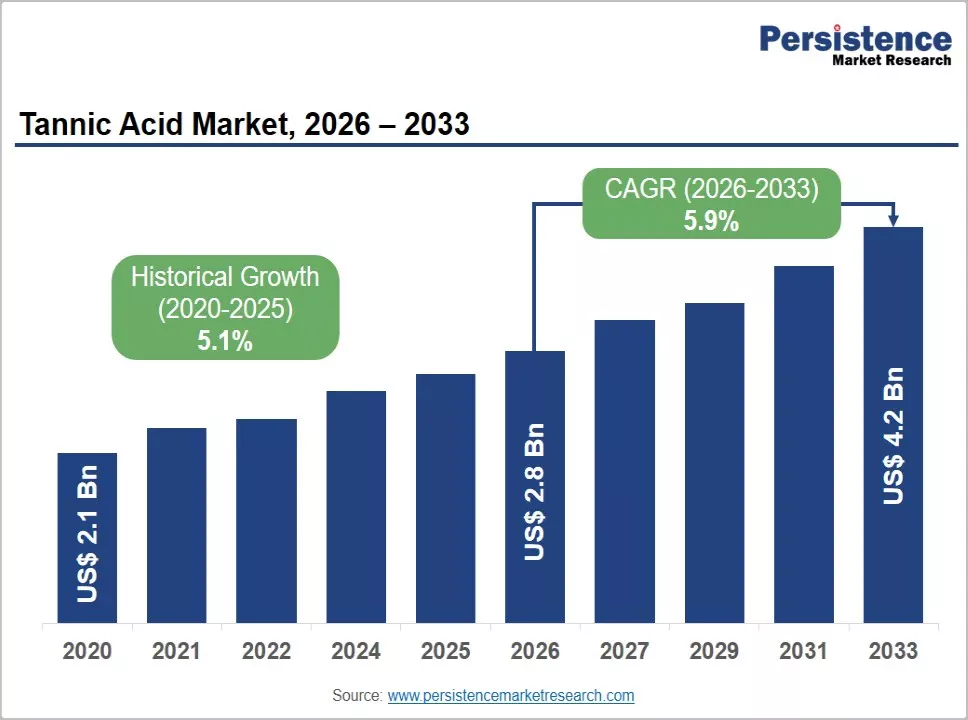
The global tannic acid market size is likely to be valued at US$2.8 billion in 2026 and is estimated to reach US$4.2 billion by 2033, growing at a CAGR of 5.9% during the forecast period from 2026 to 2033, driven by growing demand for natural polyphenols as antioxidants, preservatives, and processing aids, steady consumption in leather tanning and beverage clarification, and rising interest in plant-based alternatives to synthetic chemicals.
The forecast period anticipates stronger momentum as pharmaceutical and nutraceutical applications expand, wine and beverage producers refine processing, and sustainable sourcing of plant extracts gains priority across industries.
Key Industry Highlights:
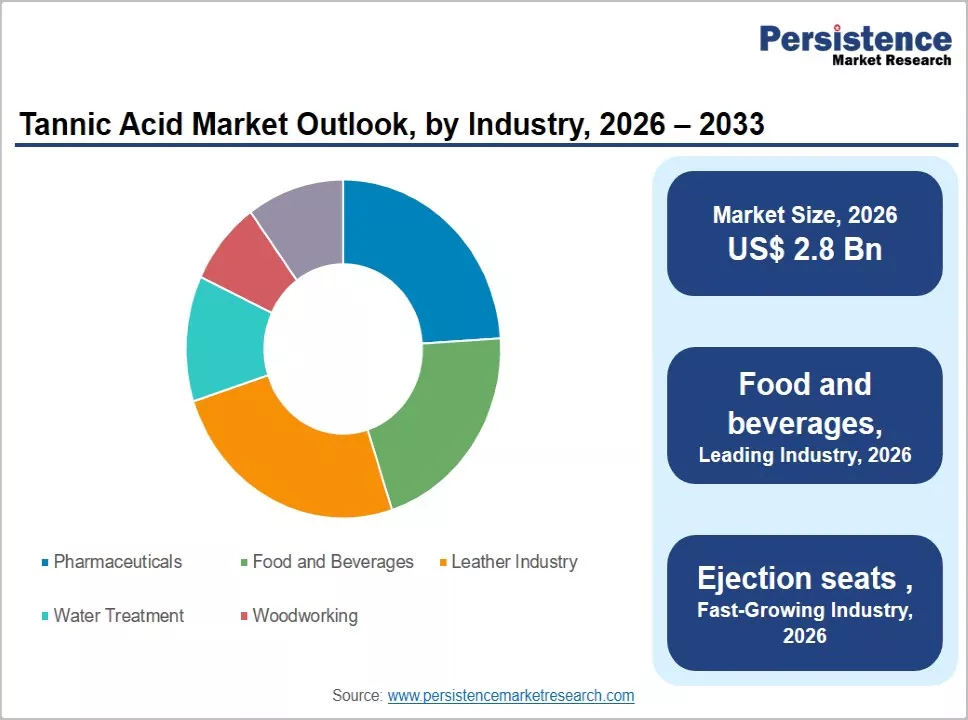
- Dominant Industry: Food and beverages are set to command around 29% of the revenue share in 2026, while pharmaceuticals are likely to grow the fastest at about 7.3% CAGR through 2033, as tannic acid is explored for its antioxidant, antimicrobial, and astringent properties.
- Leading Application: Clarifying agents are expected to lead with about 27% in 2026, while antioxidant and preservative applications are likely to be the fastest-growing at approximately 7.1% CAGR during 2026–2033, reflecting clean-label demand.
- Dominant Source: Gallnuts are anticipated to lead with an estimated 38% share in 2026, while tara pods are slated to represent the fastest-growing source at about 7.4% CAGR from 2026 to 2033.
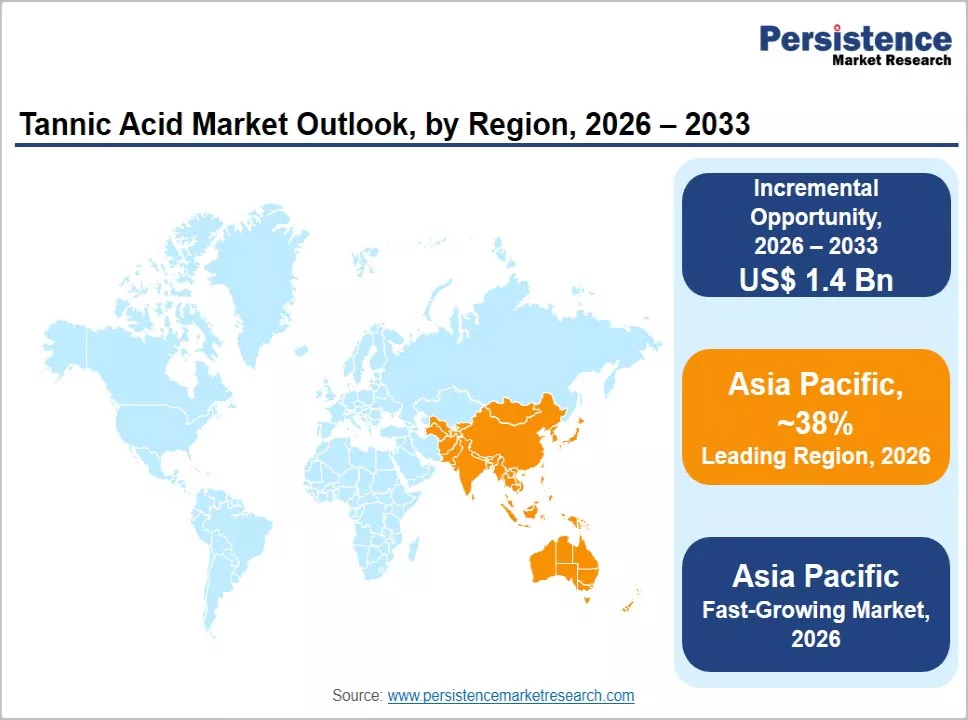
- Regional Leadership: Asia Pacific is poised to dominate with an estimated 38% share in 2026 and register a 6.5% CAGR through 2033, led by gallnut production and the leather and textile industries in China and India.
- Competitive Environment: Competitive dynamics include investments in extraction efficiency, sustainable sourcing of tannin-bearing plants, purification for food and pharmaceutical grades, and expansion into high-value applications.
DRO Analysis
Driver: Natural Ingredient Demand and Diversified Industrial Applications as Primary Growth Catalysts
Tannic acid, a hydrolyzable tannin obtained from plant sources such as gallnuts, tara pods, and sumac, is valued for its ability to bind proteins and metals, scavenge free radicals, and act as an astringent and antimicrobial agent. These properties support use as a clarifying agent in wine, beer, and fruit juices, as an antioxidant and preservative in food and nutraceutical products, and as a processing aid in leather, textiles, and wood treatment. Growing consumer preference for natural and clean-label ingredients is encouraging manufacturers to replace synthetic additives with plant-derived polyphenols.
Industrial demand also provides a stable base. Leather tanning continues to use vegetable tannins as industry seeks lower-chromium and more sustainable processes, while textile and dyeing applications rely on tannic acid as a mordant and dye fixative. Water treatment and wood treatment uses, including tannin-based coagulants and adhesives, are gaining attention as industries pursue bio-based alternatives. This diversity of end uses supports resilient demand across economic cycles.
Restraints: Raw Material Variability, Synthetic Alternatives, and Stringent Quality Requirements
Tannic acid supply depends on agricultural and forestry raw materials, whose availability and tannin content vary with season, weather, and harvesting practices. Supply is concentrated in a limited number of producing regions, exposing buyers to price swings, logistics disruptions, and trade policy changes such as tariffs that increase costs of raw plant materials and cross-border shipments. Extraction and purification are energy- and solvent-intensive, adding to production costs.
Competition from cheaper synthetic chemicals and alternative processing aids limits adoption in cost-sensitive industrial uses. Food and pharmaceutical grades must meet strict purity, residual solvent, and safety requirements, and regulatory approvals vary by region, creating barriers for new suppliers. Concerns about excessive tannin intake in some applications, and the need to demonstrate consistent quality across batches, further complicate commercialization.
Opportunities: Pharmaceutical and Nutraceutical Applications and Sustainable Sourcing
Research into the antioxidant, antimicrobial, and astringent properties of tannic acid is opening opportunities in pharmaceuticals, wound care, oral care, and nutraceuticals. Formulators are exploring its use in topical products, coatings, and functional ingredients, and demand for natural antiseptics and preservatives is rising in personal care and food packaging. Suppliers that can deliver high-purity, well-characterized grades can command premium pricing.
Sustainability offers another avenue. Valorization of forestry and agricultural by-products, such as bark and pods, and certification of responsibly harvested raw materials align with corporate sustainability goals. Emerging markets in Asia, Africa, and Latin America, which host abundant tannin-bearing plants and growing leather, textile, and food processing industries, provide opportunities for local extraction capacity, value-added processing, and technology partnerships.
Category-wise Analysis
Industry Insights
Food and beverages are the leading industry segment, expected to hold about 29% of the tannic acid market revenue share in 2026. Tannic acid is widely used to clarify wine, beer, and fruit juices by binding proteins and removing haze, and as a flavor and astringency modifier. Established winemaking and brewing industries, along with growth in juices and teas, provide steady demand, with purchasing driven by regulatory-compliant, food-grade quality.
Pharmaceuticals are likely to grow the fastest through 2033, at an estimated 7.3% CAGR. Tannic acid is used in astringent and antiseptic preparations, and ongoing research into antioxidant, antiviral, and wound-healing properties supports expanding applications. High-purity grades command premium prices. The leather industry remains an important consumer for vegetable tanning, while water treatment, woodworking, and textile dyeing contribute stable but slower-growing demand tied to industrial activity.
Application Insights
Clarifying agents are the leading application segment, holding about a 27% share in 2026. Tannic acid helps fine and stabilize beverages by precipitating proteins and suspended particles, improving clarity and shelf stability. The application is mature, linked to wine, beer, and juice production volumes, and supported by long-standing processing practices and supplier relationships.
Antioxidant and preservative applications represent the fastest-growing segment, expected to expand at about 7.1% CAGR through 2033. Rising demand for natural preservation systems in food, beverages, cosmetics, and packaging is boosting interest in plant polyphenols. Dye fixatives, tannin analyzers, antiseptic and astringent products, and wood treatment applications serve specialized needs, with growth supported by textile processing, laboratory analysis, personal care, and bio-based wood protection.
Source Insights
Gallnuts dominate the source segment, projected to capture about 38% of the revenue share in 2026. Gallnuts, particularly Chinese and Turkish varieties, are a traditional source of high-quality tannic acid with high tannin content and purity suitable for food and pharmaceutical use. Established harvesting and extraction chains, mainly in Asia, support consistent supply, though dependence on a limited number of regions creates price sensitivity.
Tara pods are likely to witness the fastest growth at roughly 7.4% CAGR through 2033. Tara, cultivated mainly in Peru, produces tannins valued for light color, low astringency, and suitability for food, beverage, and leather applications. Sustainable, plantation-based supply and demand for clean-label ingredients are supporting growth. Mimosa bark, oak bark, quebracho wood, and sumac are important sources for leather, wood, and specialty applications, with regional supply advantages in Africa, South America, and the Mediterranean.
Regional Insights
North America Tannic Acid Market Trends
North America is predicted to command an estimated 22% of the tannic acid market share in 2026. The U.S. anchors regional demand, driven by a large food and beverage industry, a growing wine sector, pharmaceutical and nutraceutical development, and water treatment applications. Interest in natural preservatives and clean-label products supports use in food and personal care.
Canada shows steady demand from beverage processing and industrial applications, while Mexico offers opportunities in leather and food processing. The regional market relies heavily on imports of raw tannins and extracts, making it sensitive to trade policies and supply chain disruptions, and encouraging buyers to diversify sourcing.
Europe Tannic Acid Market Trends
Europe is likely to hold 28% of the global market share in 2026. The region has a long tradition of winemaking, brewing, and leather production, particularly in Italy, Spain, France, and Portugal, which supports steady demand for tannins. Several leading tannin producers, including specialists in Italy, France, Slovenia, and Belgium, are based in the region and supply wine, food, and leather customers worldwide.
The Europe market is characterized by strict food safety and chemical regulations, emphasis on sustainability and traceability, and demand for chromium-free leather solutions. Eastern Europe is an emerging opportunity as food processing and leather industries modernize.
Asia Pacific Tannic Acid Market Trends
Asia Pacific is anticipated to capture the largest share of the tannic acid market, commanding an estimated 38% in 2026 and projected to achieve a 6.5% CAGR through 2033. China is a leading producer and consumer, with abundant gallnut resources, large leather and textile industries, and expanding pharmaceutical and food processing sectors. India is a major leather and textile producer with growing demand for natural processing agents.
Southeast Asia, Japan, and South Korea are also witnessing increased use of tannins in food, cosmetics, and specialty chemicals. Local extractors are investing in purification and quality control to serve export markets, while rising environmental standards in leather and textile processing are encouraging adoption of plant-based chemistries.
Competitive Landscape
The global tannic acid market is moderately fragmented, with leading specialty producers, including Ajinomoto OmniChem, Silvateam, Laffort, and Tanin Sevnica, holding a significant share of revenue. These players leverage access to tannin-bearing raw materials, extraction and purification expertise, global distribution, and strong relationships with wine, food, leather, and pharmaceutical customers.
Meanwhile, regional and niche competitors such as TANAC, Forestal Mimosa, UCL Company, and AEB Group are focusing on specific sources, applications, and regional strongholds. Raw material access, quality certifications, and technical application support limit new entrants, though demand for natural ingredients is attracting new participants to high-value segments. Consolidation is expected to increase gradually as larger specialty chemical and ingredient companies acquire extract producers to secure supply and expand portfolios.
Companies Covered in Tannic Acid Market
- Ajinomoto OmniChem N.V.
- Silvateam S.p.A.
- Laffort SA
- Tanin Sevnica d.d.
- TANAC S.A.
- Forestal Mimosa Ltda.
- UCL Company (Pty) Ltd.
- AEB Group S.p.A.
- Tannin Corporation
- Prisco - Industrie dei Derivati Tannici S.r.l.
Frequently Asked Questions
The global tannic acid market is projected to reach US$2.8 billion in 2026.
Growing demand for natural polyphenols as antioxidants and preservatives, steady use in leather and beverage processing, and interest in plant-based alternatives to synthetic chemicals are driving the market.
The tannic acid market is poised to witness a CAGR of 5.9% from 2026 to 2033.
Pharmaceutical and nutraceutical applications, sustainable sourcing of plant-based tannins, and industrial growth in emerging economies are key market opportunities.
Ajinomoto OmniChem N.V., Silvateam S.p.A., Laffort SA, and Tanin Sevnica d.d. are some of the key players in the tannic acid market.


