




- Nutraceuticals & Functional Foods
- Food Encapsulation Market
Food Encapsulation Market Size, Share, and Growth Forecast 2026 - 2033
Food Encapsulation Market by Technology (Spray Drying, Coacervation, Extrusion), Core Material (Vitamins and Minerals, Probiotics and Enzymes), Application (Functional Foods and Beverages, Dietary Supplements), and Regional Analysis, 2026 - 2033

Food Encapsulation Market Size and Trends Analysis
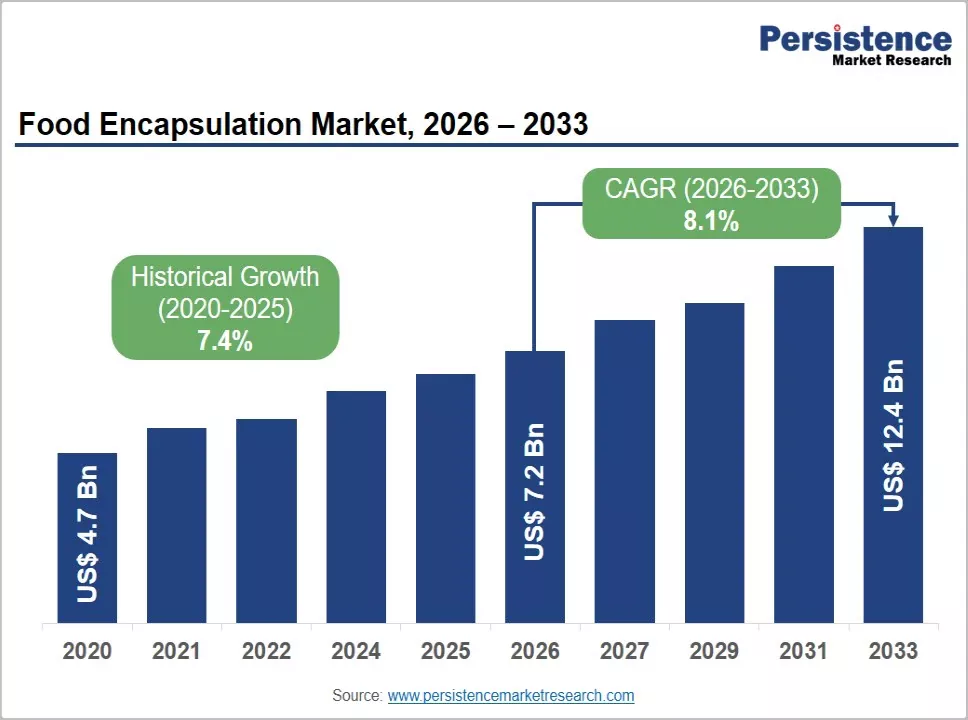
The global food encapsulation market size is likely to be valued at US$ 7.2 billion in 2026 and is estimated to reach US$ 12.4 billion by 2033, growing at a CAGR of 8.1% during the forecast period 2026 to 2033, driven by demand for stable nutrients, probiotics, and controlled-release ingredients.
Encapsulation wraps sensitive food ingredients in a protective shell. It improves stability, masks taste, and controls release. Supplement use is also rising.
Key Industry Highlights
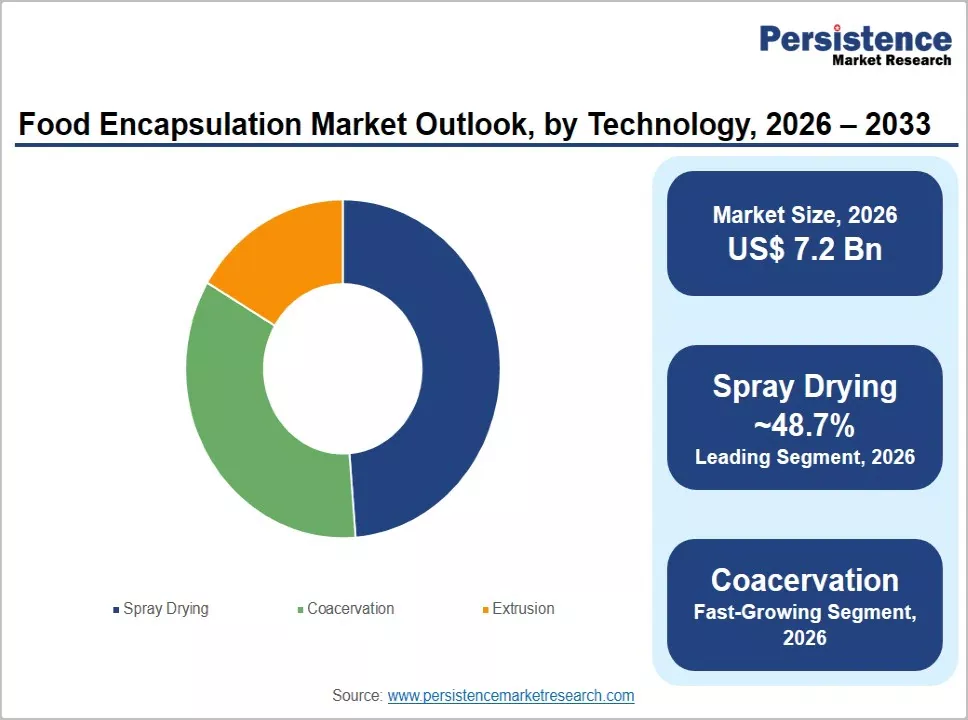
- Leading Technology: Spray drying, about 48.7% share in 2026, because it is a long-established, economical method for turning liquids into stable powders.
- Dominant Application: Functional foods and beverages, around 38.9% share in 2026, as brands add protected vitamins, probiotics, and flavors to everyday products.
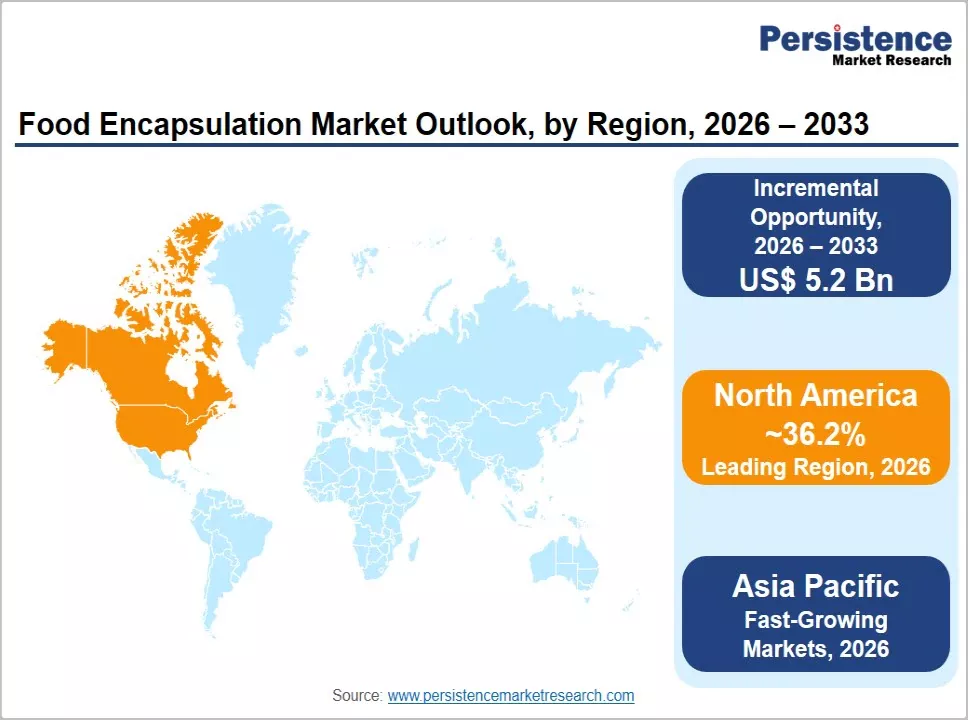
- Leading Region: North America, with about 36.2% share in 2026, as the U.S. has large ingredient suppliers and a strong supplement market.
- Fast-growing Region: Asia Pacific, due to expanding nutraceutical production, new product launches, and tighter probiotic rules in China.
- Latest Study: In January 2026, researchers published a study in Food Bioscience on the co-microencapsulation of Lacticaseibacillus paracasei and pitahaya (dragon fruit) juice using spray drying. The researchers used pitahaya peel flour combined with whey protein concentrate or gum arabic as encapsulating materials. The resulting microcapsules were incorporated into yogurt to improve its antioxidant properties, probiotic viability, and functional characteristics. The study demonstrated the potential of using fruit-processing byproducts as sustainable wall materials for encapsulating probiotics and natural pigments in functional foods.
DRO Analysis
Driver- Need for Stable and Protected Nutrients to Drive Adoption
Many food ingredients are fragile. Vitamins, oils, flavors, and probiotics can degrade during processing and storage. A peer-reviewed review in Drying Technology notes that spray drying is used to microencapsulate oils and flavors. It improves stability, protects compounds from degradation, masks unpleasant tastes, and delays release. The review, by Takeshi Furuta and Tze Loon Neoh, was published in 2021.
Suppliers are applying these benefits to nutrition products. At Vitafoods Asia 2026, Innobio showed a microencapsulated vitamin matrix. The company says it resists heat and moisture and could extend shelf life. It also showed a product designed to combine vitamins and minerals without interactions or discoloration. Its slow-release granules target complex vitamin and mineral formulations. The matrix includes plant-based vitamin D3 and natural vitamin E.
Growth in Nutrition Ingredients and Supplement Use to Bolster Demand
Ingredient suppliers are reporting solid growth. Balchem's first-quarter 2026 sales rose 8.1% to US$270.7 million. Its Human Nutrition and Health segment grew 8.3% to US$171.6 million. dsm-firmenich reported 6% growth in Taste, Texture and Health in the first half of 2026. IFF's Taste unit grew 4% in the second quarter. Balchem said growth came from nutrients and from food ingredients and solutions. dsm-firmenich said its second-quarter growth was driven entirely by higher volumes.
Consumer use also supports demand. A 2025 German survey found that 77% of respondents use supplements regularly. In the U.K., 64% of adults take a supplement daily, according to a 2025 trade body survey. Brands need dependable delivery formats for these products. Encapsulation helps meet that need. More than half of German respondents take one at least weekly.
Restraint- Strict Regulation and Trade Uncertainty May Raise Compliance Costs
Regulation is becoming stricter. On August 11, 2026, the U.S. Food and Drug Administration (FDA) proposed a rule that would make Generally Recognized as Safe (GRAS) notification mandatory. Comments are due around December 9, 2026. Companies would have to notify FDA of the basis for their GRAS conclusions. It would not be premarket approval, and marketing could continue during review.
The rule would cover new and existing substances. Compliance would be required 18 months after the effective date. Shell materials and novel carriers may need documentation. Trade is another concern. Balchem's CEO noted geopolitical and global trade uncertainties in April 2026. These factors can raise costs for smaller suppliers. Failure to notify would be a factor in setting post-market review priorities.
Opportunity- Probiotic Protection and Controlled-release Ingredients to Open New Uses
Probiotics need protection to stay viable. China's State Administration for Market Regulation released draft rules in August 2026 for probiotic health foods. They would raise minimum colony-forming unit counts through shelf life. They also require strain function and genetic stability data. Encapsulation can help products meet higher viability targets.
Controlled release also creates new uses. Wenda's SafeRelease technology releases lactic acid only when cooking heat is applied. The company says it offers an alternative to traditional fermentation. It may help processors streamline production. Similar systems can serve bakery, beverage, and meat applications. The citric acid versions come in several concentrations.
Multi-nutrient and Premium Formulations to Expand the Product Range
Complex formulas are growing. Brands want to combine vitamins, minerals, and botanicals in one product. Innobio's LocVita is said to prevent interactions between components. Its slow-release granules are aimed at complex vitamin and mineral blends. Such products can command higher prices than standard powders.
Large players are also reshaping portfolios. IFF agreed in May 2026 to sell its Food Ingredients business to CVC Capital Partners for about US$3.8 billion. IFF will keep a minority stake of about 10%. The sale is expected to close by the end of the second quarter of 2027. Focus on Taste and Health may drive new delivery technologies. IFF's Health and Biosciences sales were US$601 million in the second quarter, up 5%.
Category-wise Analysis
Technology Insights
Spray drying is predicted to lead with a share of about 48.7% in 2026, because it is a long-established and economical way to turn liquids, dispersions, and pastes into dry powders. It is widely used for oils, flavors, and fragrances. The process improves solubility and stability. It also controls release and masks poor taste or smell. It also makes labile liquid compounds easier to handle.
Coacervation is estimated to be the fastest-growing segment in the forecast period, as brands seek stronger protection for sensitive ingredients. It suits heat-sensitive probiotics, oils, and flavors. Extrusion remains important for flavors and acids in baked and processed foods. Technology choice depends on the core material, shell, and target release.
Application Insights
Functional foods and beverages are anticipated to dominate with a share of around 38.9% in 2026, because brands add protected vitamins, probiotics, and flavors to everyday products. Dairy, drinks, and cereals are common formats. Encapsulation prevents off-flavors and nutrient loss. Large suppliers such as Balchem report growth in food ingredients and solutions.
Dietary supplements are expected to be the fastest-growing application in 2026, as consumers take more daily products. In the U.K., 64% of adults report daily supplement use. Younger adults are also taking more supplements. Capsules, gummies, and powders all need stable ingredients. Bakery, confectionery, and meat products remain important uses. Supplement consumers have traditionally been aged 35 and older.
Regional Insights
North America Food Encapsulation Market Trends
North America is predicted to dominate in 2026 globally with a share of approximately 36.2%, due to large ingredient suppliers, a strong supplement market, and active product development. Balchem's sales rose 8.1% in the first quarter of 2026. Wenda Ingredients introduced SafeRelease in November 2026. The FDA's proposed GRAS rule may reshape ingredient approvals. Balchem's Animal Nutrition and Health sales rose 8.6% to US$62.2 million.
U.S. Food Encapsulation Market Trends
A share of nearly 85.6% is expected to be held by the U.S. in 2026 in North America, as it has a deep base of ingredient makers and food brands. The FDA proposed mandatory GRAS notification in August 2026. A streamlined path would be open for one year after the effective date. It would need only identifying information for substances already in commerce. Failure to notify would not be treated as adulteration by itself.
Asia Pacific Food Encapsulation Market Trends
Asia Pacific is anticipated to be the fastest-growing region globally in 2026 with a share of around 24.8%, because nutraceutical production is expanding and brands are launching new formats. Vitafoods Asia 2026 took place in Bangkok from September 2 to 4. Innobio exhibited microencapsulated amino acids, carotenoids, and functional lipids. Rising incomes support supplement demand. The event brought together exhibitors across nutrition and supplements.
China Food Encapsulation Market Trends
China will likely lead in Asia Pacific in 2026 with a share of about 35.4%, supported by a large nutraceutical and probiotic industry. The State Administration for Market Regulation consulted on draft probiotic health food rules until August 24, 2026. The draft stresses strain traceability and quality control. Higher viability standards may increase demand for protective delivery.
India Food Encapsulation Market Trends
In 2026, India is projected to account for a share of about 14.9% in Asia Pacific, because its nutraceutical sector is growing and supplement use is spreading. A regional director of the Food Safety and Standards Authority of India said in February 2026 that the industry makes up nearly 2% of the global market. She linked growth to probiotics and prebiotics. Free trade agreements may support exports. She spoke at Vitafoods India in Mumbai. She also noted trade access through agreements with the U.K., EU, and U.S.
Europe Food Encapsulation Market Trends
Europe is predicted to hold the second position in 2026 globally with a share of roughly 18.7%, as it is home to major flavor and nutrition companies. dsm-firmenich reported 5% like-for-like sales growth in the first half of 2026. Givaudan's sales rose 3.6% like for like in the same period. European supplement makers expect average sales growth of about 5% over five years. The Association of the European Self-Care Industry reported the outlook in 2025. Participating firms hold about 65% of the EEA food supplement market.
Germany Food Encapsulation Market Trends
Germany is predicted to register a substantial share of approximately 23.6% in Europe in 2026, as consumers use supplements widely and the food industry is large. A 2025 survey commissioned by Lebensmittelklarheit.de found that 77% of respondents use supplements regularly. The survey was published in May 2025. This supports demand for stable, high-quality ingredients.
U.K. Food Encapsulation Market Trends
A share of nearly 17.8% is predicted to be held by the U.K. in 2026 in Europe, due to strong supplement use and interest in gut health. The Health Food Manufacturers' Association reports that 64% of adults take a supplement daily. Its survey also found that 23% had a probiotic recommended by a healthcare professional. Younger consumers are driving new demand. The survey covered 2,000 adults in April 2025.
Competitive Landscape
The global food encapsulation market is moderately fragmented and highly competitive, with ingredient majors, flavor houses, and specialty encapsulation firms competing through technology, product stability, application support, and regulatory expertise. Balchem, dsm-firmenich, Givaudan, IFF, Kerry Group, Cargill, and Innobio have established positions, while portfolio changes are reshaping competition. Companies also compete through partnerships and acquisitions.
Key Industry Developments
- In April 2026, Lubrizol introduced a sugar-free gummy application concept featuring its Curcushine microencapsulated curcumin ingredient ahead of Vitafoods Europe. Each pectin-based gummy delivers 100 mg of Curcushine, which uses patented microencapsulation technology to improve curcumin's water dispersibility, stability, and bioavailability while reducing its characteristic turmeric flavor. The concept was developed to demonstrate the ingredient's suitability for scalable functional nutrition and nutricosmetic applications, including sugar-free gummies and other convenient food formats.
- In April 2026, INNOBIO introduced DurOmega Microencapsulated Algae DHA and EPA Powder, a water-dispersible omega-3 ingredient developed specifically for beverage formulations. Produced from Schizochytrium microalgae, the ingredient uses microencapsulation to improve oxidative stability, prevent rancidity, and minimize undesirable odors. Its ability to disperse in cold water and maintain stability across different pH conditions is intended to help food manufacturers incorporate omega-3 fatty acids into plant-based beverages, functional drinks, energy bars, and other fortified products.
- In February 2026, RAPS highlighted its Flavocaps microencapsulation technology for controlled flavor release across bakery, snack, meat, dairy, and convenience food applications. The technology uses protective matrices made from ingredients such as maltodextrin and starch to shield volatile flavor compounds from heat, moisture, and oxygen. RAPS also highlighted the use of tailored coatings to delay the release of flavors, spices, and acids during baking, frying, and other food-processing operations. The development demonstrates how encapsulation can help manufacturers improve flavor retention and support reformulation efforts involving reduced sugar and salt.
Companies Covered in Food Encapsulation Market
- Balchem Corporation
- dsm-firmenich AG
- Givaudan SA
- International Flavors & Fragrances Inc.
- Kerry Group plc
- Cargill, Incorporated
- Archer-Daniels-Midland Company
- Ingredion Incorporated
- Symrise AG
- Sensient Technologies Corporation
- Tate & Lyle PLC
- BASF SE
- Innobio Corporation Limited
- Wenda Ingredients
- AnaBio Technologies
- Others
Frequently Asked Questions
The global food encapsulation market is projected to be valued at US$ 7.2 billion in 2026.
The market is expected to reach US$ 12.4 billion by 2033.
Key market trends include protected probiotics and vitamins, controlled-release acids and flavors, multi-nutrient formulas, and stricter ingredient regulation.
Spray drying is expected to be the leading technology segment with a share of around 48.7% in 2026, as it is a long-established, economical method for turning liquids into stable powders.
The market is expected to grow at a CAGR of 8.1% from 2026 to 2033.
Balchem, dsm-firmenich, and Givaudan are a few key market players.


