




- Medical Devices
- Surgical Robotics Services Market
Surgical Robotics Services Market Size, Share, and Growth Forecast 2026 - 2033
Surgical Robotics Services Market by Service Type (Preventive Maintenance and Repair Services, Training and Education Services, Software Upgrades and System Optimization Services, Installation and Commissioning Services, Others), Robot Type (Soft Tissue Surgical Robotics, Orthopedic Surgical Robotics, Neurosurgical Robotics, Radiosurgery Robotics, Endoluminal Robotic Systems), Application, Contract Type, End-user, and Regional Analysis, 2026 - 2033

Surgical Robotics Services Market Size and Trend Analysis
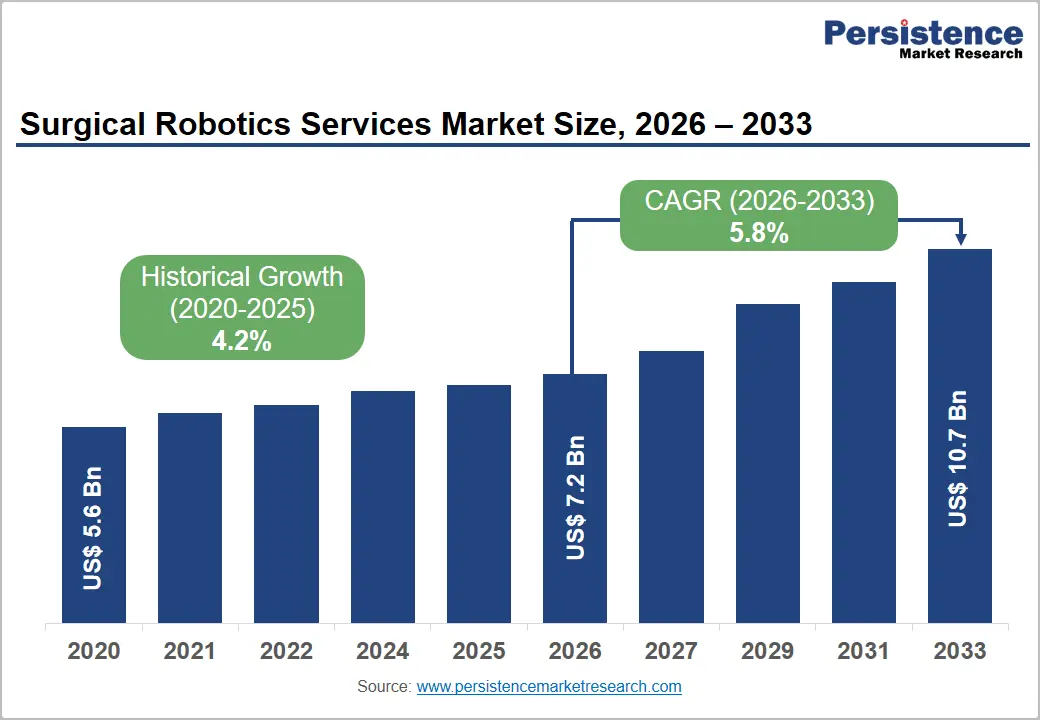
The global surgical robotics services market size is expected to be valued at US$ 7.2 billion in 2026 and projected to reach US$ 10.7 billion by 2033, growing at a CAGR of 5.8% between 2026 and 2033.
The market is experiencing robust and accelerating growth driven by the rapid global expansion of installed surgical robot fleets requiring sustained servicing, the increasing complexity of next-generation robotic systems demanding specialized engineering support, and the shift from one-time capital purchases to comprehensive, long-term service partnerships.
With Intuitive Surgical, Inc. reporting over 9,900 da Vinci® systems installed globally as of 2024 each requiring annual maintenance, software upgrades, and clinical training the sheer scale of the global installed base is generating a recurring, high-margin services revenue stream. Simultaneously, the entry of competitive robotic platforms from Medtronic's Hugo™, CMR Surgical's Versius®, and Stryker's Mako™ is expanding the overall addressable service market across soft tissue, orthopedic, and neurosurgical robotic domains.
Key Market Highlights
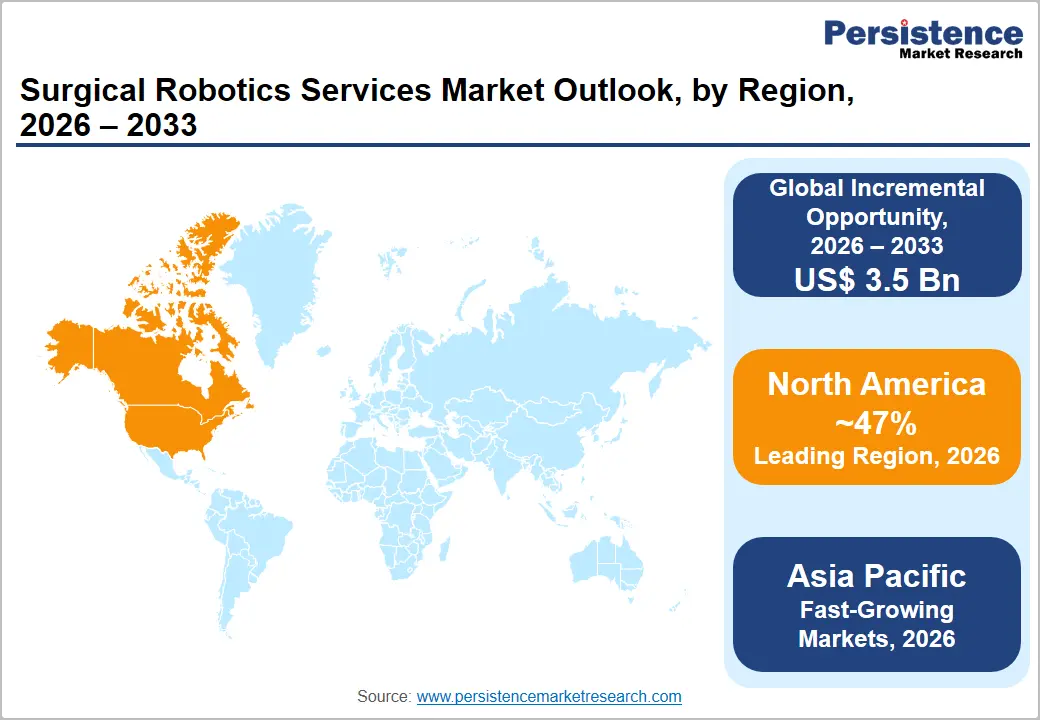
- Leading Region - North America: North America commanded approximately 47% global surgical robotics services market share in 2025, anchored by Intuitive Surgical's 9,900+ global da Vinci® installations, CMS value-based care mandates, and Stryker's Mako™ 1,500+ facility service network.
- Fastest Growing Region - Asia Pacific: Asia Pacific is the fastest-growing market, driven by China's NMPA Toumai® approval, Japan's MHLW 12-procedure reimbursement, India's Apollo/Fortis/Max Hospital robotic expansions, and CMR Surgical's Versius® Southeast Asia service network launch.
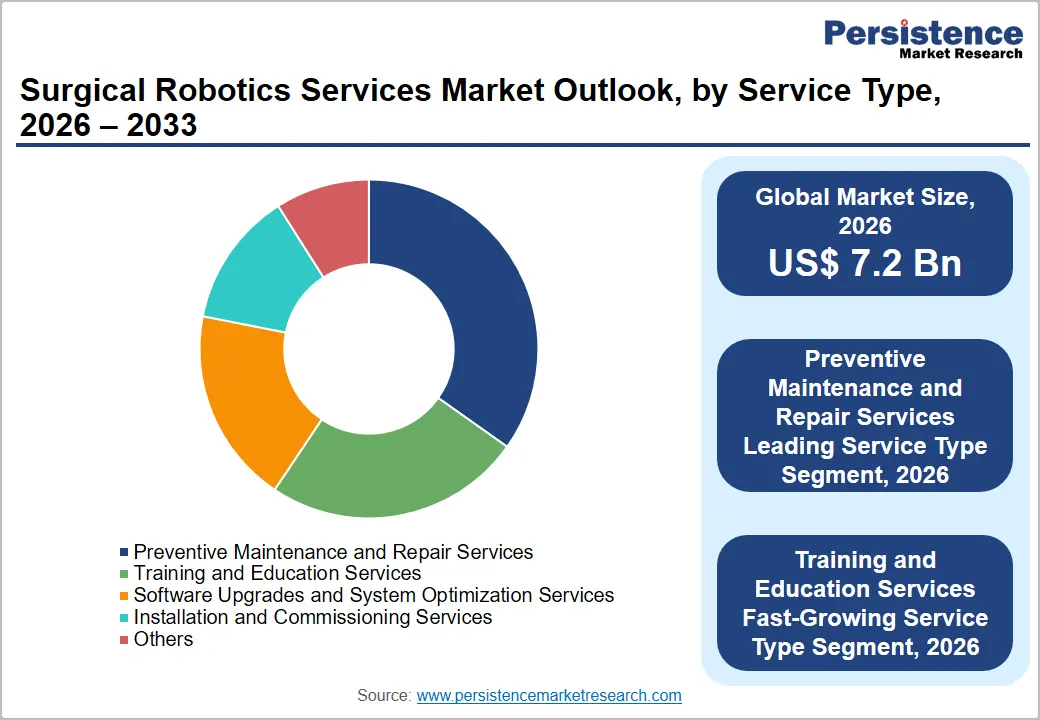
- Dominant Segment - Preventive Maintenance and Repair: Preventive maintenance held approximately 35% service market share in 2025, driven by universal system uptime requirements, Joint Commission accreditation maintenance documentation mandates, and Intuitive Surgical's global field engineer network.
- Fastest Growing Segment - Training and Education Services: Training services are fastest-growing, driven by ACS robotic credentialing frameworks, new platform proliferation (Hugo™, Versius®, LUNA™), and Intuitive Surgical's and Stryker's dedicated global training academy networks mandating structured surgeon certification.
- Key Opportunity - Outcome-Based Service Agreements: CMS BPCI and CJR value-based care programs, 2.2M+ annual da Vinci® procedures, and AI-driven predictive maintenance platforms are unlocking a high-growth outcome-linked service contract model representing a significant share of the US$ 3.5 billion incremental service opportunity through 2033.
Market Dynamics
Drivers - Rapidly Expanding Global Surgical Robot Installed Base Generating Compounding Service Revenue
The geometric growth of the global surgical robot installed base is the most powerful structural driver of the services market. Intuitive Surgical, Inc. reported 9,900+ installed da Vinci® systems globally as of Q4 2024, with each system generating approximately US$ 180,000-US$ 250,000 in annual service and consumable revenue. Stryker Corporation's Mako™ SmartRobotics platform has been installed in over 1,500 facilities globally, each requiring annual maintenance contracts (AMC) and software upgrade services.
CMR Surgical has rapidly deployed its Versius® system across Europe, Asia Pacific, and Latin America under subscription-based models that embed service costs in recurring fees. As the installed base compounds annually, the cumulative service obligation grows proportionally creating a fundamentally recurring and expanding revenue stream for surgical robotics service providers that is largely immune to capital expenditure cycle fluctuations.
Shift Toward Value-Based Healthcare Models Driving Demand for Outcome-Based Service Agreements
The global healthcare industry's accelerating transition toward value-based care where providers are reimbursed based on patient outcomes rather than procedure volumes is directly driving demand for sophisticated surgical robotics service models that ensure optimal system performance and clinical outcomes. U.S. Centers for Medicare & Medicaid Services (CMS) initiatives including Comprehensive Care for Joint Replacement (CJR) and Bundled Payments for Care Improvement (BPCI) create financial incentives for hospitals to maximize orthopedic robotic system uptime and performance driving demand for comprehensive and outcome-linked service contracts.
Intuitive Surgical's reporting of over 2.2 million da Vinci® procedures performed globally in 2023 demonstrates that hospital financial models now depend heavily on uninterrupted robotic system availability, making comprehensive service contracts a business necessity rather than an optional expenditure for high-volume robotic surgery centers.
Restraints - High Cost of Proprietary Service Contracts Limiting Hospital Budget Flexibility
Proprietary annual maintenance contracts (AMCs) for surgical robotic systems represent a significant and often non-negotiable operating expense for healthcare institutions. Intuitive Surgical's service and accessory revenue which exceeded US$ 5.3 billion in FY2023 is predominantly captured through exclusive service agreements that limit customer negotiation leverage. For smaller hospitals and ambulatory surgical centers operating under constrained budgets, the combination of high capital acquisition costs and mandatory AMC fees creates financial sustainability concerns, limiting surgical robotics adoption to well-capitalized institutions and constraining the total addressable services market in cost-sensitive healthcare systems globally.
Talent Scarcity in Surgical Robotics Engineering and Clinical Training Constraining Service Scalability
The rapid global expansion of surgical robot installations is creating a critical shortage of qualified biomedical engineers, robotic system technicians, and clinical training specialists capable of maintaining and supporting increasingly sophisticated next-generation systems. Intuitive Surgical, Medtronic, and Stryker have each publicly acknowledged workforce development as a key operational challenge. In emerging markets including India, Southeast Asia, and Latin America, the acute shortage of surgical robot-certified engineers limits the ability of OEMs and third-party service providers to scale service network coverage commensurate with installation growth rates.
Opportunities - Training and Education Services: Fastest-Growing Segment Driven by New Robotic Platform Proliferation
Training and education services represent the fastest-growing service type within the surgical robotics services market, fueled by the proliferation of new robotic surgical platforms requiring comprehensive surgeon credentialing, scrub nurse certification, and OR team simulation-based training programs. As Medtronic's Hugo™ RAS, CMR Surgical's Versius®, Asensus Surgical's LUNA™, and Verb Surgical platforms enter global markets alongside the incumbent da Vinci®, each new installation requires dedicated, FDA-supervised or national regulatory authority-approved training curricula.
The American College of Surgeons (ACS) has developed structured robotic surgery credentialing frameworks that hospitals must implement for clinical privilege granting mandating structured training services. Intuitive Surgical's dedicated da Vinci® Training & Education Centers globally and Stryker's Mako training academies are generating significant, recurring service revenue from this high-growth segment.
Asia Pacific: High-Growth Market Driven by Surgical Robot Fleet Expansion and Government Healthcare Investment
Asia Pacific is the fastest-growing regional opportunity for surgical robotics services, driven by government-backed healthcare infrastructure investment, rapidly expanding robotic surgery adoption, and a large and growing installed base requiring local service capabilities. China is experiencing exceptional surgical robot fleet growth with domestic manufacturers including Shanghai Microport MedBot and Tinavi Medical Technologies rapidly expanding installations, creating local service network demand. Japan's Ministry of Health, Labour and Welfare (MHLW) reimbursement approval for da Vinci® robotic surgery across 12 procedures has driven substantial installation growth at Japanese tertiary hospitals. India's Ayushman Bharat PM-JAY scheme and growing private hospital investment in Mumbai, Delhi, Bengaluru, and Chennai are accelerating robotic surgery adoption, with each new installation creating a multi-year service contract pipeline for both OEM service divisions and third-party providers.
Category-wise Analysis
Service Type Insights
Preventive maintenance and repair services dominated the surgical robotics services market, accounting for approximately 35% of the total service type market share in 2026. The absolute necessity of uninterrupted surgical robot uptime where an unplanned system failure can cancel complex, scheduled surgical cases and generate significant revenue losses and patient harm risks, makes preventive maintenance the highest-priority and most uniformly procured service category across all end-user types.
Intuitive Surgical's annual service contracts include scheduled preventive maintenance visits calibrated to robotic system usage cycles, with the company's field service engineer network comprising thousands of certified technicians globally. Stryker's Mako™ platform service agreements and Zimmer Biomet's ROSA® contracts similarly mandate regular calibration, end-effector inspection, and software integrity checks, reinforcing preventive maintenance's entrenched market leadership.
Application Insights
General surgery led the application segment of the surgical robotics services market, accounting for approximately 30% of total application-based service demand in 2025. General surgery's market leadership in the services context reflects its status as the highest-volume application for minimally invasive robotic procedures globally, encompassing cholecystectomy, hernia repair, bariatric surgery, and colorectal resection. The American College of Surgeons (ACS) has documented substantial year-on-year growth in robotic general surgery procedure volumes, with da Vinci® and Medtronic's Hugo™ both targeting general surgery as a primary commercial application.
The breadth of general surgery procedures drives high system utilization rates generating proportionately greater service contract obligations, consumable replacement cycles, and software update dependencies per system compared to lower-volume specialty applications.
End-user Insights
Hospitals constituted the dominant end-user segment of the surgical robotics services market, accounting for approximately 72% of total end-user service demand in 2026. The procedural complexity and capital intensity of surgical robotic systems, which require specialized OR infrastructure, engineering support, and high-volume case throughput to justify the economics, make hospitals the primary and overwhelmingly dominant end-user for both hardware and associated services.
Large academic medical centers, including Johns Hopkins Hospital, Mayo Clinic, Cleveland Clinic, and international equivalents, operate multi-system robotic programs with extensive service contract portfolios spanning maintenance, training, and upgrade services. Hospital procurement through Group Purchasing Organizations (GPOs) such as Vizient and Premier Inc. enables volume-based service contract negotiation, further entrenching the hospital segment's market dominance.
Regional Insights
North America Surgical Robotics Services Market Trends and Insights
North America accounted for an estimated 46.8% of the global surgical robotics services market in 2026, supported by the world’s largest installed base of robotic surgery systems, well-established reimbursement mechanisms, and the presence of major OEM service organizations. Strong adoption of comprehensive service contracts, software optimization programs, and structured surgeon training continues to sustain recurring revenue. The region also benefits from stringent regulatory oversight and increasing emphasis on predictive maintenance and remote diagnostics to maximize robotic system uptime.
U.S. Surgical Robotics Services Market Trends and Insights
The U.S. represented approximately 88.4% of the North American market in 2026. Demand is driven by the extensive installed base of da Vinci®, Mako™, and ROSA® systems across academic medical centers and community hospitals. Growth in value-based care and hospital investments in full-service agreements are expanding recurring service revenues. Intuitive Surgical’s headquarters in Sunnyvale and its nationwide field engineering network enable rapid technical response and standardized preventive maintenance. Increasing adoption of AI-enabled diagnostics and software upgrades is further strengthening long-term service contract penetration.
Canada Surgical Robotics Services Market Trends and Insights
Canada accounted for nearly 11.6% of the regional market in 2026. Expansion of robotic surgery programs in provinces such as Ontario, British Columbia, and Quebec is increasing demand for installation, maintenance, and clinical training services across tertiary and university-affiliated hospitals. Provincial health systems are funding robotic surgery expansion at major centers, creating additional opportunities for multi-year maintenance agreements. Growth in cross-provincial training initiatives is also boosting demand for surgeon certification and on-site technical education services.
Europe Surgical Robotics Services Market Trends and Insights
Europe captured an estimated 28.7% of the global surgical robotics services market in 2025, driven by increasing robotic procedure volumes and strict compliance requirements under EU MDR 2017/745. Hospitals are adopting long-term maintenance contracts to meet calibration and documentation standards. Expanding utilization of Versius®, da Vinci®, and orthopedic robotic systems is supporting robust demand for preventive maintenance, software upgrades, and clinician education throughout the region.
Germany Surgical Robotics Services Market Trends and Insights
Germany held approximately 24.8% of the European market in 2026. The country’s large network of university hospitals and high robotic surgery penetration in urology and general surgery generate strong demand for annual maintenance contracts and advanced technical support. Institutions such as Charité - Universitätsmedizin Berlin and University Hospital Heidelberg are among the most active adopters of robotic surgery. Germany’s emphasis on engineering precision and regulatory compliance supports high uptake of software validation and system optimization services.
UK Surgical Robotics Services Market Trends and Insights
UK accounted for about 17.9% of the regional market in 2026. NHS-backed expansion of robotic-assisted surgery and broader deployment of Versius® systems are increasing demand for installation, training, and multi-year service agreements. NHS England continues to support wider robotic surgery adoption across cancer and minimally invasive procedures. Growing use of domestically developed platforms from CMR Surgical is strengthening local demand for OEM-led technical support and clinician education.
Asia Pacific Surgical Robotics Services Market Trends and Insights
Asia Pacific is likely to represent approximately 18.9% of the global surgical robotics services market in 2026. Growth is fueled by accelerating installations in China, Japan, India, and South Korea, along with increasing investments by both public and private hospitals. Rising procedure volumes and greater reliance on OEM-led maintenance and training programs are expanding the region’s recurring service revenue base.
China Surgical Robotics Services Market Trends and Insights
China contributed around 34.6% of the Asia Pacific market in 2025. Expansion of domestic robotic platforms such as Toumai® and continued adoption of imported systems are creating substantial demand for preventive maintenance, software support, and surgeon education services. MicroPort MedBot is increasing local service capabilities as tertiary hospitals deploy domestically manufactured robotic platforms. Government support for advanced medical technologies and hospital modernization is accelerating long-term service contract adoption.
Japan Surgical Robotics Services Market Trends and Insights
Japan accounted for approximately 22.7% of the regional market in 2025. Government reimbursement for multiple robotic procedures has accelerated installations and increased demand for structured maintenance and optimization contracts across major hospitals. The Ministry of Health, Labour and Welfare has expanded reimbursement coverage, supporting higher robotic surgery volumes nationwide. Japanese hospitals place strong emphasis on equipment reliability, resulting in high adoption of preventive maintenance and calibration services.
Competitive Landscape
The global surgical robotics services market is highly consolidated at the OEM level, with Intuitive Surgical, Inc. commanding a dominant service market position through its da Vinci® installed base lock-in strategy proprietary service agreements, software-enabled usage monitoring, and exclusive consumable requirements. Stryker, Zimmer Biomet, and Medtronic compete in orthopedic and soft tissue robotic service segments respectively. Key differentiators include remote diagnostics capabilities (Intuitive Surgical's TeleRobotic Service™), AI-driven predictive maintenance platforms, and bundled training-maintenance service packages. Third-party independent service organizations (ISOs) are an emerging competitive force targeting cost-sensitive customers seeking lower-cost AMC alternatives to OEM contracts.
Key Developments:
- In May 2026, West Hertfordshire Teaching Hospitals NHS Trust deployed the next-generation Intuitive DV5 robotic surgery platform, enhancing surgical precision and control while reducing tissue trauma, shortening patient recovery times, improving clinical outcomes, and expanding the number of robotic-assisted procedures available to patients across Hertfordshire.
- In January 2026, Johnson & Johnson announced the submission of its OTTAVA™ Robotic Surgical System to the U.S. Food and Drug Administration for De Novo classification, seeking marketing authorization for multiple upper abdominal general surgery procedures based on clinical data generated from its Investigational Device Exemption (IDE) study.
Companies Covered in Surgical Robotics Services Market
- Intuitive Surgical, Inc.
- Medtronic plc
- Stryker Corporation
- Zimmer Biomet Holdings, Inc.
- Smith+Nephew plc
- Johnson & Johnson
- CMR Surgical Limited
- Asensus Surgical, Inc.
- THINK Surgical, Inc.
- Renishaw plc
- Moon Surgical
- Shanghai Microport MedBot (Group) Co., Ltd.
- Accuray Incorporated
- Globus Medical, Inc.
- Brainlab AG
- Others
Frequently Asked Questions
The global surgical robotics services market is expected to be valued at US$ 7.2 billion in 2026, growing from US$ 5.6 billion in 2020, and projected to reach US$ 10.7 billion by 2033 at a forecast CAGR of 5.8%.
The expanding global installed base of surgical robotic systems and the increasing need for preventive maintenance, software upgrades, and surgeon training to ensure optimal system uptime and clinical performance are driving demand for surgical robotics services.
North America leads with approximately 47% global market share in 2025, anchored by the U.S.'s world-leading robotic surgery installed base density, FDA service quality regulatory framework, CMS value-based care program incentives, and Intuitive Surgical's North American headquarters and global field engineer service network.
Rapid adoption of robotic surgery in emerging markets and the increasing use of remote diagnostics, predictive maintenance, and outcome-based service contracts present significant growth opportunities in the surgical robotics services market.
Leading companies include Intuitive Surgical, Inc., Stryker Corporation, Medtronic plc, Zimmer Biomet Holdings, Inc., CMR Surgical Limited, Johnson & Johnson, Brainlab AG, Accuray Incorporated, and Globus Medical, Inc., competing through proprietary service contracts, AI-driven predictive maintenance platforms, global training academies, and outcome-based service agreement innovations.


