




- Healthcare Services
- Small Molecule Drug Discovery Outsourcing Market
Small Molecule Drug Discovery Outsourcing Market Size, Share, and Growth Forecast 2026 - 2033
Small Molecule Drug Discovery Outsourcing Market by Workflow (Target Identification and Screening), Service (Chemistry, Biology), Therapeutic Area (Respiratory System, Pain and Anesthesia), and Regional Analysis, 2026 - 2033

Small Molecule Drug Discovery Outsourcing Market Size and Trends Analysis
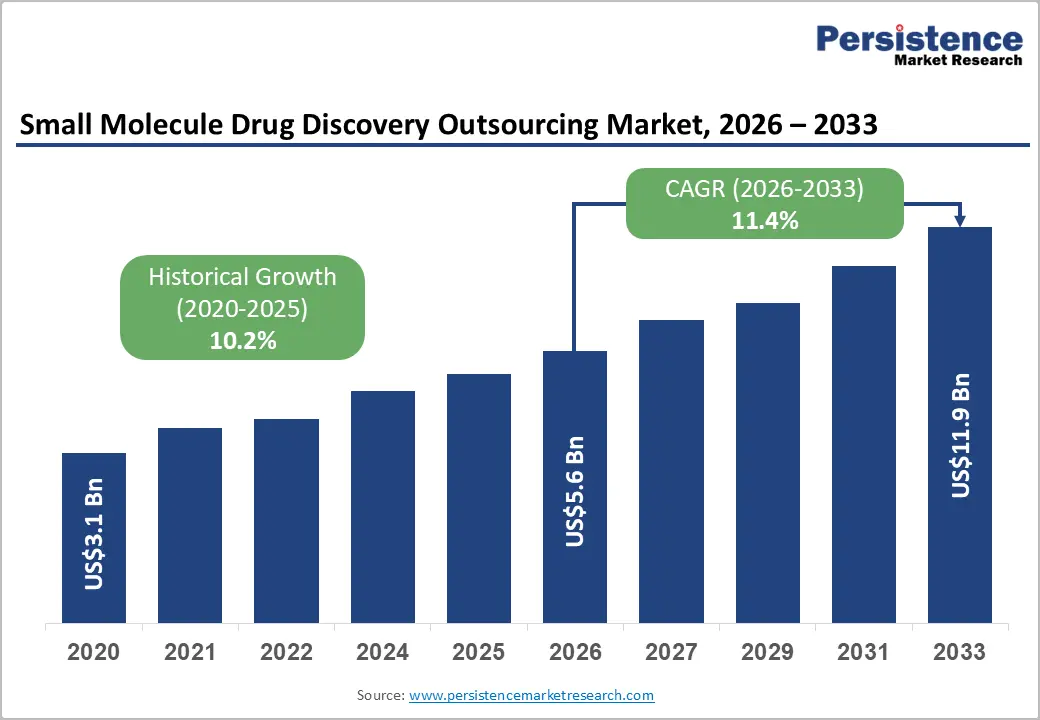
The global small molecule drug discovery outsourcing market size is likely to be valued at US$5.6 billion in 2026 and is expected to reach US$11.9 billion by 2033, growing at a CAGR of 11.4% during the forecast period from 2026 to 2033, driven by the rising reliance of pharmaceutical and biotech companies on external partners to reduce research & development costs and speed up discovery timelines. Growth is further supported by the increasing adoption of AI and computational tools in lead identification and optimization.
Key Industry Highlights:
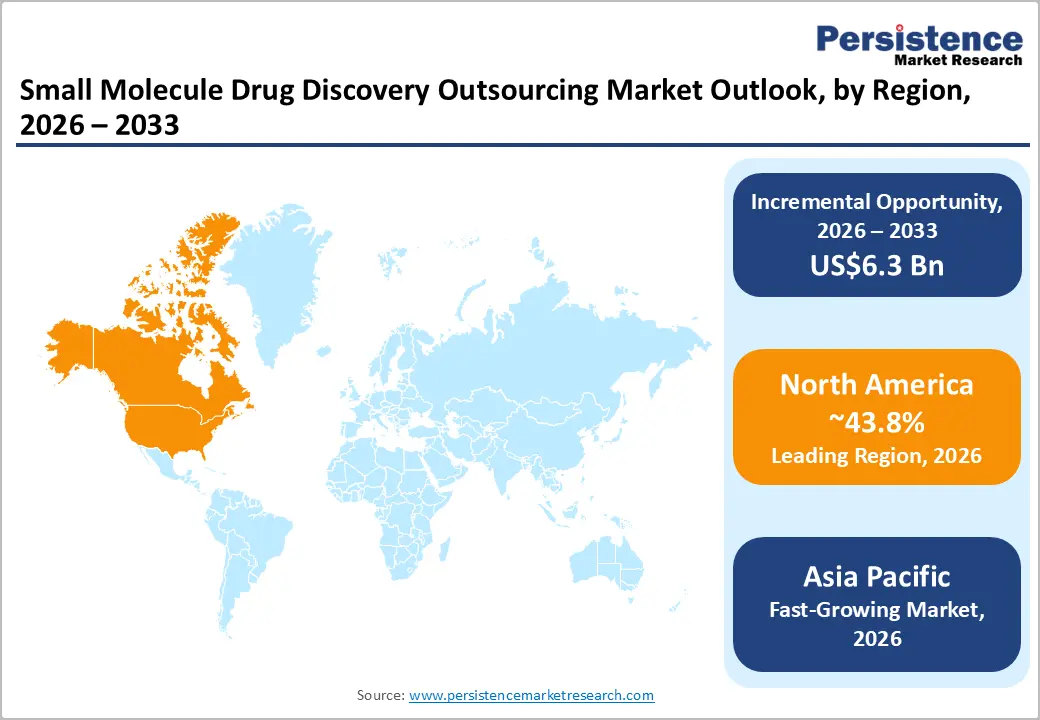
- Leading Region: North America, with about a 43.8% share in 2026, backed by the presence of various global pharma and biotech firms.
- Fast-growing Region: Asia Pacific, as it provides cost-efficient services along with rapidly improving scientific capabilities.
- New Center: In April 2025, the Icahn School of Medicine at Mount Sinai launched the AI Small Molecule Drug Discovery Center. It is a dedicated initiative to integrate AI with conventional discovery methods.
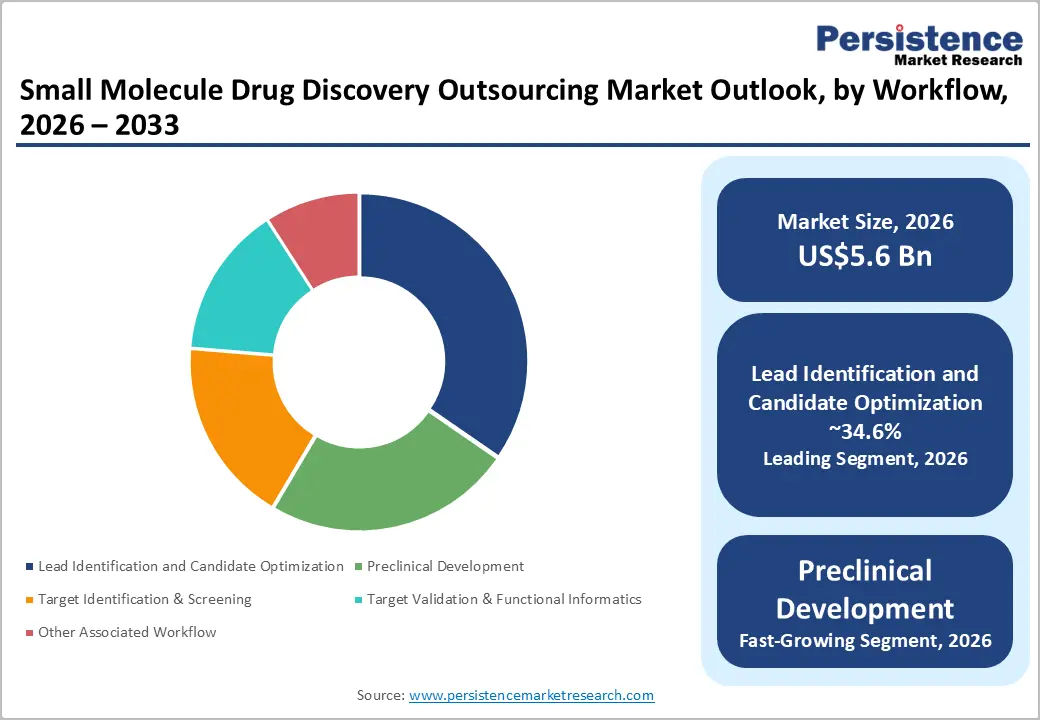
- Leading Workflow: Lead identification and candidate optimization, approximately 34.6% share in 2026, because this stage requires intensive iteration, advanced tools, and specialized expertise.
- Dominant Service: Chemistry services, nearly 67.4% in 2026, as they form the core of small molecule development.
DRO Analysis
Driver - High Demand for Cost Efficiency and Risk Management
One of the key reasons pharma companies lean on Contract Research Organizations (CROs) is the ability to pay only for what they use. Flexibility of externalized research and development is the key consideration. It can be turned on or off, basically transforming a fixed internal resource cost into a variable one. This matters because early-stage drug programs have uneven workloads. A team might require intensive medicinal chemistry support for six months and nothing for the next three.
Maintaining full in-house labs to cover those peaks is expensive and wasteful. Companies such as Astellas have leaned on CROs and specialized partners to access niche expertise without the financial commitment of maintaining high-cost facilities. As pharma restructuring continues, Pfizer's ongoing Cost Realignment Program is expected to deliver US$500 million in savings in 2025, adding to the US$4 billion it achieved in 2024. These moves have made variable-cost outsourcing models increasingly attractive across the industry.
Surging Need to Gain Access to Advanced Technologies
No single company can build expertise in every area of modern drug discovery. CROs fill this gap. High-Throughput Screening (HTS) allows CROs to assess compounds using automated and miniaturized assays, improving the success rates of hit discovery. Computational chemistry and molecular modeling tools assist in virtual screening and lead refinement by predicting how compounds behave, reducing reliance on lengthy lab procedures. AI-based platforms are raising the bar further.
Recursion Pharmaceuticals acquired Exscientia in late 2024 for US$688 million, creating a vertically integrated AI drug discovery platform that combines Recursion's phenomic screening with Exscientia's automated precision chemistry. The impact is tangible. Exscientia previously reported that its AI-designed compound for obsessive-compulsive disorder reached Phase I clinical trials after just 12 months of preclinical work, compared to the conventional four to five years. Sponsors now outsource specifically to access these capabilities rather than replicate them internally.
Restraint - The Intellectual Property Exposure Problem
Sharing proprietary compound data with an external CRO introduces security risks. Pharmaceutical data breaches carry an average cost of US$4.82 million, and when research and development investments can range from US$161 million to US$4 billion, with only 12% of drugs making it to market, the stakes are enormous. This risk is not merely theoretical. In August 2025, the Qilin ransomware group breached Indiana-based Inotiv, a CRO, stealing 176 GB of data and disrupting drug trials for nearly 10,000 individuals.
The risk extends beyond ransomware. According to the IBM Cost of a Data Breach Report 2025, pharmaceutical data breaches had an average cost of US$4.61 million, and 87% of healthcare and pharmaceutical companies report being negatively affected by a breach in their third-party ecosystem. For sponsors transferring early-stage scaffold data, assay results, and structure-activity relationships to CRO systems, a single breach can expose years of proprietary discovery work before a patent has even been filed.
Opportunity - Pairing Physical Screening with AI to Compress Discovery Timelines
CROs that combine wet-lab capacity with AI engines are creating a meaningful shortcut to Investigational New Drug (IND) filings. Streamlining preclinical workflows can reduce time-to-first-in-human by 40% or more, compressing timelines from approximately 24 months down to 12 to 15 months. The Recursion-Exscientia platform illustrates how this plays out in practice. The merged company integrates Recursion's high-throughput biological imaging, running approximately 2.2 million experiments per week across 50 human cell types.
It uses Exscientia's precision molecular design tools and more than 60 petabytes of proprietary data. Separately, a retrainable AI model applied to HTS workflows achieved an eightfold increase in hit rate and a 70% reduction in screening burden, per a 2025 bioRxiv study. As these hybrid models mature, CROs that can deliver both experimental throughput and predictive modeling in one engagement are becoming the preferred choice for sponsors trying to cut discovery cycles.
Closing the Gap between Predicted and Synthesizable Molecules
AI models can propose thousands of candidate molecules, but most cannot be made in the lab without significant rework. This gap is where CROs are building a new role. Virtual biotechs and start-ups constantly utilize AI-cloud platforms and outsourced research and development to accelerate drug discovery without heavy infrastructure costs, relying on CRO partners to move quickly from computational hits to physical candidates. A key proof of this loop working is Insilico Medicine's rentosertib.
Insilico used AI to identify a novel drug target and design a lead molecule for idiopathic pulmonary fibrosis, advancing it from target identification to Phase I readiness in under 18 months, at nearly 10% of the cost of traditional programs. By June 2025, positive Phase IIa results were published in Nature Medicine, the first clinical proof-of-concept validation of an end-to-end AI-discovered drug. CROs that can validate AI-predicted synthesis routes against real-world manufacturability constraints are well-positioned as virtual biotech models continue to rise.
Category-wise Analysis
Workflow Insights
The lead identification and candidate optimization segment is predicted to dominate with a share of approximately 34.6% in 2026, as this stage determines whether a molecule can realistically become a drug. After a target is identified, hundreds or even thousands of compounds must be screened, modified, and tested to improve potency, selectivity, safety, and pharmacokinetic properties. Most biotech firms lack the infrastructure and specialized expertise required for this highly iterative process, making outsourcing a practical choice.
The preclinical development segment is estimated to be the fastest-growing segment in the forecast period as regulators and investors now expect superior safety and efficacy data before human trials begin. Drug developers are hence conducting more extensive toxicology, pharmacokinetic, bioanalytical, and efficacy studies during the preclinical stage. Several companies outsource these activities to avoid investing in costly facilities and animal research infrastructure.
Service Insights
Chemistry services are anticipated to dominate with a share of nearly 67.4% in 2026, as chemistry sits at the core of small molecule drug discovery. Every stage, from hit generation and lead optimization to candidate selection, depends on the design, synthesis, and modification of chemical compounds. Pharmaceutical companies continuously require new compound libraries and analogs, creating sustained demand for external chemistry expertise.
Biology services are predicted to remain in the second position in 2026, as drug discovery is increasingly focused on understanding disease mechanisms rather than simply identifying active compounds. Before investing heavily in chemistry optimization, companies require reliable target validation, biomarker studies, assay development, and mechanism-of-action research. These activities fall under biology services.
Regional Insights
North America Small Molecule Drug Discovery Outsourcing Market Trends
North America is predicted to dominate in 2026 with a share of approximately 43.8%, as it has the world's largest concentration of pharmaceutical companies, biotechnology firms, academic research centers, and CROs. Drug developers in the region increasingly outsource early-stage discovery work to reduce costs and boost timelines while focusing internal resources on strategic programs. This has created a well-established outsourcing network with superior scientific expertise and regulatory support.
U.S. Small Molecule Drug Discovery Outsourcing Market Trends
A share of nearly 69.7% is expected to be held by the U.S. in 2026, as it remains the global center for biotechnology innovation. Thousands of biotech companies are developing novel therapies but lack full in-house discovery infrastructure. Outsourcing allows these firms to access specialized expertise without significant capital investments. The country is also at the forefront of AI-assisted drug discovery.
Recent industry developments show rising investments in AI platforms designed to shorten discovery timelines and improve candidate selection. For example, Takeda extended its AI-based small molecule discovery efforts through a multi-billion-dollar collaboration with Iambic, while Eli Lilly launched TuneLab to support AI-enabled drug discovery programs.
Asia Pacific Small Molecule Drug Discovery Outsourcing Market Trends
Asia Pacific is anticipated to be the fastest-growing region in 2026 with a share of nearly 30.9%, as it combines cost-efficiency with rapidly improving scientific capabilities. Countries across the region have invested heavily in biotechnology infrastructure, research parks, skilled talent, and pharmaceutical manufacturing. Hence, global drug developers are outsourcing more discovery activities to Asia Pacific-based providers. The region has also become attractive for integrated discovery services. CROs now provide medicinal chemistry, biology, ADME, toxicology, and preclinical development under one roof. This reduces project complexity for sponsors and improves turnaround times.
China Small Molecule Drug Discovery Outsourcing Market Trends
China will likely lead Asia Pacific in 2026 with a share of around 38.6%, augmented by its transformation from a low-cost outsourcing destination into a high-value innovation hub. Local CROs have expanded their capabilities in medicinal chemistry, computational biology, AI-assisted drug design, and preclinical development. This has enabled them to compete for complex discovery programs rather than only routine research work. The country also has a large pool of scientists and a rapidly expanding biotechnology sector.
Local firms increasingly collaborate with global pharmaceutical companies on drug discovery projects. Several sponsors are attracted by China's ability to provide large-scale research capacity and faster project execution.
Japan Small Molecule Drug Discovery Outsourcing Market Trends
In 2026, Japan is projected to account for a share of approximately 22.4%, as pharmaceutical companies are now seeking external expertise to improve research & development productivity. Multiple firms are partnering with CROs and technology companies to propel discovery programs and reduce development risks. The country is also becoming a key adopter of AI in drug discovery. Japan's strength in precision medicine, oncology, and rare disease research is creating additional outsourcing opportunities. Drug developers often require specialized biological models and advanced chemistry services that external partners can provide more efficiently.
Europe Small Molecule Drug Discovery Outsourcing Market Trends
Europe will likely see decent growth in the forecast period, with a share of nearly 14.7% in 2026, as it has a strong pharmaceutical research base and a well-established CRO network. Many local drug developers outsource discovery activities to manage rising research & development complexity and gain access to specialized expertise. The region also benefits from close collaboration between academia, biotechnology companies, and pharmaceutical manufacturers. These partnerships help generate a continuous pipeline of novel targets and therapeutic candidates, supporting demand for outsourced discovery services.
Germany Small Molecule Drug Discovery Outsourcing Market Trends
Germany will likely register a substantial share of approximately 36.8% in 2026. It is projected to remain one of Europe's most important markets for drug discovery outsourcing due to its well-established pharmaceutical and biotechnology sectors. The country hosts various research institutes, university laboratories, and drug developers that generate a consistent demand for outsourced discovery services. Domestic players are now adopting digital technologies, AI tools, and unique screening platforms. This is creating new opportunities for CROs that provide computational chemistry, bioinformatics, and translational research services.
U.K. Small Molecule Drug Discovery Outsourcing Market Trends
A share of around 19.5% is predicted to be held by the U.K. in 2026, owing to its superior life sciences hub, world-class universities, and active biotechnology start-up community. Research clusters around Cambridge, Oxford, and London generate a steady stream of drug discovery programs that frequently rely on external partners. A key strength of the U.K. market is its ability to translate academic research into commercial drug development. Several spin-out companies operate with virtual or semi-virtual business models and depend heavily on outsourced discovery services. This supports consistent demand for CRO partnerships.
Competitive Landscape
The global small molecule drug discovery outsourcing market is moderately fragmented with the presence of large integrated CROs, mid-sized specialist discovery firms, AI-backed drug discovery companies, and regional outsourcing providers. Leading players such as WuXi AppTec, Charles River Laboratories, Eurofins, Evotec, and Curia are expanding beyond medicinal chemistry to deliver target identification, high-throughput screening, bioassays, computational biology, preclinical development, and IND-enabling services.
CROs and discovery firms are investing heavily in AI-supported screening, predictive modeling, in silico ADMET analysis, and automated lead optimization to shorten discovery timelines and improve hit identification success rates. AI-focused partnerships have become a key differentiator. Large CROs are acquiring niche firms specializing in AI, computational chemistry, and specific therapeutic areas to extend their service portfolios and strengthen customer retention.
Key Industry Developments:
- In January 2026, Pierre Fabre Laboratories and Iktos announced an integrated AI-driven drug discovery collaboration to identify novel small-molecule candidates in oncology. Iktos will use its AI-based generative design platform to propel the discovery of optimized small-molecule candidates against an undisclosed oncology target, while Pierre Fabre Laboratories will contribute its extensive knowledge in oncology research and preclinical development to guide the selection, evaluation, and progression of candidate molecules.
- In June 2025, Insilico Medicine published Phase IIa results of Rentosertib (ISM001-055) in Nature Medicine, marking a significant milestone for AI-driven small molecule discovery outsourcing. Patients receiving 60 mg QD Rentosertib experienced the greatest mean improvement in lung function, with a mean change of +98.4 mL in forced vital capacity, compared to a mean decline of -20.3 mL in the placebo group.
- In May 2025, Peptone announced a partnership with Evotec to accelerate the development of small-molecule treatments targeting intrinsically disordered proteins (IDPs). Through the collaboration, Peptone will harness Evotec's drug discovery toolbox to smoothly integrate with its pioneering, physics-based approach to understanding IDP structural dynamics.
Companies Covered in Small Molecule Drug Discovery Outsourcing Market
- WuXi AppTec
- Pharmaceutical Product Development, LLC
- Charles River Laboratories
- Laboratory Corporation of America Holdings (Covance)
- Eurofins
- Evotec
- Albany Molecular Research (Curia)
- GenScript Biotech
- Pharmaron
- Syngene International
- Dalton Pharma Services
- Oncodesign
- Jubilant Biosys
- Domainex
- GenScript Biotech
- Merck & Co., Inc.
- QIAGEN
- Dr. Reddy Laboratories Ltd.
- Pharmaron Beijing Co., Ltd.
- TCG Lifesciences Pvt Ltd.
- Others
Frequently Asked Questions
The global small molecule drug discovery outsourcing market is projected to be valued at US$5.6 billion in 2026.
The small molecule drug discovery outsourcing market is expected to reach US$11.9 billion by 2033.
Key market trends include increasing use of integrated end-to-end outsourcing models and surging partnerships between pharma companies and tech-enabled CROs.
Lead identification and candidate optimization are expected to be the leading workflow with a share of nearly 34.6% in 2026, as companies invest more in outsourcing resources here to refine molecules early.
The small molecule drug discovery outsourcing market is expected to grow at a CAGR of 11.4% from 2026 to 2033.
WuXi AppTec, Pharmaceutical Product Development, LLC, and Charles River Laboratories are a few key market players.


