




- Display Technologies
- Portable Projectors Market
Portable Projectors Market Size, Share, and Growth Forecast 2026 - 2033
Portable Projectors Market by Technology (Digital Light Processing (DLP), Liquid Crystal Display (LCD), Liquid Crystal on Silicon (LCOS), Others), Projector Size (Below 50 Inches, 50-200 Inches, Above 200 Inches), Connectivity, End-User, Distribution Channel, and Regional Analysis, 2026 - 2033

Portable Projectors Market Size and Trend Analysis
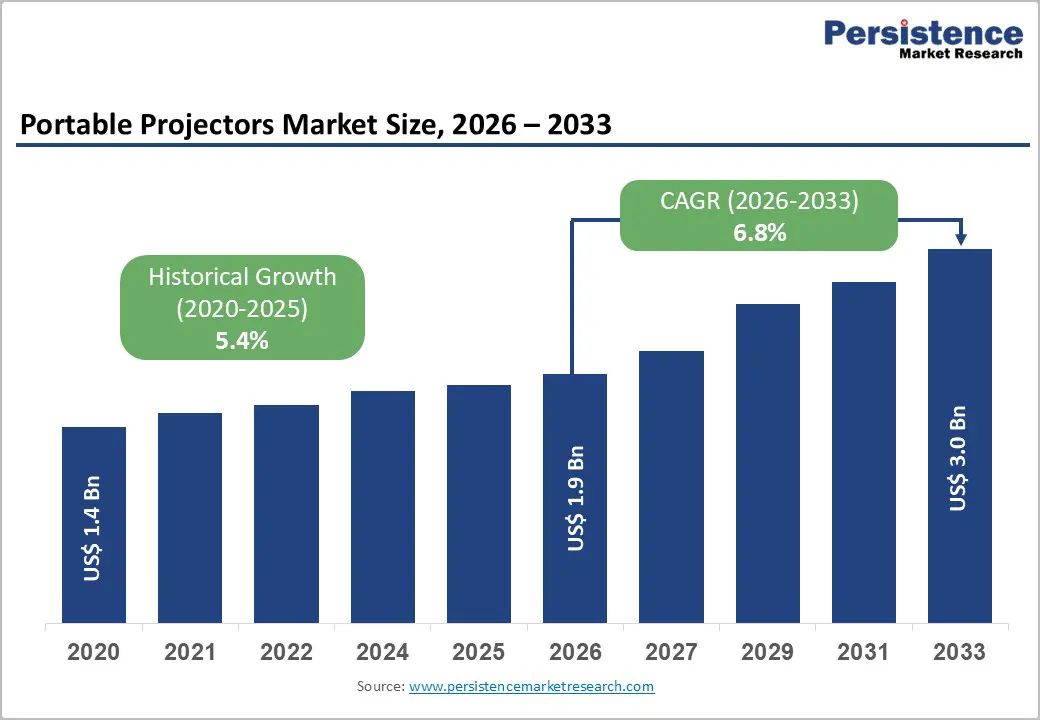
The global Portable Projectors Market size is expected to be valued at US$ 1.9 billion in 2026 and projected to reach US$ 3.0 billion by 2033, growing at a CAGR of 6.8% between 2026 and 2033.
Demand is rising as consumers and businesses increasingly seek compact, easy-to-use projection solutions for remote work, home entertainment, and digital learning. Advancements in portability, battery life, and wireless connectivity have made these devices more versatile. High-resolution displays, including 4K models, and integration with smartphones and other smart devices are driving adoption across education, corporate, and entertainment segments worldwide.
Key Market Highlights
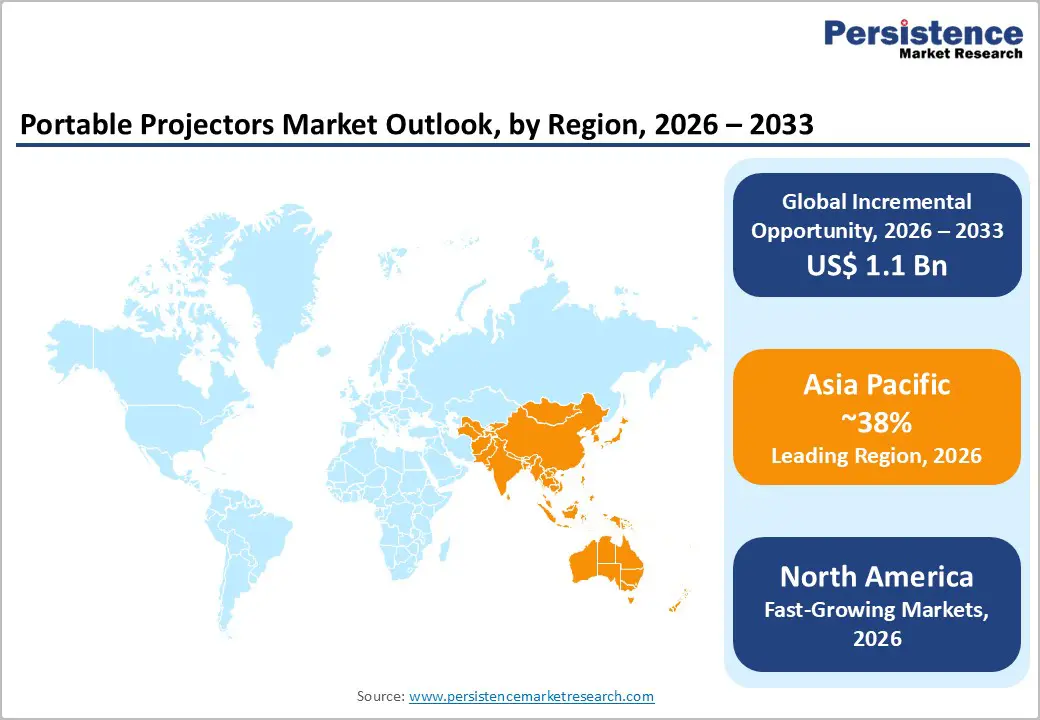
- Leading Region: Asia Pacific dominates the market with a 38% share in 2025, driven by strong demand from China and India.
- Fastest-Growing Region: Asia Pacific is the fastest-growing region, expanding at an 8.2% CAGR, supported by 5G adoption and urbanization trends.
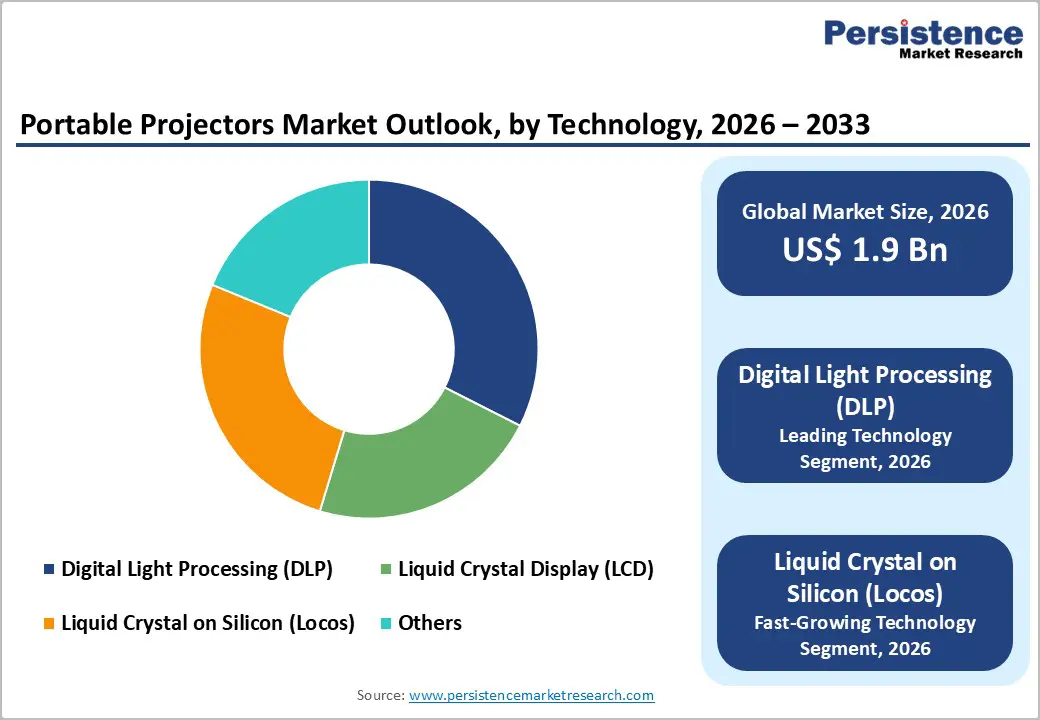
- Leading Technology: Digital Light Processing (DLP) leads the technology segment with a 55% share in 2025, due to superior color reproduction and portability.
- Fastest-Growing Connectivity: Wireless connectivity is the fastest-growing segment, with an adoption rate rising at a 9.1% CAGR, fueled by integration with smart devices and seamless streaming.
- Key Opportunity: Short-throw and 4K projectors offer significant opportunities for gaming and educational technology applications, enabling large, immersive displays in compact spaces.
| Key Insights | Details |
|---|---|
|
Portable Projectors Size (2026E) |
US$ 1.9 billion |
|
Market Value Forecast (2033F) |
US$ 3.0 billion |
|
Projected Growth CAGR (2026-2033) |
6.8% |
|
Historical Market Growth (2020-2025) |
5.4% |
Market Dynamics
Drivers - Rising Demand for Wireless Connectivity and Enhanced Portability Driving Market Growth
Consumers are increasingly seeking portable projectors that combine wireless connectivity with compact, lightweight designs, allowing seamless use at home, in offices, or during events without cumbersome cables. Integration of modern Wi-Fi and Bluetooth standards enables high-quality screen mirroring from smartphones and laptops, improving convenience and flexibility across multiple environments. Low-latency streaming and support for high-definition content enhance the overall user experience.
Manufacturers are responding by producing ultra-lightweight models under 2 lbs that are easy to carry and set up anywhere. The hybrid work and mobile lifestyle trends further encourage adoption, as professionals, educators, and gamers benefit from devices that support high-quality visuals and effortless portability, making these projectors a preferred choice for dynamic, on-the-go use.
Expansion of Home Entertainment and Digital Education Applications Accelerating Demand
The shift toward home-based entertainment and digital education has significantly increased the adoption of portable projectors. Compact projectors offer larger displays compared to traditional screens, providing an immersive viewing experience for streaming movies, gaming, or interactive learning. Battery-powered units with sufficient brightness perform well in dim environments, making them ideal for living rooms, classrooms, and temporary setups.
Educational institutions, students, and households leverage these devices to enhance engagement, participation, and accessibility in remote or hybrid learning environments. At the same time, entertainment enthusiasts value their convenience and portability for streaming and gaming. This dual application across learning and leisure continues to drive widespread adoption and encourages continuous innovation in projector features and usability.
Restraints - High Initial Costs and Limited Battery Life Constraining Portable Projector Adoption
Premium portable projectors with advanced features often carry high price tags, making them less accessible to budget-conscious consumers, particularly in emerging markets. While these devices offer high-resolution displays, wireless connectivity, and compact designs, the upfront investment remains a significant barrier for many potential buyers. This limits widespread adoption despite growing interest in mobile and home entertainment solutions.
Battery limitations further constrain usage, as average runtimes of 2–3 hours may not support extended sessions in classrooms, offices, or outdoor environments. In areas with unreliable power supply, interruptions hinder continuous use, reducing the overall convenience of portable projectors. Combined with competition from smartphones and large-screen TVs, these factors limit market penetration and slow adoption rates.
Supply Chain Disruptions and Component Shortages Hampering Production and Innovation
Global supply chain disruptions and component shortages have significantly affected the production of portable projectors. DLP chip and LCD panel shortages increase manufacturing costs, causing delays in shipments and limiting availability in key markets. Dependence on specialized optics for LCOS projectors exacerbates these challenges, slowing the rollout of innovative models.
Small and mid-sized manufacturers face difficulties scaling production, leading to constrained inventory and slower market expansion. Fluctuating prices of critical components increase operational expenses, reducing margins and delaying research and development efforts. These supply-side challenges impact both the introduction of new models and the ability of producers to meet rising consumer demand effectively.
Opportunities - Expansion through Affordable and Accessible Portable Projector Models Driving Opportunities
Rapid urbanization in Asia Pacific and initiatives like smart city development create strong demand for portable projectors in residential, commercial, and public spaces. Affordable LCD models allow event organizers, schools, and small businesses to access high-quality projection without significant investment. Low-cost options under $200 appeal to gaming and home entertainment users, while energy-efficient designs align with regional sustainability policies, encouraging adoption across multiple segments.
Growing mobile and digital infrastructure, including widespread 5G coverage, supports wireless connectivity and seamless device integration. These factors create opportunities for manufacturers to introduce cost-effective models tailored to emerging markets, expanding their customer base, and fostering adoption in regions with high population density and increasing technology penetration.
Technological Advancements in 4K Resolution and Short-Throw Projectors Creating New Market Opportunities
Innovations in 4K resolution and short-throw projection are driving the adoption of portable projectors in homes, offices, and classrooms. Short-throw models can project large images from minimal distances, making them ideal for small rooms and compact setups. High-resolution DLP technology enables pocket-sized devices while maintaining image quality, and long-lasting laser light sources enhance usability for events and corporate presentations.
The gaming sector benefits from high refresh rates, supporting immersive experiences with consoles and PCs. Similarly, educational institutions can leverage these advanced projectors for interactive classes and remote learning programs. These technological improvements open new applications and increase the value proposition for consumers seeking versatile, high-performance portable projection solutions.
Category-wise Analysis
Technology Insights
Digital Light Processing (DLP) leads the technology segment with a 55% share in 2025, driven by superior image quality, high contrast ratios, and compact designs suitable for both business and home use. DLP chips provide wide color coverage and dust-resistant features, making them reliable for professional applications. Popular models have sold millions of units, highlighting strong adoption across corporate, educational, and entertainment segments. DLP projectors are energy-efficient and lightweight, aligning with mobility trends and hybrid work setups.
Liquid Crystal on Silicon (LCoS) and LED/laser hybrid technologies are the fastest-growing segments due to their enhanced resolution, color accuracy, and energy efficiency. These technologies appeal to premium users in gaming, home entertainment, and small office setups. The improved image fidelity and ability to deliver vibrant visuals in compact designs make them increasingly preferred for immersive and professional applications.
Projector Size Insights
Projectors with screen sizes of 50–200 inches hold a 60% share in 2025, favored for their versatility across home, classroom, and office environments. This range fits standard 15x15 ft rooms, supporting educational and corporate use effectively. Leading brands report that up to 70% of their educational sales are from this category. Short-throw variants within this range also support gaming and small-space entertainment, making them highly adaptable for multiple applications.
Short-throw and ultra-short-throw projectors are the fastest-growing category, as they can project large images from minimal distances, ideal for compact living spaces, classrooms, and gaming setups. These projectors provide immersive visuals in confined rooms and are increasingly adopted for both residential and professional environments where space is limited.
Connectivity Insights
Wireless projectors lead the segment with a 52% share in 2025, supported by technologies like Miracast, AirPlay, and Wi-Fi 6 that provide faster data transfer and low-latency streaming. Samsung Freestyle models and other popular units demonstrate strong adoption, particularly among business users, who make up 45% of wireless projector customers. Wireless setups enable easy mirroring from smartphones, tablets, and laptops, enhancing user convenience and mobility.
Hybrid connectivity, combining wired and wireless options, is the fastest-growing category, offering flexibility for professionals, educators, and gamers. Users can switch between direct connections and wireless streaming, making these projectors ideal for varied scenarios such as classrooms, office presentations, and interactive home setups.
End-User Insights
Home entertainment dominates the end-user segment with a 48% share in 2025, driven by high streaming adoption and the popularity of immersive viewing experiences. Devices supporting Dolby Atmos and 4K resolution appeal to households seeking cinema-like experiences. Users stream content daily, with Netflix and other platforms contributing to growing demand. The category is fueled by the convenience of compact projectors for gaming, movie nights, and social events.
Educational and corporate segments are the fastest-growing end-users, as schools, colleges, and offices adopt portable projectors for interactive learning and collaborative work. These devices are valued for their mobility, ease of setup, and ability to deliver large-screen visuals in classrooms, meeting rooms, and hybrid workspaces.
Distribution Channel Insights
Online distribution channels lead with a 65% share in 2025, driven by e-commerce platforms like Amazon and Best Buy. Consumers rely heavily on online reviews, which influence 70% of purchase decisions, and promotional events such as Black Friday generate spikes in sales. High internet penetration and digital accessibility facilitate convenience and wider reach, particularly for tech-savvy buyers seeking home entertainment and portable business solutions.
Offline retail and specialty AV stores are the fastest-growing channels, offering hands-on experience, immediate product access, and personalized guidance. Premium and professional-grade users increasingly prefer physical stores for demonstrations, expert consultations, and quick availability, making these channels attractive for brands targeting niche and high-end segments.
Regional Insights
North America Portable Projectors Market Analysis
North America holds a significant position in the portable projector market, with the U.S. leading overall and accounting for a 34% share in 2025. Growth is driven by widespread adoption of AI-enabled and high-resolution models, showcased at events like CES 2025 with over 20 new AI-integrated units from brands like Anker. Remote work adoption, with 62% of workers leveraging flexible schedules, has increased demand for portable projection solutions in home offices and corporate environments. Strong energy efficiency standards and reliable infrastructure further support adoption across business and educational segments.
Canada contributes with growing adoption in the educational sector, implementing digital classrooms and integrating portable projectors into schools. Small businesses and content creators are increasingly using compact projectors for hybrid events, training sessions, and presentations. The combination of technological advancements, professional use cases, and home entertainment needs ensures sustained growth in the region.
Europe Portable Projectors Market Analysis
Europe’s portable projector market is gradually expanding, with Germany emerging as a key hub for DLP-based projectors. The market benefits from harmonized regulations under EU RoHS, covering the U.K., France, and Spain, which ensures environmentally compliant devices. Event and hybrid meeting adoption is rising, with 25% of corporate events now integrating portable projection solutions. Germany’s technology fairs, including EGX 2024 with 50K units exhibited, highlight strong interest in innovative, compact projectors. The region is projected to grow at a CAGR of 7.1% from 2025 to 2032, driven by corporate adoption and edtech integration.
Smaller European markets are increasingly exploring portable solutions for both education and home entertainment. Rising awareness of energy-efficient and wireless models is boosting demand in urban centers, while short-throw and high-resolution devices are gaining traction for gaming and interactive learning applications, reinforcing the market’s growth potential.
Asia Pacific Portable Projectors Market Analysis
Asia Pacific leads the global market with a 38% share in 2025, driven by strong manufacturing and consumption in China, India, and ASEAN countries. China supplies 70% of regional production and exports over 10 million units, while Sony’s LCOS projectors strengthen premium offerings. India contributes with deployment in 50,000 schools under digital education initiatives, and ASEAN countries see high gaming adoption with 100 million gamers and 55% 5G coverage, enabling seamless wireless connectivity for portable projectors.
Rapid urbanization and digital adoption across education, entertainment, and corporate sectors create opportunities for compact, energy-efficient devices. Affordable models tailored for emerging markets and high-end premium units for professional use are gaining momentum. The region is experiencing accelerated adoption of 4K and short-throw projectors, supporting large-screen experiences in homes, classrooms, and small office spaces.
Competitive Landscape
The portable projector market is moderately consolidated, with several leading players driving innovation and product differentiation. Companies focus on enhancing features such as battery life, wireless connectivity, and user-friendly applications to appeal to home, educational, and business users. Continuous investment in research and development enables improvements in display technologies, energy efficiency, and portability, helping brands maintain competitiveness and meet evolving consumer needs.
Direct-to-consumer (D2C) sales models are gaining traction, allowing companies to engage customers more effectively and offer personalized experiences. Emphasis on software ecosystems, smart device integration, and compact designs further strengthens differentiation, fostering innovation and maintaining market relevance in a dynamic environment.
Key Developments:
- In January 2025, Anker launched the Nebula Mars 4 4K at CES, featuring a 10-hour battery life and enhanced 4K resolution. The model targets home entertainment and portable use, offering compact design, wireless connectivity, and improved image quality for on-the-go consumers.
- In June 2024, Samsung introduced the Freestyle 2nd Gen Sphere Mode, delivering a versatile projection experience with 360-degree display capabilities. The portable device integrates wireless streaming, smart app compatibility, and energy-efficient operation, catering to home, educational, and professional applications.
- In October 2024, XGIMI unveiled the Halo+ Google TV, combining portable projection with Google TV integration. The device supports high-definition content, enhanced battery performance, and user-friendly smart features, appealing to home entertainment enthusiasts and digital content consumers.
Companies Covered in Portable Projectors Market
- Epson
- BenQ
- Optoma
- LG Electronics
- Samsung Electronics
- Sony
- Panasonic
- ViewSonic
- Canon
- Barco
- Acer
- XGIMI
- JMGO
- Hisense
- Sharp Corporation
Frequently Asked Questions
The global Portable Projectors market is expected to reach US$ 1.9 billion in 2026 and grow to US$ 3.0 billion by 2033 at a 6.8% CAGR.
Rising wireless connectivity, home entertainment adoption with 85% streaming, and hybrid work with 60% portable device usage are the main drivers.
Asia Pacific leads with 38% share in 2025, supported by China’s manufacturing and India’s digital education initiatives.
4K short-throw projectors for gaming and edtech, along with emerging 5G-enabled markets, present strong opportunities.
Key companies include Anker, Samsung, XGIMI, BenQ, and Sony, focusing on AI features, battery, and wireless connectivity.


