




- Plastics, Polymers & Resins
- Polyvinyl Films Market
Polyvinyl Films Market Size, Share, and Growth Forecast, 2026 - 2033
Polyvinyl Films Market by Product Type (Flexible Films, Rigid Films), Application (Packaging, Food Packaging), End-Use Industry (Food and Beverage, Healthcare and Pharmaceuticals), and Regional Analysis for 2026 - 2033

Polyvinyl Films Market Size and Trends Analysis
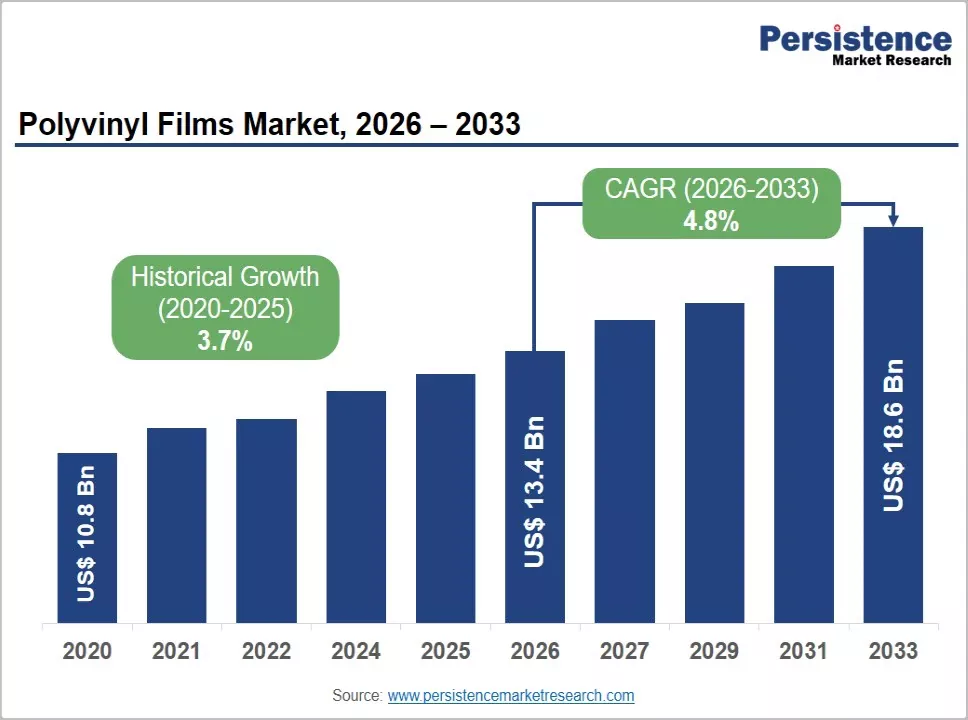
The global polyvinyl films market size is likely to be valued at US$ 13.4 billion in 2026 and is expected to reach US$ 18.6 billion by 2033, growing at a CAGR of 4.8% between 2026 and 2033, driven by sustained demand from packaging, healthcare, and construction applications.
Flexible films, pharmaceutical blister packaging, and decorative and protective surface applications are supporting volume growth, while recyclable constructions and phthalate-free plasticizers are reshaping product development across the industry.
Key Industry Highlights
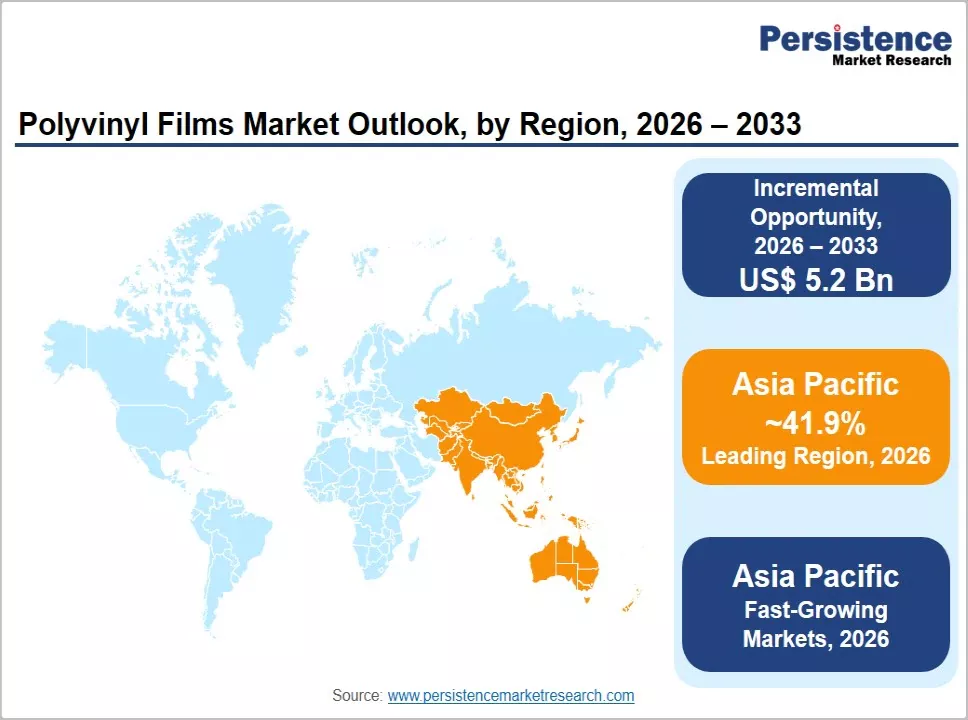
- Leading Region: Asia Pacific, accounting for 41.9% of global revenue, supported by large-scale packaging, construction, and film conversion capacity in China, India, and ASEAN.
- Fastest-growing Region: Asia Pacific, driven by rapid urbanization, expanding pharmaceutical and food packaging output, and rising infrastructure investment.
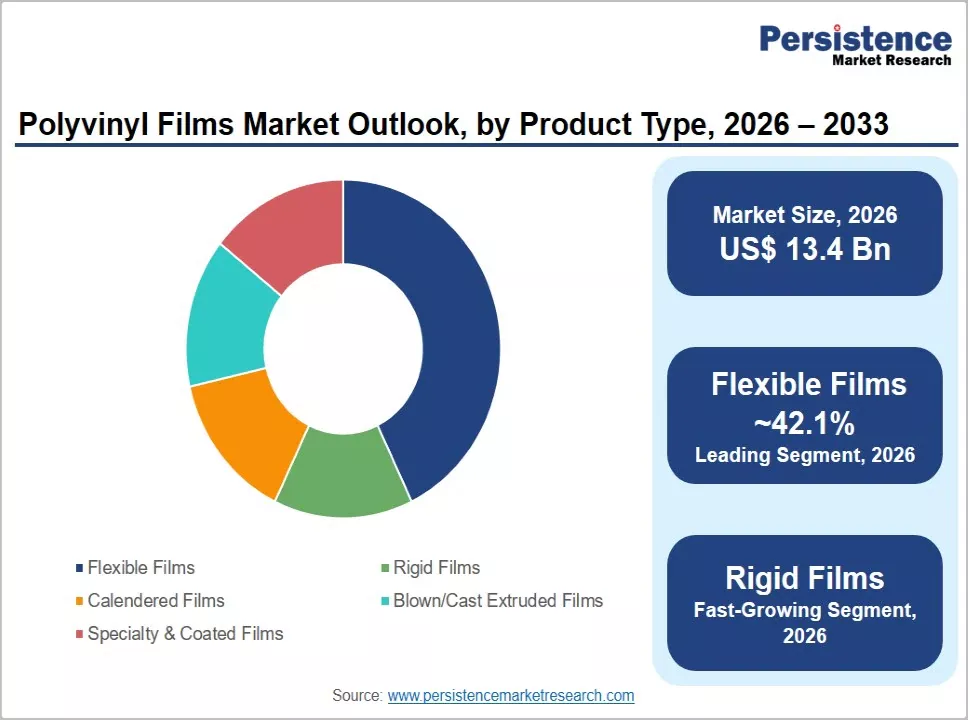
- Dominant Product Type: Flexible films, anticipated to hold approximately 42.1% of the market share, widely used across packaging, medical, and apparel applications.
- Leading Application: Packaging, accounting for approximately 47.7% of global polyvinyl films revenue, driven by food, pharmaceutical, and consumer goods demand.
DRO Analysis
Drivers - Packaging Demand From Food and Pharmaceutical Sectors Supports Volume Growth
Packaging accounts for approximately 47.7% of global polyvinyl films revenue, making it the largest demand center for the market. Polyvinyl films offer clarity, formability, and reliable sealing, and laminated structures add moisture and oxygen barrier properties for blister packs, shrink sleeves, and food wraps.
In the U.S., food-contact materials are regulated under Title 21 of the Code of Federal Regulations, and compliant grades are widely used in meat, produce, and bakery packaging. Growth in convenience foods, e-commerce shipments, and pharmaceutical output is increasing film consumption per unit sold, which supports steady volume growth across flexible and rigid formats and reinforces the role of packaging as the primary revenue base.
Restraint - Environmental Regulation and Material Substitution Increase Compliance and Cost Pressure
Regulators continue to review PVC additives, and the European Chemicals Agency completed its investigation of PVC and its additives in November 2023. Commission Regulation (EU) 2023/923 limits lead in PVC articles to below 0.1% by weight, effective November 29, 2024, and applies to imported articles, which accounted for 90% of estimated lead emissions from PVC articles in the European Union in 2016. Brand owners are also moving toward mono-material polyethylene, polypropylene, and PET packaging to meet recyclability targets. Reformulation, testing, and traceability costs weigh most heavily on smaller converters, narrowing margins in commodity film grades.
Opportunities - Pharmaceutical and Recyclable Food Packaging Films Offer Clear Product Differentiation
Healthcare and pharmaceuticals is anticipated to be the fastest-growing end-use industry, and blister packaging continues to rely on rigid polyvinyl films laminated with barrier coatings to protect moisture-sensitive tablets and capsules. Producers are also developing thinner-gauge, phthalate-free, and recyclable constructions.
Klöckner Pentaplast, for example, expanded its kp Infinity portfolio in June 2026 with a recyclable fresh fruit tray range, and its foodservice offering includes both PVC and recyclable polyolefin options. Manufacturers that combine barrier performance with recyclability are positioned to secure long-term supply agreements with pharmaceutical companies and food brand owners. Healthcare packaging also carries longer qualification cycles, which increases supplier retention once a grade is approved.
Category-wise Analysis
Product Type Insights
Flexible films are anticipated to account for approximately 42.1% of the market share, making them the leading product type. Plasticized polyvinyl films combine softness, stretch, transparency, and printability, which suits packaging, medical, and apparel applications.
Examples include shrink and stretch wraps for food, medical bags and tubing films, protective covers, and synthetic leather and textile coatings. Calendering and extrusion processes allow producers to control thickness, gloss, and texture across large production runs, supporting cost-efficient supply to high-volume converters. The shift toward phthalate-free plasticizers is shaping formulation choices, and producers that qualify compliant grades for food-contact and medical uses retain a strong position with large brand owners and healthcare customers. Medical applications rely on the transparency, kink resistance, and sterilization compatibility of flexible grades.
Rigid films are anticipated to be the fastest-growing product type, supported by construction, signage, and thermoforming demand. Unplasticized films offer stiffness, dimensional stability, and clarity, which suits pharmaceutical blister packs, food trays, card stock, and decorative laminates.
For example, rigid films laminated with barrier coatings protect moisture-sensitive tablets, while thermoformed trays support fresh and prepared food packaging. Construction uses include wall panels, laminated profiles, and flooring components, where durability and cleanability are key requirements. Calendered films, blown and cast extruded films, and specialty and coated films complement these categories, serving graphic films, high-gloss decorative surfaces, and antimicrobial or barrier-coated products for healthcare environments.
Application Insights
Packaging is anticipated to account for approximately 47.7% of global polyvinyl films revenue. The segment covers food, pharmaceutical, and consumer goods packaging, including shrink films, overwraps, blister films, clamshells, and sleeves. Polyvinyl films are valued for clarity, sealability, and ease of forming, which supports shelf visibility and product protection. For example, retailers use polyvinyl overwraps for fresh meat and produce trays, while consumer goods brands use shrink sleeves for full-body labeling on irregular containers.
Rising packaged food consumption, expanding organized retail, and growth in online shopping continue to increase film demand, and converters are investing in thinner-gauge structures that reduce plastic use per pack. Packaging converters also benefit from the film's compatibility with high-speed forming and sealing lines.
Food packaging is anticipated to be the fastest-growing application, driven by convenience foods, e-commerce, and sustainability needs. Ready meals, fresh-cut produce, and protein products require films that maintain visibility, hygiene, and shelf life through chilled distribution. Sustainability requirements are pushing suppliers toward thinner gauges, recycled content, and recyclable alternatives, and companies such as Klöckner Pentaplast are introducing recyclable tray and film ranges for meat, dairy, bakery, and fresh produce sectors.
Medical and pharmaceutical packaging, construction and building materials, automotive interiors and components, electrical insulation and electronics, and consumer goods and textiles complete the application base, each relying on the durability, flame-retardant behavior, and processing flexibility of polyvinyl films.
Regional Insights
North America Polyvinyl Films Market Trends
North America’s demand is concentrated in pharmaceutical and food packaging, medical devices, luxury vinyl flooring, and signage. The region is characterized by mature regulatory frameworks, advanced converting technology, and strong interest in recyclable and phthalate-free film formulations. Key growth drivers include pharmaceutical packaging demand, e-commerce fulfillment, renovation activity, and the adoption of recyclable constructions. Investment is directed toward barrier lamination, recyclable film lines, and automation at converting sites, as brand owners set recycled content and recyclability targets.
U.S. Polyvinyl Films Market Trends
The U.S. is the leading market in North America, supported by a large pharmaceutical sector, extensive food retail networks, and strong residential and commercial renovation activity. The U.S. Food and Drug Administration regulates food-contact materials under Title 21 of the Code of Federal Regulations, which requires compliant formulations for films in contact with food. Luxury vinyl flooring and signage add demand for decorative and rigid films, while unit-dose blister formats support pharmaceutical packaging demand.
Producers are investing in recyclable constructions and thinner gauges in response to extended producer responsibility laws for packaging enacted in several states, including California, Colorado, and Oregon. Healthcare packaging remains a core strength, with pharmaceutical manufacturers specifying rigid blister films for solid-dose products. Converters are also upgrading calendering and extrusion lines to improve yield, reduce scrap, and support thinner-gauge production.
In January 2026, Klöckner Pentaplast, which operates film production facilities in the U.S., completed a financial restructuring that followed an agreement targeting a reduction of approximately €1.3 billion in funded debt, strengthening its ability to invest in food and pharmaceutical packaging innovation.
Europe Polyvinyl Films Market Trends
Europe is supported by pharmaceutical manufacturing, food packaging, and a strong decorative and technical films industry. Key growth drivers include pharmaceutical and food packaging demand, building renovation programs, and the shift toward recyclable and thinner-gauge constructions. Investment is directed toward site modernization, energy efficiency, and recycled-content capability.
Germany Polyvinyl Films Market Trends
Germany is the leading European market for polyvinyl films and hosts the headquarters of RENOLIT in Worms, alongside major Klöckner Pentaplast production operations in Montabaur. Demand is supported by pharmaceutical packaging, automotive interiors, construction, and decorative surfaces.
In March 2025, RENOLIT announced an investment of approximately €130 million to merge its Worms and Frankenthal sites into a single modern film production facility. In September 2026, the company reported a €56 million investment in a new raw material processing facility at Worms, with commissioning of the dosing system scheduled for June 2027. These investments reflect a focus on automation, energy efficiency, and long-term competitiveness. Germany's strong engineering base and export orientation support demand for technical films used in automotive interiors and industrial applications, while pharmaceutical manufacturing sustains rigid blister film consumption. Under REACH, producers document additive use and manage substances of concern across the supply chain.
U.K. Polyvinyl Films Market Trends
The U.K. is a mature market driven by food retail, pharmaceutical packaging, and construction refurbishment. The Plastic Packaging Tax applies to plastic packaging containing less than 30% recycled content, which encourages producers to incorporate recycled material and reduce film thickness. In December 2025, RENOLIT announced a joint development agreement with UK-based Power Roll, signed on November 10, 2025, under which flexible solar film is being tested at RENOLIT facilities in Germany over 18 months.
The agreement shows growing collaboration between polymer film producers and UK energy technology companies. Retailers and brand owners in the UK are setting recyclability and recycled-content targets, which supports demand for thinner-gauge and recyclable packaging films. Pharmaceutical and healthcare packaging remain stable demand centers, supported by a large life sciences sector.
Asia Pacific Polyvinyl Films Market Trends
Asia Pacific is the leading region in the global polyvinyl films market, accounting for 41.9% of revenue. It is also the fastest-growing region, supported by large manufacturing bases, rapid urbanization, expanding pharmaceutical output, and rising packaged food consumption. Regional governments are tightening food-contact and plastic waste requirements, which is encouraging investment in compliant and recyclable film grades.
China Polyvinyl Films Market Trends
China is the largest country market in the region, backed by integrated PVC resin production, large packaging and construction industries, and high e-commerce volumes. Food-contact materials are governed by the national GB 4806 series of standards, which set migration and additive requirements.
In November 2025, RENOLIT inaugurated a new production site in Yingde, Guangdong, operated by RENOLIT (Guangdong) New and Advanced Materials Co., Ltd., reflecting continued international investment in local film capacity despite intense price competition. Domestic producers are focusing on decorative films, medical films, and high-clarity packaging grades to move up the value chain. Large domestic converters supply packaging, flooring, and signage markets, while export-oriented plants serve global brand owners. Policies supporting plastic waste reduction are encouraging recyclable and thinner packaging structures.
Competitive Landscape
The global polyvinyl films market is moderately fragmented, with competition among specialty film producers, diversified packaging companies, and regional calendering and extrusion operators. Competition centers on formulation quality, regulatory compliance, barrier performance, recycled content, and global manufacturing reach. Regional producers in Asia compete on price and proximity to converters, particularly in commodity flexible grades. The market includes both global groups with multi-region plant networks and regional specialists focused on flooring, signage, and industrial films.
Leading companies are focusing on recyclable and phthalate-free product innovation, capacity additions in Asia Pacific, site modernization in Europe, and balance sheet strengthening. Differentiation increasingly depends on technical support, qualified food-contact and pharmaceutical grades, and partnerships with energy and materials technology firms. Companies are also expanding recycled-content ranges to meet brand owner commitments.
Key Industry Developments
- In June 2026, Klöckner Pentaplast expanded its kp Infinity portfolio with a recyclable fresh fruit tray range, strengthening its fresh produce packaging offering and supporting customer sustainability goals.
- In April 2026, Klöckner Pentaplast launched kp Infinity HP3, the largest and most rigid addition to its Hotpacs range, extending its rigid packaging portfolio for food applications.
- In January 2026, Klöckner Pentaplast completed its financial restructuring, following a November 2025 agreement targeting a reduction of approximately €1.3 billion in funded debt, and reaffirmed its focus on food packaging innovation.
Companies Covered in Polyvinyl Films Market
- Klöckner Pentaplast
- RENOLIT SE
- Mitsubishi Chemical Group
- Achilles Corporation
- Sekisui Chemical Co., Ltd.
- Amcor plc
- Tekni-Plex, Inc.
- ORAFOL Europe GmbH
- Avery Dennison Corporation
- 3M Company
- LG Hausys Ltd.
- Supreme Industries Limited
- HEXIS S.A.
Frequently Asked Questions
The global polyvinyl films market is projected to be valued at US$ 13.4 billion in 2026.
The market is expected to reach US$ 18.6 billion by 2033.
Key trends include growing demand for pharmaceutical blister packaging, recyclable and thinner-gauge constructions, phthalate-free plasticizers, decorative films for flooring and interiors, and local capacity expansion in Asia Pacific.
Flexible films are anticipated to remain the leading product type, accounting for approximately 42.1% of the market, while packaging leads the application segment at approximately 47.7% of revenue.
The market is projected to expand at a CAGR of 4.8% between 2026 and 2033.
Major companies include Klöckner Pentaplast, RENOLIT, Mitsubishi Chemical Group, Achilles Corporation, and Sekisui Chemical.


