




- Plastics, Polymers & Resins
- Polyvinyl Chloride Resins Market
Polyvinyl Chloride Resins Market Size, Share, and Growth Forecast, 2026 - 2033
Polyvinyl Chloride Resins Market by Resin Type (Suspension PVC, Flexible PVC), Application (Pipes & Fittings, Automotive Dashboards), End-Use Industry, Product Grade, and Regional Analysis for 2026 - 2033

Polyvinyl Chloride Resins Market Size and Trends Analysis
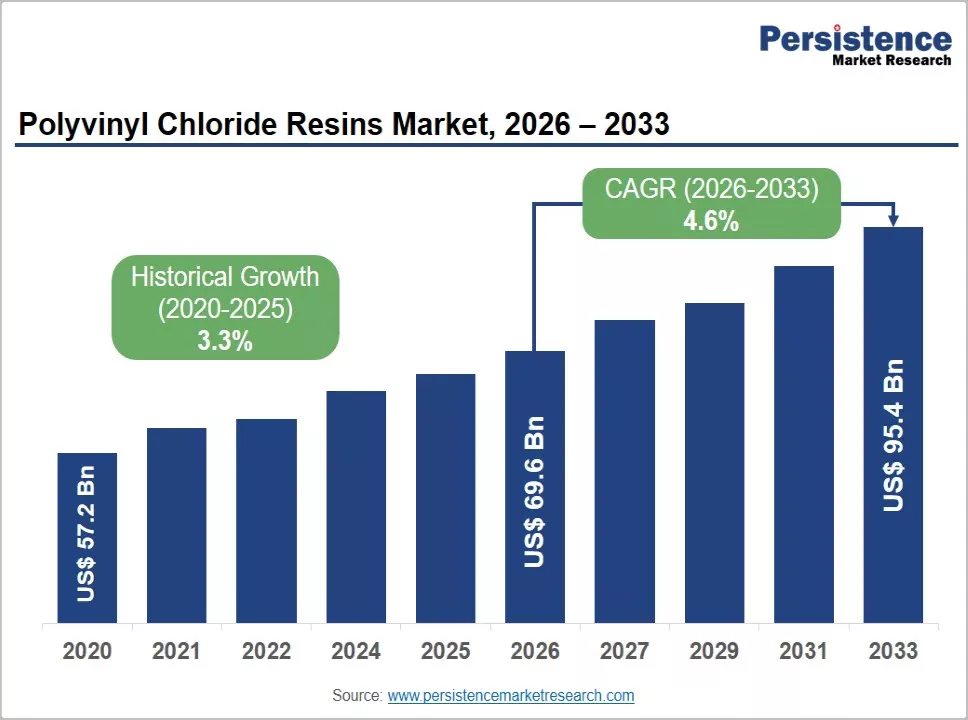
The global polyvinyl chloride resins market size is likely to be valued at US$ 69.6 billion in 2026 and is expected to reach US$ 95.4 billion by 2033, growing at a CAGR of 4.6% between 2026 and 2033, driven by sustained demand for water and sanitation piping, construction materials, and flexible PVC in healthcare and automotive applications. Producers are adding integrated capacity in North America and South Asia, while trade-defense measures are reshaping import flows in Europe and India.
Key Industry Highlights
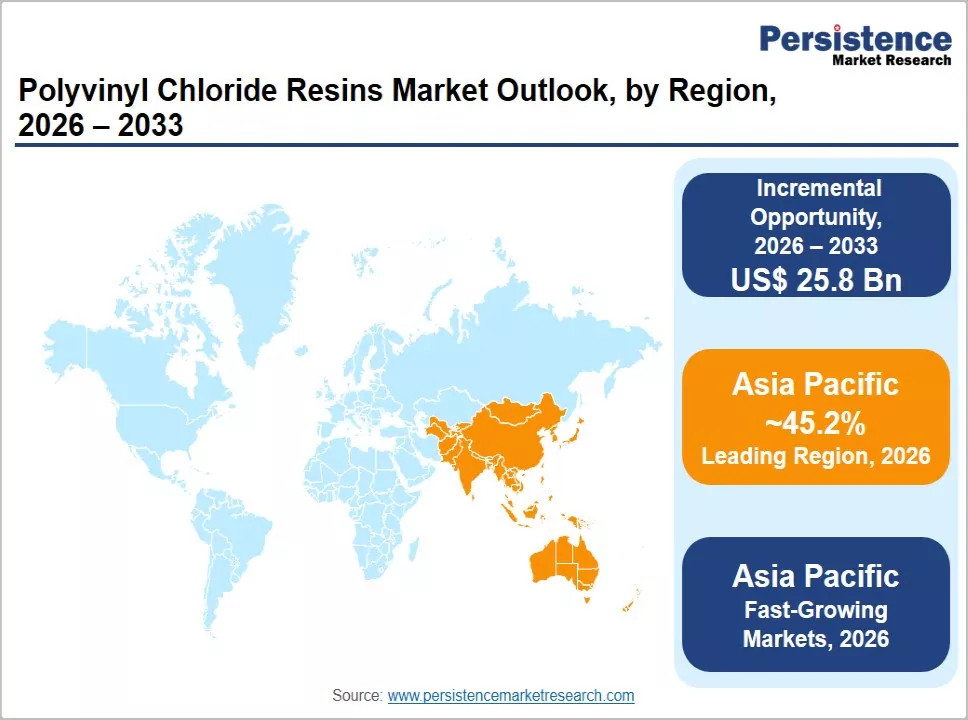
- Leading Region: Asia Pacific, anticipated to account for 45.2% of revenue share, supported by large construction, water infrastructure, and manufacturing bases in China, India, and Southeast Asia.
- Fastest-growing Region: Asia Pacific, driven by urbanization, expanding piping and housing programs, and new integrated PVC capacity in India and Southeast Asia.
- Dominant Resin Type: Suspension PVC, anticipated to hold approximately 71.5% of the market, driven by its use in pipes, profiles, siding, and high-volume construction applications.
- Leading Application: Pipes and fittings, anticipated to account for 47.2% of the market share, supported by housing, water supply, sanitation, and infrastructure projects.
DRO Analysis
Drivers - Water Infrastructure and Construction Demand Anchor Resin Consumption
Pipes and fittings account for approximately 47% of PVC resin consumption, making water supply, sewerage, drainage, and housing programs the largest demand base for the market. Suspension PVC, which holds about 71.5% of the market, is the principal grade for these products because of its corrosion resistance, long service life, and low installed cost compared with metal alternatives.
Governments in Asia Pacific, the Middle East, and Africa continue to expand water and sanitation networks, while replacement of aging pipelines supports demand in North America and Europe. In India, annual PVC demand of about 4.7 million tons exceeds domestic capacity of about 1.8 million tons, which illustrates the scale of infrastructure-led consumption in fast-urbanizing economies.
Flexible PVC Adoption in Healthcare and Automotive Applications Is Widening the Demand Base
Flexible PVC is gaining traction in medical tubing, blood bags, gloves, cables, flooring, and automotive interiors, where plasticized grades provide softness, durability, and chemical resistance. The medical and healthcare end-use segment is projected to grow at an estimated 7.4% CAGR through 2035, the fastest among end-use industries.
Automotive dashboards are valued at US$5.53 billion and are projected to grow at a 5.06% CAGR, supported by demand for molded skins, trims, and wiring insulation. These applications diversify demand beyond construction and are expected to improve product mix for producers with flexible-grade capabilities.
Restraint - Global Overcapacity and Expanding Trade-Defense Measures Pressure Margins and Trade Flows
Structural oversupply remains the most significant restraint. Capacity expansion in China has outpaced domestic demand, resulting in operating losses for producers and large export volumes that depress prices in import-dependent regions. China responded with capacity rationalization and the removal of the value-added-tax export rebate on PVC effective April 1, 2026, but excess supply persists in several grades.
Importing regions are responding with trade remedies. The European Union imposed anti-dumping duties of 63.7-100.1% on PVC resins from the U.S. and Egypt in 2024 and opened a new investigation in September 2026 covering China, South Korea, Taiwan, and Mexico. India has notified import duties and initiated a countervailing duty case against Chinese suspension resin. These measures raise compliance costs and add uncertainty to pricing, sourcing, and capital planning.
Opportunities - India and Southeast Asia Import Substitution Creates New Capacity and Downstream Demand
India offers the clearest capacity-led opportunity. Domestic production covers well under half of national demand, and imports from China alone reached 1.18 million tons of suspension resin between October 2024 and September 2025. Reliance Industries is adding capacity in phases from 2026-27, and the Adani Group is building a 1 million ton per year PVC complex at Mundra, targeted for fiscal 2028.
Southeast Asia is also moving from net-importer status toward near self-sufficiency as new plants start up. Downstream pipe, profile, and cable converters in both regions are anticipated to benefit from secure regional resin supply, shorter lead times, and reduced exposure to import-price volatility.
Lower-Emission Production and Specialty Grades Offer Differentiation Opportunities
Carbon intensity is becoming a competitive factor. INEOS has stated that coal-based PVC production in China carries a carbon footprint more than four times that of equivalent European production. Shintech's US$ 3.4 billion Louisiana expansion, announced in March 2026, incorporates technology designed to reduce emissions per pound of PVC and caustic soda produced.
Producers with low-emission process routes and specialty formulations for medical, cable, and automotive uses are positioned to capture demand from regulated end markets. Medical-grade and high-K flexible resins in particular offer differentiation from commodity pipe-grade products.
Category-wise Analysis
Resin Type Insights
Suspension PVC is anticipated to account for approximately 71.5% of the market share. It is produced through suspension polymerization and serves as the base material for pipes, fittings, profiles, siding, and other high-volume construction products. For example, rigid pressure pipes for water distribution and sewer lines are manufactured predominantly from suspension-grade resin, and window profiles and cladding use the same grade. Trade policy also centers on this grade, as the European Union, the U.K., and India have each opened cases on suspension PVC imports, which underlines its scale in global trade.
Flexible PVC is anticipated to be the fastest-growing resin type, driven by automotive interiors, cables, flooring, and medical products. Plasticized compounds provide the softness and chemical resistance required in blood bags, tubing, wire insulation, and molded dashboard skins. For example, a cable manufacturer uses flexible compounds for insulation and sheathing, while a medical device maker uses medical-grade compounds for tubing and gloves. Rising healthcare demand and growing vehicle interior content are expected to support volume growth in this segment.
Application Insights
Pipes and fittings are anticipated to account for approximately 47.2% of the market share. The segment covers pressure pipes, drainage and sewer lines, conduits, and fittings used in housing, water supply, irrigation, and infrastructure projects. For example, municipal water authorities select PVC pressure pipe for distribution mains because of its corrosion resistance and ease of installation. Government-funded water and sanitation programs, particularly in Asia Pacific, continue to underpin volume demand in this segment.
Automotive dashboards are anticipated to be the fastest-growing application, projected to expand at a 5.1% CAGR. PVC compounds are used for instrument panel skins, door trims, and wire harness insulation because of their moldability, surface finish, and cost efficiency. For example, slush-molded PVC skins are used as dashboard covers across a range of vehicle platforms. Other applications, including profiles and windows, wire and cable insulation, flooring, films, and medical devices, add breadth to the demand base.
Regional Insights
North America Polyvinyl Chloride Resins Market Trends
North America is anticipated to remain a major producing and consuming region, supported by ethane-based ethylene feedstock, integrated chlor-alkali and vinyl chloride monomer production, and steady demand from housing, water infrastructure, and repair and remodeling. Producers are investing to expand integrated capacity, and the region supplies export markets in addition to domestic demand.
U.S. Polyvinyl Chloride Resins Market Trends
The U.S. is the regional leader, with production concentrated on the Gulf Coast. In January 2026, Berkshire Hathaway completed its US$9.7 billion acquisition of OxyChem, a top-three U.S. PVC manufacturer, with existing management retained.
In March 2026, Shintech announced a US$ 3.4 billion expansion at its Plaquemine, Louisiana complex, adding ethylene capacity of 625,000 tons per year, vinyl chloride monomer capacity of 500,000 tons per year, and caustic soda capacity of 310,000 tons per year. The first phase is expected around 2030. The site holds PVC capacity of 3.64 million tons per year, according to the company's annual report. The 2024 European duties on U.S.-origin PVC have also redirected export volumes toward other markets.
Canada Polyvinyl Chloride Resins Market Trends
Canada is a secondary market closely linked to U.S. supply. Demand is driven by residential construction, municipal water and sewer projects, and the replacement of aging pipe networks, while resin is supplied largely through the integrated North American production base. OxyChem operates in the U.S., Canada, and Latin America, which supports regional supply continuity.
Europe Polyvinyl Chloride Resins Market Trends
Europe is a mature, import-sensitive market characterized by high-quality construction demand, strict chemical regulation, and a high-cost production base. European PVC prices are among the highest globally, which has created an arbitrage for imports from lower-cost producers. PVC imports from China, South Korea, Taiwan, and Mexico more than doubled to 171.5 thousand tons in 2025, and the European Commission opened an anti-dumping investigation in September 2026.
Germany Polyvinyl Chloride Resins Market Trends
Germany is Europe's largest industrial economy and a key PVC production and processing base. Its construction, window-profile, pipe, and cable industries generate steady resin demand, while high energy costs pressure producer competitiveness.
Westlake Vinnolit plans to close its Cologne plant by the first quarter of 2027, illustrating continued rationalization of European capacity. Domestic producers and converters are closely following the outcome of the EU investigation, with provisional measures expected to be disclosed around April 2027 and definitive measures around November 2027.
U.K. Polyvinyl Chloride Resins Market Trends
The U.K. is a mature market driven by housing repair and renovation, window and cladding demand, and water infrastructure. The U.K. launched an anti-dumping investigation into suspension PVC imports from China, Mexico, and South Korea in August 2026.
The investigation is anticipated to influence sourcing decisions for U.K. pipe and profile manufacturers, which draw on both domestic and imported resin supply.
Asia Pacific Polyvinyl Chloride Resins Market Trends
Asia Pacific is anticipated to be both the leading and the fastest-growing regional market, accounting for approximately 45.2% of global PVC resin revenue. Demand is anchored by construction, water infrastructure, and manufacturing, while new capacity expansion is shifting away from mainland China toward India and Southeast Asia amid domestic oversupply and capacity rationalization.
China Polyvinyl Chloride Resins Market Trends
China is the region's largest producer, with production based on both coal-based carbide and ethylene routes. Capacity has expanded while domestic demand has remained sluggish, resulting in operating losses and a heavy reliance on exports.
Government policy is widely characterized as an anti-involution measure aimed at phasing out inefficient, low-end capacity, and the export value-added-tax rebate on PVC was eliminated effective April 1, 2026. These measures are anticipated to improve industry profitability over time and moderate low-priced exports.
India Polyvinyl Chloride Resins Market Trends
India is the fastest-growing major national market, with annual demand of about 4.7 million tons against domestic capacity of about 1.8 million tons. Policy support for domestic producers is expanding. India notified duties on July 24, 2026 on suspension PVC imports with a cost, insurance, and freight value at or below US$0.766 per kilogram, and the Directorate General of Trade Remedies recommended provisional countervailing duties on Chinese suspension resin in preliminary findings released on October 26, 2026.
Domestic capacity additions by Reliance Industries and the Adani Group are scheduled to begin from fiscal 2027 onward, which is expected to reduce import dependence over the forecast period.
Competitive Landscape
The global polyvinyl chloride resins market is moderately fragmented, with highly consolidated producer groups in North America and Europe and a larger number of regional producers in China and India. Shin-Etsu Chemical, through Shintech, is the world's largest PVC producer. Other leading participants include Formosa Plastics, Westlake, INEOS Inovyn, OxyChem, Orbia, LG Chem, and Hanwha Solutions. Competition is based on feedstock access, integration from chlor-alkali to PVC, cost position, grade breadth, and proximity to customers.
Leading companies are focusing on integrated capacity expansion, feedstock security, cost leadership, and lower-emission process technology. Producers in Europe and India are seeking trade-remedy protection, while North American and Japanese producers are investing in feedstock integration. Companies are also expanding specialty and medical-grade portfolios and strengthening long-term supply agreements with pipe, profile, and cable converters.
Key Industry Developments
- In April 2026, China eliminated the value-added-tax export rebate on PVC, a measure anticipated to support capacity rationalization and moderate low-priced exports.
- In July 2026, India notified import duties on suspension PVC with a cost, insurance, and freight value at or below US$0.766 per kilogram, supporting domestic producers ahead of new capacity start-ups.
- In September 2026, the European Commission initiated an anti-dumping investigation into suspension PVC imports from China, South Korea, Taiwan, and Mexico, with potential duties applicable to imports arriving from October 23, 2026.
Companies Covered in Polyvinyl Chloride Resins Market
- Shin-Etsu Chemical Co., Ltd.
- Formosa Plastics Corporation
- Westlake Corporation
- INEOS Inovyn
- OxyChem
- Orbia Advance Corporation
- LG Chem Ltd.
- Hanwha Solutions Corporation
- Reliance Industries Limited
- Xinjiang Zhongtai Chemical Co., Ltd.
- Tosoh Corporation
- Kem One
- Finolex Industries Limited
- Vynova Group
- Chemplast Sanmar Limited
Frequently Asked Questions
The global polyvinyl chloride resins market is projected to be valued at US$ 69.6 billion in 2026.
The market is expected to reach US$ 95.4 billion by 2033.
Key trends include integrated capacity expansion in North America and South Asia, growing use of flexible and medical-grade PVC, rising demand for automotive interiors, lower-emission production technology, and expanding trade-defense measures across Europe, India, and the U.K.
Suspension PVC is anticipated to remain the leading resin type segment, accounting for approximately 71.5% of the market.
The market is projected to expand at a CAGR of 4.6% between 2026 and 2033.
Major companies include Shin-Etsu Chemical, Formosa Plastics, Westlake, INEOS Inovyn, and OxyChem.


