




- Plastics, Polymers & Resins
- Polyvinyl Chloride Strip Curtain Market
Polyvinyl Chloride Strip Curtain Market Size, Share, and Growth Forecast, 2026 - 2033
Polyvinyl Chloride Strip Curtain Market by Product Type (Clear PVC Strip Curtains, Anti-static PVC Strip Curtains), Application (Industrial, Logistics), End-Use Industry, and Regional Analysis for 2026 - 2033

Polyvinyl Chloride Strip Curtain Market Size and Trends Analysis
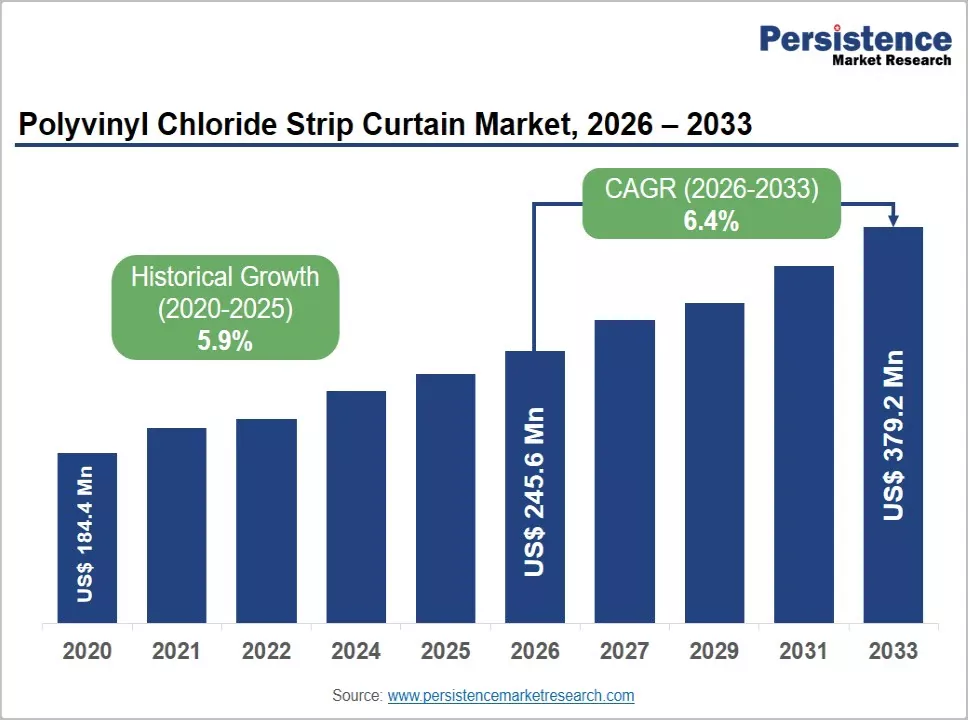
The global polyvinyl chloride strip curtain market size is likely to be valued at US$ 245.6 million in 2026 and is expected to reach US$ 379.2 million by 2033, growing at a CAGR of 6.4% between 2026 and 2033, driven by the expansion of warehousing and cold chain infrastructure, rising focus on energy efficiency in temperature-controlled facilities, and growing demand for low-cost physical separation in industrial workplaces. Facility operators are increasingly installing flexible PVC barriers to limit air exchange, control dust and noise, and maintain safe forklift and pedestrian movement without restricting access.
Key Industry Highlights
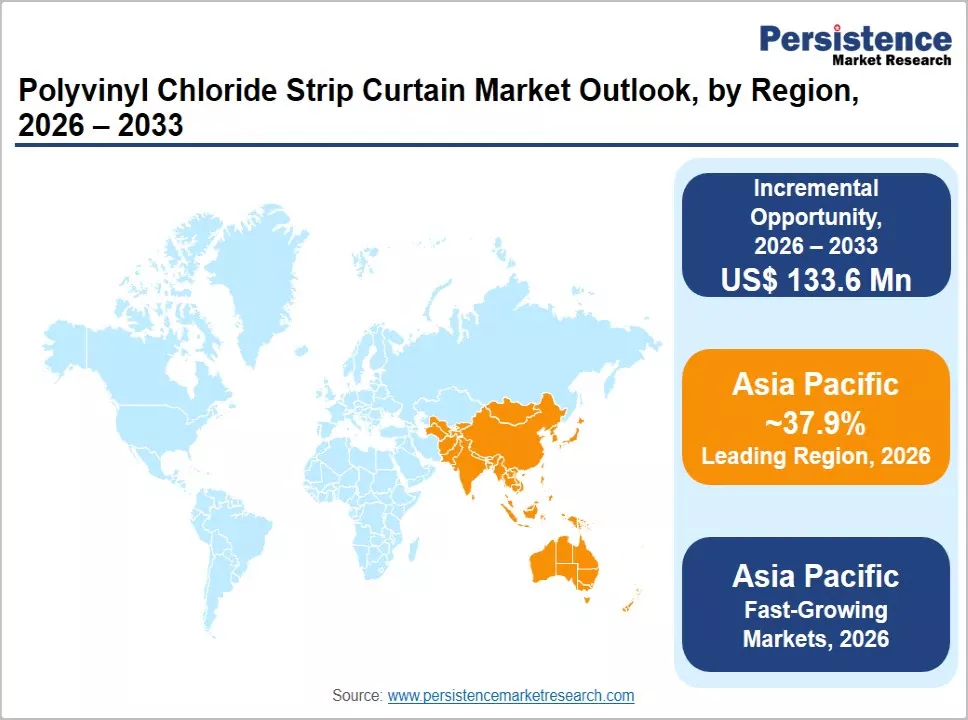
- Leading and Fastest-growing Region: Asia Pacific, anticipated to account for 37.9% of the market share, supported by large-scale manufacturing, expanding logistics networks, and growing food processing and cold storage capacity.
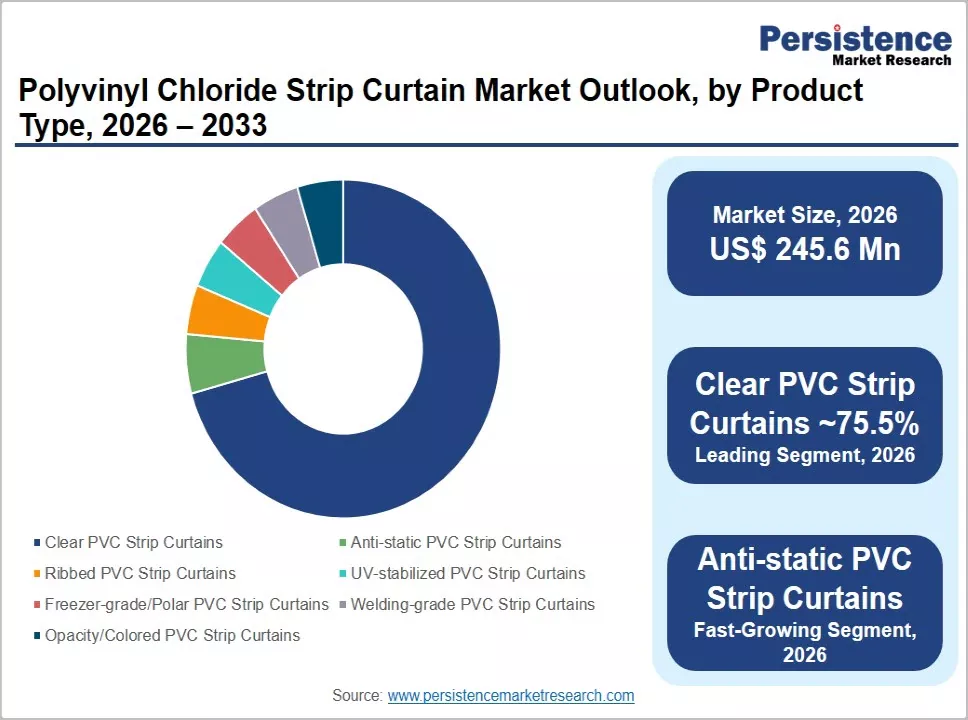
- Dominant Product Type: Clear PVC strip curtains, anticipated to hold 75.5% of the market, driven by visibility, low installed cost, and suitability across warehouse, dock, and cold room openings.
- Leading Application: Industrial applications, anticipated to account for approximately 44.6% of the market usage, supported by the use of strip curtains for temperature, dust, and noise separation in manufacturing facilities.
DRO Analysis
Drivers - Cold Chain and Warehouse Expansion Are Increasing Demand for Doorway Barriers
Temperature-controlled storage continues to expand as food, pharmaceutical, and specialty goods supply chains require stable cold conditions. Every doorway in a refrigerated facility is a point of heat and moisture ingress, and air infiltration places additional load on refrigeration systems. A study of a food-industry cold room in Paraná, Brazil, found that infiltration of external air accounted for 43.1% of the total thermal load, and the installation of a door lock, air curtains, and strip curtains raised doorway protection effectiveness from 76% to 91%.
Research indexed by the International Institute of Refrigeration reported a 92% reduction in air infiltration when a strip curtain was installed at a rapid-roll door opening of a commercial cold store operating at -18°C. These results highlight the role of PVC strip curtains as a low-cost measure for cold rooms, warehouses, and loading docks, supporting both new installations and recurring replacement demand as strips wear with daily traffic.
Energy Efficiency and Workplace Safety Priorities Are Broadening Adoption
Industrial operators are focusing on lower energy consumption and clearly separated working zones. PVC strip curtains divide heated, cooled, dusty, and noisy areas while allowing forklifts and personnel to pass without stopping, which reduces the time openings remain exposed. Transparent strips also improve visibility at intersections and dock doors, supporting safer traffic movement.
Product specialization is widening the user base. Anti-static grades address electrostatic discharge in electronics manufacturing, cleanrooms, and data centers, while tinted welding-grade strips filter arc light in fabrication cells. The availability of ribbed, UV-stabilized, and freezer-grade formulations allows buyers to select a barrier matched to each doorway, extending demand beyond traditional warehouse applications.
Restraint - Raw Material Price Volatility and Plasticizer Regulation Increase Cost and Compliance Pressure
Raw material dependence remains a structural challenge for the Polyvinyl Chloride Strip Curtain Market. Production relies on PVC resin, plasticizers, stabilizers, and colorants, and resin prices follow petrochemical and energy cost cycles. Movements in these inputs directly affect manufacturer margins, particularly for standard clear strips that compete mainly on price.
Regulation adds further complexity. In the European Union, REACH restrictions limit four phthalate plasticizers (DEHP, DBP, BBP, and DIBP) to 0.1% by weight in plasticized material in articles, requiring manufacturers to reformulate and document compliance. Competing doorway solutions, including air curtains and high-speed doors, also limit adoption at high-traffic or hygiene-sensitive openings where strips contact goods or separate with use.
Opportunities - Specialty and Anti-static Grades Create Access to Higher-value Applications
A significant opportunity lies in the shift from standard clear strips toward application-specific grades. Electronics assembly, data center, cleanroom, and pharmaceutical operations require electrostatic and contamination control at doorways, while cold storage operators require formulations that remain flexible at sub-zero temperatures. Anti-static, antimicrobial, and freezer-grade strips carry higher unit value than standard products.
Manufacturers that expand specialty portfolios, offer custom sizing, and provide installation and replacement services are positioned to reduce dependence on price-based competition. Recurring replacement of worn strips also creates a stable aftermarket revenue stream for suppliers with strong distributor networks.
Category-wise Analysis
Product Type Insights
Clear PVC strip curtains are anticipated to account for 75.5% of the market share. It includes standard transparent flexible strips installed at warehouse doors, loading docks, cold room entries, and production-area openings. For example, a distribution center installs overlapping clear strips at dock-to-warehouse openings to limit airflow and dust while keeping forklift drivers and pedestrians visible to each other. Low installed cost, simple replacement of individual strips, and compatibility with standard hanging hardware support the segment’s leading position. Other types in the market include ribbed, UV-stabilized, freezer-grade, welding-grade, and opacity or colored strip curtains.
Anti-static PVC strip curtains are anticipated to be the fastest-growing product type, driven by demand from electronics manufacturing, cleanrooms, data centers, and pharmaceutical facilities. For example, an electronics assembly plant installs anti-static strips with controlled surface resistivity at the entrance to a static-sensitive production zone, limiting both particle movement and electrostatic discharge. Freezer-grade strips are also gaining relevance as cold storage capacity expands, since these formulations retain flexibility at low temperatures where standard strips stiffen.
Application Insights
Industrial applications are anticipated to account for approximately 44.6% of the market usage. The segment includes strip curtains used in manufacturing plants, workshops, and processing facilities to separate areas by temperature, dust, noise, or welding activity. For example, a metal fabrication plant uses tinted welding-grade strips to shield adjacent workers from arc light, while an automotive plant uses clear strips to separate production zones from general traffic aisles. The wide use of strip curtains across facility types and their low installed cost support the segment’s leading position. Cold storage, food processing, dust control, temperature control, and noise control are other key application areas.
Logistics is anticipated to be the fastest-growing application, expanding at a CAGR of 7.6%, driven by growth in e-commerce fulfillment, distribution centers, and temperature-controlled warehousing. For example, a regional distribution center installs strip curtains at dock doors and between ambient and chilled zones to reduce air exchange during high-frequency forklift movement. Rising throughput in these facilities increases the number of door openings per shift, which raises both the value of doorway barriers and the frequency of strip replacement.
Regional Insights
North America Polyvinyl Chloride Strip Curtain Market Trends
North America is a mature regional market characterized by an extensive warehousing and cold storage base, established workplace safety practices, and strong replacement demand. The U.S. leads regional demand, supported by large distribution networks, food processing facilities, and a broad base of domestic strip curtain manufacturers and distributors. Energy conservation in refrigerated and conditioned facilities remains a primary purchasing consideration.
U.S. Polyvinyl Chloride Strip Curtain Market Trends
The U.S. remains the dominant market in North America due to its large logistics, food processing, and manufacturing sectors. Domestic suppliers such as TMI, LLC, Aleco, Chase Doors, Singer Safety Company, and Kingman Industries serve industrial and commercial buyers with strip doors, flexible PVC rolls, and related hardware. TMI, headquartered in Pittsburgh, Pennsylvania, has produced PVC strip doors since 1988 and offers energy-control products alongside PVC film, industrial curtains, and enclosures.
Buyers in the country increasingly specify freezer-grade and anti-static strips for cold storage and electronics facilities, while recurring replacement of worn strips supports steady aftermarket sales through industrial distributors and online channels.
Canada Polyvinyl Chloride Strip Curtain Market Trends
Canada represents an important secondary market, supported by cold climate conditions, food processing, and a developed cold storage sector. Canadian suppliers include Super Seal Manufacturing Limited, established in 1976 in Woodbridge, Ontario, and Canadian Tarpaulin, which fabricates clear and colored welding-grade PVC strip curtains for cooler and freezer entries, high-temperature areas, and welding booths. Long heating seasons increase the value of doorway barriers that retain conditioned air in warehouses and production facilities.
Europe Polyvinyl Chloride Strip Curtain Market Trends
Europe is a mature regional market characterized by strict energy efficiency expectations, food safety requirements, and chemical regulation. REACH restrictions on plasticizers influence PVC formulations, encouraging suppliers to document material compliance and expand compliant product ranges. Demand is supported by cold chain logistics, food processing, pharmaceutical distribution, and industrial manufacturing. Extruflex, which has manufactured PVC strips, sheets, and films since 1962, operates a group office in Levallois-Perret, France, and supplies flexible PVC for industrial doors and partitions.
Germany Polyvinyl Chloride Strip Curtain Market Trends
Germany represents a major European market because of its large manufacturing, automotive, and logistics base. Industrial door manufacturers such as Hörmann are listed among suppliers of transparent vinyl strip curtains, reflecting the integration of strip curtains into broader dock and industrial door offerings. Demand is supported by temperature separation in production and storage areas and by established workplace safety practices.
German buyers place significant importance on material compliance and durability, supporting demand for certified, longer-life strip formulations. Anti-static and welding-grade strips are used in electronics and metal fabrication facilities, while freezer-grade products serve food distribution and cold storage operations.
U.K. Polyvinyl Chloride Strip Curtain Market Trends
The U.K. remains an important market for PVC strip curtains because of its large food retail, cold chain, and distribution sectors. UK suppliers such as Teknomek offer clear, polar, perforated, and anti-static strip curtains, along with antimicrobial variants designed to add hygiene control in sensitive environments.
Refrigeration is the largest electrical load in most cold storage and food retail facilities, which keeps doorway energy loss a central concern for operators. This is supporting demand for polar-grade strips at chiller and freezer entries and for anti-static strips in data centers and electronics workshops.
Asia Pacific Polyvinyl Chloride Strip Curtain Market Trends
Asia Pacific is anticipated to be both the leading and the fastest-growing regional market, accounting for 37.9% of the market share. Regional demand is supported by concentrated manufacturing capacity, expanding logistics and e-commerce networks, rising food processing output, and growing cold storage investment. Local production keeps product prices competitive and supports exports to other regions.
China Polyvinyl Chloride Strip Curtain Market Trends
China is the largest regional production base for PVC strip curtains and flexible PVC sheet. Domestic manufacturers such as Hebei Juchang, Hebei Haoxiongdi, and Langfang Huakang supply clear, ultra-clear, and opacity strip curtains for domestic and export markets.
Extruflex operates a manufacturing facility in Zhongshan, where it has installed solar panels as part of its sustainability initiatives. Expansion of warehousing, e-commerce logistics, and food processing supports continued domestic installation demand, while export-oriented production serves buyers in Europe, the Middle East, and Southeast Asia.
India Polyvinyl Chloride Strip Curtain Market Trends
India is emerging as a major growth market because of expanding warehousing, food processing, pharmaceutical distribution, and cold storage infrastructure. Domestic suppliers such as Dolphy India Pvt. Ltd. offer PVC strip curtains for industrial and commercial buyers.
Rising investment in cold chain facilities and organized logistics parks is increasing the number of temperature-controlled doorways that require barriers, while price-sensitive buyers favor locally produced standard clear strips. Growing electronics and pharmaceutical manufacturing is also creating demand for anti-static and cleanroom-grade products.
Competitive Landscape
The global polyvinyl chloride strip curtain market is fragmented, with competition among specialist flexible PVC manufacturers, industrial door and dock equipment suppliers, regional fabricators, and distributors. Major companies compete based on product range, material quality, availability of specialty grades, custom fabrication, lead times, pricing, and distribution reach. The market includes global PVC extruders such as Extruflex and TMI alongside a large number of regional manufacturers, particularly in China.
Leading companies are focusing on specialty product development, sustainable manufacturing, regional production capacity, and expansion of distributor and online sales channels. Competitive differentiation increasingly depends on the ability to supply application-specific grades, such as anti-static, freezer-grade, and antimicrobial strips, along with complete kits, hardware, and replacement services.
Key Industry Developments
- In July 2026, ALECO (by ES ROBBINS) highlighted its Luxe Collection of decorative PVC strip doors, featuring premium textures and finishes that combine the conventional benefits of strip curtains, such as temperature control, energy efficiency and easy access, with enhanced aesthetics and privacy.
Companies Covered in Polyvinyl Chloride Strip Curtain Market
- Extruflex
- TMI, LLC
- WaveLock
- Rayflex Group
- Maxiflex
- Redwood PVC
- Garlin
- Aleco
- Chase Doors
- Singer Safety Company
- Kingman Industries, Inc.
- Kenfield Ltd.
- Hebei Juchang
- Hebei Haoxiongdi
- Langfang Huakang
Frequently Asked Questions
The global polyvinyl chloride strip curtain market is projected to be valued at US$ 245.6 million in 2026.
The market is expected to reach US$ 379.2 million by 2033.
Key trends include growing adoption of freezer-grade and anti-static strip curtains, expansion of cold chain and warehousing infrastructure, emphasis on energy efficiency at facility doorways, sustainable PVC manufacturing, and rising demand from logistics and pharmaceutical facilities.
Clear PVC strip curtains are anticipated to remain the leading product type segment, accounting for approximately 75.5% of the market.
The market is projected to expand at a CAGR of 6.4% between 2026 and 2033.
Major companies include Extruflex, TMI, LLC, WaveLock, Rayflex Group, and Maxiflex.


