




- Plastics, Polymers & Resins
- Purified Terephthalic Acid (PTA) Market
Purified Terephthalic Acid (PTA) Market Size, Share, and Growth Forecast, 2026 - 2033
Purified Terephthalic Acid (PTA) Market by Application (Polyester, Fiber & Yarn Grade, Polybutylene terephthalate (PET) Grade, Film Grade, Others), End-user (Textile, PET Bottles, Others), and Regional Analysis for 2026 - 2033

Purified Terephthalic Acid (PTA) Market Size and Trends Analysis
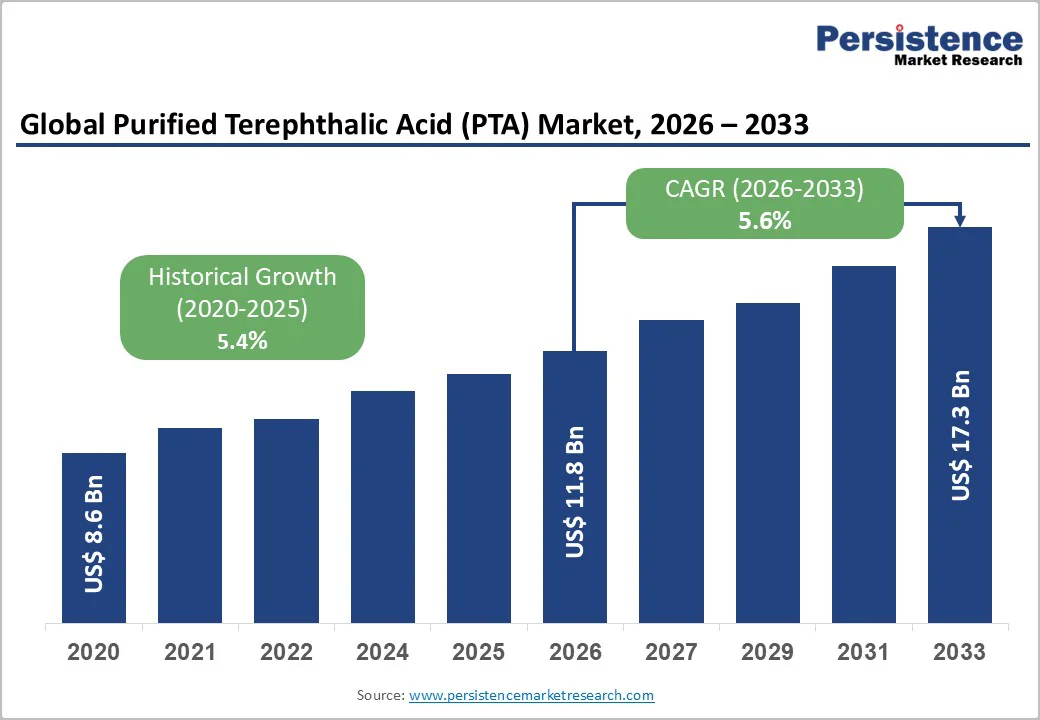
The global purified terephthalic acid (PTA) market size is likely to be valued at US$11.8 billion in 2026 and is projected to reach US$17.3 billion by 2033, growing at a CAGR of 5.6% during the forecast period from 2026 to 2033, driven by the increasing prevalence of polyester fiber production, rising demand for PET bottles in packaging, and advancements in purification technologies.
Demand for high-purity PTA to produce durable textiles and recyclable plastics is accelerating adoption across industries. Innovations in lightweight, sustainable polyester and PBT grades further support growth, while the rising use of PTA in consumer packaging, especially in Asia Pacific, remains a key market driver.
Key Industry Highlights:
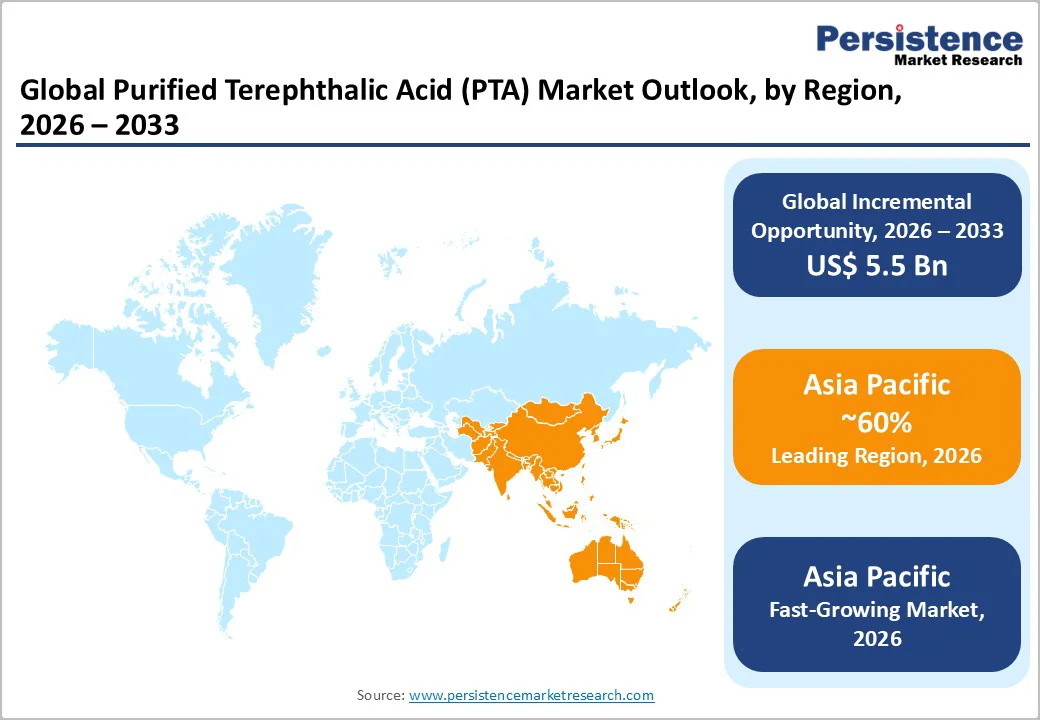
- Leading Region: Asia Pacific, to command a 60% market share in 2026, driven by massive textile manufacturing, high prevalence of PET production, and strong R&D activities in China.
- Fastest-growing Region: Asia Pacific is likely to be the fastest-growing market due to its rapidly expanding polyester and PET manufacturing base, supported by strong textile, packaging, and consumer goods demand.
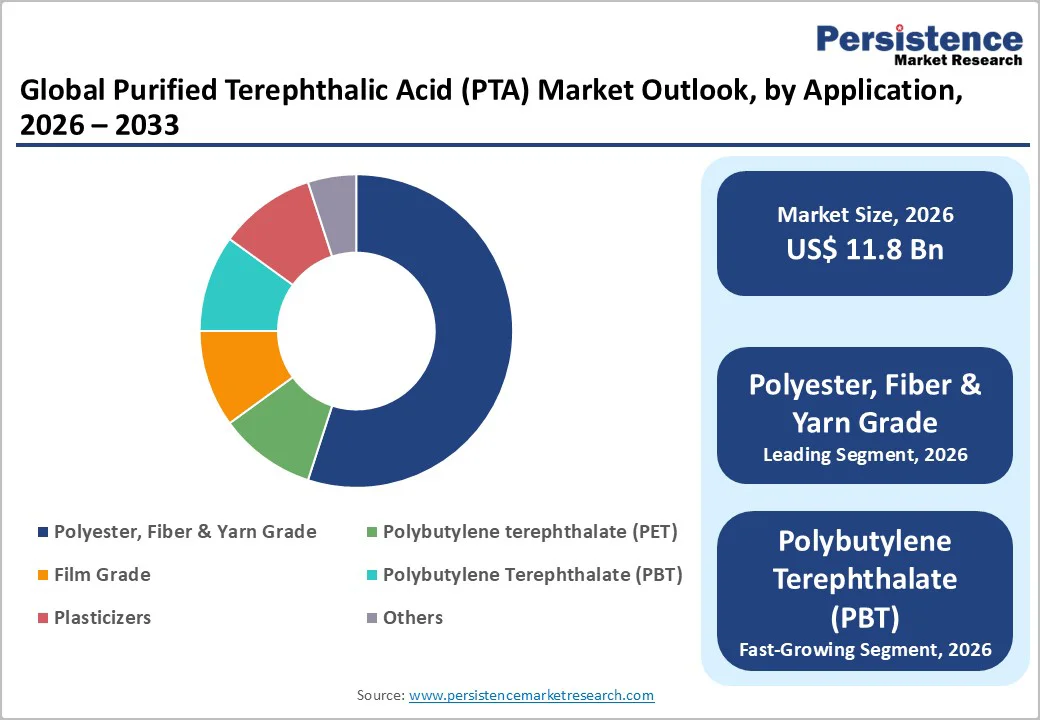
- Dominant Application: The polyester, fiber & yarn grade segment, to hold 55% of the market share, due to textile demands.
- Leading End-user: Textiles are expected to hold over 50% of market revenue in 2026, driven by polyester’s heavy reliance on PTA for large-scale fiber production. Growing demand for affordable, durable apparel and expanding home textile use further reinforce this dominance.
| Key Insights | Details |
|---|---|
|
Purified Terephthalic Acid (PTA) Market Size (2026E) |
US$11.8 Bn |
|
Market Value Forecast (2033F) |
US$17.3 Bn |
|
Projected Growth (CAGR 2026 to 2033) |
5.6% |
|
Historical Market Growth (CAGR 2020 to 2025) |
5.4% |
Market Factors - Growth, Barriers, and Opportunity Analysis
Growing Polyester Fiber Production and Rising PET Bottle Demand
The rising prevalence of polyester fiber production globally is a primary driver of the purified terephthalic acid (PTA) market. Polyester fiber remains one of the most widely used synthetic fibers globally due to its durability, cost-effectiveness, and versatility in clothing, home textiles, and industrial fabrics. As apparel consumption increases, particularly in Asia Pacific and emerging economies, manufacturers continue expanding polyester capacity, directly boosting PTA consumption. The shift toward affordable fast fashion and the rising use of technical textiles further reinforce this trend.
PET bottles have become the preferred choice for beverage, personal-care, and household product packaging as they are lightweight, shatter-resistant, and highly recyclable. Growing urbanization, rising disposable incomes, and increased consumption of bottled water and ready-to-drink beverages continue to accelerate PET bottle demand worldwide. Brand focus on sustainability is also reshaping the packaging landscape, with many companies increasing their use of recyclable and food-grade PET materials. This sustained rise in PET packaging directly drives the need for PTA as a key feedstock.
High Development and Raw Material Costs
The high costs associated with development and raw material sourcing of purified terephthalic acid (PTA) pose a significant restraint on market growth. PTA manufacturing depends heavily on paraxylene, a petrochemical feedstock whose prices fluctuate due to crude oil volatility, refinery output, and global supply-demand imbalances. When paraxylene prices rise, PTA producers experience immediate cost pressures, often reducing profit margins or forcing price adjustments across the polyester value chain. Advanced production technologies, catalyst systems, and energy-efficient processes require substantial capital investment, making initial setup and upgrading of facilities expensive.
Development of sustainable solutions, such as bio-based PTA or low-carbon production routes, further adds to the cost burden. These technologies require extensive research, testing, and pilot-scale validation before commercial adoption, increasing financial risk for producers. Environmental compliance also contributes to higher expenses, as companies must invest in emission-control systems, waste treatment, and energy optimization to meet regulatory standards. Smaller producers often struggle to absorb these costs, leading to industry consolidation.
Advancements in Bio-Based PTA and Circular Recycling Technologies
Advancements in bio-based PTA and circular recycling technologies present significant growth opportunities for the market. Bio-based PTA development focuses on producing terephthalic acid from renewable feedstocks such as biomass-derived paraxylene or plant-based intermediates. These innovations aim to cut carbon emissions, enhance sustainability, and support brand commitments to greener materials. Although still emerging, improvements in catalytic conversion, fermentation processes, and feedstock efficiency are making bio-based PTA more commercially viable.
Circular recycling technologies are rapidly transforming PET and PTA recovery. Chemical recycling methods such as depolymerization, glycolysis, and hydrolysis allow PET waste to be broken down into high-purity PTA and MEG, enabling repeated use without quality loss. These techniques improve circularity, reduce landfill burdens, and ensure a stable supply of recycled feedstocks for packaging and textile manufacturers. Producers are increasingly integrating recycling facilities with existing PTA-PET operations to enhance cost efficiency and lower carbon footprints. Together, bio-based PTA and advanced recycling technologies are pushing the industry toward a more regenerative, low-carbon model, addressing global sustainability demands and strengthening the competitiveness of eco-friendly PTA solutions.
Category-wise Analysis
Application Insights
The polyester fiber & yarn grade segment is anticipated to dominate the market, accounting for 55% of the share in 2026. Its dominance is driven by high textile production, affordability, and broad applicability in apparel, home textiles, and industrial fabrics. Its consistent quality, strong mechanical properties, and ease of processing make it the preferred PTA grade for large-scale manufacturers. Growing demand for fast-fashion and performance textiles further strengthens its lead. For example, Sinopec Yizheng Chemical Fibre Company, one of the world’s largest polyester producers, supplies high-purity PTA used in polyester fiber and yarn manufacturing, ensuring stable polymerization and reliable output for textile manufacturers.
Polybutylene terephthalate (PBT) is likely to be the fastest-growing segment, due to its rising use in engineering plastics and automotive applications. Its strong heat resistance and mechanical durability make it ideal for connectors, housings, and under-the-hood components. With a growing focus on high-performance materials, innovation in advanced PBT grades is accelerating adoption across North America and Europe. For example, BASF produces Ultradur® PBT, widely used in automotive electrical connectors and electronic housings due to its thermal stability and strength, supporting the growing need for reliable engineering materials.
End-user Insights
The textile segment is anticipated to lead the market, holding 50% of the share in 2026, driven by the extensive use of PTA in polyester fiber production. High global fabric manufacturing volumes and the affordability, durability, and versatility of polyester make PTA indispensable for apparel, home textiles, and industrial fabrics. Rising demand for fast-fashion, sportswear, and functional clothing further reinforces the segment’s dominance. For example, Indorama Ventures, one of the world’s largest polyester producers, uses PTA extensively to manufacture polyester fibers and yarns for garments and home textiles, supporting large-scale textile production worldwide. This strong integration of PTA into fiber manufacturing ensures sustained market leadership.
PET bottles represent the fastest-growing segment, as beverage and packaged-goods industries increasingly adopt lightweight, durable, and cost-efficient packaging solutions. PET bottles offer excellent clarity, impact resistance, and compatibility with recycling systems, making them ideal for water, soft drinks, juices, and personal-care products. Their strong role in circular-economy initiatives and reduced transportation costs further accelerate adoption. Rising demand for packaged beverages in emerging markets continues to drive rapid growth. For example, Coca-Cola uses PTA-based PET resin to produce lightweight beverage bottles across its global portfolio, supporting sustainability goals through enhanced recyclability and reduced material usage.
Regional Insights
North America Purified Terephthalic Acid (PTA) Market Trends
North America is driven by steady demand from the PET packaging, beverage, and industrial fiber sectors, supported by a well-established petrochemical infrastructure. The region benefits from abundant feedstock availability, particularly paraxylene derived from a strong refining and aromatics industry, which helps ensure production stability and competitive pricing. Demand growth is largely driven by rising consumption of PET bottles, food and beverage containers, and technical textiles used in automotive, construction, and home furnishing applications.
In North America, growing focus on sustainability, recyclability, and low-carbon manufacturing is reshaping the PTA market. Producers are increasingly integrating PTA operations with PET resin facilities to enhance efficiency and minimize environmental impact. The region is also experiencing rising investment in advanced recycling technologies, particularly chemical recycling, which can reduce reliance on virgin PTA while supporting circular economy targets. Regulatory pressures and brand commitments to higher recycled content are driving cleaner production practices and interest in bio-based PTA alternatives. Capacity optimization, feedstock flexibility, and an emphasis on high-purity applications continue to define the competitive landscape.
Europe Purified Terephthalic Acid (PTA) Market Trends
Market growth in Europe is shaped by a combination of stringent environmental regulations, growing sustainability requirements, and a mature yet stable polyester and PET packaging industry. Demand is primarily driven by applications in PET bottles, food-grade packaging, and industrial fibers, supported by Europe’s strong emphasis on recyclability and circular economy initiatives. As beverage and consumer goods companies commit to higher recycled content and low-carbon materials, PTA producers in the region are increasingly adopting cleaner production technologies and collaborating with recyclers to improve feedstock efficiency.
The rising integration of PTA operations with PET resin manufacturing aims to optimize production economics and reduce emissions. Although Europe has a relatively smaller capacity compared to Asia Pacific, it remains competitive through advanced process technologies, high-quality standards, and a focus on specialty-grade PTA. The push toward bio-based chemicals is also influencing the market, encouraging research into renewable feedstocks and more sustainable production pathways. Regulatory frameworks promoting carbon reduction and waste minimization are accelerating innovation across the value chain.
Asia Pacific Purified Terephthalic Acid (PTA) Market Trends
Asia Pacific is projected to be the leading and fastest-growing market, accounting for 60% of the share in 2026, driven by strong polyester production, rising textile consumption, and continuous capacity additions across China, India, South Korea, and Southeast Asia. China remains the core hub, supported by large integrated petrochemical complexes and steady demand from the apparel, home textiles, and PET packaging sectors. India is emerging as a major growth engine as domestic manufacturers invest in backward integration to reduce import dependence and meet rising polyester fiber demand. The region also benefits from growing PET bottle usage in beverages, personal care, and household products, which continues to push PTA consumption upward.
There is an increasing shift toward more sustainable and energy-efficient production technologies as governments tighten environmental norms. Producers increasingly focus on process optimization, waste heat recovery, and low-carbon manufacturing to stay competitive. Several Asia Pacific players are exploring bio-based PTA pathways to align with global sustainability goals. Strategic partnerships, joint ventures, and capacity expansions remain frequent as companies aim to secure feedstock supply and strengthen their regional footprint.
Competitive Landscape
The global purified terephthalic acid (PTA) market is highly competitive, shaped by a mix of large petrochemical corporations and regional specialists targeting niche demand. In mature markets such as North America and Europe, companies such as Indorama Ventures and BP leverage strong R&D capabilities, integrated production chains, and long-established distribution networks to maintain leadership. Their focus on operational efficiency, product consistency, and sustainability standards helps them meet the stringent regulatory requirements in these regions.
Asia Pacific, the largest PTA-consuming region, continues to strengthen its position as Chinese producers such as Sinopec Yizheng Chemical Fibre Company expand capacity and deliver cost-efficient, localized solutions to meet rising polyester and packaging demand. Across the sector, companies are increasingly leveraging strategic partnerships, long-term supply contracts, and targeted acquisitions to enhance market reach and streamline value chains. Innovation is now centered on bio-based PTA and low-carbon production technologies as global brands push for more sustainable materials in textiles, PET bottles, and industrial applications. This shift toward circularity, waste reduction, and renewable feedstocks is reshaping competitive dynamics and positioning sustainability-focused manufacturers as leaders in the future market.
Key Industry Developments
- In January 2024, Indorama Ventures entered a strategic partnership with a leading European recycling technology company to accelerate the production of recycled PTA for sustainable PET and polyester applications. The collaboration focused on integrating advanced recycling processes capable of converting post-consumer PET waste into high-purity monomers, including PTA, suitable for food-grade and textile use.
Companies Covered in Purified Terephthalic Acid (PTA) Market
- Indorama Ventures
- BP (British Petroleum)
- Sinopec Yizheng Chemical Fibre Company
- Mitsui Chemicals
- Reliance Industries Limited
- Eastman Chemical Company
- DuPont
- Formosa Plastics Group
- Alfa Group
- Indian Oil Corporation
- Mitsubishi Chemical Corporation
- SABIC
- Samsung Petrochemical Co. Ltd.
- Samyang Corporation
Frequently Asked Questions
The global purified terephthalic acid (PTA) market is projected to reach US$11.8 billion in 2026.
The rising prevalence of polyester fiber production and demand for PET bottles in packaging are the key drivers.
The purified terephthalic acid (PTA) market is poised to witness a CAGR of 5.6% from 2026 to 2033.
Advancements in bio-based PTA and circular recycling technologies are the key opportunities.
Indorama Ventures, BP (British Petroleum), Sinopec Yizheng Chemical Fibre Company, Reliance Industries Limited, and Eastman Chemical Company are the key players.


