




- Plastics, Polymers & Resins
- Synthetic Polymers Market
Synthetic Polymers Market Size, Share, and Growth Forecast 2026 - 2033
Synthetic Polymers Market by Type (Polyethylene, Polypropylene, Polyvinyl Chloride), Application (Packaging, Automotive), End Use Industry (Automotive, Consumer Goods, Healthcare), Form (Granules, Powder), and Regional Analysis, 2026 - 2033

Synthetic Polymers Market Size and Trend Analysis
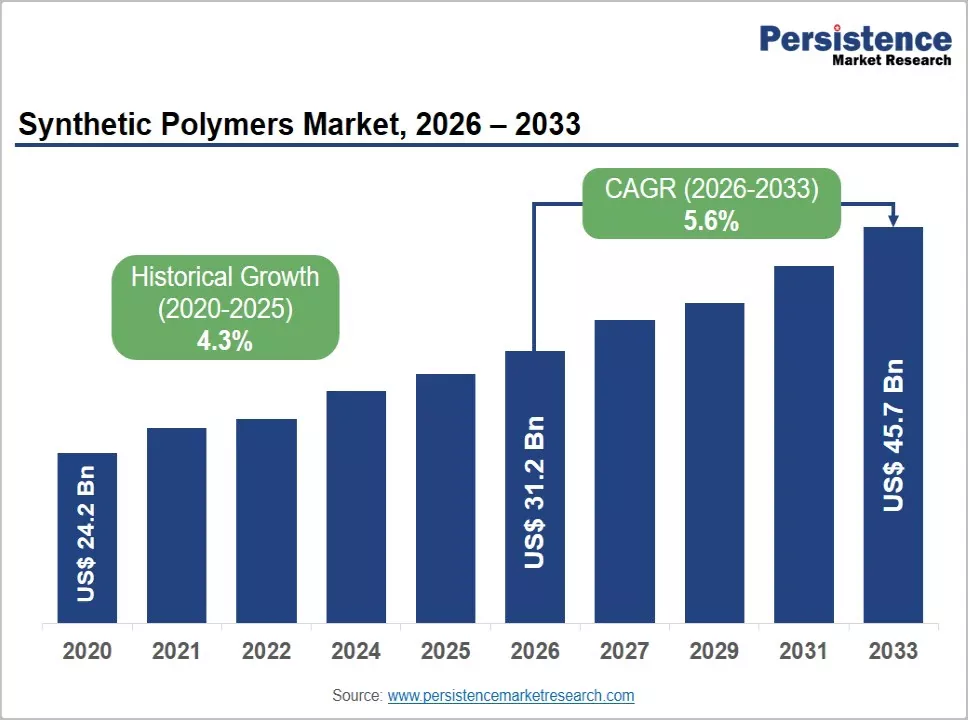
The global synthetic polymers market size is likely to be valued at US$ 31.2 billion in 2026, and is estimated to reach US$ 45.7 billion by 2033, growing at a CAGR of 5.6% during the forecast period 2026 - 2033. Growth is underpinned by sustained demand for flexible and rigid packaging, lightweight automotive components, and construction materials, along with the steady shift of polymer-intensive manufacturing towards Asia and the Middle East.
The market recorded a CAGR of 4.3% during 2020–2025, as energy price shocks, petrochemical overcapacity, and inconsistent downstream demand weighed on margins and delayed investment. However, the forecast period anticipates firmer acceleration as supply rationalization restores operating rates, recycled and bio-attributed grades scale, and growth in healthcare, electronics, and electric mobility lifts demand for higher-performance polymers.
Key Industry Highlights
- Dominant Type: Polyethylene is set to command around 34% of the revenue share in 2026, while polyurethane is likely to grow the fastest at 6.4% CAGR through 2033, as demand rises for insulation, foams, and coatings.
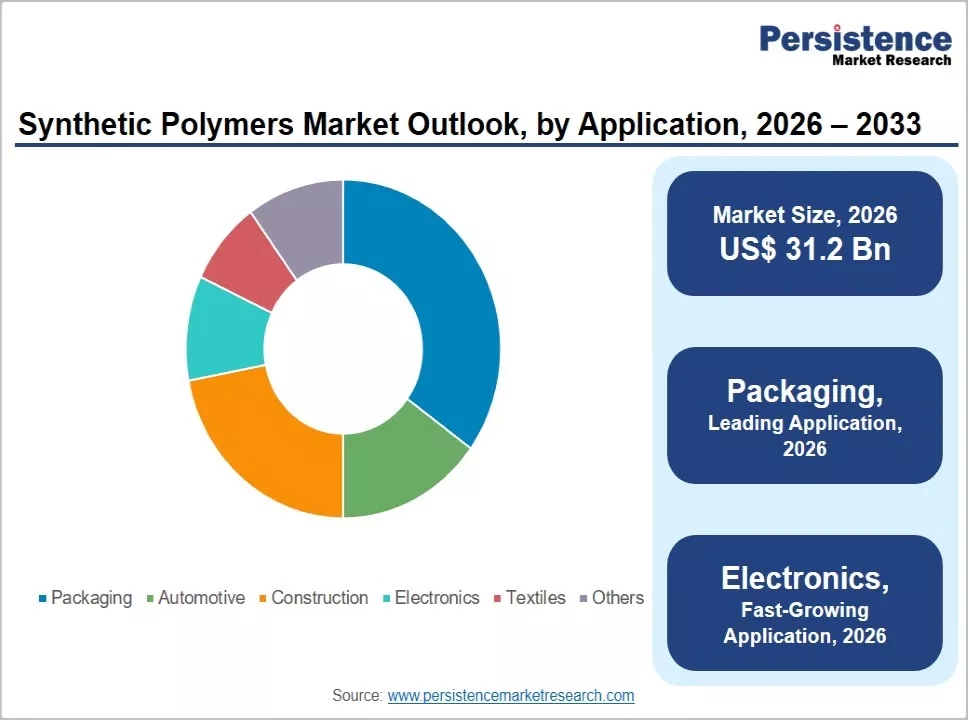
- Leading Application: Packaging is expected to lead with 38% in 2026, while electronics are likely to be the fastest-growing application at about 6.9% CAGR during 2026–2033.
- Dominant End Use Industry: Consumer goods are anticipated to lead with an estimated 29% share in 2026, while healthcare is slated to represent the fastest-growing end use segment at 6.8% CAGR from 2026 to 2033.
- Leading Form: Granules are projected to hold about 64% of the market in 2026, while emulsions are expected to grow the fastest at 6.5% CAGR through 2033.
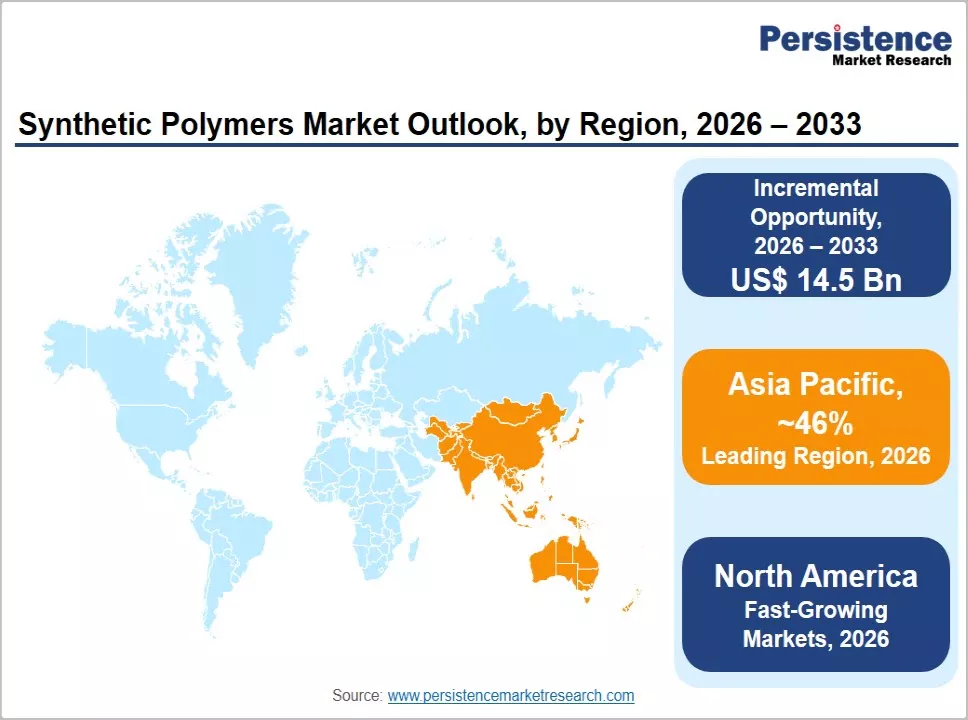
- Regional Leadership: Asia Pacific is poised to dominate with an estimated 46% share in 2026 and register a 6.3% CAGR through 2033, led by China, India, and Southeast Asia, while European capacity closures reshape trade flows.
DRO Analysis
Drivers: Packaging, Mobility, and Construction Demand as Primary Growth Catalyst
Rising consumption in packaging, automotive, and construction is the leading force driving the synthetic polymers market growth, as manufacturers rely on polymers for lightweight, durable, and cost-efficient materials. Urbanization and growth in e-commerce, processed food, and consumer goods in Asia, Africa, and Latin America are expanding demand for films, containers, and closures, while automotive producers substitute metal with engineered polymers to improve fuel efficiency and extend electric vehicle range.
Construction uses pipes, insulation foams, window profiles, and membranes that require polyvinyl chloride, polyethylene, and polyurethane. Capacity additions in the Middle East, China, and the U.S., which benefit from feedstock advantages, are also keeping supply ample and pricing competitive, supporting conversion of traditional materials to polymers across industries.
Healthcare, Electronics, and Recycled-Content Mandates
Healthcare and electronics are adding high-value demand for medical-grade, flame-retardant, and high-purity polymers, while recycled-content targets in packaging regulations are encouraging producers to scale mechanically and chemically recycled grades.
This combination of volume demand and specification-driven upgrading supports both tonnage growth and improved product mix. Advances in compounding are also allowing polymers to replace glass, metal, and wood in appliances, furniture, and sports goods, while electric vehicle growth raises consumption of polypropylene compounds and polyurethane foams for lightweight interiors and battery thermal management.
Restraints: Regulatory Pressure on Plastics and Feedstock Volatility
Regulatory scrutiny of plastic waste is a significant challenge for the synthetic polymers market. Single-use plastics restrictions, extended producer responsibility schemes, recycled-content requirements, and taxes on virgin plastic are raising compliance costs and in some cases reducing demand for virgin resin.
Brand owners are also redesigning packaging to cut material use, which can lower consumption per unit of product. Public concern over microplastics and marine litter is further intensifying policy attention, including international discussions on a global plastics treaty, which adds uncertainty for long-term capacity planning.
Overcapacity, Volatile Feedstock, and Regional Closures
Polymer producers face volatile crude oil, naphtha, and natural gas prices, and new capacity in Asia and the Middle East has led to persistent oversupply and weak margins. Europe has been hit hardest, with chemical capacity announced for closure reaching roughly 37 million tons since 2022 and elevated energy costs undermining competitiveness. Closures and asset sales are disrupting regional supply chains, increasing import dependency, and creating uncertainty for converters planning long-term sourcing.
Opportunities: Circular Polymers, Bio-Attributed Grades, and Emerging Market Growth
Circular and low-carbon polymers present the largest opportunity. Producers are investing in advanced recycling, mass-balance bio-attributed resins, and higher-recycled-content grades to meet brand owner commitments and regulatory mandates. Premium pricing for certified circular grades, combined with long-term offtake agreements with consumer goods companies, offers a route to improved margins that commodity volumes alone cannot provide. Collaborations between producers, converters, and brand owners on chemical recycling and pyrolysis-oil supply are also reducing dependence on fossil feedstock and strengthening supply security for food-contact applications.
Gulf Producers and Emerging Market Consumption
As European crackers close, producers with low-cost feedstock in the Gulf and North America are positioned to supply more polyethylene and polypropylene to import-dependent regions. At the same time, rising incomes and infrastructure spending in South Asia, Southeast Asia, Africa, and Latin America are expected to increase per-capita polymer consumption, supporting investments in downstream conversion, compounding, and local distribution.
Category-wise Insights
Type Analysis
Why Does Polyethylene Lead the Synthetic Polymers Market?
Polyethylene is the leading type segment, expected to hold about 34% of the synthetic polymers market revenue share in 2026. HDPE, LDPE, and LLDPE serve films, bags, bottles, pipes, and containers across packaging, agriculture, and construction. Its low cost, processability, and chemical resistance make it indispensable for everyday applications, while established recycling streams support growing use of recycled-content grades. Ample capacity in the Gulf, North America, and China keeps supply competitive, and demand for stretch films and flexible packaging remains robust, although recycled-content mandates and thin-gauge packaging trends moderate volume growth. Mechanical recycling of post-consumer polyethylene film and rigid containers is expanding steadily, giving producers a route to supply certified recycled grades alongside virgin resin.
Polyurethane is likely to grow the fastest through 2033, at an estimated 6.4% CAGR. Flexible and rigid foams, coatings, adhesives, elastomers, and sealants are used in furniture, bedding, automotive seating, appliances, and building insulation. Energy-efficiency regulations for buildings and refrigeration are increasing demand for rigid insulation foams, while electric vehicles require lightweight thermal and acoustic management materials. Producers are developing bio-based polyols and recyclable chemistries to address sustainability concerns. Polypropylene, polyvinyl chloride, and polystyrene remain important, serving automotive parts, pipes and profiles, and food packaging.
Application Analysis
Why Does Packaging Lead Synthetic Polymers Applications?
Packaging is the leading application segment, projected to capture about 38% of the revenue share in 2026. Polymers protect food, beverages, pharmaceuticals, and consumer products while reducing weight and transportation cost compared with glass and metal. Growth in e-commerce, ready-to-eat food, and organized retail in emerging economies sustains demand, even as regulations drive down-gauging, mono-material design, and recycled-content use. Converters are adopting mono-material polyethylene and polypropylene structures that simplify recycling, creating opportunities for suppliers offering barrier and sealant performance within recyclable formats.
Electronics is the fastest-growing application, expected to register about 6.9% CAGR during 2026–2033. Polymers are used in housings, connectors, insulation, circuit board laminates, displays, and cable sheathing, where flame retardancy, dielectric strength, and dimensional stability are crucial. Growth in data centers, 5G equipment, consumer devices, and electric vehicle electronics is raising demand for engineered and high-purity grades. Automotive, construction, and textiles also remain significant, supported by lightweight components, pipes and insulation, and synthetic fibers.
End Use Industry Analysis
Why Do Consumer Goods Lead Synthetic Polymers End Use Industries?
Consumer goods are poised to lead with an estimated 29% share in 2026, covering household products, toys, appliances, personal care containers, and sporting goods. Polymers offer design freedom, colorability, durability, and low unit cost, enabling high-volume production across price tiers. Brand owners are increasingly specifying recycled-content and bio-attributed grades to meet sustainability pledges, which is reshaping supplier selection. Demand follows consumer spending patterns and is therefore sensitive to inflation and discretionary income.
Healthcare is the fastest-growing end use industry, anticipated to achieve about 6.8% CAGR through 2033. Syringes, IV bags, tubing, diagnostic consumables, implants, and device housings rely on medical-grade polyethylene, polypropylene, polyurethane, and PVC alternatives that meet biocompatibility and sterilization requirements. Ageing populations, expanding healthcare access, and single-use medical consumables are supporting volumes, while qualification requirements create high entry barriers. Automotive, construction, and electronics remain central, driven by weight reduction, infrastructure, and device manufacturing.
Form Analysis
Why Do Granules Dominate Synthetic Polymers Forms?
Granules dominate the form segment, projected to account for about 64% of the market in 2026. Pellets are the standard feedstock for injection molding, extrusion, blow molding, and film production, and are easy to store, transport, and blend with additives and masterbatches. Their compatibility with existing converting equipment and the availability of virgin, recycled, and compounded grades make them the preferred supply form across industries. Standardized specifications and large-volume contracts also keep pricing transparent.
Emulsions are likely to be the fastest-growing form, with an estimated 6.5% CAGR through 2033. Water-based polymer emulsions, including acrylic, polyurethane, and vinyl acetate systems, are replacing solvent-based products in paints, adhesives, coatings, and textile finishing as VOC limits tighten. Powders, sheets, and films retain specialized roles in rotational molding, thermoforming, and packaging, supported by demand for lightweight and customized solutions.
Regional Insights
North America Synthetic Polymers Market Trends and Insights
North America is anticipated to account for an estimated 20% of the global synthetic polymers market in 2026. The region’s market is likely to benefit from abundant, low-cost ethane-based feedstock, large integrated petrochemical complexes on the Gulf Coast, and strong demand from packaging, automotive, and construction. Export competitiveness is expected to remain high, particularly for polyethylene, while increasing recycled-content requirements and extended producer responsibility laws at the state level are likely to shape product development through 2033.
U.S. Synthetic Polymers Market Size
The U.S. is estimated to account for approximately 82% of the North America synthetic polymers market in 2026. Market growth is likely to be supported by low-cost shale-derived feedstock, extensive pipeline and export infrastructure, and sustained packaging and construction demand. Producers continue to invest in advanced recycling and circular polymer projects, while export volumes to Europe and Asia are expected to benefit from regional closures. Policy developments on plastics and trade are anticipated to influence investment decisions and cross-border flows.
Canada Synthetic Polymers Market Size
Canada is projected to represent approximately 8% of the North America synthetic polymers market in 2026. Market expansion is expected to be driven by polyethylene production in Alberta and Ontario, demand from packaging, pipes, and automotive parts, and federal policy targeting plastic waste and recycled content. Integrated feedstock supply and proximity to the U.S. market support producers, while investments in circular plastics and recycling infrastructure are expected to create opportunities for recycled-content resin through 2033.
Europe Synthetic Polymers Market Trends and Insights
Europe is estimated to account for approximately 11% of the global synthetic polymers market in 2026. The region’s market is under structural pressure from high energy costs, weak demand, and competition from imports, with Cefic reporting that capacity announced for closure since 2022 amounts to roughly 9% of European chemical production capacity. At the same time, the Packaging and Packaging Waste Regulation and ambitious recycled-content targets are expected to accelerate demand for recycled and bio-attributed polymers, favouring producers with strong circular portfolios and advanced recycling investments.
Germany Synthetic Polymers Market Size
Germany is anticipated to account for approximately 26% of the Europe synthetic polymers market in 2026. Demand is expected to be supported by the automotive industry, machinery, construction, and a large converter base. However, producers are restructuring, with Dow having approved the closure of its Böhlen ethylene cracker, scheduled for the fourth quarter of 2027, highlighting pressure on upstream capacity. Specialty grades, compounds, and recycled-content polymers are likely to gain importance as commodity production rationalizes.
Why Is Asia Pacific Expected to Lead the Synthetic Polymers Market?
Asia Pacific is projected to account for approximately 46% of the global synthetic polymers market in 2026, making it the largest regional market. The region is also anticipated to register the fastest growth, expanding at an estimated CAGR of 6.3% through 2033. Market expansion is likely to be driven by massive downstream manufacturing, rising consumer spending, and continued capacity additions. China and India are expected to remain the primary demand centres, while Southeast Asian economies are likely to expand converting and packaging capacity.
China Synthetic Polymers Market Size
China is estimated to represent approximately 44% of the Asia Pacific synthetic polymers market in 2026. The country’s market is expected to benefit from large integrated refining and petrochemical complexes, a vast downstream manufacturing base, and growing exports of polypropylene to neighbouring countries. Overcapacity in several commodity polymers is pressuring margins and encouraging a shift towards specialty and engineering grades. Government priorities on high-end materials and environmental standards are projected to support upgrading and sustain China’s regional leadership through 2033.
India Synthetic Polymers Market Size
India is projected to account for approximately 15% of the Asia Pacific synthetic polymers market in 2026. The market is expected to witness strong expansion, supported by infrastructure spending, rising packaged food and consumer goods consumption, and growth in automotive and appliance manufacturing. Domestic producers such as Reliance Industries are expanding capacity, while import dependence for several grades remains substantial. Government schemes encouraging domestic manufacturing and plastic waste management rules requiring recycled content are likely to influence demand and supply dynamics through 2033.
Competitive Landscape
The global synthetic polymers market structure is moderately consolidated, with the top vendors, including SABIC, Dow, ExxonMobil, LyondellBasell, and Sinopec, controlling a considerable share of the revenue. These established players have been leveraging integrated feedstock positions, scale, and global distribution networks. They are also known to invest in advanced recycling, bio-attributed resins, and process efficiency to maintain cost leadership and meet sustainability commitments.
Regional and niche competitors such as Borealis, INEOS, TotalEnergies, and Reliance Industries are focusing on specialized grades, regional strongholds, and downstream integration. Barriers such as capital intensity, feedstock access, and environmental permitting limit new entrants, but restructuring is changing the landscape, with European assets being closed or sold to new regional entities. Market consolidation is expected to continue as producers rationalize capacity, form joint ventures, and divest non-core assets to protect profitability. Gulf producers with advantaged feedstock are widening their footprint in Europe and Asia through joint ventures and acquisitions, increasing competitive intensity for higher-cost regional assets.
Key Market Developments
- In June 2026, LyondellBasell announced plans to close its remaining polypropylene production at Brindisi, Italy, by the end of the year, reflecting continued rationalization of European polymer capacity.
- In May 2026, LyondellBasell completed the sale of several European assets to Velogy, a new regional petrochemical and polymer company, as part of ongoing portfolio restructuring in the region.
- In February 2026, ExxonMobil permanently closed its Mossmorran ethylene cracker in Scotland, contributing to a cumulative 3.3 million tons of ethylene capacity leaving the European market in two years.
Companies Covered in Synthetic Polymers Market
- SABIC
- The Dow Chemical Company
- Exxon Mobil Corporation
- LyondellBasell Industries N.V.
- China Petroleum & Chemical Corporation (Sinopec)
- INEOS Group Limited
- Borealis AG
- TotalEnergies SE
- BASF SE
- Reliance Industries Limited
- Covestro AG
Frequently Asked Questions
The global synthetic polymers market is valued at US$ 31.2 billion in 2026 and is projected to reach US$ 45.7 billion by 2033, expanding at a CAGR of 5.6% during 2026 - 2033.
Rising consumption in packaging, automotive, and construction, growing demand from healthcare and electronics, and capacity additions backed by competitive feedstock are driving the market.
The leading segments in 2026 are polyethylene by type (about 34% share), packaging by application (about 38% share), consumer goods by end use industry (about 29% share), and granules by form (about 64% share).
Asia Pacific dominates the market with an estimated 46% share in 2026 and is projected to register a 6.3% CAGR through 2033, led by China, India, and Southeast Asian economies.
Circular and bio-attributed polymers, export opportunities for low-cost feedstock producers as European capacity closes, and rising per-capita consumption in emerging economies are key market opportunities.
The market is moderately consolidated, with SABIC, Dow, ExxonMobil, LyondellBasell, and Sinopec controlling a considerable share of the revenue.


