




- Advanced Materials
- Petroleum Sorbent Pads Market
Petroleum Sorbent Pads Market Size, Share, and Growth Forecast, 2026 - 2033
Petroleum Sorbent Pads Market by Product Type (Lightweight Pads, Heavyweight Pads, Others), Material Type (Polypropylene, Organic Sorbents, Others), End-user, and Regional Analysis for 2026 - 2033

Petroleum Sorbent Pads Market Size and Trends Analysis
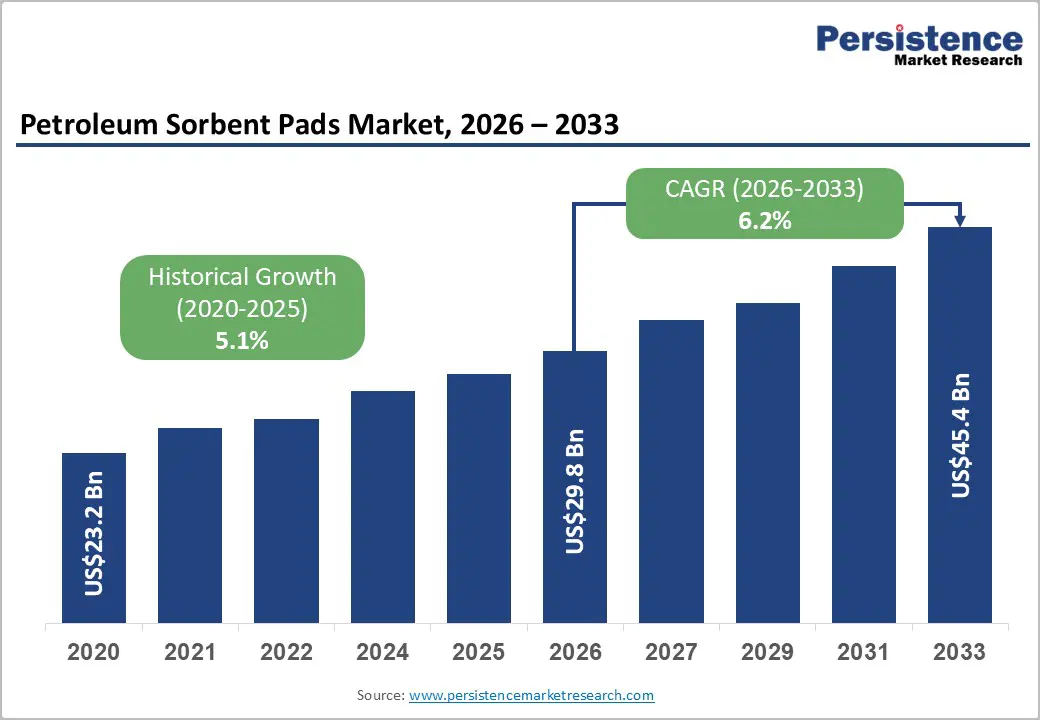
The global petroleum sorbent pads market size is likely to be valued at US$ 29.8 billion in 2026 and is expected to reach US$45.4 billion by 2033, growing at a CAGR of 6.2% between 2026 and 2033, driven by the critical role in industrial spill management and environmental protection, enabling rapid absorption of hydrocarbons while repelling water. Their use spans oil and gas operations, transportation fleets, marine vessels, chemical facilities, and manufacturing plants.
The market’s growth trajectory is supported by mandatory spill-response planning, expanding industrial infrastructure, and rising global energy production. Companies are also investing in advanced polypropylene nonwoven materials and biodegradable sorbent technologies that improve absorption capacity and reduce disposal costs. From a strategic perspective, manufacturers that combine cost-efficient production with service-oriented distribution models, such as spill kits, inventory replenishment programs, and regional logistics hubs, are positioned to capture significant market share.
Key Industry Highlights:
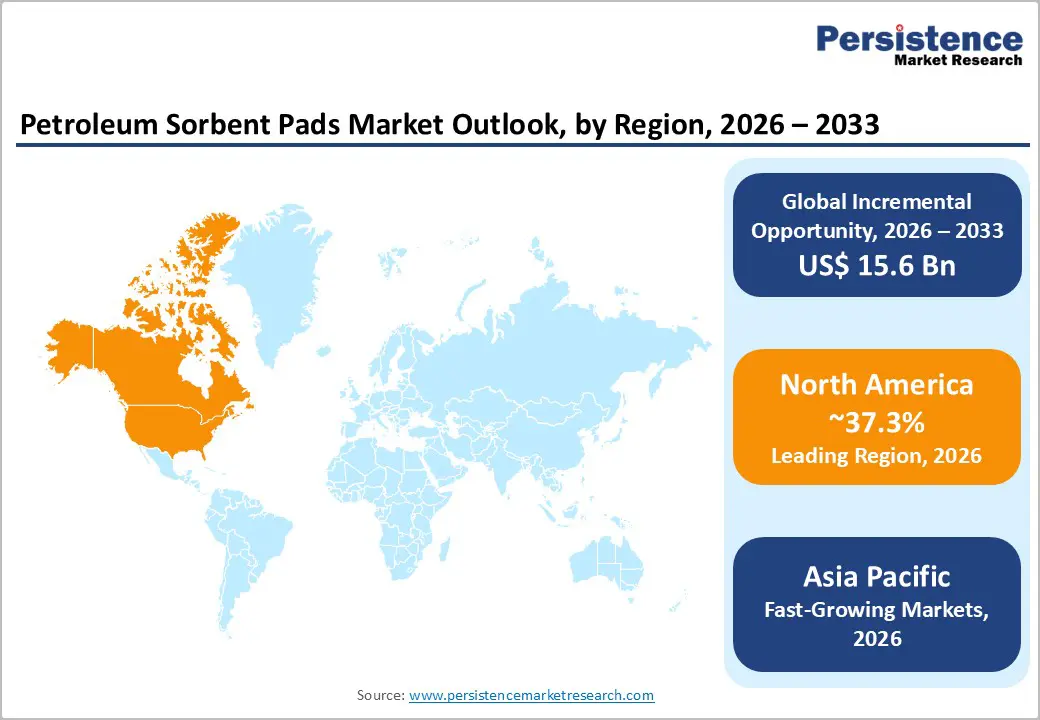
- Leading Region: North America is projected to account for approximately 37.3% of the market share, supported by extensive oil and gas infrastructure, strong regulatory frameworks for spill prevention, and widespread adoption of industrial safety equipment across refineries, marine facilities, and transportation networks.
- Fastest-growing Region: Asia Pacific is projected to be the fastest-growing regional market, driven by rapid industrialization, expanding refining capacity, increasing maritime trade, and rising investments in spill prevention systems across major economies such as China, India, and Japan.
- Investment Plans: Market participants are increasingly investing in advanced absorbent materials, sustainable sorbent technologies, and regional manufacturing and distribution capabilities to improve product performance and supply reliability for industrial customers. Several manufacturers are also focusing on biodegradable absorbents and high-capacity sorbent pads to align with environmental sustainability initiatives.
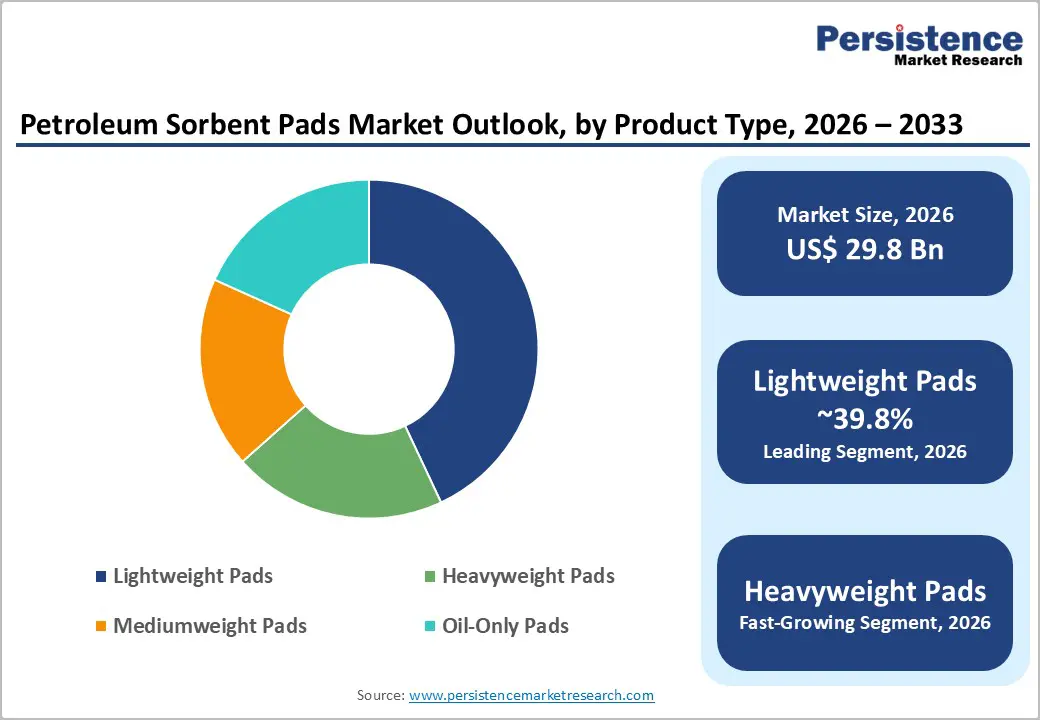
- Dominant Product Type: Lightweight petroleum sorbent pads are projected to account for approximately 39.8% of market revenue, owing to their cost efficiency, ease of handling, and widespread use in routine industrial spill management.
- Leading Material: Polypropylene is expected to account for approximately 68.4% of the market share, owing to its superior oil absorption capacity, hydrophobic properties, and cost-effective large-scale production via nonwoven manufacturing technologies.
| Key Insights | Details | |
|---|---|---|
|
Petroleum Sorbent Pads Market Size (2026E) |
US$29.8 Bn |
|
|
Market Value Forecast (2033F) |
US$45.4 Bn |
|
|
Projected Growth (CAGR 2026 to 2033) |
6.2% |
|
|
Historical Market Growth (CAGR 2020 to 2025) |
5.1% |
Market Factors - Growth, Barriers, and Opportunity Analysis
Growth Analysis - Regulatory Enforcement and Environmental Compliance Requirements
Government agencies and maritime regulatory bodies across major economies enforce strict regulations on petroleum handling facilities, ports, pipelines, and transportation fleets to prevent spills and protect the environment. These regulations require organizations to maintain spill response plans and emergency containment equipment, including petroleum sorbent pads. Industrial sites that store or transport oil products must maintain adequate spill-control inventories to minimize environmental damage from accidental releases. This regulatory environment creates consistent demand for absorbent materials used in containment and cleanup operations. The impact of regulatory enforcement is particularly strong in developed markets where environmental protection frameworks are well established. Facilities must periodically replenish spill response kits and absorbent materials, which generates recurring procurement cycles and stable baseline demand for petroleum sorbent pads.
Expansion of Global Oil and Gas Activities and Maritime Transportation
Global energy demand continues to drive exploration, production, refining, and transportation of petroleum products, increasing the likelihood of maintenance spills, operational leaks, and transportation incidents. Upstream oil and gas activities, including drilling operations, pipeline construction, and offshore production, require large volumes of absorbent materials to manage routine spills and equipment maintenance procedures. Similarly, marine shipping and freight logistics operations rely heavily on sorbent pads to control leaks during fuel transfer, cargo handling, and equipment servicing. The growing volume of oil transportation across global supply chains underscores the need for rapid-response spill management solutions, particularly in high-risk environments such as ports, tank farms, and refineries. As a result, petroleum sorbent pads are becoming standard safety equipment across the energy and logistics industries.
Barrier Analysis - Volatility in Polypropylene and Nonwoven Raw Material Prices
Most petroleum sorbent pads are manufactured from polypropylene melt-blown or spunbond nonwoven materials derived from petrochemical feedstocks. Price fluctuations in polymer markets can significantly affect manufacturing costs and product pricing. When resin costs increase, producers face margin pressure and reduced pricing flexibility, particularly in highly competitive distribution markets. Smaller manufacturers may struggle to maintain profitability amid volatility in raw material prices. Price instability also affects procurement decisions for industrial buyers, particularly in emerging markets where cost sensitivity remains high. These dynamics can slow short-term market expansion despite strong long-term demand fundamentals.
Environmental Concerns Regarding Single-Use Absorbent Materials
Petroleum sorbent pads often become contaminated with hydrocarbons after use, requiring specialized disposal procedures. In several jurisdictions, these materials are classified as hazardous waste, increasing handling and disposal costs for industrial users. Growing environmental awareness and sustainability initiatives are placing greater scrutiny on single-use plastic absorbents, particularly polypropylene-based materials. Organizations are seeking alternatives that reduce landfill waste and improve environmental performance. Higher disposal costs and environmental concerns can limit adoption in certain markets and encourage users to explore reusable or biodegradable absorbent solutions, creating competitive pressure on conventional product categories.
Opportunity Analysis - Development of Biodegradable and Sustainable Sorbent Technologies
Sustainability initiatives across industrial sectors are driving interest in eco-friendly absorbent materials derived from natural fibers, cellulose, and biodegradable polymers. These materials can reduce environmental impact while maintaining adequate absorption performance. Advancements in fiber treatment technologies are enabling organic sorbents to achieve improved hydrocarbon absorption efficiency, narrowing the performance gap with traditional polypropylene pads. Companies that invest in sustainable product innovation and environmentally responsible disposal solutions can differentiate themselves in a market increasingly influenced by corporate environmental commitments and regulatory expectations.
Growth in Transportation and Logistics Spill Response Programs
Transportation and logistics companies are implementing fleet-wide spill management programs to comply with hazardous-material-handling regulations and environmental safety standards. Truck fleets, rail operators, aviation maintenance facilities, and port terminals are equipping vehicles and operational areas with specialized spill kits containing sorbent pads and containment tools. These kits require regular replacement and replenishment, creating recurring demand. Suppliers that offer customized spill control kits, managed inventory systems, and rapid distribution capabilities are well-positioned to capture growth in this expanding end-user segment.
Category-wise Analysis
Product Type Analysis
Lightweight petroleum sorbent pads are anticipated to account for approximately 39.8% of the market revenue in 2026, making them the dominant product category during the forecast period. Their widespread adoption is largely attributed to cost-efficiency, ease of handling, and suitability for routine maintenance spills across industrial facilities and transportation operations. These pads are commonly used in workshops, manufacturing plants, vehicle maintenance centers, warehouses, and small-scale industrial units where minor oil leaks and fluid drips occur frequently. Their compact design and lightweight structure allow organizations to store large quantities without requiring extensive storage space, making them a practical component of standard spill preparedness systems.
For example, automotive service centers and machinery maintenance facilities often deploy lightweight sorbent pads beneath equipment to capture hydraulic oil leaks or lubricant drips, preventing workplace contamination and slip hazards. Industrial distributors and safety product suppliers also include lightweight pads in preconfigured spill response kits used by trucking fleets, chemical warehouses, and fuel storage facilities, which further strengthens their market penetration. Their affordability and versatility make them particularly suitable for routine operational spill control, ensuring consistent demand across multiple industries.
Heavyweight petroleum sorbent pads represent the fastest-growing segment within the product type, supported by rising demand from oil and gas operations, offshore drilling platforms, and large-scale industrial facilities that require higher absorbency. These pads are engineered to deliver superior absorption capacity and structural durability, enabling them to handle significant hydrocarbon spills in demanding environments. Their thicker construction allows them to retain larger volumes of oil and petroleum-based liquids, reducing the number of pads required during cleanup operations and improving overall efficiency.
Industries such as offshore drilling, refinery maintenance, pipeline servicing, and marine transportation increasingly rely on heavyweight pads for high-volume spill containment and emergency response operations. For instance, oil refineries and fuel storage terminals often deploy heavyweight sorbent pads around transfer pumps, loading docks, and tanker truck filling areas to mitigate potential leaks during fuel transfer. Similarly, marine vessels and port terminals use heavyweight absorbent pads during refueling operations to contain accidental fuel spills, minimizing environmental risks. As industrial safety standards continue to tighten and global energy infrastructure expands, demand for high-capacity absorbent solutions is expected to accelerate, driving strong growth in this segment.
Material Type Insights
Polypropylene is anticipated to hold approximately 68.4% of the market share in 2026, making it the dominant material used in absorbent pad manufacturing. Its leadership position is driven by excellent hydrophobic properties, high oil absorption capacity, and cost-effective large-scale production capabilities. Polypropylene fibers are inherently water-repellent and selectively absorb hydrocarbons, making them highly effective for oil spill cleanup in both industrial and marine environments. This property allows sorbent pads to float on water surfaces while absorbing oil-based liquids, making them particularly useful for spill containment in ports, offshore drilling operations, and marine shipping environments.
Manufacturing processes such as melt-blown and spunbond nonwoven technologies enable high-volume production of polypropylene absorbents while maintaining consistent product quality and structural strength. For example, industrial maintenance facilities often use polypropylene-based pads beneath hydraulic machinery to capture lubricants and hydraulic oils, while marine operators deploy polypropylene sorbents during vessel fueling operations to prevent fuel contamination in water bodies. Due to their durability, affordability, and strong performance in hydrocarbon absorption, polypropylene pads remain the preferred solution across oil and gas facilities, manufacturing plants, chemical processing units, and transportation fleets.
Organic sorbents are emerging as the fastest-growing material category. These materials are typically produced from natural fibers such as cotton, cellulose, peat, wood pulp, and agricultural by-products, offering an environmentally sustainable alternative to synthetic absorbents. The increasing adoption of organic sorbents is largely driven by growing environmental awareness, corporate sustainability initiatives, and stricter waste management regulations that encourage the use of biodegradable materials.
Compared with conventional synthetic sorbents, organic materials often decompose more readily and reduce landfill waste, making them attractive to environmentally conscious organizations. Advancements in fiber treatment technologies have significantly improved the absorption efficiency and durability of natural fiber sorbents, enabling them to compete more effectively with polypropylene-based products. For example, treated cellulose absorbents are increasingly used in manufacturing plants and chemical facilities to manage small oil leaks while supporting sustainability goals. Similarly, agriculture-derived absorbent materials are gaining traction in environmental cleanup operations and shoreline oil spill response projects, where biodegradable materials help reduce ecological impact. As industries continue to prioritize sustainable operations and environmental compliance, organic sorbents are expected to gain greater adoption across multiple end-use sectors.
Regional Insights
North America Petroleum Sorbent Pads Market Trends - Oil & Gas Infrastructure and Industrial Spill Preparedness
North America is expected to be the largest regional market, accounting for approximately 37.3% of market share in 2026. The region’s leadership is supported by a well-established oil and gas industry, extensive pipeline networks, and stringent environmental protection frameworks that mandate spill preparedness across industrial operations. Petroleum sorbent pads are widely used throughout the region as part of routine maintenance and emergency spill response systems in refineries, fuel storage terminals, and transportation networks. The U.S. remains the primary contributor to regional demand due to its large concentration of refineries, offshore drilling operations in the Gulf of Mexico, and extensive petrochemical infrastructure along the Gulf Coast and in states such as Texas and Louisiana.
Industrial safety regulations require facilities handling petroleum products to maintain comprehensive spill prevention and response systems, which typically include oil-only sorbent pads, absorbent booms, and spill containment kits. Large industrial safety product manufacturers such as 3M and New Pig Corporation supply a broad range of petroleum sorbent pads used in these applications. For example, New Pig Corporation’s PIG Oil-Only Absorbent Pads are widely used in refineries and maintenance facilities to absorb lubricants and fuel spills without absorbing water.
North America also benefits from a strong industrial safety distribution ecosystem, with suppliers providing rapid delivery of spill control equipment to manufacturing plants, logistics operators, and marine facilities. Companies such as ENPAC and Oil-Dri Corporation of America have expanded product portfolios and production capacity to meet the growing demand for absorbent materials. Oil-Dri’s strategic acquisitions over the past few years have strengthened its ability to supply industrial absorbents for spill response and environmental remediation.
Innovation across the region is increasingly focused on high-capacity absorbent materials and environmentally responsible spill response solutions. Several manufacturers are developing advanced sorbent technologies that improve absorption efficiency while reducing waste disposal volumes. These innovations support regulatory compliance and operational efficiency for industries operating in high-risk environments such as oil refining, chemical processing, and marine transportation.
Europe Petroleum Sorbent Pads Market Trends - Regulatory Compliance and Sustainable Absorbent Innovation
Europe represents a significant market for petroleum sorbent pads, driven by strict environmental regulations, advanced industrial infrastructure, and strong occupational safety standards. Countries including Germany, the U.K., France, and Spain play a major role in regional demand due to their industrial manufacturing capacity, large maritime trade volumes, and active energy sectors. European regulatory frameworks governing marine pollution prevention, hazardous waste management, and industrial safety require organizations handling petroleum products to implement robust spill prevention and containment procedures. As a result, petroleum sorbent pads are widely used across ports, refineries, offshore energy installations, and chemical manufacturing plants throughout the region.
Germany’s strong manufacturing and engineering industries generate consistent demand for industrial absorbent products used in equipment maintenance and factory safety programs. Meanwhile, the U.K’s extensive maritime trade and offshore energy operations in the North Sea support significant consumption of oil-only absorbent pads for spill control during vessel fueling, cargo transfers, and offshore maintenance activities. Companies such as Darcy Spillcare in the U.K. provide a wide range of spill control solutions, including petroleum sorbent pads and emergency response kits used by industrial and marine operators.
The European market is also characterized by growing emphasis on sustainability and environmentally responsible absorbent solutions. Manufacturers are responding by developing biodegradable and recycled fiber sorbents designed to reduce landfill waste and improve disposal efficiency. For instance, Ahlstrom, a Finland-based specialty materials manufacturer, continues to invest in advanced fiber technologies used in industrial filtration and absorbent applications. These developments support the production of higher-performance materials that meet stringent European environmental standards. As sustainability becomes a central priority across European industries, manufacturers are increasingly investing in eco-friendly absorbent product lines, recyclable packaging solutions, and lifecycle documentation to comply with regional environmental policies and corporate sustainability goals.
Asia Pacific Petroleum Sorbent Pads Market Trends - Rapid Industrialization and Expanding Energy Infrastructure Demand
Asia Pacific is the fastest-growing regional market for petroleum sorbent pads, driven by rapid industrialization, expanding energy infrastructure, and rising maritime trade. Increasing investments in manufacturing, oil refining, and transportation networks are significantly expanding the demand for spill response and environmental protection equipment. Countries such as China, Japan, and India are major contributors to regional market growth. China’s large industrial manufacturing base and extensive port infrastructure make it one of the most significant consumers of petroleum sorbent pads used for equipment maintenance and spill management.
Industrial safety equipment manufacturers such as Shanghai SYSBEL Industry & Technology Co., Ltd. produce spill control products widely used in Chinese manufacturing plants, chemical facilities, and logistics centers. Japan’s market emphasizes high-quality industrial safety products and advanced spill containment technologies, particularly within marine transport and heavy manufacturing industries. Japanese ports and shipyards rely on oil-only sorbent pads to manage fuel spills during vessel maintenance and cargo handling operations. In addition, strict environmental standards encourage the adoption of high-performance absorbent materials capable of minimizing contamination in coastal waters.
India is emerging as an important growth market due to expanding oil refining capacity, infrastructure development, and logistics sector growth. Large industrial safety suppliers and domestic companies such as Log9 Spill Containment Pvt. Ltd. are introducing innovative absorbent materials designed for oil spill cleanup and industrial leak management. These products are increasingly used in refineries, fuel storage terminals, and railway transport operations handling petroleum products. As energy demand and industrial activity continue to increase, Asia Pacific is expected to remain a key growth engine for the global petroleum sorbent pads market.
Competitive Landscape
The global petroleum sorbent pads market demonstrates moderate concentration, with a mix of global manufacturers and regional suppliers competing across industrial safety and environmental protection segments. Large multinational companies maintain strong market positions through advanced manufacturing technologies, extensive distribution networks, and established brand recognition. At the same time, numerous regional manufacturers compete on price and localized supply capabilities. Market competition is influenced by product quality, absorption performance, pricing strategies, and distribution efficiency, particularly in industrial supply channels. Leading companies are focusing on product innovation, regional expansion, and service-oriented distribution strategies. Differentiation is achieved through high-performance absorbent materials, customized spill response kits, and integrated supply programs that provide reliable product availability for industrial customers.
Key Industry Developments:
- In 2025, New Pig Corporation expanded its industrial spill response product portfolio with advanced absorbent solutions such as the PIG® Stat-Mat® absorbent pad, designed to dissipate static electricity while absorbing petroleum-based liquids, improving safety in facilities handling flammable fluids.
Companies Covered in Petroleum Sorbent Pads Market
- 3M
- New Pig Corporation
- Oil-Dri Corporation of America
- Ahlstrom
- Kimberly-Clark Professional
- ENPAC LLC
- Darcy Spillcare Manufacture Ltd.
- Meltblown Technologies Inc.
- Sorbent Products Company
- Brady Corporation
- Justrite Safety Group
- Fentex Ltd.
- SpillTech Environmental Inc.
- Evolution Sorbent Products LLC
- UltraTech International Inc.
- Global Spill Control Pvt. Ltd.
Frequently Asked Questions
The petroleum sorbent pads market is estimated to reach US$29.8 billion in 2026.
The global petroleum sorbent pads market is projected to reach US$45.4 billion by 2033.
Key trends include the development of high-capacity absorbent materials, increasing demand for environmentally sustainable sorbent solutions, rising adoption of pre-configured spill response kits, and growing investment in regional manufacturing and distribution networks to improve supply efficiency for industrial customers.
The lightweight petroleum sorbent pads segment is anticipated to remain the leading product category, accounting for around 39.8% of market revenue, primarily due to its affordability, ease of storage, and widespread use in routine industrial spill management.
The petroleum sorbent pads market is expected to grow at a CAGR of 6.2% between 2026 and 2033.
Some of the major companies include 3M, New Pig Corporation, Oil-Dri Corporation of America, Ahlstrom, and Kimberly-Clark Professional.


