




- Renewable Energy
- Pad-Mounted Switchgear Market
Pad-Mounted Switchgear Market Size, Share, and Growth Forecast, 2026 - 2033
Pad-Mounted Switchgear Market by Product Type (Gas‑Insulated, Solid Dielectric, Others), Voltage Rating (16-25 kV / 15-25 kV, 25-38 kV, Others), Application, and Regional Analysis for 2026 - 2033

Pad-Mounted Switchgear Market Size and Trends Analysis
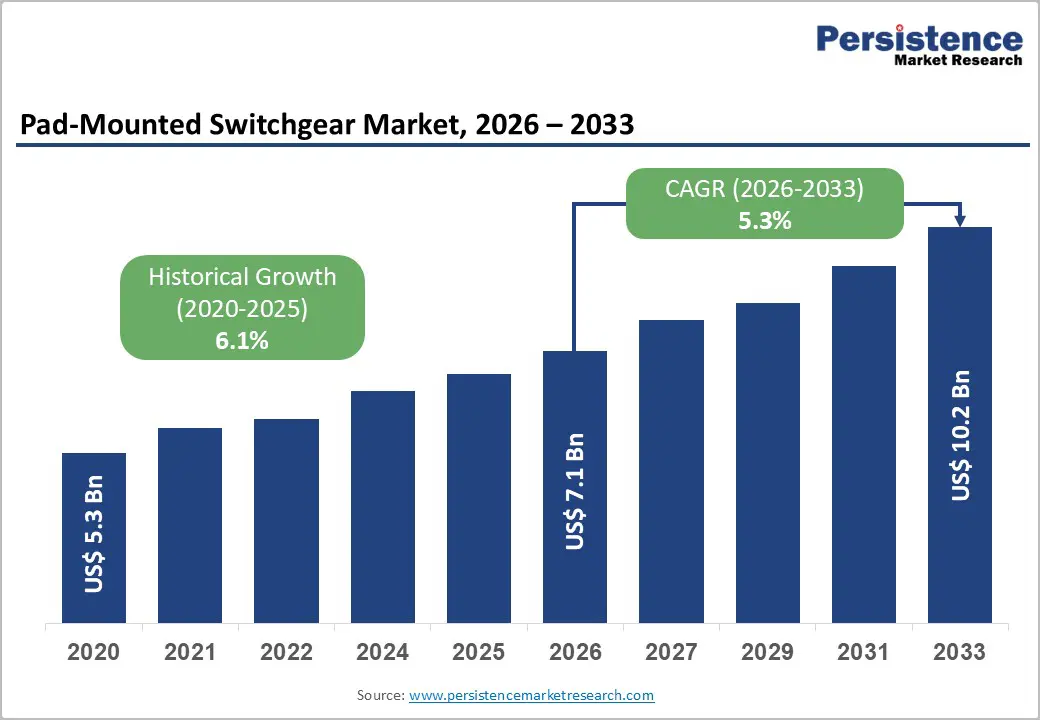
The global pad-mounted switchgear market size is likely to be valued at US$ 7.1 billion in 2026 and is expected to reach US$ 10.2 billion by 2033, growing at a CAGR of 5.3% between 2026 and 2033, driven by the undergrounding of distribution networks, the integration of distributed renewable energy systems and electric-vehicle charging infrastructure, and regulatory pressure to reduce the use of SF6 gas in medium-voltage equipment. Grid modernization investments and rising demand for SF6-free and solid-dielectric switchgear technologies are major near-term drivers, supported by growing utility capital expenditures and industrial electrification initiatives.
Key Industry Highlights:
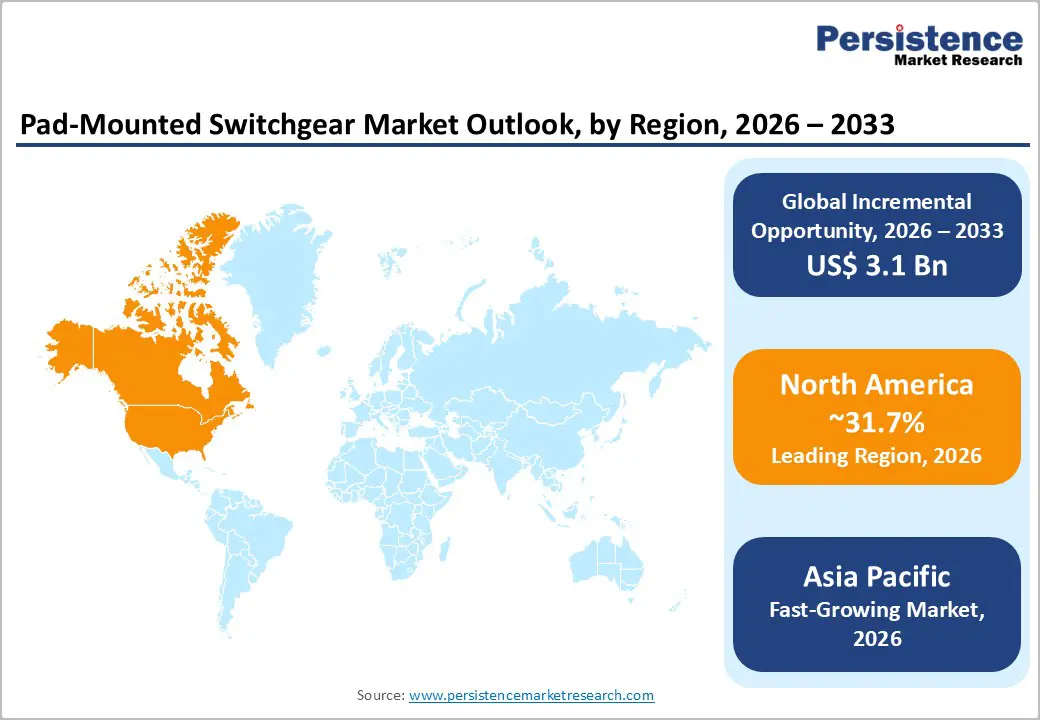
- Leading Region: North America is expected to remain the leading regional market, accounting for approximately 31.7% of the share, supported by extensive grid modernization programs, underground distribution expansion, and strong investments by utilities in the U.S. and Canada.
- Fastest-growing Region: Asia Pacific is projected to be the fastest-growing regional market, driven by rapid urbanization, industrial expansion, and large-scale power distribution infrastructure projects across China, India, and Southeast Asia.
- Investment Plans: Significant investments are being directed toward grid modernization, underground cable networks, smart grid technologies, and renewable energy integration, particularly in North America, Europe, and emerging Asian economies, which is accelerating demand for advanced medium-voltage distribution equipment.
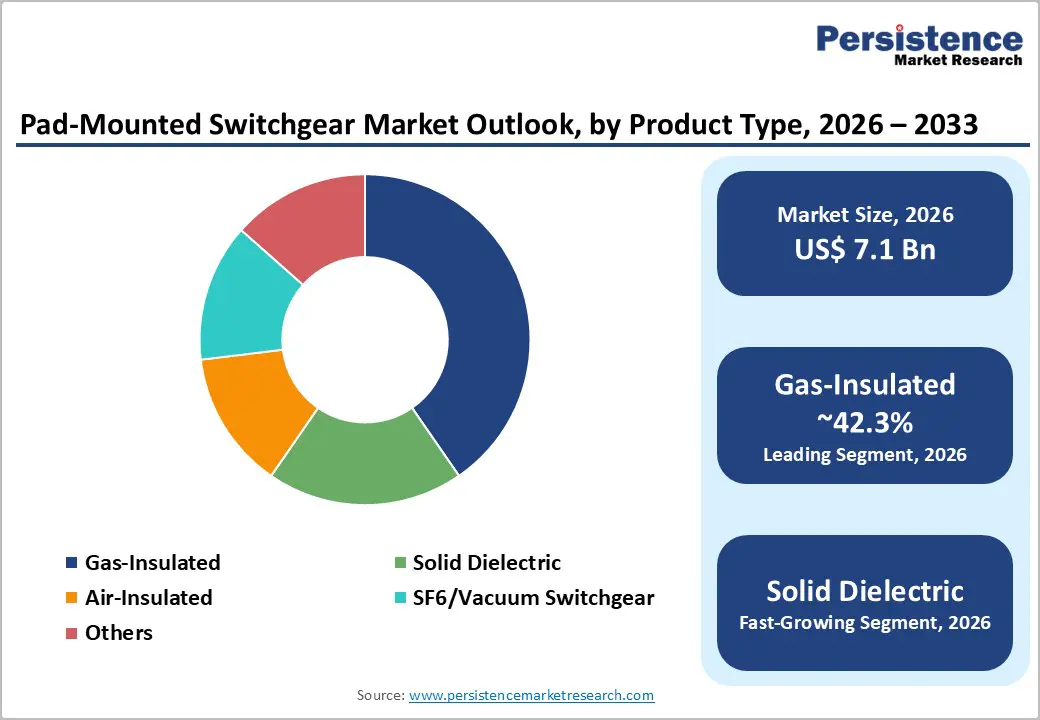
- Dominant Product Type: Gas-insulated pad-mounted switchgear is anticipated to account for approximately 42.3% of the market share, due to its compact design, high reliability, and strong suitability for underground distribution networks in densely populated urban areas.
- Leading Voltage Rating: The 15-25 kV voltage rating is estimated to hold approximately 47.5% of the market share, as this range corresponds to the most widely used medium-voltage levels in residential, commercial, and industrial electricity distribution systems.
| Key Insights | Details |
|---|---|
| Pad-Mounted Switchgear Market Size (2026E) | US$7.1 Bn |
| Market Value Forecast (2033F) | US$10.2 Bn |
| Projected Growth (CAGR 2026 to 2033) | 5.3% |
| Historical Market Growth (CAGR 2020 to 2025) | 6.1% |
Market Factors - Growth, Barriers, and Opportunity Analysis
Growth Analysis - Undergrounding of Distribution Infrastructure
Utilities across developed and emerging economies are accelerating the transition from overhead distribution lines to underground networks to improve grid reliability and reduce vulnerability to storms and environmental hazards. Pad-mounted switchgear is specifically designed for underground distribution systems as it provides compact, tamper-resistant, and weather-resistant protection for medium-voltage feeders. Urban resilience programs and infrastructure modernization initiatives in North America, Europe, and parts of Asia Pacific have increased investment in underground distribution. Municipal governments and utilities are prioritizing underground power networks in densely populated areas to minimize outages and improve safety. As underground cable deployment expands, demand for pad-mounted switchgear increases directly, particularly in the 15-25 kV voltage range widely used in distribution networks.
Environmental Regulations and Transition Away from SF6
Sulfur hexafluoride (SF6) has traditionally been used as an insulating gas in medium-voltage switchgear owing to its excellent dielectric properties. However, SF6 is recognized as a potent greenhouse gas with a very high global warming potential. Governments and regulatory bodies are introducing policies to reduce emissions from electrical equipment and encourage the adoption of environmentally friendly alternatives. As a result, manufacturers are increasingly developing SF6-free switchgear technologies, including solid-dielectric and alternative gas insulation systems. Utilities seeking to comply with environmental regulations and corporate sustainability commitments are adopting these new technologies in distribution networks. The transition toward environmentally sustainable insulation materials is expected to drive strong demand for next-generation pad-mounted switchgear products.
Expansion of Distributed Energy and Grid Automation
Rapid deployment of distributed energy resources such as rooftop solar panels, community solar projects, and battery storage systems is transforming distribution networks. These systems create bidirectional power flows and introduce new operational challenges for utilities. Pad-mounted switchgear equipped with intelligent protection relays, remote monitoring capabilities, and automation functions helps utilities manage these dynamic networks more effectively. Utilities are increasingly installing digitally enabled switchgear that integrates with SCADA systems and distribution automation platforms. The growing need for automated fault isolation, remote switching, and grid monitoring is significantly increasing demand for advanced pad-mounted switchgear solutions.
Barrier Analysis - High Installation and Infrastructure Costs
Although pad-mounted switchgear offers significant operational advantages, installation often requires extensive civil infrastructure, including concrete pads, underground cabling, and protective enclosures. These requirements increase project costs compared with conventional overhead switching equipment. For municipalities and utilities operating under budget constraints, the high upfront capital investment associated with underground distribution infrastructure can delay deployment timelines. In many cases, undergrounding projects require long-term planning and funding approvals, which can slow adoption rates in cost-sensitive regions.
Supply Chain Constraints and Component Availability
Manufacturing pad-mounted switchgear requires specialized materials and components, including vacuum interrupters, insulating materials, and electronic protection devices. Global supply chain disruptions and fluctuations in raw material prices can affect equipment production schedules and project delivery timelines. Shortages of electronic components, along with volatility in the prices of copper, steel, and insulation materials, can increase manufacturing costs and extend equipment lead times. If supply constraints persist, utilities may face delays in grid modernization projects, affecting near-term market growth.
Opportunity Analysis - Replacement of Legacy Distribution Equipment
A significant portion of the global distribution infrastructure installed decades ago is reaching the end of its operational life. Many utilities operate legacy switchgear systems that rely on outdated insulation technologies or oil-filled components. This situation creates a major opportunity for manufacturers of modern pad-mounted switchgear solutions. Utilities are increasingly replacing aging equipment with compact and environmentally sustainable alternatives. Vendors that offer integrated retrofit solutions, including removal and replacement services, are likely to benefit from large-scale modernization programs.
Digital Monitoring and Lifecycle Service Solutions
The increasing digitalization of power distribution networks is creating opportunities for new service-based business models. Pad-mounted switchgear equipped with sensors and communication modules can provide real-time operational data, enabling predictive maintenance and performance monitoring. Utilities are increasingly adopting lifecycle service agreements that include remote monitoring, condition-based maintenance, and software upgrades. Manufacturers that combine hardware solutions with digital analytics platforms can generate recurring revenue streams and build stronger long-term relationships with utility customers.
Category-wise Analysis
Product Type Analysis
Gas-insulated pad-mounted switchgear is anticipated to account for around 42.3% of the market share in 2026, making it the leading product category throughout the forecast period. These systems use gas insulation to achieve high dielectric strength within a sealed enclosure, enabling compact designs that are particularly suitable for dense urban environments where space constraints limit the installation of larger electrical equipment. Utilities and industrial operators favor gas-insulated switchgear for its high operational reliability, longer service life, and strong resistance to environmental contaminants such as dust, moisture, humidity, and chemical pollutants. The sealed design protects internal components from external environmental factors, significantly reducing maintenance requirements and improving operational stability. In densely populated cities, gas-insulated pad-mounted switchgear enables utilities to deploy underground electrical distribution infrastructure without relying on overhead lines or large substations.
For example, many municipal utilities in major metropolitan areas such as New York, London, and Tokyo utilize compact gas-insulated pad-mounted switchgear to support underground cable networks serving residential neighborhoods and commercial districts. Industrial facilities also rely heavily on gas-insulated systems to ensure reliable medium-voltage power distribution. Manufacturing plants, petrochemical complexes, mining operations, and data center campuses frequently install these units to protect underground feeders and maintain a stable power supply to critical equipment.
Solid-dielectric pad-mounted switchgear is expected to be the fastest-growing product segment during the forecast period, supported by increasing environmental regulations and growing industry demand for sustainable electrical equipment. These systems replace traditional gas insulation with solid insulating materials, eliminating the need for sulfur hexafluoride (SF6), which is widely recognized as a high global warming potential greenhouse gas. Another key advantage of solid-dielectric switchgear is its simplified installation and operational maintenance. Since these systems do not rely on pressurized gas insulation, they eliminate the need for gas-handling, monitoring, or leak-detection systems. This reduces both installation complexity and long-term operational costs.
For example, several utility modernization projects in Europe and North America have begun deploying solid-dielectric pad-mounted switchgear in urban underground distribution networks as part of broader sustainability initiatives. Industrial operators and renewable energy projects are also increasingly adopting these systems as they align with corporate environmental goals and regulatory compliance requirements. Air-insulated and hybrid switchgear technologies continue to serve niche applications, particularly in cost-sensitive projects or legacy system replacements where environmental regulations are less stringent.
Voltage Rating Insights
The 15-25 kV voltage rating segment is anticipated to account for approximately 47.5% of the market share in 2026, making it the dominant voltage class in medium-voltage distribution networks. This voltage range aligns with the standard operating levels used by most electrical utilities to distribute power from substations to residential, commercial, and industrial customers. Pad-mounted switchgear operating within this voltage range is widely deployed in underground distribution systems as it provides effective protection and switching capabilities for medium-voltage feeders. Utilities use these systems to manage electrical loads, isolate faults, and maintain reliability across distribution networks.
Urban and suburban power distribution infrastructure in many countries operates primarily within the 15-25 kV range. For instance, numerous utility distribution systems in the U.S., Canada, and parts of Europe rely on feeders operating at approximately 13 kV to 24 kV. These systems require reliable switching equipment to manage underground cables supplying electricity to residential communities, commercial complexes, and industrial facilities. Manufacturers continue to focus research and development efforts on this voltage class as it represents the largest portion of global distribution infrastructure. Standardized equipment designs within the 15-25 kV range also allow utilities to maintain compatibility with existing cable systems and protection devices, reinforcing the segment's continued dominance.
The 25-38 kV voltage segment is expected to record the fastest growth during the forecast period, driven by increasing electricity demand and the need for more efficient power distribution systems. Utilities and large industrial facilities are gradually shifting toward higher-voltage distribution networks to transmit larger amounts of power while minimizing energy losses. Higher-voltage distribution infrastructure enables electricity to be delivered over longer distances with improved efficiency. This capability is particularly important in rapidly expanding metropolitan areas and industrial corridors where energy demand continues to rise.
By operating at higher voltage levels, utilities can reduce transmission losses and enhance overall grid performance. For example, several fast-growing urban regions in the Asia Pacific and the Middle East are adopting distribution systems operating at 33 kV to support expanding infrastructure and industrial development. Large-scale industrial parks, mining operations, and renewable energy projects often require higher-capacity electrical systems, making the 25-38 kV range increasingly attractive for new installations. As utilities continue to modernize distribution infrastructure and industrial facilities expand their electrification initiatives, the demand for pad-mounted switchgear in this higher-voltage range is expected to grow significantly.
Regional Insights
North America Pad-Mounted Switchgear Market Trends - Underground Distribution Expansion and Grid Resilience Investments
North America is projected to represent the largest regional market, with an anticipated share of approximately 31.7% of market share in 2026. The U.S. dominates the regional market due to extensive investments in grid modernization and electrical infrastructure upgrades. A significant portion of the region’s electrical distribution infrastructure was installed several decades ago and now requires replacement or modernization. Utilities are increasingly investing in underground cable systems to improve reliability and reduce weather-related outages caused by storms, wildfires, and extreme temperatures. Pad-mounted switchgear plays a critical role in underground distribution systems by enabling safe switching, protection, and feeder sectionalization. Major utilities across the U.S. are deploying equipment supplied by manufacturers such as Eaton, S&C Electric Company, and G&W Electric. These technologies enable utilities to quickly detect and isolate faults, reducing customer outages.
Government initiatives supporting resilient infrastructure and renewable energy integration are further accelerating grid modernization programs. Programs linked to federal infrastructure investments and resilience planning have encouraged utilities to upgrade distribution networks with advanced equipment. Many manufacturers are also introducing digital monitoring and smart grid compatibility features in new switchgear products. The presence of major manufacturers such as Hubbell Incorporated and Schneider Electric in North America further strengthens the region’s market leadership. These companies continue to launch environmentally friendly and digitally enabled switchgear solutions designed to meet evolving regulatory requirements and grid performance expectations.
Canada is also experiencing steady demand for pad-mounted switchgear as utilities expand underground distribution networks in growing urban centers such as Toronto and Vancouver. Canadian utilities often require robust equipment that operates reliably in harsh winter conditions, increasing demand for highly durable switchgear designs. The adoption of smart grid technologies is another important driver in North America. Utilities are integrating communication systems, sensors, and automated switching equipment to improve operational efficiency and system visibility. As infrastructure modernization continues and utilities prioritize grid resilience and sustainability, North America is expected to maintain its leading position in the global pad-mounted switchgear market.
Europe Pad-Mounted Switchgear Market Trends - SF6-Free Switchgear Adoption and Urban Grid Modernization
Europe represents a mature but steadily growing market for pad-mounted switchgear. Countries including Germany, the U.K., France, Spain, and Italy are actively modernizing electrical distribution networks and integrating renewable energy resources. One of the most significant drivers in the European market is the region’s strong environmental policy framework. European governments and regulatory bodies have introduced strict policies to reduce greenhouse gas emissions and encourage environmentally sustainable technologies in electrical equipment.
These regulations are accelerating the development and adoption of SF6-free switchgear solutions. Leading manufacturers such as Siemens Energy, ABB, and Schneider Electric are actively developing alternative insulation technologies. For example, Schneider Electric’s AirSeT technology and Siemens’ Blue GIS solutions are designed to eliminate the use of SF6 gas while maintaining high performance and reliability in medium-voltage applications. The growing availability of such technologies is accelerating the transition toward environmentally friendly switchgear solutions across European utilities.
Urban redevelopment projects across major European cities are also driving demand for underground distribution infrastructure. Cities such as London, Paris, and Berlin are expanding underground cable networks to meet rising electricity demand and enhance urban aesthetics. Pad-mounted switchgear plays an essential role in these projects by enabling compact switching and protection solutions within constrained urban environments. European utilities are also prioritizing grid reliability and flexibility as renewable energy capacity expands. Wind and solar generation projects require upgraded distribution infrastructure capable of managing variable power flows.
Equipment supplied by companies such as Ormazabal and Lucy Electric is widely deployed across European networks to support renewable integration and modern distribution automation systems. The combination of regulatory pressure, renewable energy expansion, and infrastructure modernization is expected to sustain steady growth in the European pad-mounted switchgear market over the forecast period.
Asia Pacific Pad-Mounted Switchgear Market Trends - Rapid Urbanization and Large-Scale Distribution Infrastructure Development
Asia Pacific is expected to be the fastest-growing regional market. Rapid urbanization, industrialization, and infrastructure development across countries such as China, India, Japan, South Korea, and Southeast Asian nations are driving strong demand for modern electrical distribution equipment. China represents the largest market in the region due to extensive investment in electrical infrastructure and large-scale urban development. The country continues to expand its power distribution networks to support rapid economic growth and increasing electricity consumption.
Major grid operators such as State Grid Corporation of China are investing heavily in advanced distribution infrastructure, including underground cable networks and modern switchgear systems. Domestic and international manufacturers, including Siemens, Hitachi Energy, and TBEA, are actively supplying medium-voltage equipment to support these large infrastructure projects. The rapid expansion of industrial zones and new urban districts continues to generate strong demand for compact and reliable pad-mounted switchgear solutions.
India is also experiencing significant growth in the pad-mounted switchgear market as utilities modernize distribution infrastructure and expand electricity access. Programs aimed at improving power reliability and strengthening distribution networks have increased demand for medium-voltage equipment. Utilities such as Tata Power and Adani Electricity have implemented underground distribution and smart grid projects in major cities, including Mumbai and Delhi, which require advanced pad-mounted switchgear systems. Japan and South Korea focus on high-quality electrical infrastructure and advanced technologies to support dense urban environments.
Companies such as Mitsubishi Electric and Toshiba Energy Systems manufacture compact gas-insulated and solid-dielectric switchgear designed for underground networks in metropolitan areas such as Tokyo and Seoul. Southeast Asian countries, including Vietnam, Indonesia, and Thailand, are also investing in distribution infrastructure as electricity demand rises and urban development accelerates. As regional governments expand electrification programs and industrial development zones, the adoption of pad-mounted switchgear across Asia Pacific is expected to grow rapidly in the coming years.
Competitive Landscape
The global pad-mounted switchgear market is moderately consolidated, with several large multinational manufacturers holding significant market shares. These companies benefit from strong engineering capabilities, extensive product portfolios, and established relationships with utilities and industrial customers. At the same time, regional manufacturers and specialized equipment providers remain competitive in local markets by offering cost-effective solutions tailored to regional standards and regulatory requirements. Competitive differentiation is increasingly driven by technological innovation, environmental sustainability, and digital integration capabilities. Leading companies focus on technology innovation, global market expansion, and lifecycle service offerings to strengthen their competitive position. Many manufacturers are investing in SF6-free insulation technologies, digital monitoring systems, and smart grid compatibility to meet evolving utility requirements and environmental regulations.
Key Industry Developments:
- In January 2026, Schneider Electric announced the expansion of its SM AirSeT SF6-free medium-voltage switchgear deployment across East Africa, supporting utilities and infrastructure projects in transitioning toward low-carbon power distribution systems and improving grid reliability.
- In November 2025, Schneider Electric launched its GM AirSeT SF6-free primary switchgear technology, designed to provide digitally enabled, pure-air insulated medium-voltage solutions for grid operators, data centers, and industrial facilities seeking to reduce greenhouse-gas emissions and modernize power infrastructure.
Companies Covered in Pad-Mounted Switchgear Market
- ABB Ltd.
- Eaton Corporation plc
- S&C Electric Company
- G&W Electric Co.
- Hubbell Power Systems Inc.
- Schneider Electric SE
- Siemens AG
- General Electric Company
- Powell Industries, Inc.
- Trayer Engineering Corporation
- The International Electrical Products Company (TIEPCO)
- ENTEC Electric & Electronic Co., Ltd.
- Electro-Mechanical, LLC
- Lucy Electric
- Ormazabal
- Hitachi Energy
- Mitsubishi Electric Corporation
- Toshiba Energy Systems & Solutions Corporation
Frequently Asked Questions
The global pad-mounted switchgear market is estimated to reach US$7.1 billion in 2026.
The pad-mounted switchgear market is projected to reach approximately US$10.2 billion by 2033.
Major trends include the growing adoption of SF6-free and solid-dielectric switchgear, increasing deployment of underground cable distribution systems, integration of smart grid technologies, and rising investments in grid resilience and renewable energy infrastructure.
Gas-insulated pad-mounted switchgear is the leading product segment, accounting for approximately 42.3% of the market share, due to its compact design, reliability, and suitability for urban underground distribution networks.
The pad-mounted switchgear market is expected to grow at a CAGR of approximately 5.3% from 2026 to 2033.
Some of the major companies with strong product portfolios include ABB Ltd., Eaton Corporation plc, Schneider Electric SE, Siemens AG, and S&C Electric Company.


