




- Renewable Energy
- Solar Powered Cold Storage Market
Solar Powered Cold Storage Market Size, Share, and Growth Forecast, 2026 - 2033
Solar Powered Cold Storage Market by System Type (Mobile Solar Cold Storage Units, Others), Technology (Photovoltaic (PV) Direct DC Systems, PV + Battery Storage Systems, Others), Application, Capacity, and Regional Analysis for 2026 - 2033

Solar Powered Cold Storage Market Size and Trends Analysis
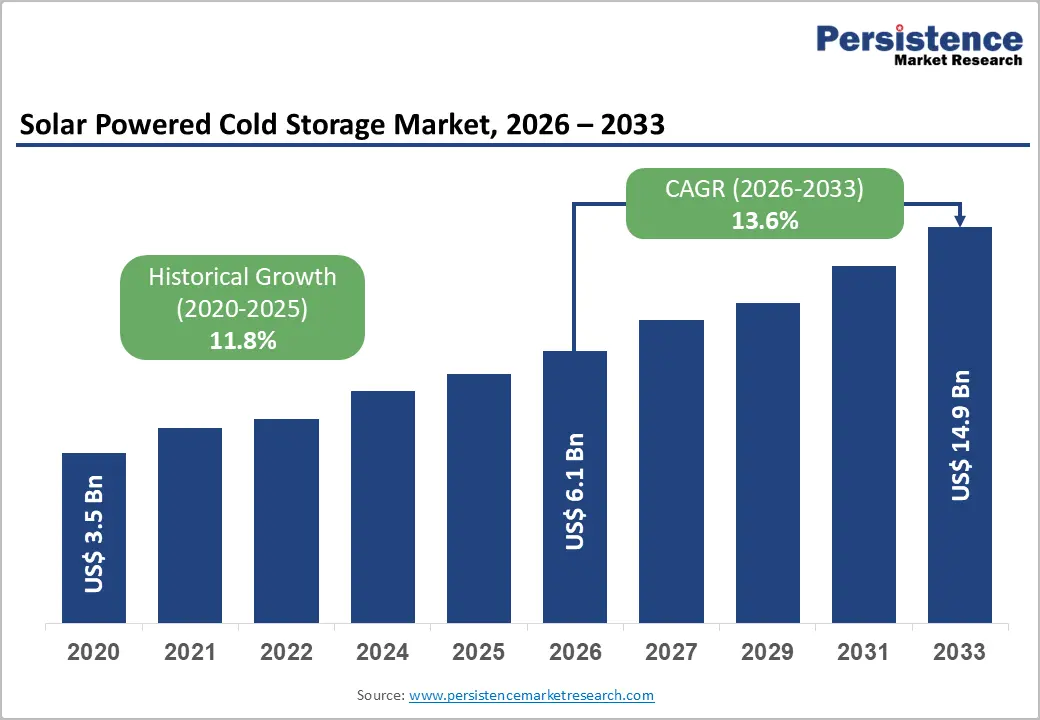
The global solar powered cold storage market size is likely to be valued at US$6.1 billion in 2026 and is expected to reach US$14.9 billion by 2033, growing at a CAGR of 13.6% between 2026 and 2033, driven by rising food-loss concerns, expanding pharmaceutical cold-chain requirements, and increasing deployment of solar-powered refrigeration in remote and off-grid areas.
Declining solar photovoltaic and battery storage costs are improving system affordability and operational efficiency. Government-backed rural infrastructure programs and sustainability-focused supply-chain investments are further accelerating adoption across agriculture, healthcare, fisheries, and retail distribution.
Key Industry Highlights:
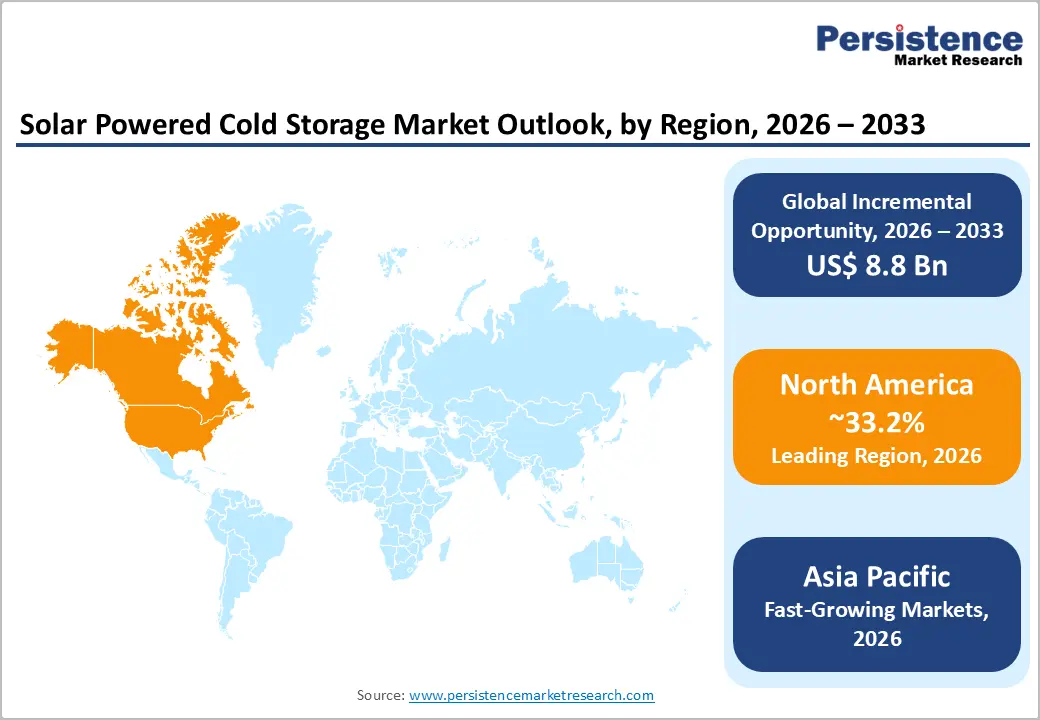
- Leading Region: North America is anticipated to account for approximately 33.2% of the market share, supported by advanced cold-chain infrastructure, strong renewable energy adoption, and increasing deployment of hybrid solar-battery refrigeration systems across the food logistics and healthcare sectors.
- Fastest-growing Region: Asia Pacific is projected to register the fastest growth, driven by rising agricultural cold-chain investments, expanding solar manufacturing capacity, and government-supported rural refrigeration programs in China, India, and ASEAN countries.
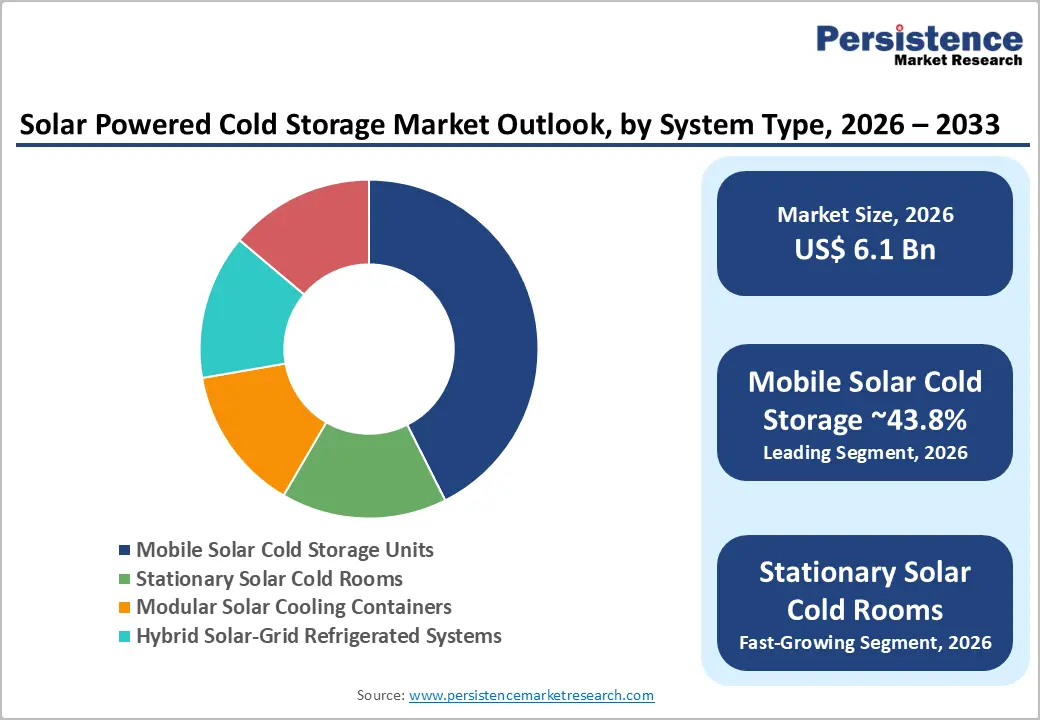
- Dominant System Type: Mobile solar cold storage units are expected to remain the leading segment, accounting for approximately 43.8% of the market share, supported by strong adoption in smallholder farming, fisheries, and last-mile food distribution networks.
- Leading Technology: Photovoltaic (PV) direct DC systems are anticipated to hold approximately 37.4% of the market share in 2026, driven by lower conversion losses, a simplified system architecture, and strong deployment in rural healthcare and farm-level refrigeration applications.
DRO Analysis
Drivers - Food Loss Reduction Is Increasing Demand for Decentralized Cold Storage Infrastructure
Post-harvest food losses remain a major economic and supply-chain challenge across developing and emerging economies. Solar-powered cold storage systems are increasingly being deployed to preserve fruits, vegetables, dairy products, seafood, and meat products in regions with unreliable grid infrastructure. Decentralized cold-chain solutions help maintain product quality, extend shelf life, and improve farmer income realization by reducing spoilage during transportation and storage.
Agricultural supply chains are shifting toward distributed aggregation and localized storage networks, particularly in South Asia, Africa, and Southeast Asia. This trend is encouraging investments in mobile and modular solar cold rooms that can operate independently from centralized electricity systems. Food retailers and cooperatives are also integrating solar refrigeration systems into procurement and distribution networks to stabilize product availability and reduce seasonal wastage.
Declining Solar and Battery Costs Are Improving Commercial Viability
Rapid improvements in solar photovoltaic efficiency and energy storage economics are significantly improving the financial feasibility of solar-powered refrigeration systems. Battery prices have declined substantially over the past decade, making hybrid solar-plus-storage systems more accessible for agricultural cooperatives, warehouse operators, healthcare institutions, and food distributors. Advancements in lithium-ion battery technology, thermal energy storage, and intelligent energy management systems are enabling continuous cooling performance during nighttime operation and low-solar conditions. Hybrid PV-battery systems are increasingly replacing diesel-powered refrigeration solutions due to lower operating costs, reduced fuel dependence, and lower maintenance requirements.
Technology integration is also improving system reliability and temperature consistency, which is particularly important for pharmaceutical storage and vaccine distribution. Falling component costs are enabling manufacturers to introduce scalable solutions across a range of capacities, supporting wider market penetration in rural and semi-urban regions.
Restraint - High Initial Capital Investment Limits Large-Scale Adoption
Despite long-term operating cost advantages, solar-powered cold storage systems continue to face adoption barriers related to high upfront investment requirements. Deployment typically involves expenditure on solar panels, refrigeration equipment, thermal insulation, battery storage systems, control units, installation services, and maintenance infrastructure. For smallholder farmers, rural cooperatives, and micro-enterprises, financing remains a critical challenge, particularly in markets with limited access to low-interest credit or government subsidy programs. System payback periods can vary depending on storage utilization rates, crop seasonality, electricity tariffs, and logistics efficiency.
Maintenance capability also remains inconsistent in remote regions where technical service networks are underdeveloped. In several emerging markets, limited awareness regarding lifecycle cost savings further delays investment decisions. These factors collectively slow adoption rates in cost-sensitive agricultural economies despite strong long-term market potential.
Opportunities - Government-Supported Cold-Chain Expansion Is Creating New Revenue Channels
Governments and development agencies are increasingly supporting solar-powered cold-chain infrastructure as part of broader food security and rural development programs. Public-sector initiatives targeting agricultural modernization, fisheries management, and rural electrification are creating procurement opportunities for solar refrigeration manufacturers and system integrators.
National renewable energy departments are introducing technical standards, subsidy frameworks, and pilot programs to accelerate the deployment of decentralized cold-storage infrastructure. Agricultural cooperatives and farmer-producer organizations are emerging as major buyers of medium-scale solar cold rooms designed for aggregation centers and regional distribution hubs.
Development finance institutions are also funding cold-chain expansion projects focused on reducing post-harvest losses and improving supply-chain efficiency. These initiatives are expected to create sustained demand for turnkey cold-storage systems, particularly across Asia Pacific, Sub-Saharan Africa, and Latin America.
Healthcare Cold Chains Represent a High-Value Growth Segment
The pharmaceutical and vaccine distribution sector is becoming one of the most strategically important applications for solar-powered refrigeration systems. Expanding immunization programs, biologics distribution, and temperature-sensitive medicine storage requirements are increasing demand for highly reliable off-grid cooling infrastructure.
Healthcare providers require stable temperature management, backup autonomy, and regulatory compliance, making battery-backed solar systems especially attractive. Solar-powered vaccine refrigerators and pharmaceutical storage units are increasingly deployed in remote clinics, humanitarian operations, and disaster-relief environments where grid reliability is limited.
Compared with agricultural applications, healthcare cold-chain projects typically involve higher system specifications and stronger quality assurance requirements, enabling suppliers to achieve premium pricing and long-term service contracts. The segment is expected to experience accelerated growth as healthcare infrastructure investments increase across developing economies.
Category-wise Analysis
System Type Insights
Mobile solar cold storage units are anticipated to hold 43.8% market share in 2026, due to strong adoption across smallholder farming, fisheries, and last-mile food distribution networks. These systems are widely used in India, Kenya, and Nigeria, where decentralized agricultural supply chains require flexible and off-grid refrigeration solutions.
Companies such as Ecozen, ColdHubs, and Solar Freeze have deployed mobile cold-storage platforms near farms, fishing ports, and roadside markets to reduce post-harvest losses. The segment benefits from lower installation complexity, portability, and pay-as-you-go business models that improve affordability for rural users. Demand remains strong in emerging economies where grid reliability is inconsistent and cold-chain infrastructure gaps persist.
Stationary solar cold rooms are projected to be the fastest-growing system type, driven by increased investment in organized cold-chain infrastructure and agricultural aggregation centers. These systems offer larger storage capacity, improved temperature stability, and stronger integration with thermal storage and digital monitoring technologies.
Food cooperatives, warehouse operators, and food processing companies are increasingly adopting stationary cold rooms to manage seasonal inventory and reduce spoilage. For example, solar-powered cold-room initiatives in India and Southeast Asia are supporting farm-level storage and regional food distribution networks.
Technology Insights
PV direct DC systems are anticipated to hold a 37.4% market share in 2026, driven by their simple system architecture, lower energy conversion losses, and reduced maintenance requirements. These systems are commonly deployed in rural healthcare clinics, farm-level cold rooms, and small food-storage facilities where daytime cooling demand aligns with solar generation.
Companies such as SunDanzer and SureChill use direct-drive solar refrigeration technologies for vaccine storage and off-grid cooling applications. The segment continues to benefit from cost efficiency, simplified installation, and improving compressor and insulation technologies.
PV plus battery storage systems are expected to witness the fastest growth due to their ability to deliver continuous refrigeration during nighttime and low-solar conditions. These systems are increasingly used in pharmaceutical storage, dairy cooling, seafood preservation, and medium-scale warehouses where uninterrupted cooling is critical.
Falling lithium-ion battery costs and improvements in energy management software are accelerating adoption globally. Hybrid solar-battery systems are also replacing diesel-based refrigeration in several agricultural and healthcare projects across the Asia Pacific and Africa, helping reduce fuel costs and carbon emissions.
Regional Insights
North America Solar Powered Cold Storage Market Trends
North America represents a high-value market characterized by advanced cold-chain infrastructure, strong renewable energy adoption, and increasing investment in energy-efficient refrigeration technologies. The region benefits from mature logistics networks, rising battery storage deployment, and growing emphasis on carbon reduction across food and pharmaceutical supply chains.
U.S. Solar-Powered Cold Storage Market Trends
The U.S. dominates the North America market due to large-scale solar PV deployment, expanding battery storage infrastructure, and supportive federal clean-energy policies. Demand is primarily driven by food distribution, pharmaceutical logistics, specialty agriculture, and disaster-resilient cold-chain infrastructure.
Warehouse operators, healthcare providers, and food retailers are increasingly integrating hybrid solar refrigeration systems into distribution centers and storage facilities to reduce electricity costs and improve operational resilience. The market also benefits from advanced software integration, predictive maintenance technologies, and industrial automation capabilities.
Canada Solar Powered Cold Storage Market Trends
Canada is witnessing gradual adoption of solar-powered cold storage systems, particularly in remote agricultural and food-processing regions where energy costs are high. Provincial clean-energy initiatives and sustainability-focused food logistics investments are supporting market growth.
Cold-chain modernization projects in seafood processing, dairy storage, and rural food distribution are creating opportunities for hybrid refrigeration systems with battery backup capabilities. The country’s focus on low-carbon infrastructure is expected to encourage wider deployment over the forecast period.
Europe Solar Powered Cold Storage Market Trends
Europe’s solar powered cold storage market is being driven by food-waste reduction policies, decarbonization targets, and increasing investment in sustainable logistics infrastructure. Rising electricity prices and strong renewable energy adoption are encouraging commercial operators to transition toward energy-efficient refrigeration systems.
Germany Solar Powered Cold Storage Market Trends
Germany represents one of Europe’s leading markets due to its strong renewable energy ecosystem, advanced cold-chain infrastructure, and aggressive sustainability targets. Food processing companies and logistics operators are investing in energy-efficient cold rooms and hybrid refrigeration systems to reduce operating costs and carbon emissions.
The country also benefits from advanced industrial automation capabilities and strong adoption of intelligent energy management systems.
U.K. Solar Powered Cold Storage Market Trends
The U.K. is experiencing growing demand for solar-powered cold storage systems across food retail, pharmaceutical logistics, and warehouse distribution sectors. Corporate sustainability commitments and increasing pressure to reduce food waste are supporting investment in renewable-powered refrigeration infrastructure.
Retailers and logistics companies are increasingly integrating thermal storage systems and smart refrigeration technologies into distribution centers to improve energy efficiency.
France Solar Powered Cold Storage Market Trends
France is expanding investment in sustainable agricultural logistics and low-emission refrigeration technologies. The country’s food-processing industry is adopting solar-assisted cold storage systems to improve supply-chain efficiency and support carbon reduction objectives.
Demand is particularly strong in dairy, fresh produce, and pharmaceutical storage applications where temperature stability and energy efficiency are critical.
Asia Pacific Solar Powered Cold Storage Market Trends
Asia Pacific is projected to remain the fastest-growing regional market, due to rising agricultural demand, rapid solar energy deployment, and increasing government support for decentralized cold-chain infrastructure. The region combines large-scale manufacturing capability with significant unmet refrigeration demand across farming, fisheries, and healthcare sectors.
China Solar Powered Cold Storage Market Trends
China represents a major market due to its large solar manufacturing ecosystem, extensive agricultural supply chains, and rapid renewable energy expansion. The country is investing heavily in energy-efficient cold-chain logistics and warehouse modernization to support food security and export competitiveness.
Strong domestic production of solar modules and battery systems also provides cost advantages for local cold-storage deployment.
India Solar Powered Cold Storage Market Trends
India is one of the fastest-growing markets for solar-powered cold storage due to rising post-harvest loss concerns, expanding agricultural modernization programs, and increasing government support for decentralized refrigeration infrastructure.
Solar-powered cold rooms are being deployed across farming cooperatives, milk collection centers, fisheries, and rural food distribution networks. Policy support for solar cold storage systems and renewable energy integration is expected to accelerate market penetration across semi-urban and rural regions.
Japan Solar Powered Cold Storage Market Trends
Japan’s market is driven by advanced refrigeration technology adoption, energy-efficiency regulations, and growing investment in resilient food and pharmaceutical supply chains. The country is focusing on intelligent refrigeration systems, thermal energy optimization, and low-emission cold-chain infrastructure. Demand is particularly strong in pharmaceutical storage, premium food logistics, and disaster-resilient refrigeration applications.
Decentralized refrigeration systems are being adopted to reduce seafood spoilage, improve food distribution efficiency, and strengthen rural supply chains. Growing renewable energy investments and improving cold-chain awareness are expected to support long-term regional growth.
Competitive Landscape
The global solar powered cold storage market remains moderately fragmented, with competition driven by regional refrigeration providers, renewable energy companies, agricultural technology firms, and cold-chain system integrators. Market participants compete on system reliability, battery performance, thermal efficiency, financing flexibility, and after-sales service capability.
Leading companies are prioritizing modular system design, battery-backed refrigeration architecture, and service-oriented business models. Strategic focus areas include rural market expansion, financing partnerships, intelligent monitoring platforms, and hybrid solar-grid integration. Cold-storage-as-a-service models are becoming increasingly common, particularly in agricultural and healthcare applications where customers prefer lower upfront investment requirements.
Key Industry Developments:
- In May 2025, Copeland partnered with Ecozen Solutions to develop advanced solar-powered cold storage systems for India’s agricultural sector, integrating variable-speed compressor technology to improve energy efficiency and reduce post-harvest food losses.
- In January 2025, Ecozen Solutions secured over US$23 million in funding from multiple institutional investors to scale its Ecofrost solar cold storage systems and expand climate-smart refrigeration deployment across agricultural supply chains.
Companies Covered in Solar Powered Cold Storage Market
- Ecozen Solutions
- ColdHubs
- Inficold India Pvt. Ltd.
- SunDanzer Refrigeration Inc.
- InspiraFarms Cooling
- SureChill
- Koolboks
- Solar Freeze Ltd.
- Ice Make Refrigeration Limited
- Aldelano Solar Solutions
- Pluss Advanced Technologies
- Termodizayn
- Ecotutu
- NewLeaf Symbiotics
- Danfoss
- Carrier Global Corporation
Frequently Asked Questions
The global solar powered cold storage market is anticipated to reach US$6.1 billion in 2026.
The market is projected to reach approximately US$14.9 billion by 2033.
Major market trends include rising deployment of PV + battery storage systems, increasing adoption of mobile solar cold rooms, growing integration of smart energy management systems, and expanding investment in decentralized agricultural cold-chain infrastructure.
Mobile solar cold storage units are expected to remain the leading system type segment, accounting for approximately 43.8% of the global market share due to strong adoption across smallholder farming, fisheries, and rural food distribution networks.
The solar powered cold storage market is projected to grow at a CAGR of 13.6% between 2026 and 2033.
Some of the major companies include Ecozen Solutions, ColdHubs, Inficold India Pvt. Ltd., SunDanzer Refrigeration Inc. and InspiraFarms Cooling.


